

Back to School: How Bright Horizons Used Business Process Mapping to Streamline High-Volume Hiring
Business process mapping is one of the most underleveraged practices in talent acquisition. Not because teams don’t see the value, but because the urgency of day-to-day hiring leaves little room to step back and examine the process beneath it. The result is a system full of potential that is never fully realized, and a team full of capable people spending time on work that the technology could handle.
For Bright Horizons, a global leader in early childhood education and family services with over 31,000 employees across the US, UK, Netherlands, India, and Australia, building that discipline has been a deliberate investment.
At IAMPHENOM 2026, Camilla Langenderfer, Senior Director of Talent Acquisition Operations and Strategy, shared how the team has used iterative business process mapping over the past two years to surface hidden inefficiencies, eliminate manual workarounds, and build automation workflows that have already returned over 1,000 hours to the recruiting team in just 90 days.
Watch the session here, or catch the key insights below!
What Are the Biggest High-Volume Hiring Challenges in Early Education?
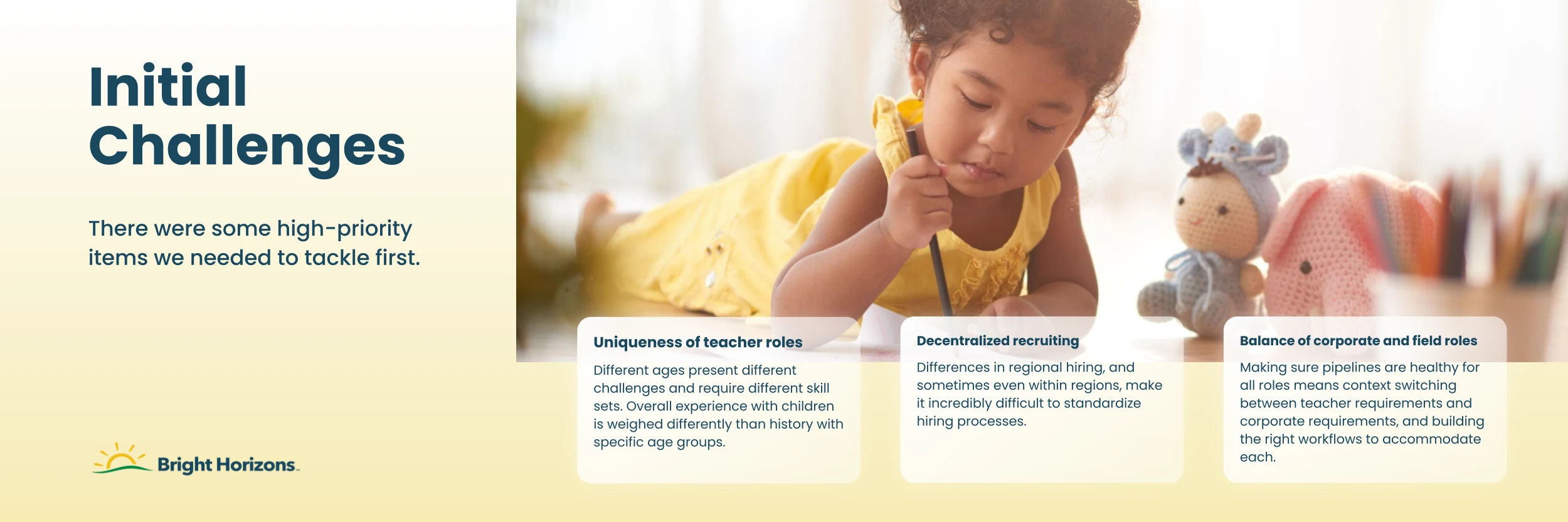
Early childhood education isn’t just a competitive hiring market. It’s a structurally complex one. The professionals who work in it form deep relationships with the children and families they serve, which makes it difficult to attract candidates away from organizations where they have built years of trust and connection. Getting highly qualified, tenured educators to the top of the funnel quickly requires more than a job posting.
The complexity doesn’t stop there. What qualifies someone to teach in Massachusetts isn’t the same as what qualifies them in Texas. Bright Horizons operates across dozens of states, each with its own certification requirements, local hiring nuances, and regulatory considerations. Building a consistent recruiting process across that landscape, while also accommodating a corporate population that makes up 10 to 15% of all US hires, is an equation with a lot of variables. Three challenges defined the starting point:
Uniqueness of teacher roles: Different age groups require different skill sets and certifications. Overall experience with children is weighted differently than experience with specific age groups, making candidate evaluation inherently nuanced.
Decentralized recruiting: Regional differences in hiring requirements make standardization difficult. What works in one market may not apply in another, even within the same state.
Balancing corporate and field roles: Keeping pipelines healthy across both teacher and corporate roles requires context-switching between very different candidate profiles and workflow needs.
How Can Business Process Mapping Help Recruiting Teams Eliminate Manual Work?
Business process mapping (BPM) is exactly what it sounds like: a structured exercise that documents every step in a workflow, identifies who is responsible at each stage, and surfaces inefficiencies, redundancies, or gaps.
For talent acquisition teams, it means going beyond what the system shows to uncover what recruiters are actually doing, including the spreadsheets, calendar reminders, and manual workarounds that never make it into official process documentation.
One of the most telling signs that a process needs attention is not a broken system. It is the workarounds that quietly build up around it. Langenderfer put it with a smile: "I want to know about your secret spreadsheet. I want to know about the calendar reminders that you have put on there outside the system, because I know every single recruiter has them." Business process mapping is how those workarounds come to light, and more importantly, how they get resolved, either by automating the step that made them necessary or by redesigning the workflow so the system handles it properly. For Bright Horizons, the exercise has been continuous and iterative. They build a map, identify what to change, implement it, and then come back to do it again. Round one focused on high-volume workflows and automation opportunities. In practice, Round One meant deploying Phenom's pre-apply automation engine to qualify and disposition candidates at scale, introducing automated interview scheduling and one-way video screening through X+ screening, and building out CRM post-apply automations to handle candidate communication without manual intervention.
What Results Did Bright Horizons See?

Within 90 days of rolling out their first round of automations using Phenom Automated Interview Scheduling, Phenom X+ Screening, and Phenom Talent CRM, the impact was measurable across the entire hiring funnel:
Automatic Dispositions: 70% of candidates were automatically identified as not meeting the qualifications for a teacher role, removing a significant volume of manual review from the recruiter's plate while still routing them toward more suitable roles, such as associate teacher.
Screening and Interviewing Hours Saved: 245 hours recovered through automated scheduling and one-way video screening, removing the back-and-forth that previously consumed recruiter time.
Active CRM Automations: 23 post-apply automations now running across the candidate journey, covering everything from status updates to re-engagement outreach.
Hours Saved Eliminating Manual Tasks: 1,039 hours returned to the team in the last 90 days alone. Projected across a full year, the compounding effect of those savings becomes significant.
What the numbers don’t fully capture is the hidden time recovery. Every time an automation handles a task that a recruiter used to manage manually, there’s time saved that no one will ever report because no one tracked the manual version in the first place. BPM makes those gains visible precisely because it starts by finding what the system was never doing.
What Is Bright Horizons Tackling Next?
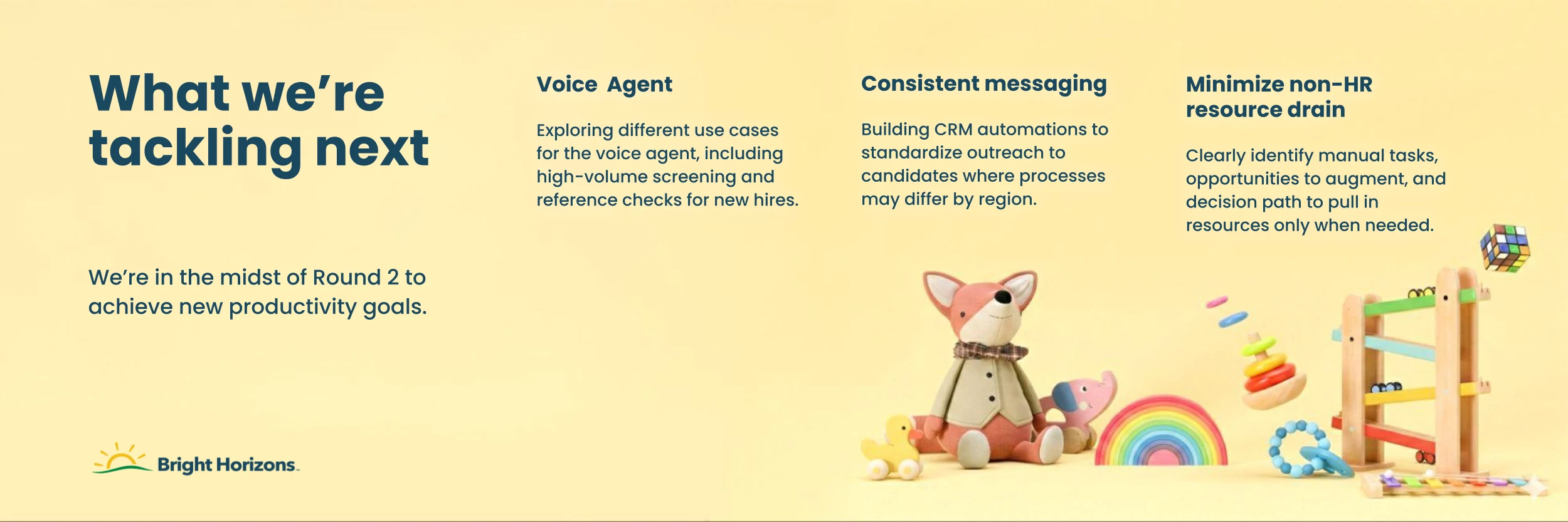
Round Two is the next layer of the iterative process: identify the highest-value opportunities, sequence the work carefully, and implement changes without disrupting what is already working. The piloting approach Langenderfer described captures this well. "We can focus on a specific job profile in one market and truly work on optimizing it, and we do not have to impact any of the other pieces of the business as we are going through, figuring out, and piloting." That ability to go narrow before going broad is what makes the process sustainable over time.
1. Voice Agent
Bright Horizons has two active voice agent pilots underway: one for reference checks and one for high-volume screening in select markets. The team is actively mapping where voice screening makes the most sense, which roles, which markets, and which stages of the process, before expanding further.
Related: Scaling Reference Checks with AI: Inside Bright Horizons' Voice Agent Success
2. Consistent Messaging
Langenderfer introduced a phrase worth keeping: “the doom loop.” It’s the cycle of generic, unbranded holding messages that candidates receive when a recruiter forgets to follow up, or simply runs out of time to do so. Building Talent CRM automations that handle timely, consistent candidate communication breaks that loop without adding to the recruiter's workload. The goal is that no candidate goes three or four days without an update simply because a recruiter's attention was elsewhere.
3. Re-engaging Internal Talent
After nearly five years with Phenom, Bright Horizons has built a substantial database of leads and talent community members who have actively expressed interest in the organization. The challenge is behavioral. Every recruiter and sourcer's instinct is to reach for LinkedIn or Indeed first, assuming the right candidate is someone they have not found yet. That instinct is understandable, but it bypasses a pipeline that already exists. These are candidates who raised their hand for Bright Horizons at a point when the role or the market was not quite right. Round Two includes a deliberate effort to shift that default and build the habit of going back to the system first.
Where Should TA Teams Start?
Langenderfer's closing recommendations apply well beyond Bright Horizons. For any TA team considering a BPM exercise, four principles matter most.
Find the busy work: Start by listing the processes that require the most manual coordination. Those are the highest-value targets for automation and the clearest signal of where recruiter time is being lost.
Identify key players: Process stakeholders extend beyond the recruiting team. Hiring managers, HR business partners, and operations leaders all have a view of where the friction lives. The most complete map comes from the most comprehensive set of inputs.
Know the tech: Before redesigning a workflow, understand what the platform can actually do. Many teams build manual workarounds for problems the system already solves. A thorough product audit often surfaces capabilities that change the design entirely.
Ruthlessly prioritize: Not everything can be fixed at once, and trying to do too much creates change fatigue before the most important improvements have a chance to take hold. Sequence the work around what will generate the greatest impact with the least organizational disruption.
Langenderfer's advice for teams entering this process for the first time: resist the instinct to go it alone. "Once you have what the current state is and where you are going, heavily lean on your Phenom partners on how to achieve this, versus deciding what you are going to do and then asking the system to do it."
BPM isn’t a project with a finish line. Bright Horizons has been at it for two years and is still finding new opportunities with each round. That isn’t a sign of an incomplete process. It’s a sign of a team that has built the discipline to keep improving.
Ready to start mapping your own hiring process? Sign into Phenom Community to access business process mapping templates and resources, or Phenom Explorer to see how the platform can support your next round of workflow improvements.

John is a Sr. Director of Product Marketing at Phenom. He enjoys horror novels and running — mostly from age.


Get the latest talent experience insights delivered to your inbox.
Sign up to the Phenom email list for weekly updates!


