


How Elara Caring Uses a Conversational Voice AI Screening Agent To Enhance Hiring and Candidate Reach
Home healthcare runs on availability. Caregivers work early mornings, late evenings, and weekends, and the candidates applying for those roles live by the same schedules. For Elara Caring, one of the country's largest home-based care providers, that reality created a fundamental mismatch: a recruiting process built around business hours trying to reach a workforce that doesn't operate on them.
Anne Strickroot, VP of Talent Acquisition at Elara Caring, joined us at IAMPHENOM 2026 to walk through how their conversational AI voice screening agent changed the math on high-volume hiring, cutting time from application to offer nearly in half and returning hundreds of hours a month to a recruiter team that had none to spare.
Watch the full session here, or explore the highlights below!
What Made High-Volume Home Health Hiring So Hard to Scale?
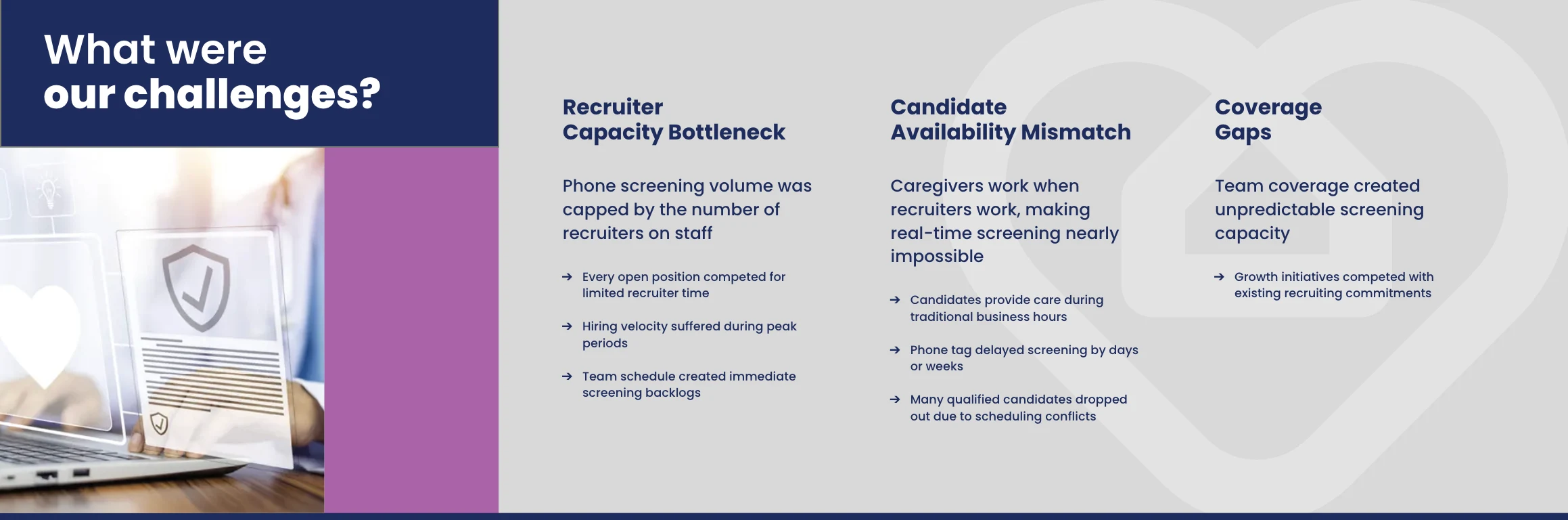
Elara Caring processes between 7,000 and 10,000 candidates per month across 200 locations in 18 states, and needs to hire between 1,300 and 1,800 people monthly to meet demand. At that scale, there’s little room for inefficiency. Their biggest challenge wasn’t the volume of applications; it was the bottleneck created between application and recruiter capacity.
Strickroot regaled this year’s IAMPHENOM audience with this story from the trenches: “So it was exactly a year ago, the day before IAMPHENOM 2025, and my boss asked me, ‘How many people do you need to hire 600 people a month in this particular state?’ I had sent him an email saying I needed 19 people: two-thirds being recruiters and the other third background checkers. It was halfway through Markus's presentation on Voice Screening Agent last year when I sent my boss a text message from the audience saying, ‘I think we have another way.’”
And according to Strickroot, that's actually what made them more strategic. With the voice agent handling the admin overhead, her team shifted from checkbox execution to genuinely thoughtful, people-focused work.
Previously, recruiters were spending the bulk of their time on scheduling and conducting basic phone screens, chasing candidates who didn't pick up, and trying to reach people who worked non-traditional hours and weren't available during a standard workday. Coverage gaps in the evenings and on weekends meant that interested candidates who applied outside of business hours waited. And in a competitive labor market for caregivers, waiting is losing.
How Does Elara Caring's AI Voice Screening Agent Actually Work?
The solution Elara Caring built with Phenom centered on a conversational AI voice screening agent named Emma, which they deployed at the top of the hiring funnel.
When a qualified candidate submits a form, they're invited to speak with Emma. The agent informs the candidate of their scheduled screening time shortly after the application, while also giving them full flexibility to reschedule or complete the call any time of day or night, seven days a week. That immediacy and convenience lead many candidates to complete the screening right away, with most completing it within the same hour.
Phenom’s Voice Screening Agent powers the experience, with the AI handling the structured portion of the screening conversation while keeping a consistent, professional tone. The conversation includes knockout questions, state-specific compliance questions, and behavioral and situational interview questions.
After the call, the agent applies a scoring rubric based on customer-defined evaluation criteria, and human recruiters review the screening and results to determine the next hiring decision. The design philosophy keeps humans in the decision seat: Emma screens and scores, but a recruiter always reviews and makes the call.
The 24/7 availability was deliberate. Caregivers often apply during the hours they're not working, evenings, early mornings, and weekends. Emma matches that window. When a candidate is ready to talk at 9 pm on a Saturday, Emma is available. That timing shift alone changed who was actually getting screened, and when.
“The conversational voice screening has allowed us to do phone interviews when it is good for the candidate. What we're finding is that we can conduct those interviews 24/7. Sixteen percent of our candidates are completing their interviews on Saturdays and Sundays, and forty percent overall are completing those interviews either on Saturday, Sunday, or in the evening hours. So now I'm no longer restricted by the number of recruiters I have. I'm also now no longer restricted by the number of hours a day those recruiters can work.”
Related Read: Voice AI in Recruitment: Transforming Conversations & Screening
What Impact Did Voice AI Have on Hiring Outcomes?
"In home health care, a delayed hire isn't just a number on a dashboard; it affects patients waiting for care,” shared Strickroot. “Since deploying Phenom's AI voice screening agent, we've seen 40% growth in candidate screenings, with 91% completed within a day and more than 40% happening outside of business hours. We've seen a 21% increase in hires and cut time to offer by nearly a day and a half. What's changed most for our recruiters isn't the volume. It's that they're now focused on the conversations that actually require a human."
Comparing six weeks before and after Emma's deployment, the results showed improvement across every stage of the funnel, not just at the screening step:
Time from application to offer dropped from 6.1 days to 2.7 days
21% increase in hires; 21% more offers extended; 18% more offers accepted; 23% more background checks initiated
50% more candidates processed per month
400 recruiter hours saved per month
92% of screenings completed within one day; 41% in under an hour
40% of interviews completed in evenings or on weekends
The weekend and evening completion data tells the story that matters most for this workforce. A process that only ran during business hours would have missed 40% of the screenings that actually happened. Those aren't edge cases; they represent a significant portion of candidate activity that would have been missed in a business-hours-only recruiting model.
The 50% productivity differential between Emma and their top human recruiter didn't come from Emma being faster at any single task. It came from Emma having no off hours, no call reluctance, and no days when the queue backed up. Strickroot noted that the metric made the business case to leadership in a way that hour counts alone couldn't.
Where Is Elara Caring Taking Voice AI Next?
Spanish-language screening is the first expansion on the roadmap, reflecting the demographics of Elara Caring's caregiver pipeline. Additional roles beyond caregivers are in active planning, along with reference checking via voice agent, which would extend the AI touchpoint deeper into the pre-hire process without adding recruiter time.
The broader implication Strickroot pointed to is structural: home health care has historically struggled to apply technology solutions that work in other industries because the workforce and the work don't conform to standard schedules or processes. A patient 24/7 voice agent that operates like the people it's trying to hire closes that gap in a way that no amount of recruiter headcount ever fully could. The 19-headcount request that started this story? Emma answered it differently with results that defied expectations.
Book a demo today to see Phenom X+ Screening and Voice Screening Agent in action!


Get the latest talent experience insights delivered to your inbox.
Sign up to the Phenom email list for weekly updates!


