

Agiliti’s Healthcare Talent Acquisition Strategy Transformation: Balancing Speed, Quality, and Cost
The healthcare industry doesn't have the luxury of slow hiring. When patient care is on the line, every open role carries real consequences, and every dollar spent on talent acquisition needs to deliver measurable recruiting ROI.
That's the environment Agiliti operates in. A nationwide provider of medical and surgical equipment supporting hospitals across the U.S., Agiliti can't afford a talent acquisition strategy built around just one priority.
Over the past several years, their hiring priorities kept shifting — first speed, then quality, then cost. Now, as Rob Barnes, Director of Talent Acquisition at Agiliti, put it: "we want all three of those things this year."
Hitting all three required more than a tooling swap. It demanded a full TA digital transformation — one powered by AI in recruitment, a modern talent experience platform, and a structural shift toward reducing agency spend.
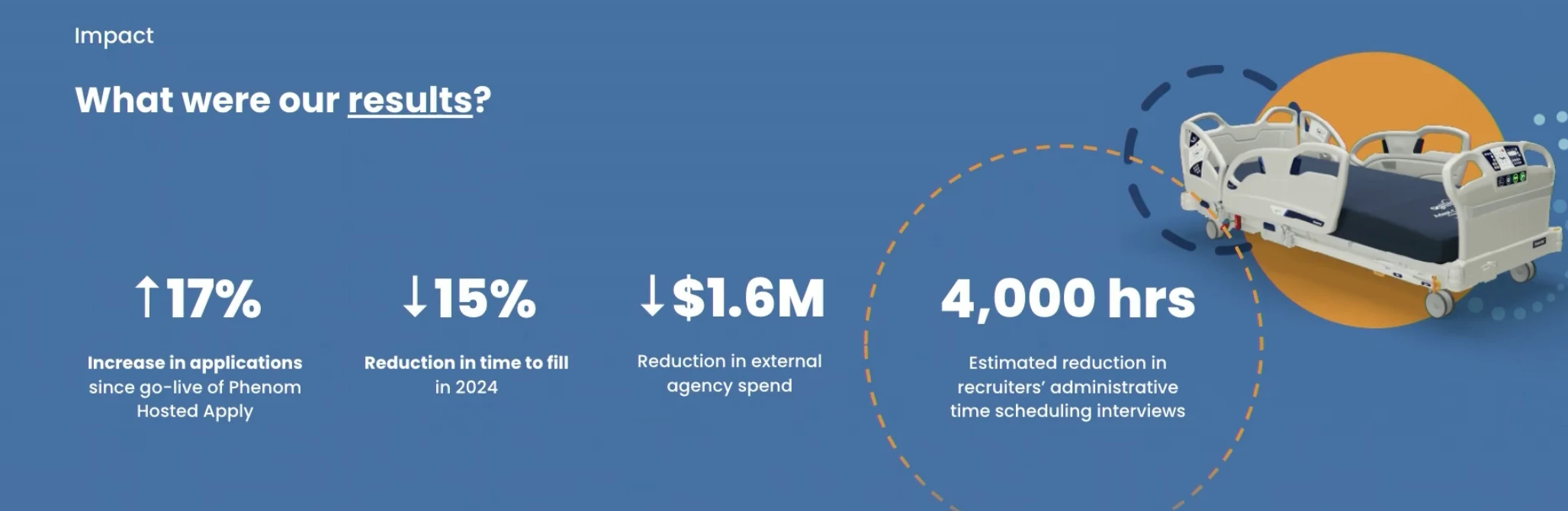
The results speak for themselves:
$1.6M reduction in agency spend
15% reduction in time to fill
17% increase in applications
4,000 recruiter hours saved
What changed wasn't just the technology. It was the entire talent acquisition strategy.
About Agiliti: Healthcare Hiring with Real-World Impact
Agiliti’s story goes back to 1939, starting as a two-person operation and growing into a company with over 6,000 employees and 150+ service centers nationwide.
But what stands out isn’t just scale — it’s purpose.
For Agiliti, hiring isn’t abstract. Every role ties back to patient care. As Barnes explained, “our end user is a patient, someone’s mother, father, brother, or sister.”
In one instance, a hospital called in the middle of the night, around 2:33 AM, needing urgent support for a patient. Within 30 minutes, Agiliti had delivered the required equipment.
That level of responsiveness depends entirely on having the right people in place, which is why healthcare hiring at Agiliti is closely tied to business outcomes.
What Does It Take to Build a Talent Acquisition Strategy That Optimizes Speed, Quality, and Cost with Measurable ROI?
Agiliti’s journey reflects how hiring priorities evolve, and why measurable traditional approaches fall short.
The Speed to Quality to Cost Talent Acquisition Loop
In 2020, hiring was all about speed. Demand surged during COVID, and the team scaled quickly, relying heavily on recruiters and external agencies to keep up.
By 2022, the focus shifted. Turnover increased, candidate expectations changed, and hiring became less about volume and more about fit. That meant more targeted sourcing, better alignment with hiring managers, and a deeper focus on quality.
Then came 2024, where cost pressures took center stage. Agency spend had grown significantly, and leadership expected more efficiency and clearer ROI from hiring efforts.
Now, those phases have converged. Talent teams are expected to deliver speed, quality, and cost efficiency simultaneously.
Why High-Volume Healthcare Hiring Is Hard to Scale
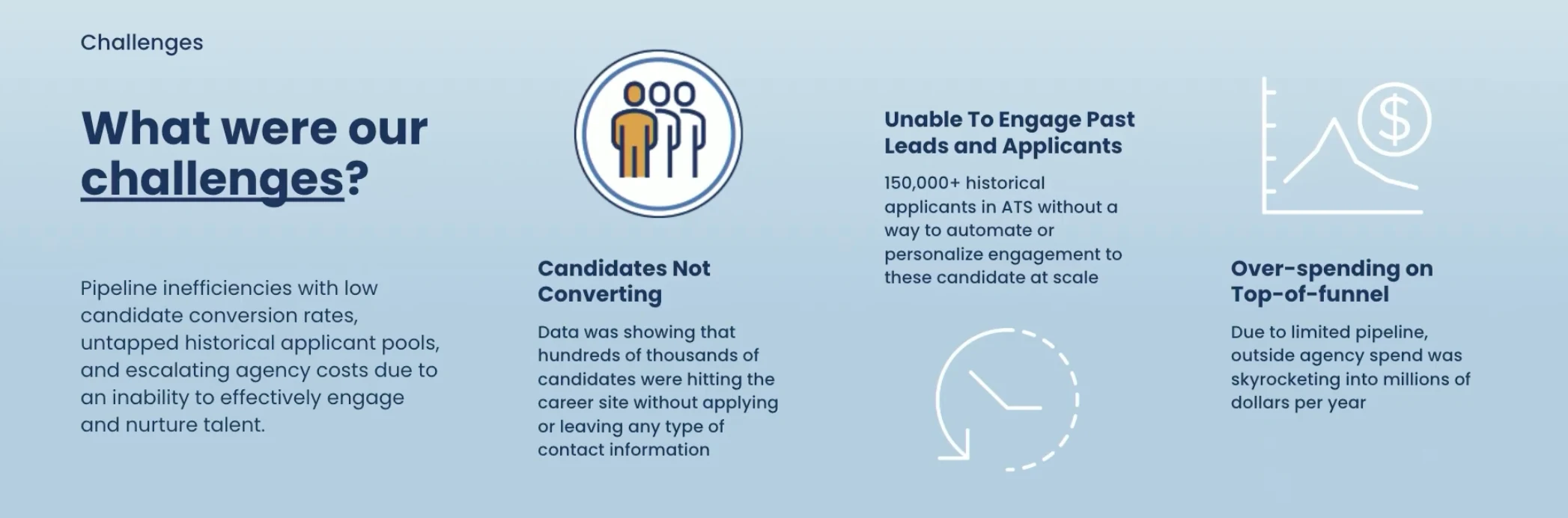
One of the biggest challenges for Agiliti was hiring for high-volume roles like Hospital Service Technicians.
These roles are physically demanding and compete directly with industries like retail, hospitality, and warehousing. There are fewer barriers to entry, which means more applicants—but also more drop-off and inconsistency.
At one point, the team didn’t even have visibility into partial applications, making it difficult to understand where candidates were dropping off.
This exposed a clear need for a stronger candidate experience platform and better recruitment automation.
Related Resource: How a Healthcare Provider Uses a Voice Agent for Screening
Why Traditional Recruiting Metrics Weren’t Enough
Metrics like time to fill and cost per hire were still being tracked, but as Barnes described them, they were “rear-view mirror metrics” useful for reporting, not for improving outcomes in real time.
On top of that, manual reporting through spreadsheets limited how far the team could go with recruiting analytics.
To move forward, they needed metrics that could guide hiring performance, not just summarize it.
The Solution: Elevating Candidate, Recruiter, and Manager Experiences
To address these challenges, Agiliti focused on three key areas:
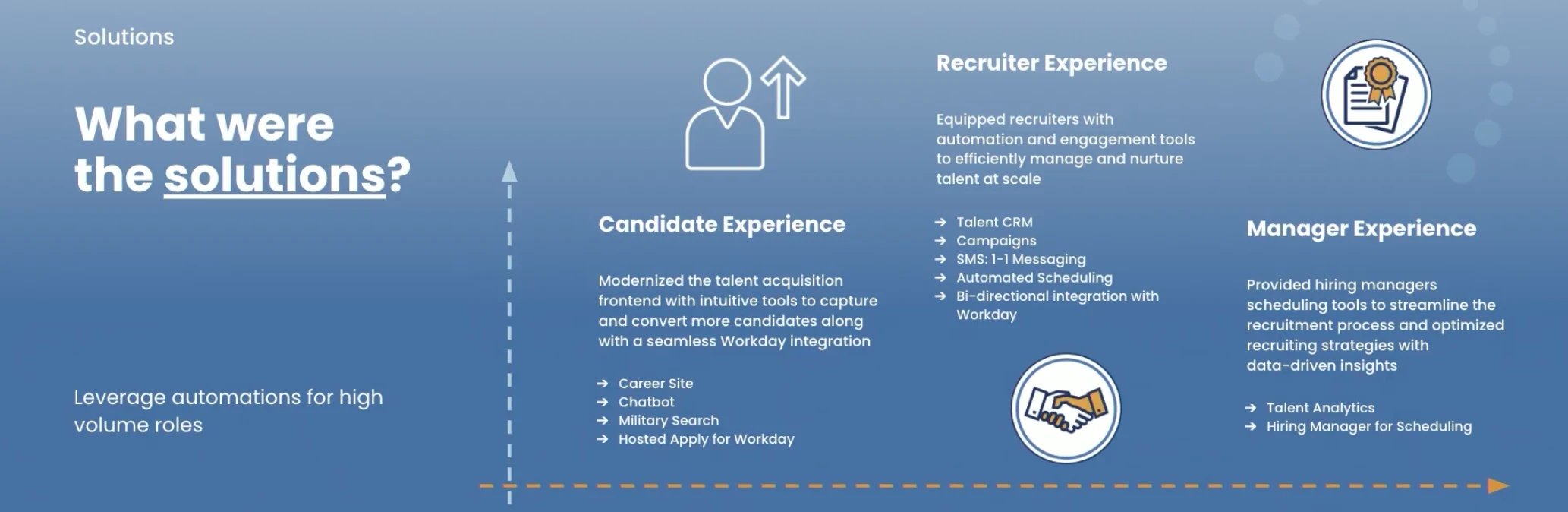
Improving Candidate Experience to Drive More Applications
The first step was optimizing the career site experience.
By making it easier for candidates to discover roles, navigate the application process, and engage with content, Agiliti was able to improve conversion.
The impact was an immediate 17% increase in applications, driven largely by a more intuitive and personalized experience.
Using Recruitment Automation to Refocus Recruiters
Recruiters were spending too much time on administrative work, which limited their ability to focus on what actually drives hiring success.
With recruitment automation, much of that manual work was reduced, if not eliminated entirely.
Instead of managing repetitive tasks, recruiters could spend more time engaging with candidates, asking better questions, and focusing on sourcing the right talent.
That shift resulted in over 4,000 hours saved.
Accelerating Hiring with Automated Scheduling
Scheduling was another major bottleneck.
By introducing automation into the process, Agiliti reduced candidate response time for interview scheduling to around 2.5 hours on average.
This helped move candidates through the funnel faster and contributed to a 15% reduction in time-to-fill.
Talent Acquisition AI as an Augment, Not a Replacement
The shift in mindset was simple. As Barnes explained, “AI is an augment, it’s gonna make that human better.”
In practice, that meant less time spent on administrative work and more time focused on candidate interactions, decision-making, and improving hiring outcomes.
Lessons for HR Leaders: Aligning Talent Acquisition with Business Strategy
Agiliti’s approach offers a clear framework:
Start by understanding your current performance. Without a clear baseline, it’s difficult to identify where improvements are needed.
Next, align hiring with business goals. Talent acquisition needs to connect directly to operational and financial outcomes.
Then, focus on proving incremental improvements. Small, measurable changes build the case for larger investments.
Finally, scale with the right technology.
This approach ties back to a broader shift in how HR is viewed. As Barnes put it, “the purpose and value of HR is to help the business move faster.”
Building a Sourcing Engine to Reduce Agency Dependence
One of the most impactful changes Agiliti made was building an internal sourcing function.
Using a sourcer-closer model, sourcers focused on generating and qualifying candidates, while recruiters focused on closing them.
This allowed the team to prioritize high-impact roles, improve efficiency, and reduce reliance on external agencies.
For many organizations, this represents a meaningful shift in how talent acquisition strategy is structured.
FAQs
What is talent acquisition?
Talent acquisition is a long-term strategy focused on attracting, engaging, and hiring talent aligned with business goals.
What’s the difference between recruitment and talent acquisition?
Recruitment focuses on filling roles quickly, while talent acquisition is a broader, strategic approach.
Why is healthcare hiring difficult to scale?
High competition, demanding roles, and limited visibility into candidate behavior make scaling healthcare hiring difficult.
How does recruitment automation improve time to fill?
Automation as part of a talent acquisition strategy removes bottlenecks in scheduling, communication, and workflows to speed up recruitment and hiring.
Will AI replace recruiters?
AI enhances recruiter productivity and effectiveness rather than replacing them.
Conclusion: Moving Faster Without Compromising on Quality or Cost
Agiliti’s transformation shows what’s possible when strategy, data, and technology come together.
They didn’t just improve hiring outcomes; they redefined how hiring works:
Faster processes
Better candidate alignment
Lower costs
Most importantly, they proved that speed, quality, and cost don’t have to be trade-offs.
A modern talent acquisition strategy, powered by AI in talent acquisition, recruitment automation, and strong recruiting analytics, can deliver all three at the same time.
Download the High-Volume Hiring Playbook to learn how to drive speed, quality, and cost efficiency at scale.

Fariya Banu is a content marketing writer at Phenom who loves decoding buyer psychology and crafting stories that convert. With engineering and marketing expertise, she brings analytical thinking to creative storytelling. When not writing, she's snorkelling, cooking, or diving into any adventure that sparks curiosity.


Get the latest talent experience insights delivered to your inbox.
Sign up to the Phenom email list for weekly updates!


