

Deploying HR AI Agents with Confidence: Trust, Oversight, and Workflow Integration
Deploying AI agents at scale is no longer a future-state conversation for enterprise HR teams. AI agents are already on the highway. Most organizations spent 2025 at the on-ramp, engine running, and watching traffic. In 2026, they are merging agents with the rest of their IT systems and traffic. Gartner predicts 40% of enterprise applications will feature task-specific AI agents by the end of 2026. The question is no longer whether to enter. It is whether you know the speed limit, your lane, and who is watching the road.
For HR and talent acquisition (TA) teams, that question is especially pointed. Deploying AI agents at scale in recruiting means putting agentic AI systems into workflows that touch candidate experience, compliance, and hiring outcomes simultaneously. The real complexity is not technical. It is organizational: building the trust, governance, and confidence that make production-ready AI agents work in practice, not just in a pilot.
At IAMPHENOM 2026, Cara Monastra and Silja Nordmeyer-Andrez shared their guidance on what it takes to move enterprise HR AI agents from evaluation into production. This blog captures their insights, covering what AI agents look like when built for HR, how human oversight is embedded into the experience by design, and what responsible deployment looks like from the first workflow to full-scale rollout.
In this Article:
Why the AI Deployment Gap Is Wider Than Most Organizations Expect?
25% of enterprises deploying generative AI are already launching agents, a number projected to reach 50% by 2027. The adoption curve is steep, but the gap between purchasing an agent and running it confidently in production is wider than most teams anticipate. In HR, the stakes of getting it wrong are higher than in most automation contexts. Agent decisions in recruiting affect candidate experience, compliance, and hiring outcomes simultaneously. A misconfigured workflow does not just create an operational problem. It creates a trust problem with candidates, with hiring managers, and with the broader organization that needs to believe the process is fair.
The questions that surface most often are not about capability. They are about control. Who oversees what the agent does? What happens when it gets something wrong? And how do recruiters trust a system acting on their behalf?. As Nordmeyer-Andrez puts it,
"There is a lot of uncertainty around AI, especially around AI agents.” In recruiting specifically, the stakes are higher than in most automation contexts. Agent decisions directly affect the candidate experience, compliance, and hiring outcomes. A framework for deploying AI agents at scale needs to account for all of that before the first workflow goes live.
Not All Agents Are Built Equally
Most AI agents in the market today are built as general-purpose tools. They can generate text, summarize content, and respond to prompts across virtually any context, but they have no inherent understanding of job taxonomy, compliance requirements, candidate fit scoring, or the sequencing of a recruiting workflow. Using them in HR means months of configuration just to get to a functional starting point.
Phenom AI agents take a different starting point. A Phenom AI agent is a contextualized, goal-driven system that interprets talent data and workflow signals, recommends actions, and performs tasks, always with human-in-the-lead control over the agent experience. As Monastra explains: "When we combine these pieces: trigger, role, reasoning, context, and tools, you can move from just having a model to having a system that can take action inside a workflow."
The HR knowledge is already embedded, which means teams are deploying AI agents at scale from a foundation that understands the work, not one that needs to be taught it first. Every Phenom agent is made up of five building blocks:
Building Block | Agent Function | In Practice |
|---|---|---|
Trigger | How the agent is triggered | A recruiter action in the CRM, a candidate applying to a job, a workflow event, or a message in Slack or Microsoft Teams |
Role | The purpose and tasks the agent performs | Screening candidates, scheduling interviews, or gathering intake information from a hiring manager |
Reasoning | The agent engine for thinking and decision-making | Determines what to do next based on available information and workflow context |
Context | The data that informs decisions | Job descriptions, hiring history, company ontologies, and candidate profiles |
Tools | The actions the agent can take | Sending messages, scheduling interviews, retrieving data, or updating records |
The following sections outline how each of these building blocks operates inside Phenom's agent architecture, and what that means for HR teams deploying enterprise AI agents.
How Production-Ready AI Agents Are Built to Work Inside Existing Workflows
Principle 1: Production-Ready AI Agents Work Where Recruiters Already Do
One of the most consistent failure points when introducing AI into recruiting is adding it as a separate tool. Recruiters already manage more systems than most workflows can absorb, and a new interface requiring a new login and an extra step rarely gets a high adoption rate. Phenom agents are built around three principles that address this directly.
Embedded by design: Phenom agents operate within the recruiter’s existing workflows. There is no separate login, no parallel dashboard, and no additional workflow to manage.
Purpose-built for HR: Phenom agents start with embedded knowledge, which means they are production-ready for HR use cases without the configuration overhead required by general-purpose AI tools.
Augmentation, not replacement: The goal is to remove administrative load, not human judgment. Agents propose actions, surface candidates, and handle coordination, all while keeping recruiters in control of decisions.
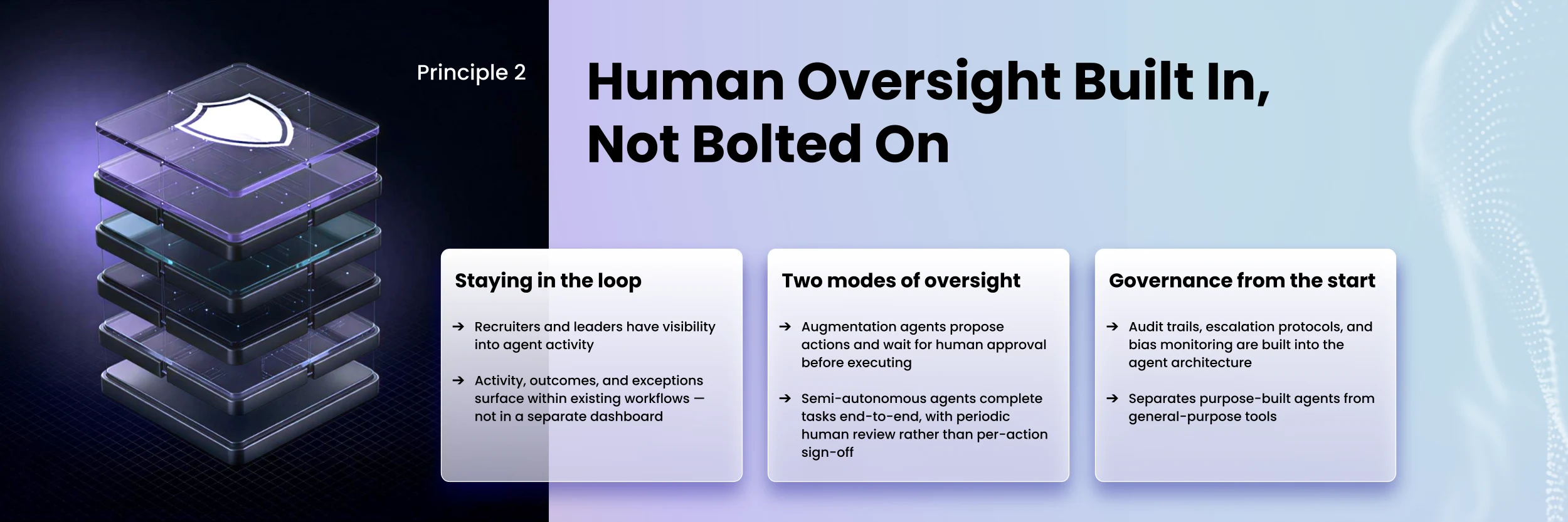
Principle 2: Human Oversight Built In, Not Bolted On
Understanding Phenom's agent architecture is what gives teams the confidence to move from a single pilot to deploying AI agents at scale. Nordmeyer-Andrez draws a distinction that reframes how most organizations think about the difference between human-in-the-loop and human-in-the-lead:
"In the human-in-the-loop model, AI does the work. A person reviews, approves, and corrects before it is finalized. In the human-in-the-lead model, the human defines the intent, the values, and the boundaries.”
This distinction has direct implications for how agents are configured:
Two modes of oversight: Augmentation agents propose actions and wait for human approval before executing. Semi-autonomous agents complete tasks end-to-end, with periodic human review. The right mode depends on the context, the consequences of an error, and the organization's current readiness.
Visibility without friction: Recruiters and leaders have full visibility into agent activity within the workflows they already use. Outcomes and exceptions surface in the same place where the work happens, not in a monitoring tool that requires a separate check-in.
Governance from the start: Audit trails, escalation protocols, and bias monitoring are built into the agent architecture.
Candidate Integrity: Where Enterprise HR AI Agents Extend Beyond Automation
As remote hiring scales, a challenge is emerging that manual review alone can’t consistently address: candidate fraud. Impersonation during interviews, mismatched credentials, and candidates applying to multiple roles under different identities are patterns that become harder to catch as hiring volume grows.
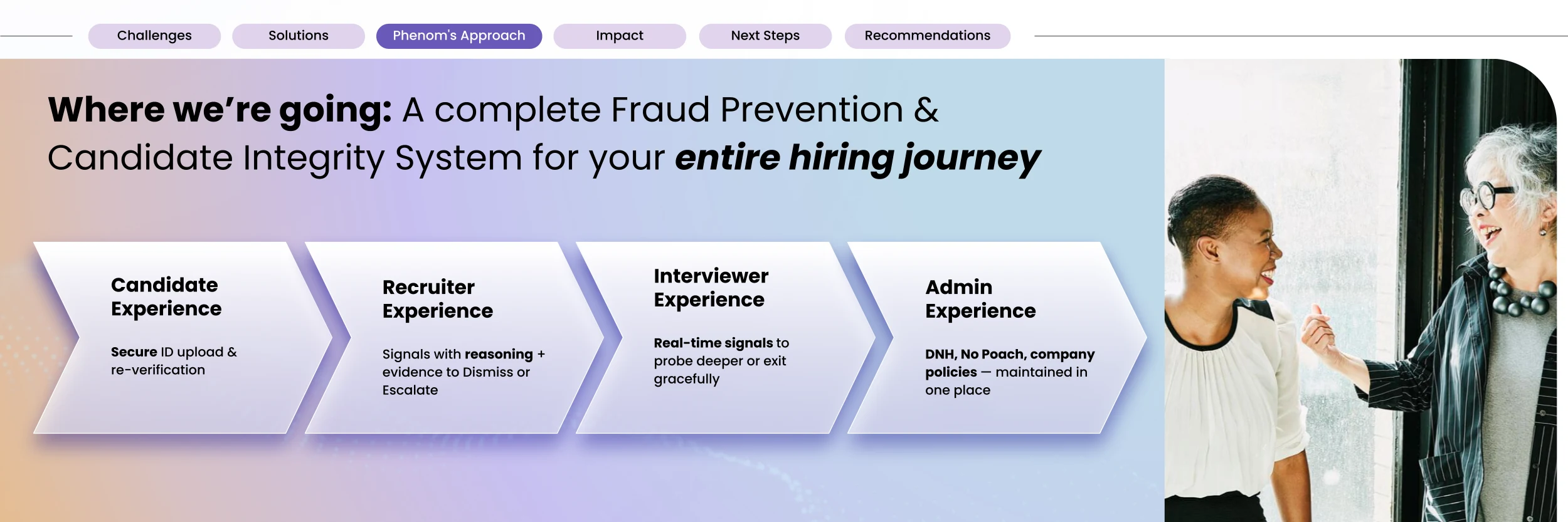
Phenom's fraud detection agent functions across the entire hiring lifecycle. The approach is layered by role:
Candidate experience: secure identity upload and re-verification steps built into the process
Recruiter experience: signals with reasoning and evidence to dismiss or escalate, surfaced directly on the candidate profile in the CRM
Interviewer experience: real-time indicators that prompt deeper probing when something seems inconsistent
Admin experience: do-not-hire, no-poach, and other compliance policies are maintained centrally and applied across the system
What Organizations Report After Deploying HR AI Agents at Scale
A major healthcare system that implemented the voice agent for candidate screening reported results that reflect both the operational and cultural shift
Screening time: reduced from 20 minutes to 8 minutes per candidate
Candidate-to-hire ratio: improved from 7:1 to 3:1
Completion rate: 85% across nearly 1,800 candidates
Recruiter change management: moved from skeptical to requesting expansion of the program
Related Read: How Elara Caring Uses a Conversational Voice AI Screening Agent To Enhance Hiring and Candidate Reach
Best Practices Before AI Agent Deployment
The gap between evaluating AI and running it confidently in production closes faster when organizations are deliberate about how they start. Four actions apply regardless of where a team currently sits in its deployment journey.
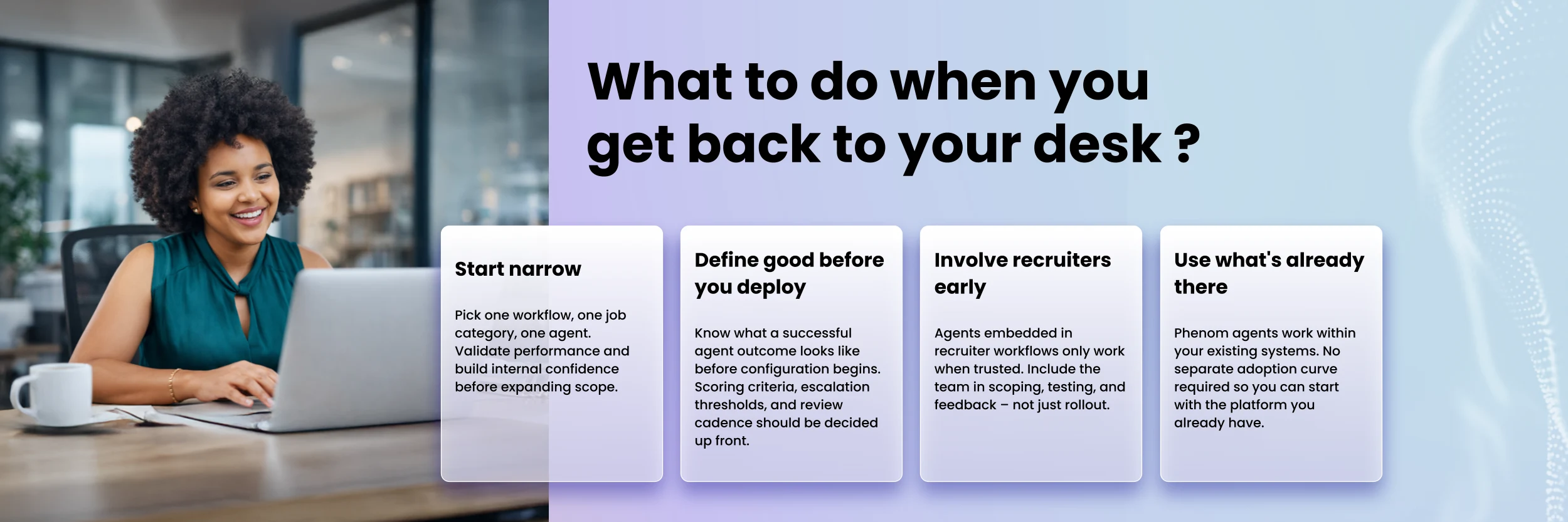
Start narrow: Pick one workflow, one job category, one agent. Validate performance and build internal confidence before expanding the scope. Organizations that try to deploy broadly before trust is established tend to stall at the point where recruiter skepticism and leadership scrutiny converge.
Define success before configuration begins: Know what a good agent outcome looks like before the first setting is configured. Scoring criteria, escalation thresholds, and review cadence should be decided up front.
Involve recruiters before rollout: Agents embedded in recruiter workflows only work when trusted. Including the team in scoping, testing, and feedback, not just implementation, is what builds that trust.
Build on what is already there: Phenom agents work within existing systems. There is no separate adoption curve, no new platform to onboard, and no parallel workflow to maintain. The starting point is the infrastructure the organization already has.
Responsible Deployment Makes AI Agent Scale Possible
The organizations that are deploying AI agents at scale successfully share a common foundation: they treat oversight, explainability, and recruiter trust as design requirements from the start, not problems to address after go-live.
Human-in-the-lead control built into the agent experience is not a constraint on what AI can do. It is what makes AI agents deployable in the first place. When the human remains the architect and the strategist, and the agent handles the execution, the result is a recruiting function that moves faster, makes better-informed decisions, and builds the kind of internal confidence that turns a single pilot into an organization-wide capability. As Nordmeyer-Andrez concluded: "We want you to be the architects and the strategists. We want to enable you to drive that change."
Ready to take the next step?
Connect with your Phenom account manager to understand your team's readiness and which agents are the right fit for your workflows.

Devi is a content marketing writer passionate about crafting content that informs and engages. Outside of work, you'll find her watching films or listening to NFAK.


Get the latest talent experience insights delivered to your inbox.
Sign up to the Phenom email list for weekly updates!


