


The AI Agents HPE Uses to Simplify Executive Screening
Phenom’s Voice Agent was built for high-volume, fast-turnaround pre-screening with simple knockout questions, frontline roles, and five-minute calls.
But Hewlett Packard Enterprise (HPE)’s Jordan Kaiser, Manager, Global Talent Acquisition Process and Compliance, brought a different idea to the Phenom product team. The ask? To use Phenom Voice Screening Agent for VP-level executive hiring, with in-depth probing questions, leadership assessments, and calls stretching up to 90 minutes.
HPE has held the World's Most Ethical Companies designation seven years running, a standard that shapes every technology decision the company makes — including this one. At IAMPHENOM 2026, Kaiser shared what happened when those standards met an unconventional use case shared what happened when those standards met an unconventional use case.
Watch the full session here, or explore the highlights below.
Why Was Executive Screening Difficult to Scale?
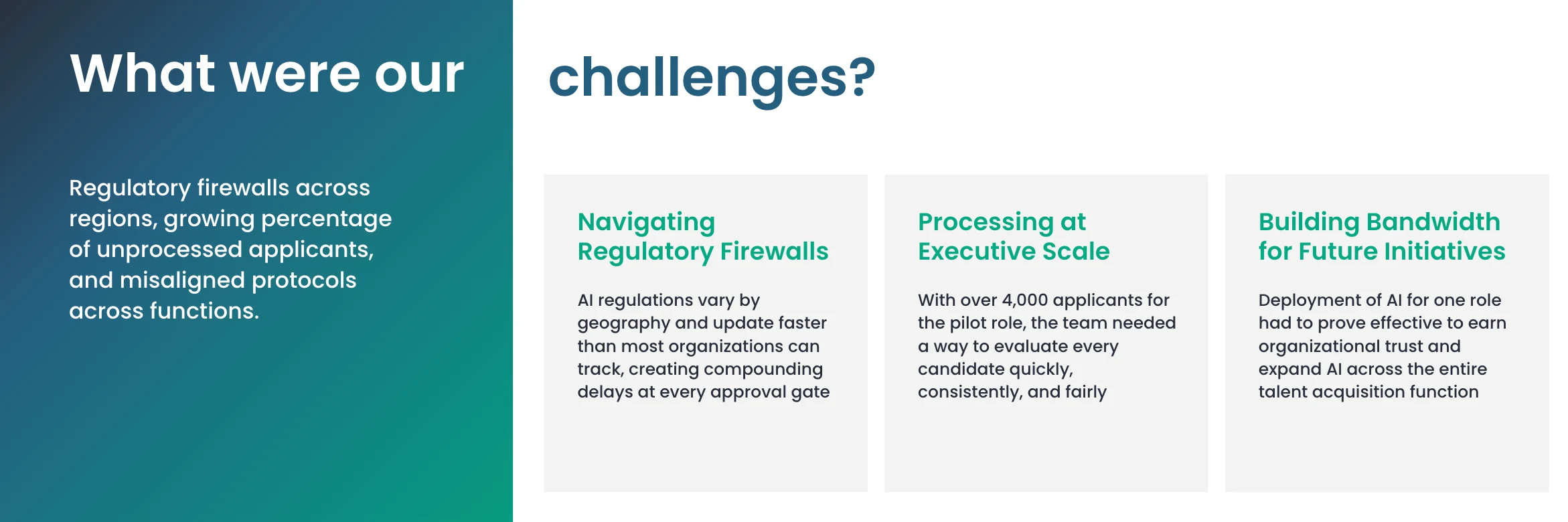
Even with decreased year-over-year applicant volume last year, HPE still received more than a million applications. With that kind of scale, the challenge isn't just processing volume; it's visibility. Only 27% of applications were acted on by a recruiter, not because candidates were reviewed and passed over, but because capacity constraints impacted reach. As a company committed to evaluating every applicant fairly and consistently, that gap mattered to the team.
The challenge was compounded by what executive recruiting actually requires. Reaching a VP candidate means calling them before 9 a.m. or after 5 p.m. And finding calendar time for an hour-long conversation can take weeks.
Screening 4,000 applicants for a single role while maintaining equitable evaluation was simply not achievable manually. Kaiser framed the objective clearly: "It was to ensure that every applicant could be evaluated fairly and consistently, so we stopped leaving qualified talent on the table. The second was to restore recruiter and hiring manager capacity by removing the administrative screening, improving both candidate and hiring manager experience, and then finally, create a signal in the funnel so we can distinguish whether we have a quality issue, a quantity issue, or an operating model issue."
Related Resource: Improve Candidate Screening: Detailed Guide to Screen Smarter & Faster
How Can AI Streamline Executive Hiring?
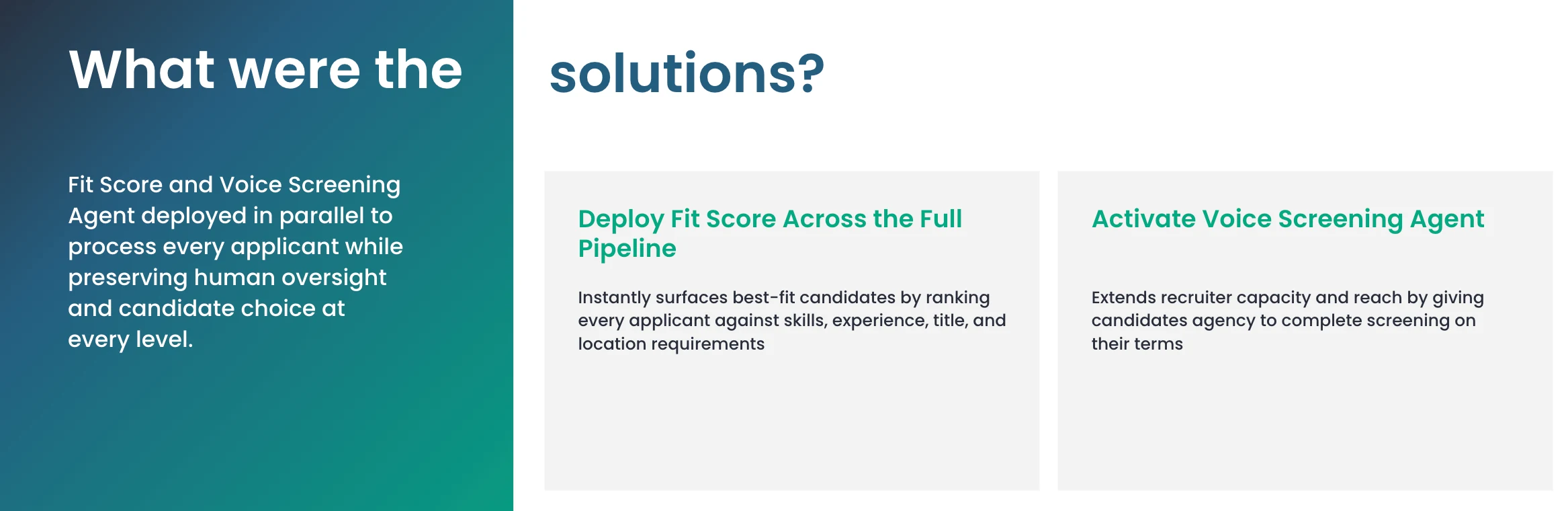
HPE paired two capabilities, Phenom Fit Score and Phenom Voice Screening Agent, with distinct roles. Together, these capabilities were deployed in parallel to process every applicant while preserving human oversight and candidate choice at every stage. Fit Score ranks candidates by match against defined criteria, bringing consistency and transparency to how applications move through the funnel. A threshold-based automation then determines which candidates advance to the agent.
The Voice Screening Agent handles the next stage by conducting structured, in-depth conversations with candidates to capture insights into leadership experience, strategic thinking, and cultural fit. The questions are defined in advance, and rubrics determine what a strong response looks like across each dimension, generating a standardized score out of five. While the AI provides a recommended rating, the recruiter reviews, can override, and owns the final call.
Candidates had three options when invited: accept an automated call from the virtual agent, reschedule for a better time, or complete the screening via web browser. Opting out of AI screening was always available, with an alternative manual recruiter process as the accommodation. In fact, the person HPE hired opted out of the voice screening entirely and went through a manual assessment, but became a champion of the technology afterward.
Related Resource: Phenom Fit Score: 2025 Report
What Can One Requisition Reveal About AI Screening?
HPE’s test pilot was to fill a single VP of Enterprise Transformation requisition with 4,000 applicants. From the moment Kaiser reached out to the Phenom team, the system was in production in 72 hours. That speed wasn’t luck; it was the result of pre-work done ahead of time to bring internal compliance, legal, ethics, cybersecurity, and IT teams into the process before asking for approval.
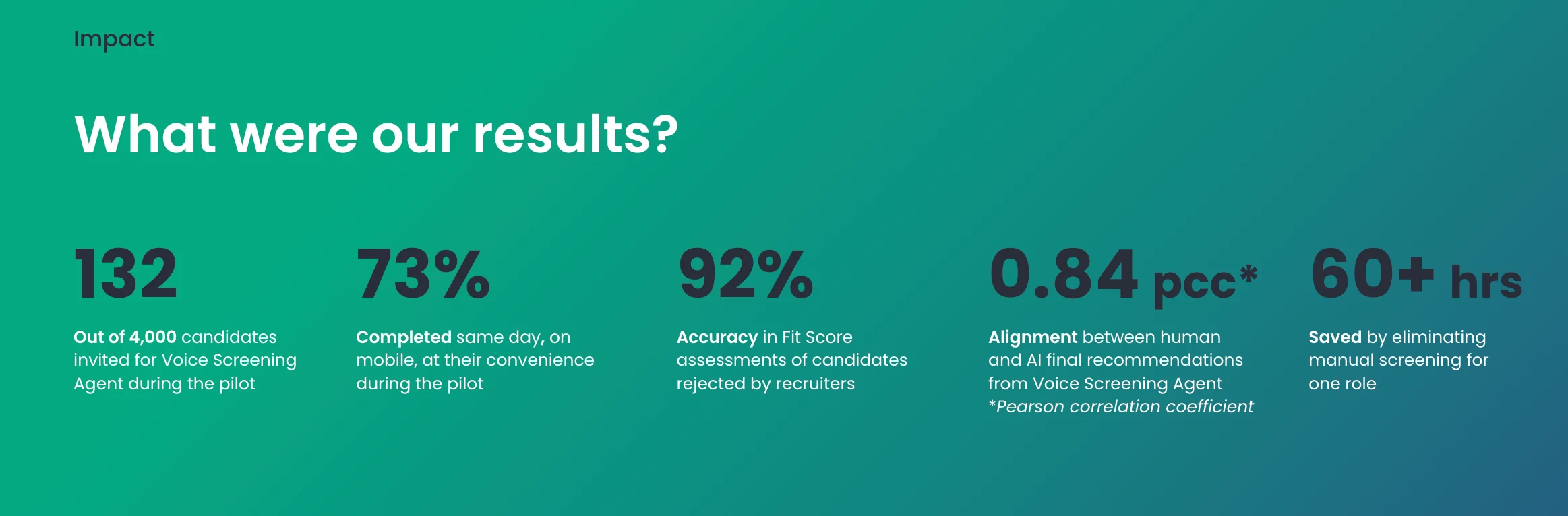
Kaiser also noted something that reframes what long calls actually signal: "A lot of times as recruiters we're cutting the depth of our conversation because we're trying to figure out how we get eight screens a day at 30 minutes. " The pilot created room to capture important details. The pilot resulted in:
132 qualified candidates identified from 4,000 applicants via automated Fit Score and threshold-based logic
73% same-day completion on mobile at candidates' convenience
92% accuracy in Fit Score rankings against recruiter evaluations
0.84 Pearson correlation between Voice Screening Agent ratings and human decisions
60+ hours saved on a single requisition
"When you align on what ‘goodness’ looks like, this is the statistical significance you should be seeing in your outcomes," Kaiser noted. HPE's internal executive test group — people who initially said they'd never participate — came back calling it "very human." One went further, spending extra time asking the agent questions about company culture that no one had prompted her to ask.
What Did It Take to Get AI Governance Right?
“Regulation itself does not block innovation. It's unmanaged regulation that does," Kaiser said.
HPE has a centralized AI governance council comprising cybersecurity, IT, legal, ethics, and compliance. That council exists because HPE sells AI solutions to its clients and holds itself to the same standards internally. For TA teams without a centralized council, Kaiser’s recommendation is to deliberately form one and to introduce purposeful friction into the AI review process. The friction is what builds the trust that eventually allows things to move faster.
A key framing shift that drove stakeholder buy-in was treating AI not as a SaaS tool but as introducing behavior into the system. As Kaiser put it, "You have to think about it as introducing behavior into your system, not a tool."
A traditional SaaS tool executes defined rules. An AI agent interprets intent, influences what people see, and shapes when and how candidates interact with the organization. Procurement, legal, and compliance teams that review it as a SaaS contract will miss the meaningful questions. Getting them to see it differently from the start is what enables speed.
"When compliance trusts your intent, AI becomes an enabler, not a blocker," Kaiser added.
Where Is HPE Taking AI Screening from Here?
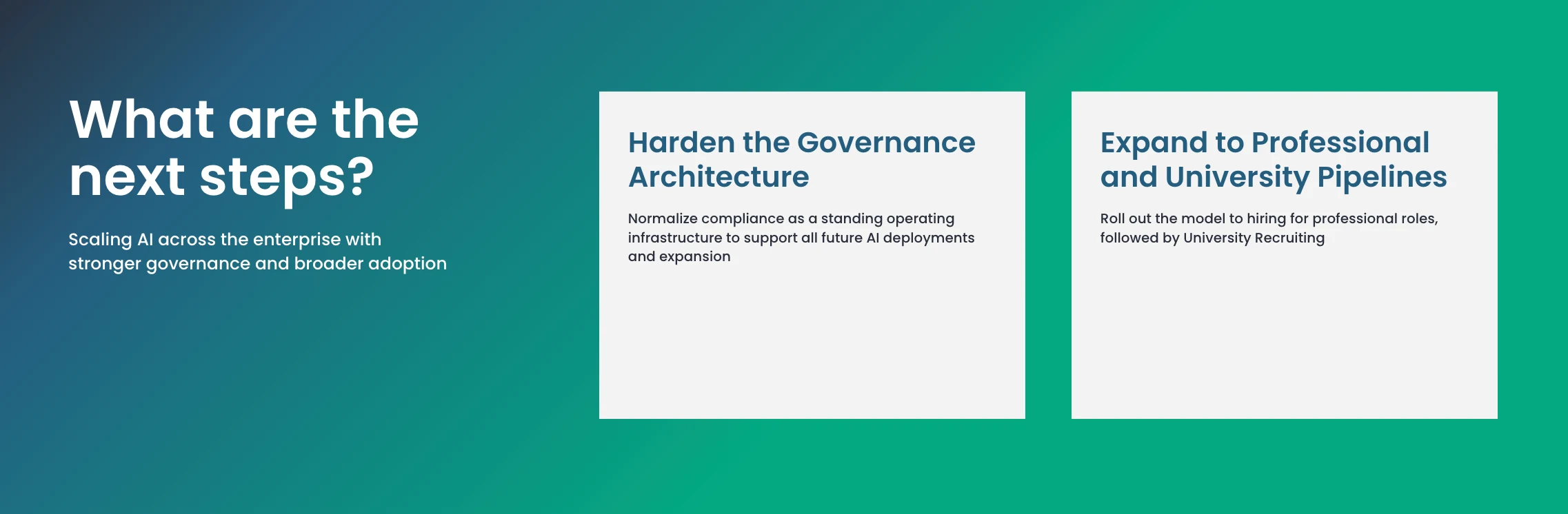
Kaiser deliberately started their screening agent pilot at the most resistance-heavy use case (VP level), since proving it there creates a defensible foundation for everything below it. The threshold logic, rubrics, and oversight framework transfer, and the expansion plan now runs downstream: professional roles, university hiring, and entry-level positions.
HPE is also actively monitoring Phenom’s candidate fraud detection capabilities. As AI-assisted candidate responses become more sophisticated, the question of what constitutes acceptable AI use versus fraudulent use in a voice screening process is still being worked out — legally, ethically, and practically.
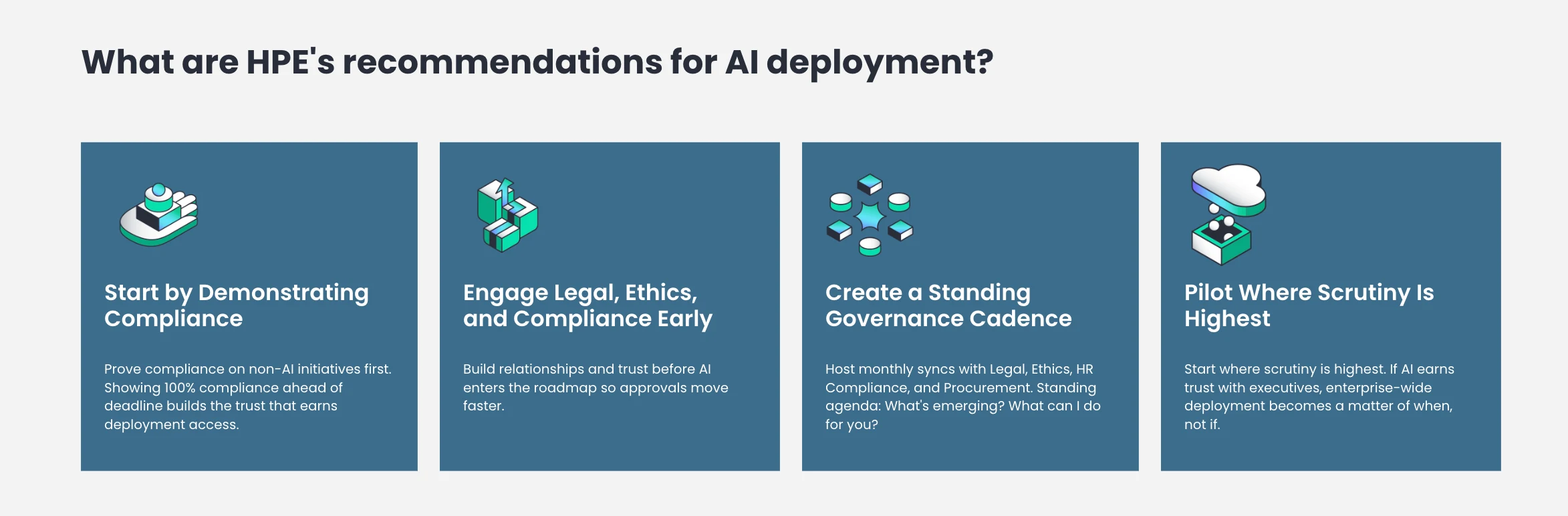
Kaiser’s parting advice? "Start with compliance before AI. It flips the conversation from risk to readiness. Pilot where scrutiny is the highest. If it works there, it's bound to work just about anywhere. And governance isn't a checkpoint; it is a cadence. Go live is not your final destination. It is completely iterative."
Learn more about AI agents to simplify screening


Get the latest talent experience insights delivered to your inbox.
Sign up to the Phenom email list for weekly updates!


