

AI and Automation in HR: A Complete Guide to Building Smarter, Faster Talent Teams
HR teams today are caught between business urgency and outdated processes. Organizations expect faster hiring, sharper insights, and increased productivity from their teams while employing cost-saving methods. Yet many HR functions remain anchored to manual systems that slow progress and increase operational cost. These fragmented workflows create inconsistencies, drag down efficiency, and reinforce the perception that HR can’t keep pace with the rest of the business.
That’s where AI and automation in HR are rewriting the playbook, transforming how teams attract, hire, and retain talent. AI brings data-driven intelligence to workforce planning and candidate selection, while automation removes repetitive tasks and streamlines execution. The outcome is a faster, more responsive, and more consistent talent function.
But where do most organizations stand today and how can they move forward strategically? The AI & Automation Maturity Model helps HR leaders answer exactly that. It provides a clear diagnostic view of where their organization sits today and what steps will unlock the next stage of maturity. This blog introduces the model, outlining how teams can progress from manual execution to adaptive, AI-driven decision-making.
In This Article:
The Importance of AI and Automation for HR
The future of HR depends on how intelligently and efficiently organizations can act. Speed alone is no longer the differentiator, what matters is the ability to make accurate, data-driven decisions and execute them instantly across every talent process. That’s where AI and automation come in.
AI (artificial intelligence or intelligence in this framework), strengthens decision-making by interpreting data, identifying patterns, and providing actionable context. It interprets data, identifies patterns, and provides context that helps recruiters and leaders make smarter choices, from predicting which candidates are most likely to convert to identifying employees at risk of leaving. These insights move HR beyond instinct and toward measurable, continuous improvement.
Automation, meanwhile, accelerates execution. It eliminates repetitive tasks like scheduling interviews, sending status updates, managing workflows. Recruiters get time back to focus on strategic priorities while candidates experience faster, more transparent communication.
When AI and automation operate together, HR functions can finally move in real time. AI determines what should happen based on insight; automation makes it happen instantly and consistently. A strong candidate isn’t lost in manual lag, an onboarding process doesn’t stall in email loops, and an internal mobility opportunity surfaces automatically.
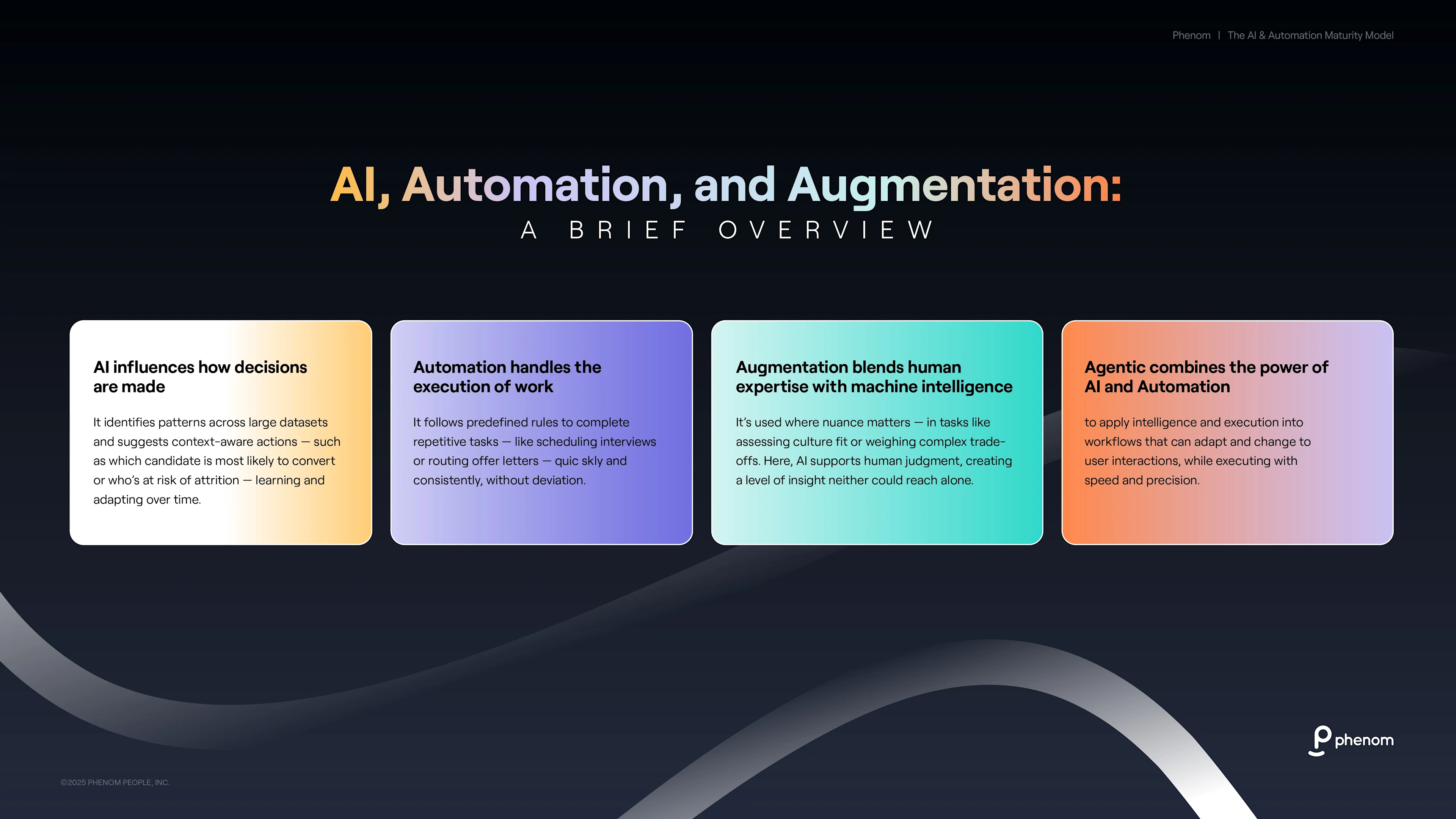
This is the foundation of the AI & Automation Maturity Model, a diagnostic framework that shows where an organization currently stands on both sides: artificial intelligence and automation. When intelligence and execution align, AI in HR workflow automation turns hiring, onboarding, and mobility into connected systems that learn, adapt, and act in real time.
Benefits of Advancing AI and Automation in HR
AI and automation create the most value when they advance together. Moving one forward without the other delivers limited results. Real progress comes when intelligence informs execution, helping HR operate with speed, accuracy, and adaptability. Here are five outcomes HR leaders can expect as maturity advances:
1. Shorter Hiring Cycles
Organizations that connect AI and automation often see hiring timelines cut dramatically. Automation handles coordination such as scheduling interviews, sending reminders, and triggering follow-ups, while AI identifies top candidates and predicts offer acceptance. Recruiters can spend less time on logistics and more time building relationships that convert, improving productivity without adding headcount.
2. Smarter, Consistent Decisions
When intelligence drives hiring choices, every decision becomes grounded in data rather than instinct. Recruiters and managers share one transparent view of candidate potential, reducing bias and strengthening quality of hire. AI enables consistent, evidence-based decision-making that scales across the organization. Better decisions also reduce the cost and disruption associated with misaligned hires.
3. Greater Team Capacity
Automation expands capacity without increasing headcount. Tasks like communication, offer routing, and onboarding run on intelligent workflows, while AI detects process bottlenecks and recommends improvements. Teams can manage higher volumes of work with fewer manual touchpoints and greater consistency, increasing productivity while keeping operational costs stable.
4. Better Experiences for Talent and Employees
AI and automation together elevate the experience for every stakeholder. Candidates receive timely, personalized updates instead of long silences. Employees discover learning paths and internal roles aligned to their skills and aspirations. The result is a talent journey that feels faster, fairer, and more human.
5. Strong ROI and Organizational Agility
When both dimensions mature, efficiency gains translate directly into business outcomes. Recruiters reclaim hours once lost to coordination, operational costs decrease as manual work reduces, and AI strengthens budget allocation and workforce forecasting. Automation helps HR adapt quickly to changing priorities, turning process efficiency into measurable ROI and a more agile talent function.
When AI and automation mature together, HR evolves from a support function to a strategic engine — one that continuously learns, scales, and improves with every interaction.
Related: Key Insights from AI Day 2025: Applying AI & AI Agents
Introducing the AI & Automation Maturity Model
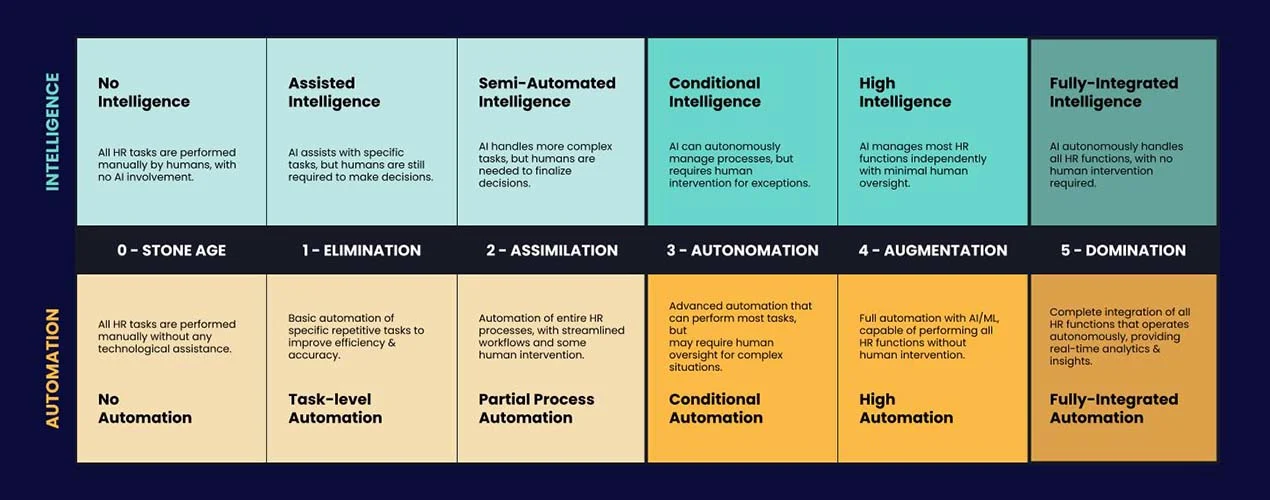
Before diving into the maturity levels themselves, let’s understand what the AI and Automation Maturity Model represents. Developed after supporting more than a thousand HR transformations, the model outlines five levels of adoption across two dimensions: intelligence and automation.
It’s designed as a layered matrix rather than a linear ladder, because companies rarely advance in a straight line. Some processes become automated faster than they become intelligent, and others move quickly on the intelligence side but remain manual in execution.
The matrix gives HR leaders a clear way to assess where they stand across both dimensions, understand why progress may be uneven, and identify the steps that will drive the most impact next. It connects effectiveness on the intelligence side with efficiency on the automation side, creating a more complete view of how a talent function actually operates today — and what needs to evolve to support the business better.
The Levels of AI and Automation Maturity
Every organization sits somewhere along the maturity spectrum. Some are still buried in spreadsheets and manual coordination, while others are experimenting with AI or scaling advanced automation. The AI & Automation Maturity Model serves as a roadmap, helping HR leaders see where they are today and what progress looks like in practice.
Level 0: Foundational
AI: There is no AI involvement at this stage. All decisions depend entirely on human judgment, personal experience, and gut instinct.
Automation: All HR tasks are performed manually with no technological assistance. Recruiters handle screening, scheduling, communication, document tracking, and process updates through spreadsheets, emails, and phone calls. As hiring scales, this approach creates slowdowns and inconsistencies.
Teams depend on fully manual coordination. Recruiters review resumes by hand, manage interviews through back-and-forth emails, and make hiring decisions using unstructured assessments that vary from person to person. Work only moves when someone takes action, which increases the chances of missed steps, delays, and inconsistent candidate experiences. The effort is high, the output is limited, and the process is difficult to scale.
Level 1: Streamlined
AI: AI supports simple tasks such as resume parsing, keyword searches, preliminary rankings, and basic chatbots that answer routine questions. All decisions remain fully human.
Automation: Basic repetitive actions like sending confirmations, reminders, invitations, and posting jobs, run automatically. Each task still requires manual initiation, and tools do not operate as connected workflows.
At this stage, technology removes some administrative effort, but the hiring process still depends on manual coordination. Recruiters review all candidates themselves, make every decision, and move each candidate through every stage. Automation handles small, isolated tasks, making hiring slightly faster and more consistent but still heavily manual.
Level 2: Integrated
AI: AI supports more complex analysis and becomes part of daily operations. It provides candidate fit scores, identifies strong matches using multiple data points, and surfaces high-potential talent. Humans still make all final decisions, but AI now influences which candidates receive attention.
Automation: Automation expands into partial process automation. Scheduling, reminders, updates, and document steps trigger automatically across systems, creating smoother handoffs. Workflows connect stages, though human checkpoints remain in place.
At this stage, processes begin to feel coordinated rather than piecemeal. Recruiters use AI-supported recommendations instead of starting reviews from scratch, while automation manages routine coordination like scheduling and basic follow-ups. Teams still approve key decisions, but the manual load decreases noticeably, improving capacity, consistency, and hiring speed.
Level 3: Intelligent
AI: AI begins making routine decisions independently. It screens and ranks candidates, advances those who meet defined criteria, adapts recommendations based on context, and triggers proactive actions when recurring patterns appear. Humans intervene only for exceptions or complex cases.
Automation: Automation becomes more responsive. Workflows follow defined logic, adapt to conditions like candidate availability or process requirements, and route exceptions to the right people automatically. Most common scenarios run with minimal manual involvement.
At this stage, recruiters step back from daily coordination as the system manages routine decisions and movement through the hiring process. Human involvement is reserved for unusual, high-impact, or sensitive roles. Hiring accelerates with fewer delays, and teams shift more time toward advising managers, refining processes, and strengthening pipelines. Efficiency increases substantially, but human oversight still ensures quality and consistency.
Level 4: Optimized
AI: AI manages most decisions with minimal oversight. It detects bottlenecks, adjusts workflows in real time, and anticipates hiring needs based on patterns across the talent lifecycle.
Automation: Automation runs end-to-end processes independently. Workflows optimize themselves based on performance data, and tasks across screening, scheduling, communication, and documentation execute without manual effort.
At this stage, teams shift from managing workflows to improving strategy. The system not only executes processes but actively optimizes them, removing bottlenecks and improving consistency without human prompting. Recruiters focus on workforce planning, partnering with managers, and designing stronger talent strategies, while the platform handles routine execution and real-time optimization behind the scenes. HR operates with high predictability, fast turnaround, and reliable outcomes across roles and regions.
Level 5: Transformed
AI: AI operates autonomously across the entire talent lifecycle. It evaluates candidates, manages decisions end-to-end, adapts strategies in real time, and continuously refines its own models based on outcomes. Human input is limited to governance, ethical oversight, and rare edge cases.
Automation: Automation is fully integrated and self-directing. Every workflow — sourcing, screening, scheduling, offers, onboarding, and internal mobility — executes independently. Processes monitor their own performance, reroute when issues arise, and optimize without manual intervention.
At this stage, HR functions as a strategic command center rather than an operational engine. The system runs talent acquisition and internal mobility autonomously, improving itself as it learns. Recruiters and HR leaders focus on long-term workforce planning, culture, capability-building, and organizational design. Human involvement centers on oversight, exceptions, and maintaining alignment with business priorities. Execution is continuous, predictive, and highly scalable, with HR guiding direction rather than managing processes.
Most organizations operate at multiple levels simultaneously. The maturity model helps leaders identify where progress is uneven, what’s holding them back, and how to move forward deliberately. When AI and automation grow together, HR evolves from a support function into a strategic engine for workforce performance and business agility.
AI and Automation: Industry Trends and Use Cases
While the maturity model applies universally, each industry advances differently based on hiring volume, regulatory complexity, and workforce scale. Understanding where AI and automation create the most impact helps HR leaders focus investments that drive measurable results.
Retail and Hospitality: High-Volume Hiring at Scale
In retail and hospitality, hiring needs rise quickly as stores grow, seasons shift, or demand spikes. These environments require talent teams to move fast while keeping the candidate experience seamless.
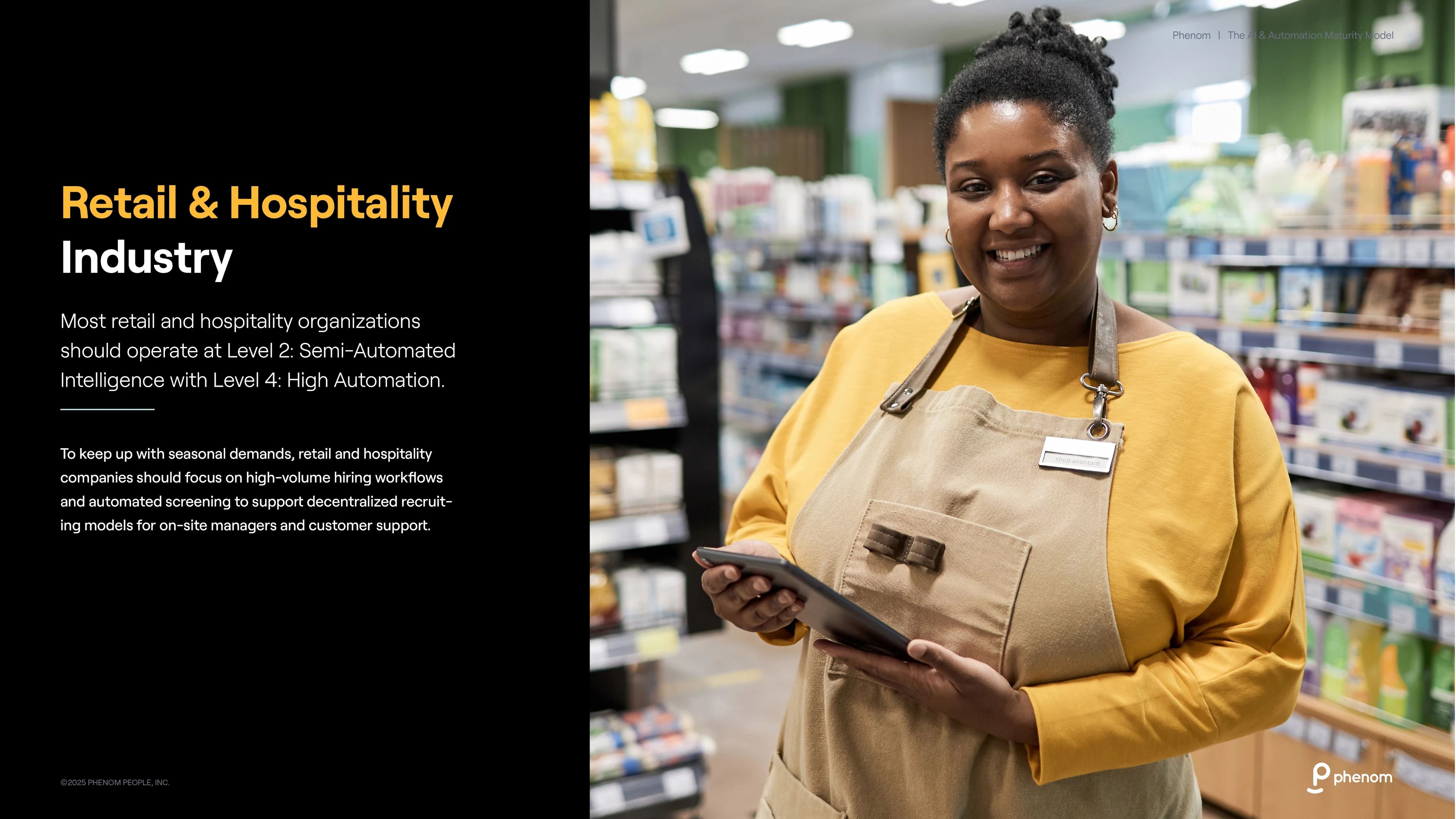
Automation delivers the greatest impact by managing early screening, coordinating interviews, and sending timely updates without manual effort. This gives recruiters the capacity to support large volumes of frontline roles across multiple locations. AI adds value by improving matching and highlighting promising candidates within big applicant pools, and at higher maturity, it can forecast staffing needs by store or season.
Retail and hospitality organizations should aim for a hiring flow where frontline candidates progress from application to offer within hours through automated screening, instant scheduling, and mobile-first communication. Recruiters can then focus on partnering with store leaders and building reliable pipelines while the system handles day-to-day execution.
Healthcare: Precision, Compliance, and Role Fit
In healthcare, hiring decisions directly affect patient care and regulatory safety. Roles require verified credentials, updated certifications, and strong alignment with clinical standards, making accuracy more important than speed.
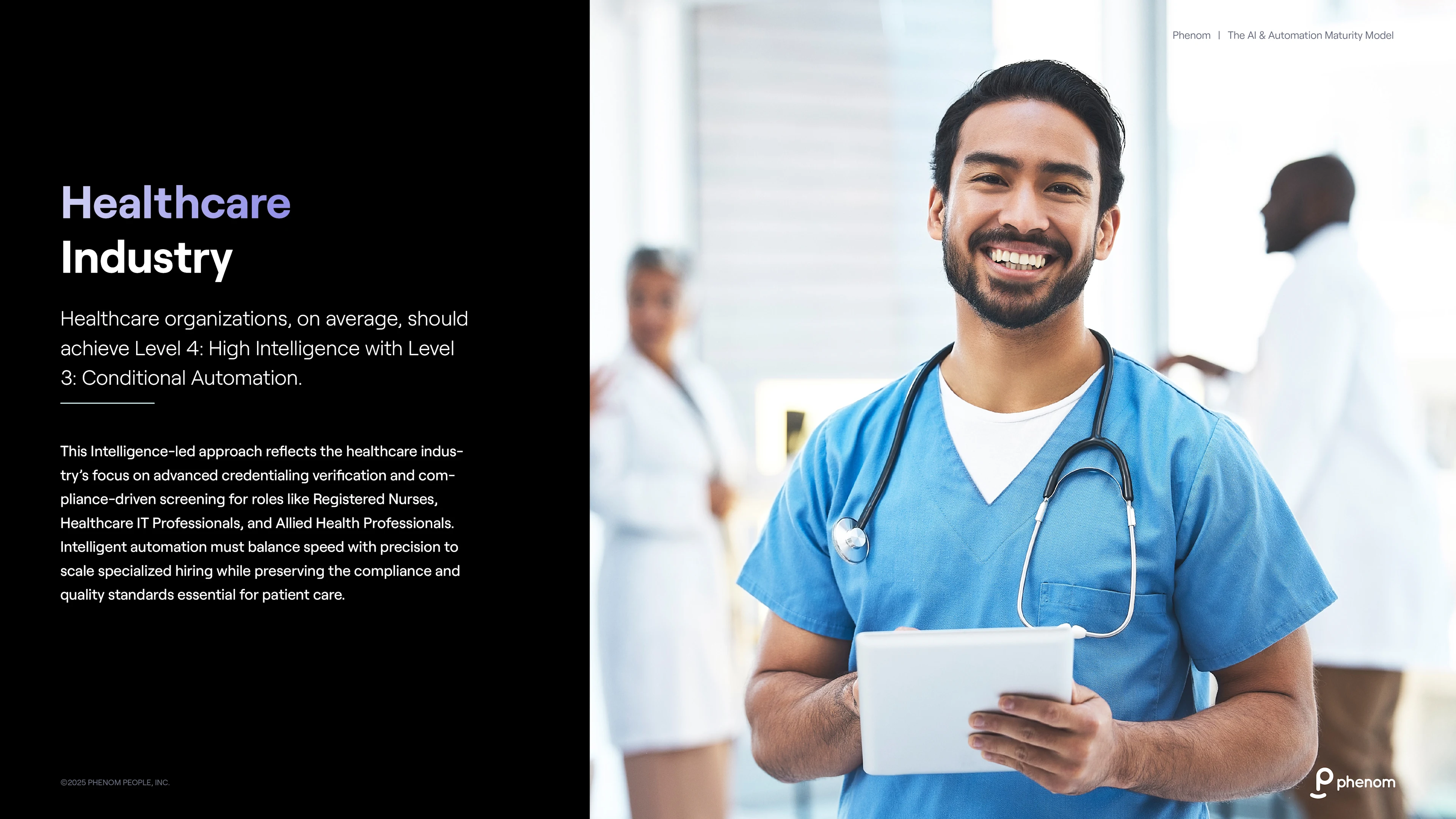
Automation supports this precision by managing documentation, tracking onboarding steps, coordinating interviews, and sending credential-related reminders. This helps teams maintain consistent, audit-ready workflows without manual follow-up. AI strengthens these processes by validating licenses across databases, flagging risks early, and assessing candidate fit based on clinical skills and experience. At higher maturity, it also anticipates staffing gaps and identifies strong clinical talent before demand spikes.
Healthcare organizations should aim for a system where credentials are checked automatically, compliance risks are surfaced early, and onboarding progresses reliably, allowing recruiters and clinical leaders to focus on evaluating capability and patient-care fit while the system protects accuracy and regulatory alignment.
Manufacturing: Global Coordination and Workforce Planning
Manufacturers manage a wide mix of roles across plants, regions, and shifts. Hiring needs vary by site, production volume, and technical skill requirements, making consistency and coordination essential.
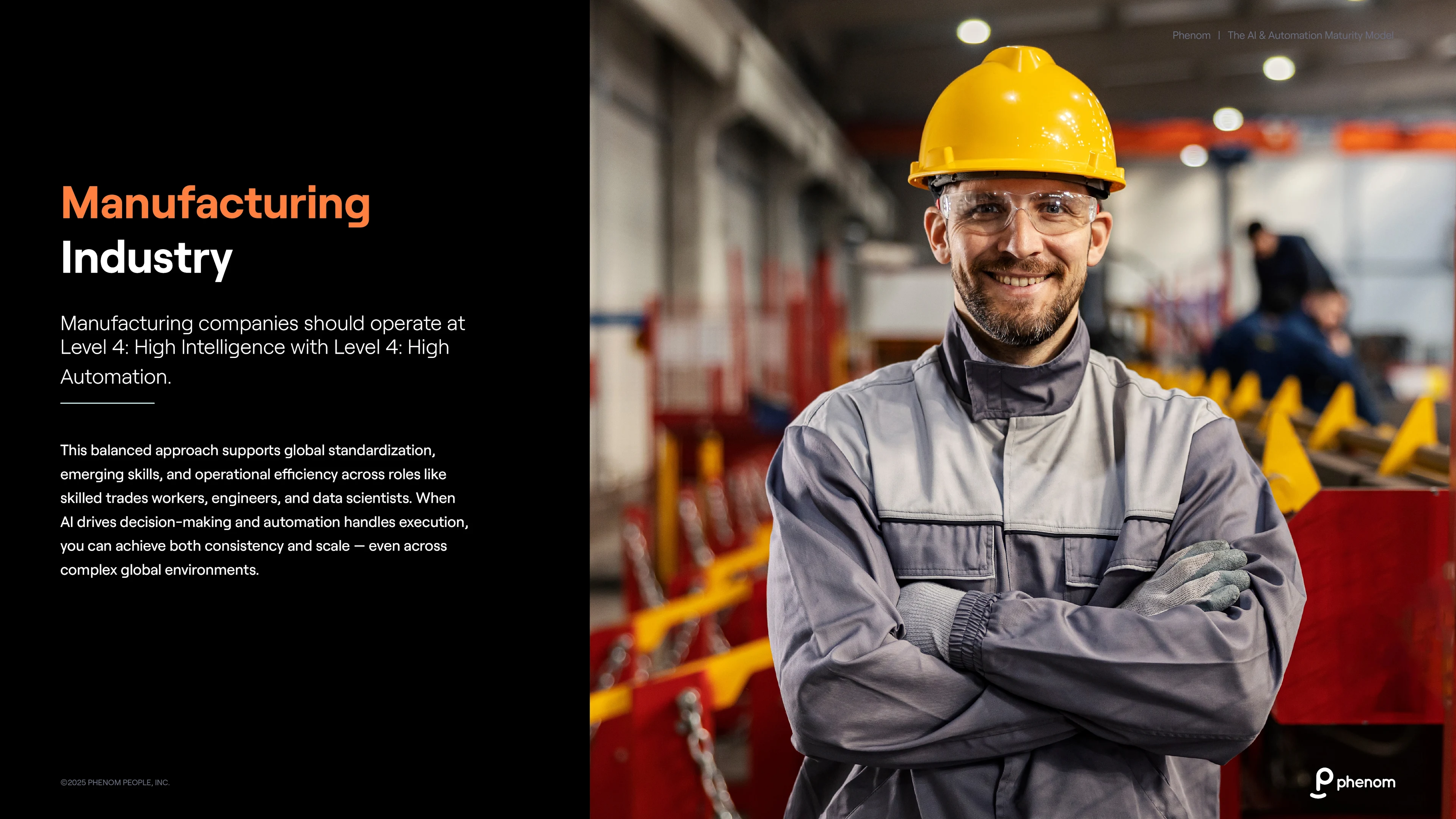
Automation delivers strong gains by standardizing workflows across locations. Interview scheduling, assessments, documentation, and offer approvals run the same way across plants, reducing variability and improving turnaround time for both high-volume and skilled roles. AI adds depth by assessing fit across different job families, predicting future labor needs based on production and workforce trends, and identifying employees who can be re-skilled for evolving technical demands. It also strengthens internal mobility by matching workers to roles based on skills, certifications, and on-the-job performance.
Manufacturing organizations should aim for a hiring system that delivers consistent workflows across every plant and region, where AI predicts talent needs in advance and automation manages execution reliably, allowing recruiters and site leaders to focus on closing capability gaps and building pipelines for specialized skill areas.
Financial Services: Precision, Risk Management, and Regulatory Control
Financial services teams hire for roles where accuracy, compliance, and risk mitigation matter as much as candidate quality. From wealth advisors to analysts to operations specialists, every hire must meet strict regulatory standards and pass multiple layers of screening and credential verification.
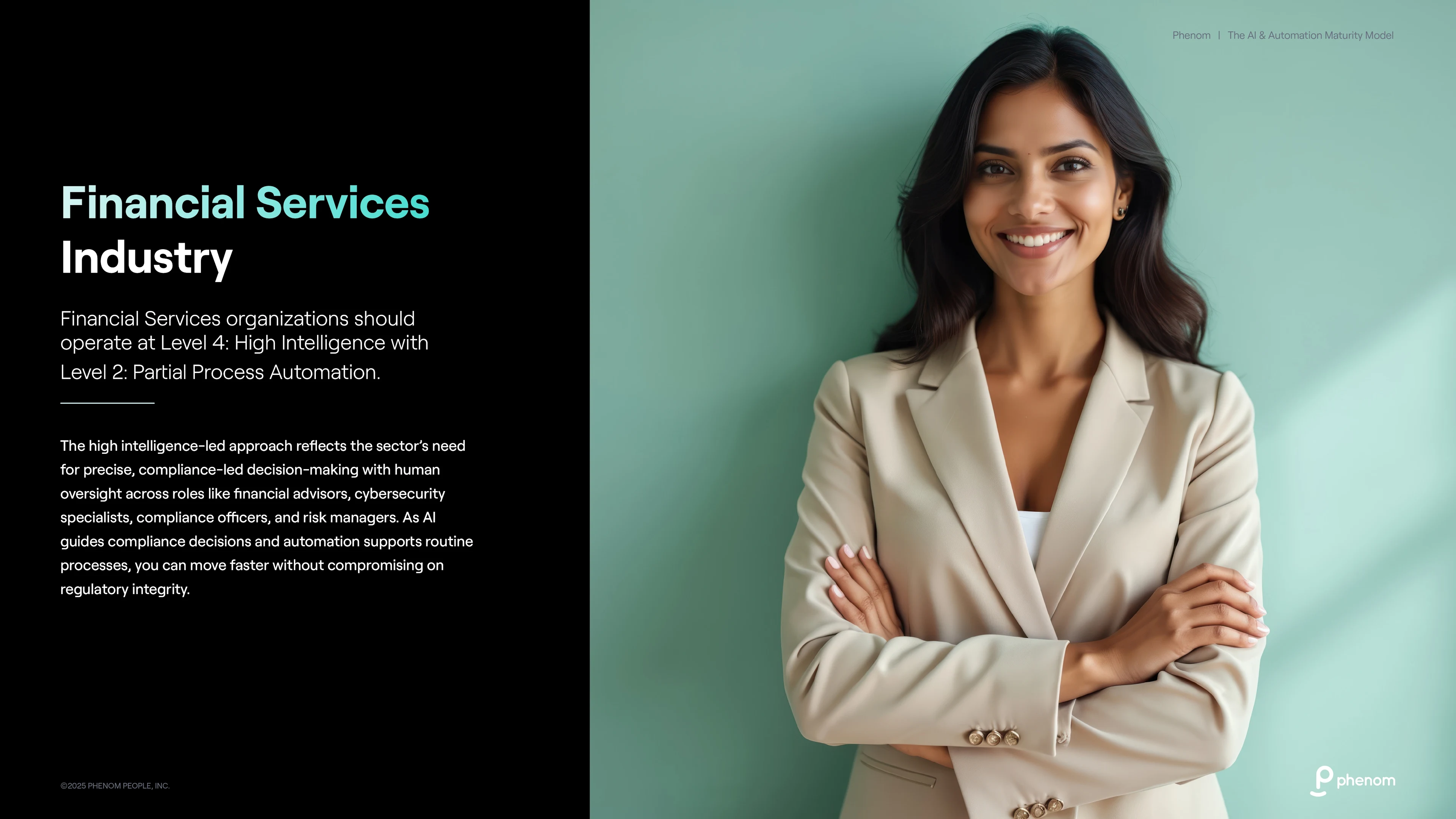
Automation supports these requirements by managing background check workflows, coordinating interview steps, tracking documentation, and sending timely compliance reminders. These workflows reduce manual follow-up and help teams maintain audit-ready processes across high-volume and regulated roles. AI strengthens hiring decisions by validating licenses and certifications across regulatory databases, flagging potential risk indicators, and assessing candidate fit based on experience, certifications, and role requirements. At higher maturity, AI identifies emerging skill needs, improves workforce planning accuracy, and helps teams detect patterns that may influence long-term performance or compliance risk.
Financial services organizations should aim for a hiring system where regulatory checks, documentation, and screening workflows run reliably in the background, while AI provides clarity around fit, risk, and future capability needs, allowing recruiters and business leaders to focus on strategic hiring decisions with confidence.
Common Challenges on the Path to AI and Automation Maturity
Most HR teams progress unevenly across intelligence and automation, often automating faster than they build AI capability. Recognizing where progress slows helps leaders plan smarter and invest where impact will be greatest.
Uneven Progress Between AI and Automation. Most teams start by automating routine tasks like scheduling or email workflows before applying AI to decision-making. The result is faster coordination but limited precision. True maturity comes when automation and AI advance together, combining speed with smarter, data-led choices.
Limited Data Quality and Visibility. AI can only perform as well as the data it’s trained on. Incomplete, inconsistent, or scattered candidate and employee data weakens insights and leads to unreliable outcomes. Consolidating and cleaning data is the first step toward meaningful intelligence and dependable automation.
Siloed HR Systems. Disconnected tools limit how far automation can flow and how effectively AI can learn. When recruiting, onboarding, and learning systems don’t communicate, insights stay trapped in individual processes. Integration unlocks the full power of AI in HR workflow automation, enabling seamless, end-to-end execution.
Change Resistance and Adoption Gaps. Even the best technology fails without trust. Recruiters and managers often hesitate to rely on AI they don’t fully understand. Transparency about how AI scores, learns, and adapts, combined with visible results, builds confidence and consistent adoption.
Lack of Continuous Optimization. AI and automation aren’t “set and forget.” Without ongoing refinement, models drift and workflows lose relevance. The most mature HR teams treat optimization as a continuous process — fine-tuning algorithms, retraining data, and adjusting automation to reflect evolving business needs.
How to Assess Your AI and Automation Maturity
Understanding the five maturity levels is one thing, but knowing where your organization actually sits is what turns insight into action. The AI & Automation Maturity Assessment helps teams evaluate their current state across both dimensions, highlight gaps, and identify where progress will deliver the greatest impact. Here’s how to begin:
Identify where manual work still dominates. Map your key HR workflows end-to-end. If most steps still rely on spreadsheets, manual scheduling, or email coordination, start by automating repetitive tasks to create quick wins and build momentum.
Evaluate how decisions are made. Review how hiring and workforce planning choices happen today. If decisions rely more on intuition than data, it’s time to bring intelligence into the process. AI-generated insights help teams replace guesswork with clarity and measurable improvement.
Review how workflows execute. Assess how efficiently work moves through your systems. Higher automation maturity means tasks progress seamlessly without manual triggers or delays.
Diagnose gaps between AI and automation. Teams often advance one dimension faster than the other, automating tasks long before they adopt decision intelligence, or investing in analytics while workflows remain manual. The goal is balance: intelligence that guides decisions and automation that carries them forward.
These observations form the foundation of your maturity profile and reveal where advancement will have the greatest impact. You can use the self-assessment in the AI & Automation Toolkit to translate these signals into a clear baseline across both dimensions. If you need help interpreting the results or prioritizing next steps, a brief maturity conversation can provide additional guidance.
Building Your Roadmap to Intelligent HR Operations
Maturity isn’t about implementing more tools; it’s about aligning AI and automation to your organization’s goals and using both to elevate how work gets done. Once you have a clear view of your current state, you can begin shaping a roadmap that builds capability over time.
Start with immediate wins by automating repetitive, time-consuming tasks to free up recruiter and manager bandwidth. From there, introduce intelligence into the workflow — AI that improves decision quality, predicts workforce needs, and anticipates candidate behavior. As these layers connect, execution becomes more seamless, decisions become more consistent, and the overall talent experience becomes more responsive.
This progression turns AI and automation into practical levers that help teams scale, stay ahead of demand, and support the organization more strategically.
Download the AI & Automation Toolkit for HR to benchmark your maturity and build your roadmap to intelligent HR operations. You can also schedule an AI and automation maturity conversation, where our advisors will help assess where your company stands today and highlight future opportunities.
Frequently Asked Questions
The AI & Automation Maturity Model is a diagnostic framework developed after supporting more than 1,000 HR transformations. It maps organizations across two dimensions — intelligence and automation — through five maturity levels: Foundational, Streamlined, Integrated, Intelligent, Optimized, and Transformed. The model helps HR leaders identify gaps and plan progress.
In Phenom's framework, AI strengthens decision-making by interpreting data, identifying patterns, and providing actionable context — predicting which candidates will convert or which employees are at risk of leaving. Automation accelerates execution by eliminating repetitive tasks like interview scheduling, status updates, and workflow management. AI determines what should happen based on insight; automation makes it happen instantly and consistently.
The model defines six stages from Level 0 to Level 5. Level 0 (Foundational) relies on fully manual coordination with no AI. Level 1 (Streamlined) uses basic resume parsing and automated reminders. Level 2 (Integrated) introduces fit scores and partial workflow automation. Level 3 (Intelligent) lets AI make routine decisions independently. Level 4 (Optimized) runs end-to-end processes with self-optimizing workflows. Level 5 (Transformed) operates autonomously across the talent lifecycle with humans focused on governance and exceptions.
Impact varies by industry context. Retail and hospitality benefit most from high-volume automation that progresses frontline candidates from application to offer within hours via automated screening and instant scheduling. Healthcare uses AI to validate credentials and flag compliance risks early. Manufacturing standardizes interview workflows across plants and predicts technical labor needs. Financial services applies AI to validate licenses across regulatory databases and identify long-term performance and compliance risk indicators across high-volume, regulated roles.
Start by mapping HR workflows end-to-end to identify where manual work dominates. Evaluate how hiring decisions are made — intuition versus data. Review how efficiently work moves through systems without manual triggers. Diagnose gaps between AI and automation dimensions, since teams often advance one faster than the other. Phenom's AI & Automation Toolkit includes a self-assessment that translates these signals into a maturity baseline across both dimensions.
Five challenges slow progress: uneven progress between AI and automation (teams automate faster than they build intelligence), limited data quality and visibility, siloed HR systems that trap insights, change resistance and adoption gaps among recruiters, and lack of continuous optimization. AI and automation are not "set and forget" — without ongoing refinement, models drift and workflows lose relevance.

Apurba is a writer who specializes in creating engaging content, backed by storytelling, data, SEO and a cup of coffee. When she’s not writing, she’s reading, cooking fusion food, or curiously traveling like a local.


Get the latest applied AI insights delivered to your inbox.
Sign up to stay up-to-date on the latest original content from Phenom, including new podcast episodes, events, and more.


