

Phenom AI Day 2025: Applying AI & AI Agents to Hire Faster, Develop Better & Retain Longer
Every HR and IT leader faces the same dilemma: the most valuable knowledge about people, skills, and processes is fragmented across disconnected systems — or worse, lost when employees leave. HR and IT are also under pressure to keep up with ever-changing markets and job conditions. Generic AI tools promise quick answers, but without understanding your business context, including goals and use cases, they miss the mark. The result? Insights and content that might sound good at the surface-level, but don’t actually help you hire faster, develop people better, or make decisions you can trust.
That’s why we’ve built applied AI for the enterprise — purpose-built for HR and IT. Instead of layering AI on top of broken data, our architecture creates a digital twin of your talent ecosystem: a living model of roles, skills, relationships, and processes unique to your organization.
This foundation allows AI to go beyond simple automation. It enables context-aware reasoning, transparent decision-making, and intelligent agents that collaborate with humans at every step of the talent journey. From job search to onboarding to career growth, applied AI can accelerate work while keeping people — not technology — at the center.
During AI Day for HR & IT, we took a behind-the-curtain look at truly effective artificial intelligence and agents for talent acquisition and management. Check out our recap of the event, featuring deep-dive sessions and the real-world impact already transforming HR and IT teams today.
In This Article
Applied AI is the Future of HR
During the opening keynote, Mahe Bayireddi, CEO & co-founder at Phenom, explored how the way we work has drastically shifted, and where organizations must now take action — or risk falling behind.
While the last couple of decades were about digitalization, in just two years, the entire equation has shifted with the adoption of large language models (LLMs), generative AI, and agentic AI. Workflows cannot function as static inputs; they need to self-improve to be continually valuable and effective.
"We're moving from static to dynamic, from instruction to prediction, from automation to agentic," Bayireddi explained, painting a picture of a fundamental shift in how we work. "We're heading into a new world where software isn't about doing small tasks — it's a collaborative teammate."
Think of the difference between a cook and a chef: cooks follow recipes, but chefs design them. AI is stepping into the role of the cook — handling repeatable execution — so that people can step fully into the role of the chef, innovating, experimenting, and leading.
In HR, this means vertical-specific agents built on:
Agentic architectures with rigorous evaluation
Fine-tuned models specialized by domain and industry
AI safety and compliance at the core
Persona-driven experiences that adapt to both recruiters and candidates
Phenom uses a multi-model approach for building agentic AI — from small, domain-specific models to frontier models driving deep reasoning, alongside traditional systems. Together, they form a feedback loop that continuously learns, adapts, and orchestrates across applications, data, and people, delivering what Bayireddi describes as “a new paradigm in HR that is transforming work itself.”
Entire job markets, patterns, and behaviors are being reset. One of the most widespread evolutions happening right now is the transition of recruiters from pure executors to guides and refiners, staying present with candidates while AI handles context, memory, and scale. Productivity won’t come from chasing perfect accuracy, but from embracing probabilistic thinking, delegating effectively, and setting new guardrails.
For organizations, understanding how AI works for HR is critical. While many are talking about AI, few can show the problems identified, the solutions found, the outcomes achieved, and the lessons learned. “The most important aspects of AI are how the user experience works and how AI safety works,” commented Bayireddi. Because in the end, AI in HR isn’t about lines of code — it’s about transforming how people work, grow, and connect.
Architecting AI for HR and IT
HR and IT teams face a fundamental challenge: currently, critical knowledge about hiring processes, employee skills, and organizational structures lives in disconnected platforms. When experienced team members leave or processes change, that institutional knowledge vanishes. Generic AI tools can struggle to grasp your unique business context, limiting their ability to deliver meaningful insights.
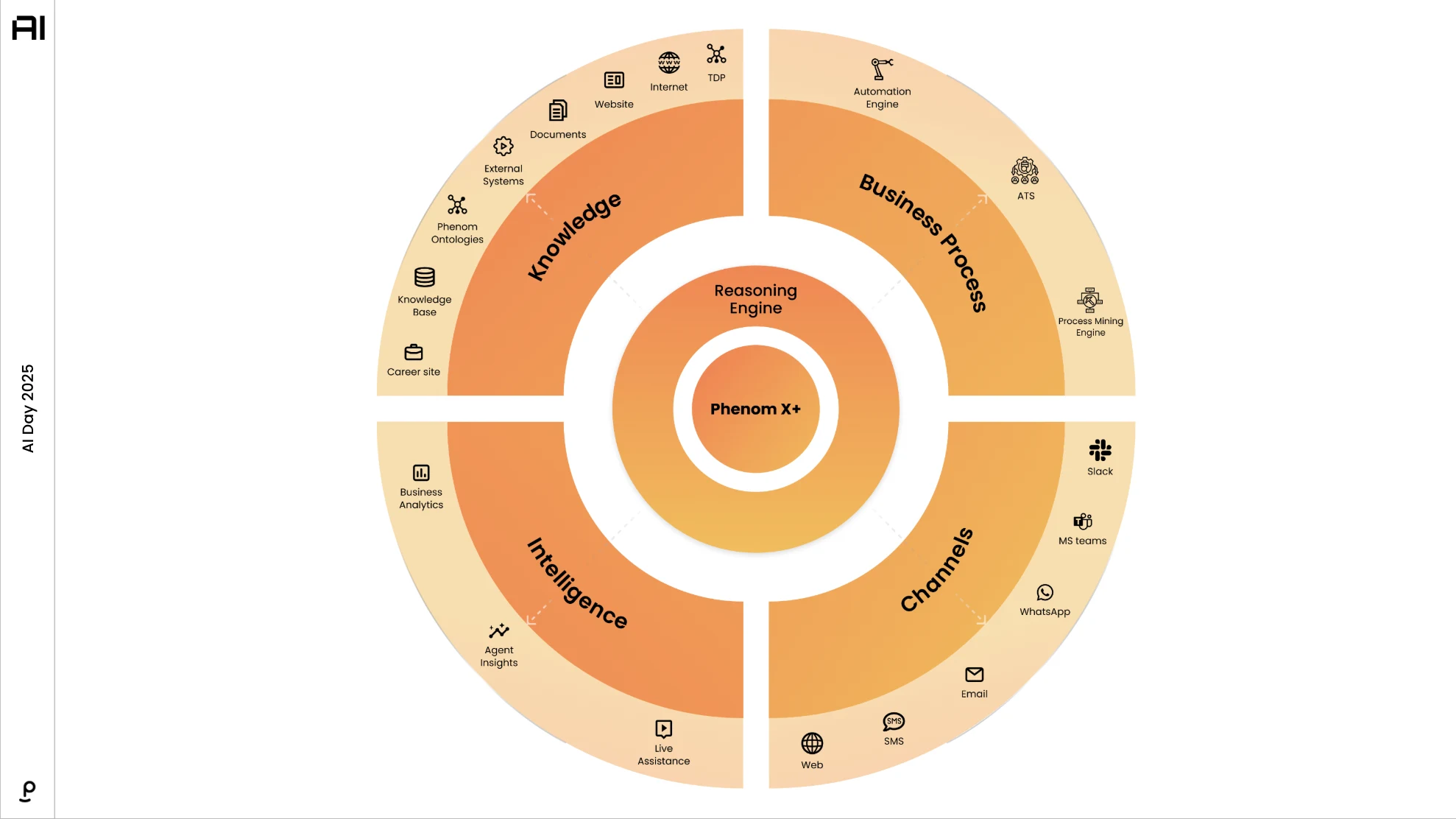
Phenom's robust AI architecture addresses this challenge through an ontology-driven approach that creates a comprehensive view of each organization's talent ecosystem.
Creating a Digital Twin of Your Organization
While disconnected systems create a unique problem, the solution starts with understanding how your organization's data actually connects.
During a live demo, Maggie Allen, VP of Global Revenue Enablement & Solutions Consulting at Phenom, showcased how the platform turns unstructured information into actionable intelligence. Like a digital twin in manufacturing that mirrors physical systems, Phenom creates a virtual replica of your talent ecosystem, capturing every role, relationship, and process.
The result? Phenom is able to automatically extract key information and map relationships between locations, roles, skills, and career paths. Sunny Yang-Hicks, Senior Director of Product Management at Phenom, explained how this can enable location-specific strategies for a manufacturing company, allowing sites near training centers to recruit entry-level candidates for development, while remote locations prioritize experienced talent.
"When data is modeled as relationships and knowledge graphs, we can answer sophisticated, once nearly impossible questions instantly," Yang-Hicks explained.
The Three-Pillar Architecture
With this foundation of connected data in place, the next challenge is building an architecture that can handle real-world enterprise environments. Sivaphani Maddi, Director of Engineering at Phenom, walked through the platform's three-pillar architecture:
The Ontology System creates a map of how everything in your organization connects
The Data System manages your employee and candidate records
Hybrid RAG Integration reads both your structured databases and unstructured documents, like PDFs and interview notes
Together, these three pillars enable Phenom's platform to recognize context, not just data.
For example, when searching for "Maintenance Technicians in Plant Operations East with OSHA certifications," the platform knows this is a specific business unit, validates certifications from HR records, and finds relevant experience, pulling insights from both official databases and informal documentation to make better hiring decisions.
Handling Conflicting Information Intelligently
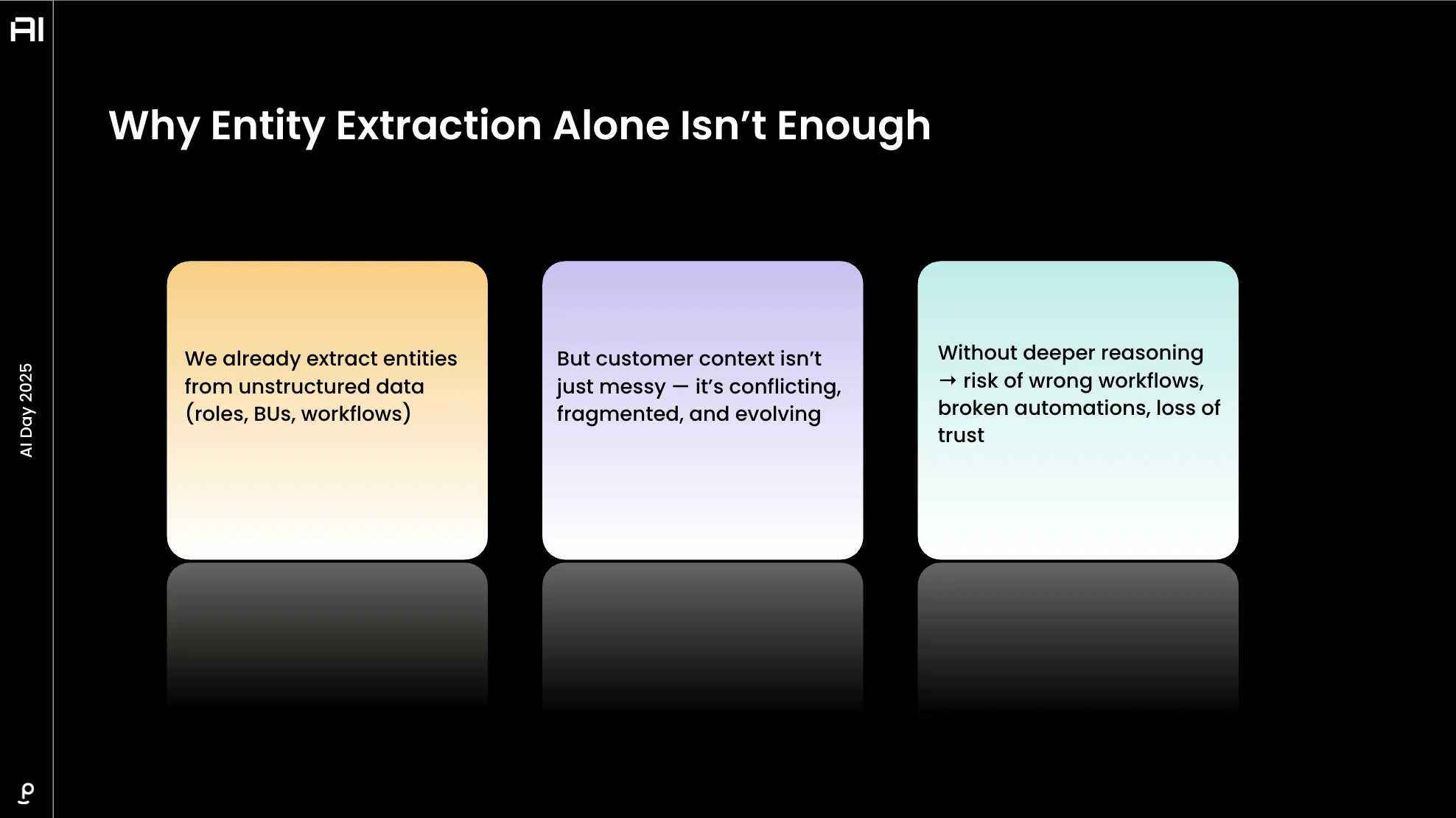
Organizations can have conflicting data across different platforms and locations, meaning documentation might contradict recent process changes. Phenom’s metacognitive reasoning capabilities resolve these conflicts intelligently. But having smart technology only matters if it can handle the disorganized reality of how organizations actually store information.
Maddi demonstrated this with a practical example: A company with offices in San Francisco, California, might use video interviews, while hiring teams in Austin, Texas, use phone screening to connect with candidates. Rather than treating this as an error or choosing the most recent data, the system recognizes these as location-specific variations and maintains accurate workflows for each office,” Maddi explained.
Transparent Decision-Making
Building trust requires both accurate results and transparency in how those results are generated. During a live demo, we saw how an AI assistant leveraged Phenom Ontology Studio reasoning to analyze whether a company could handle 2,000 frontline hires internally or if they needed to employ agency support to reach their hiring goals. The platform recommended an 85/15 split between internal and agency hiring, showing its complete reasoning process.
"The reasoning layer gives me confidence there's a combined approach," Allen noted, demonstrating how users can review the exact data sources and logic behind recommendations before taking action on the provided data or insights. This transforms AI from a mysterious black box into a transparent and trusted advisor that HR teams can verify in real time.
Practical Benefits for Your Organization
For HR teams, the three-pillar architecture functioning behind the scenes means that AI has the ability to interpret and apply your specific job families, locations, and workflows without extensive customization. Recruiters can search using your unique company terminology and get relevant results immediately. At the same time, talent strategies can adapt as your business evolves continuously. For IT teams, it means reduced integration challenges and technology that adapts to process changes automatically.
The key insight from Phenom's approach: successful enterprise AI requires more than sophisticated algorithms. It needs to comprehend your business context, adapt to your processes, and provide transparent reasoning for its recommendations. By building this comprehension into the architecture itself, organizations can successfully realize AI's potential to transform talent acquisition and management.
With the foundation set for understanding your organization's unique context, it’s time to take a look at specialized agents that put this intelligence into action at every stage of the candidate journey.
Meet the Experience Agents Enhancing Talent Acquisition
Recruiters need speed and personalization without sacrificing quality. Phenom Experience Agents combine automation, reasoning, and context to guide candidates from search through screening. Each agent focuses on a specific stage of the journey, removing friction for candidates and saving recruiters valuable time.
Smarter Job Discovery with Agentic Search
The way candidates traditionally search for jobs forces them to adapt to the system they’re using, which can be a cumbersome discovery experience.
Phenom Agentic Job Search flips that model by understanding natural language queries (e.g., “I want an order-filler role but can’t lift more than 50 pounds”), routes them intelligently, enriches results with geolocation and context, and re-ranks them using engagement metrics. By enriching results with contextual data and continuously retraining on engagement signals, the search agent ensures candidates see roles that best match their skills, location, and intent.
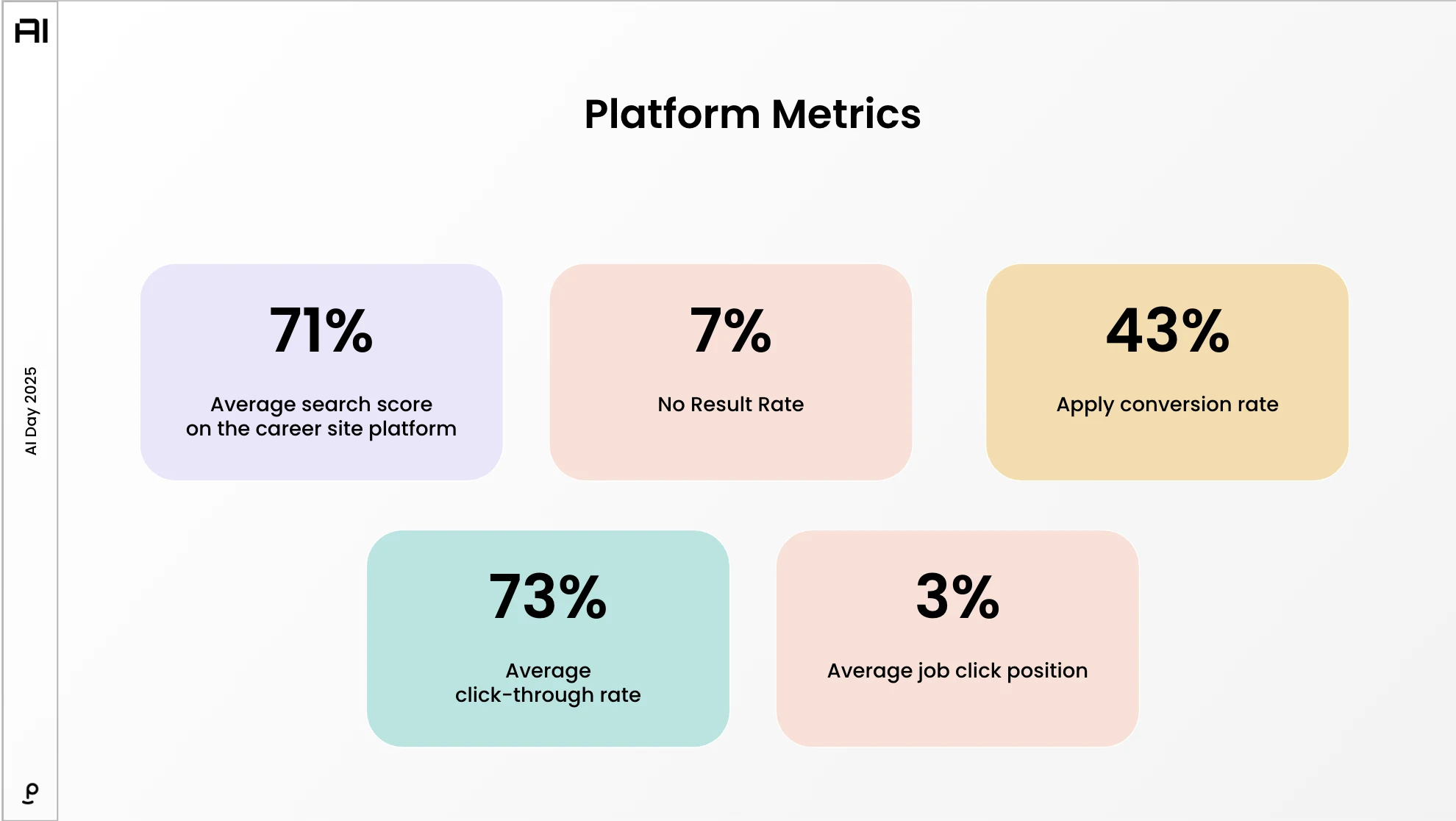
In the last 12 months alone, Phenom has processed 1 billion job searches, achieving a 43% apply conversion rate, 73% click-through rate, and reducing the no-result rate to 7%.
Fast-Tracking Candidates with the Candidate Concierge Agent
The Phenom Candidate Concierge Agent guides applicants in real time, taking a conversational approach. Instead of static search-and-apply flows, the agent recommends roles, answers detailed questions, and removes friction from the application process.
Powered by the Phenom Reasoning Engine, natural language Agent Operation Policies (AOPs), and enterprise data, the agent fast-tracks high-fit talent to recruiters. For applicants, it delivers clarity and consistency; for recruiters, it eliminates repetitive inquiries and accelerates decision-making. For hard-to-fill roles, the concierge successfully:
Drove an 80% increase in candidate engagement
Identified 45% more high-fit candidates
Cut time-to-hire by 12%
Quicker Hiring Decisions with Voice Screening Agent
Phenom Voice Screening Agent streamlines one of the most time-consuming parts of hiring — the initial phone screen — by turning it into a seamless, AI-powered conversation. Rather than relying on rigid questionnaires that provide limited insights, the agent captures richer candidate information in a consistent, scalable way. It adapts naturally to noisy environments, interruptions, and pauses, making each interaction feel more like a real discussion with a recruiter.
With capabilities like emotional awareness and natural turn-taking, it ensures candidates feel heard and supported — even when thousands are being engaged at once. Recruiters receive consistent, high-quality candidate data without hours of manual calls, freeing them to focus on more strategic work. All of this leads to faster hiring pipelines, decreased candidate drop-offs, and improved candidate quality.
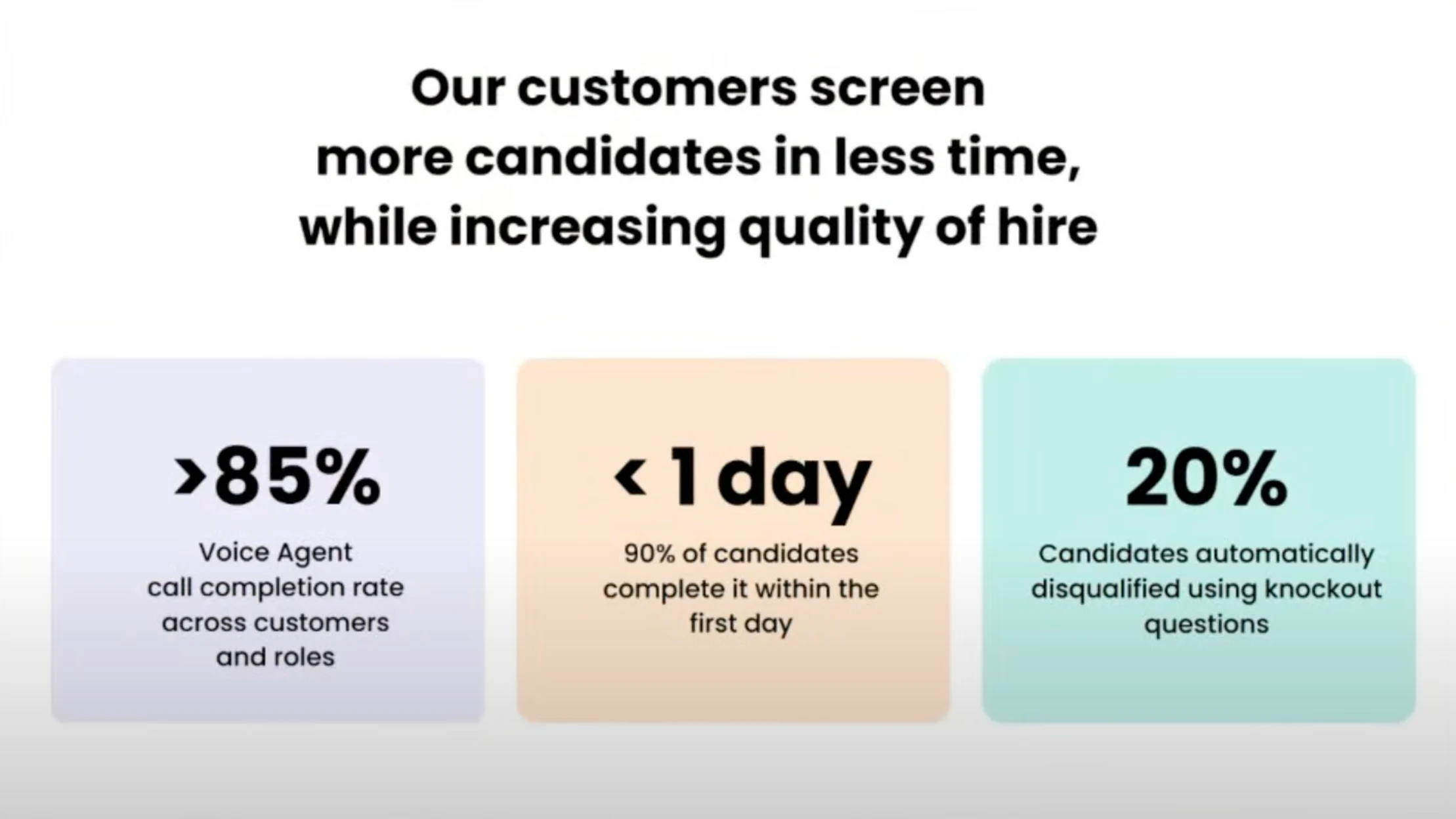
A home health company, which hires more than 17,000 aides across 50 branches, was challenged to rapidly fill roles in new markets while maintaining candidate quality. By piloting the Voice Screening Agent, the organization achieved:
A 1.3-day reduction in time-to-hire
Higher candidate acceptance rates when interviews were conducted by the X+ Agent
Greater post-hire commitment, with AI-screened candidates working more hours per week on average than those screened by recruiters
Improved candidate readiness, as AI-screened applicants were more likely to start their first job sooner
“The largest surprise was the post-hire outcomes. AI-interviewed candidates took a first job faster and worked on average three more hours a week than those interviewed by a human recruiter. We realized these candidates were more serious, and we also shaved about 1.3 days off hire time,” stated their VP of Talent Acquisition.
Together, these agents demonstrate how applied AI understands intent in search, guides applicants like a recruiter would, and screens at scale with conversational precision.
Meet the Persona Agents Augmenting Talent Acquisition
Persona Agents represent a categorical shift in how AI integrates into enterprise workflows. Unlike generic AI assistants that attempt to serve every function with surface-level capabilities, Persona Agents are purpose-built as role-native operators — autonomous systems designed to execute complete workflows using the specific policies, data architectures, and tools that define how work actually gets done within an organization.
The market validation is already compelling. Across industries, specialized agents are delivering transformative productivity gains that generic tools cannot match:
OpenEvidence's Physician Assistant for healthcare cuts diagnosis time by 50%
Harvey AI's Legal Assistant saves lawyers 2-10 hours weekly, processing approximately 1,000 contracts in hours
Artisan's Ava autonomously sources and qualifies sales leads, doubling top-of-funnel coverage through intelligent segmentation
The pattern is clear: when X+ agents are built with deep domain expertise, trained on role-specific data, and integrated into actual workflows, they don't just assist — they operate.
Phenom takes this same industry-dedicated approach to talent acquisition and talent management, creating specialized persona agents for recruiters, hiring managers, HR business partners, and employees. Guru Yerramilli, Principal Product Manager at Phenom, explained that these agents take an "autonomy with human-in-the-loop" approach, handling routine workflows while escalating nuanced decisions to human experts.
The Smart Start to Hiring Success: Intake Agent
Traditional intake meetings represent one of talent acquisition's most persistent inefficiencies: 60-90 minutes of recruiter and hiring manager time that routinely produces inconsistent question coverage, misaligned expectations, and context that evaporates between hiring cycles. Generic AI tools fail to address this challenge — they lack enterprise data integration, cannot maintain context across multi-turn conversations, and cannot orchestrate the complex downstream workflows that transform a conversation into an active requisition.
Phenom Intake Agent represents a fundamentally different approach.
Kolluru Venkata Deepak Kumar, Product Development Engineer III at Phenom, demonstrated how the system's architecture is built on four sophisticated, interconnected elements:
Dynamic question generation that leverages historical hiring insights, salary benchmarking data, and role-specific intelligence to guide conversations toward completeness — not just capturing what hiring managers say they need, but surfacing what the data reveals they'll actually need for successful hires
Interactive dialogue management that conducts natural, adaptive conversations while simultaneously invoking real-time API calls, querying enterprise ontologies, and adjusting its approach based on contextual signals, creating an experience that feels conversational while operating with systematic precision
Multi-agent orchestration that coordinates specialized sub-agents for market intelligence, enterprise knowledge retrieval, and workflow execution — each optimized for specific tasks but working in concert under centralized governance
Post-processing automation that doesn't just transcribe conversations, but transforms them into production-ready job descriptions, structured interview guides, and data-driven hiring strategies aligned with organizational standards
The Four-Phase Agentic Loop
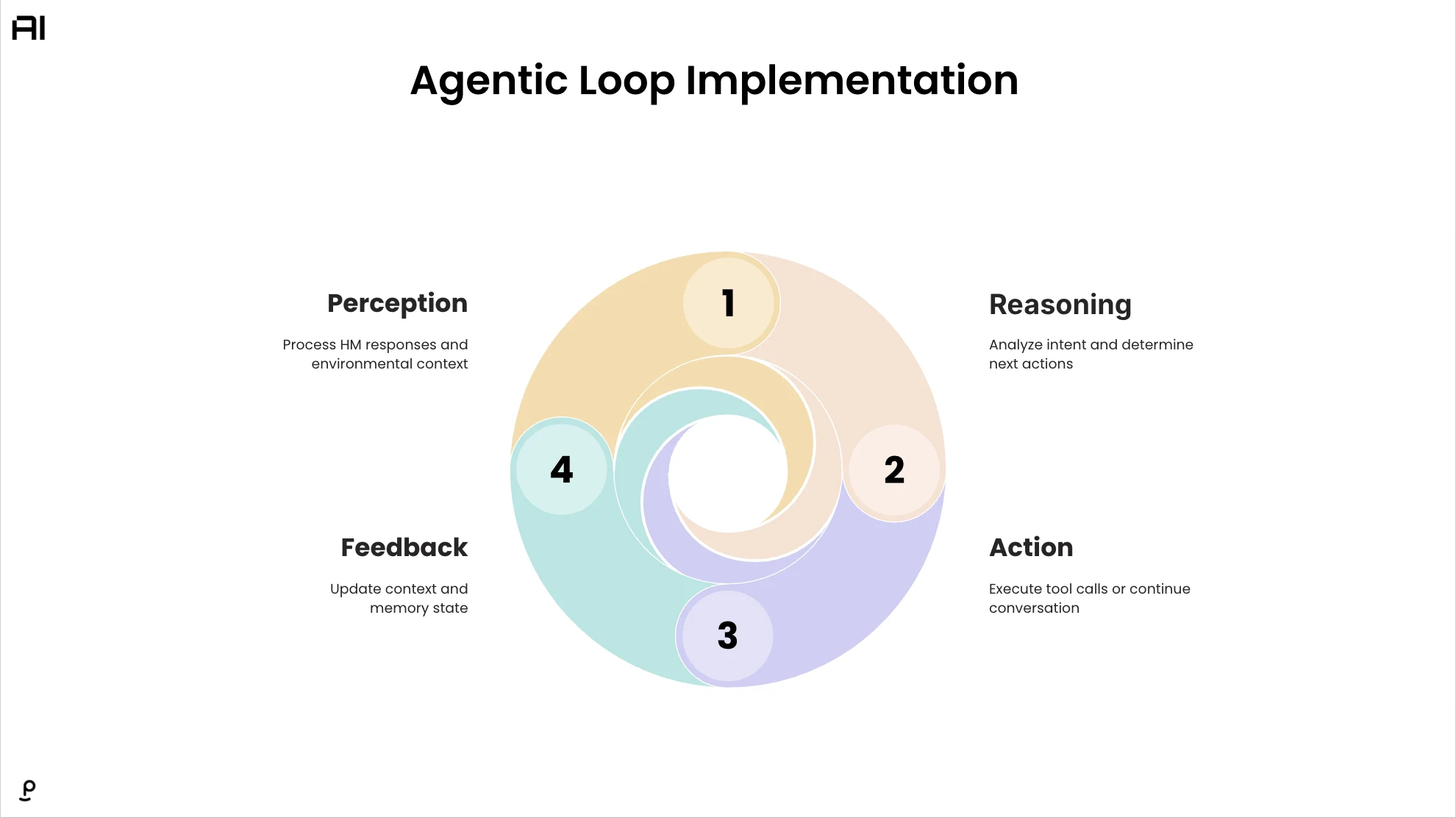
At the system's core operates a continuous four-phase cycle that makes the agent genuinely adaptive rather than following predetermined scripts:
Perception: The agent processes input through semantic parsing and ontology-linked entity extraction, understanding not just words but their enterprise-specific meanings and relationships.
Reasoning: Using chain-of-thought planning, the system determines optimal next actions, weighing multiple pathways and anticipating downstream implications before committing to a response.
Action: The agent executes structured tool calls, engaging specialized sub-agents, retrieving data, and orchestrating workflows based on its reasoning.
Incorporating Feedback: After each action, the system updates its memory state, learning from the interaction to inform subsequent cycles and maintaining context across the entire conversation.
This approach enables the agent to handle complexity that would historically overwhelm rule-based systems, adapting to ambiguity, recovering from miscommunication, and refining its understanding in real-time.
Specialized Intelligence Working in Concert
The Intake Agent's true sophistication emerges in how it delegates work to specialized sub-agents, each bringing domain expertise to specific subtasks:
The Ontology Agent leverages Phenom's universal knowledge graph to standardize skills and requirements, grounding conversational language — like "bedside manner" or "customer-facing experience" — to canonical definitions that ensure consistency across the organization and enable accurate matching downstream.
The Enterprise Search Agent retrieves relevant historical data — similar roles, previous hiring patterns, successful candidate profiles, and compensation benchmarks — from internal sources, bringing institutional memory into every new requisition.
The Sourcing Agent manages final workflow stages, translating the enriched intake data into candidate criteria, configuring search parameters, and executing seamless handoffs to the ATS with all context preserved.
From Intake Conversation to Requisition in Minutes
The system now produces three production-ready deliverables in minutes — work that once demanded hours of manual effort.
First, it generates enhanced job descriptions using ontology reasoning to translate conversational terms into standardized roles and skills, ensuring clarity, consistency, and searchability while preserving the hiring manager’s intent.
Next, it creates matching criteria that automatically configure Phenom Fit Score with importance-tagged skills, normalized requirements, and weighted priorities, turning subjective preferences into objective, measurable assessments.
Finally, it delivers optimized search parameters for both Boolean and vector-based queries, expanding candidate recall with related titles and adjacent skills, helping recruiters surface qualified talent they might not have known to look for.
Results are compelling:
Minimal manual editing required: Outputs need only 10-15% manual edits
High routing accuracy: The orchestrator routes queries to correct sub-agents with 93% accuracy
Significant time savings: Recruiters save 2-3 hours per role through automated intake, requirement capture, and document generation
This isn't incremental improvement. It's a fundamental reimagining of how organizations translate hiring needs into action — faster, more consistent, and more intelligent than manual processes could ever achieve.
Supercharging Recruiter Productivity with Advanced AI Infrastructures
As hiring grows more complex, recruiters need AI that doesn’t just automate tasks but makes decisions clearer, faster, and fairer. Phenom’s latest advancements to Fit Score and X+ Agents do exactly that — from matching candidates with greater accuracy, to learning from recruiter feedback, to answering complex hiring questions in seconds.
Together, these innovations give talent teams the confidence to act quickly, while improving transparency and delivering better candidate and employee experiences. The following insights highlight how Phenom is transforming recruiter productivity and helping in better decision-making:
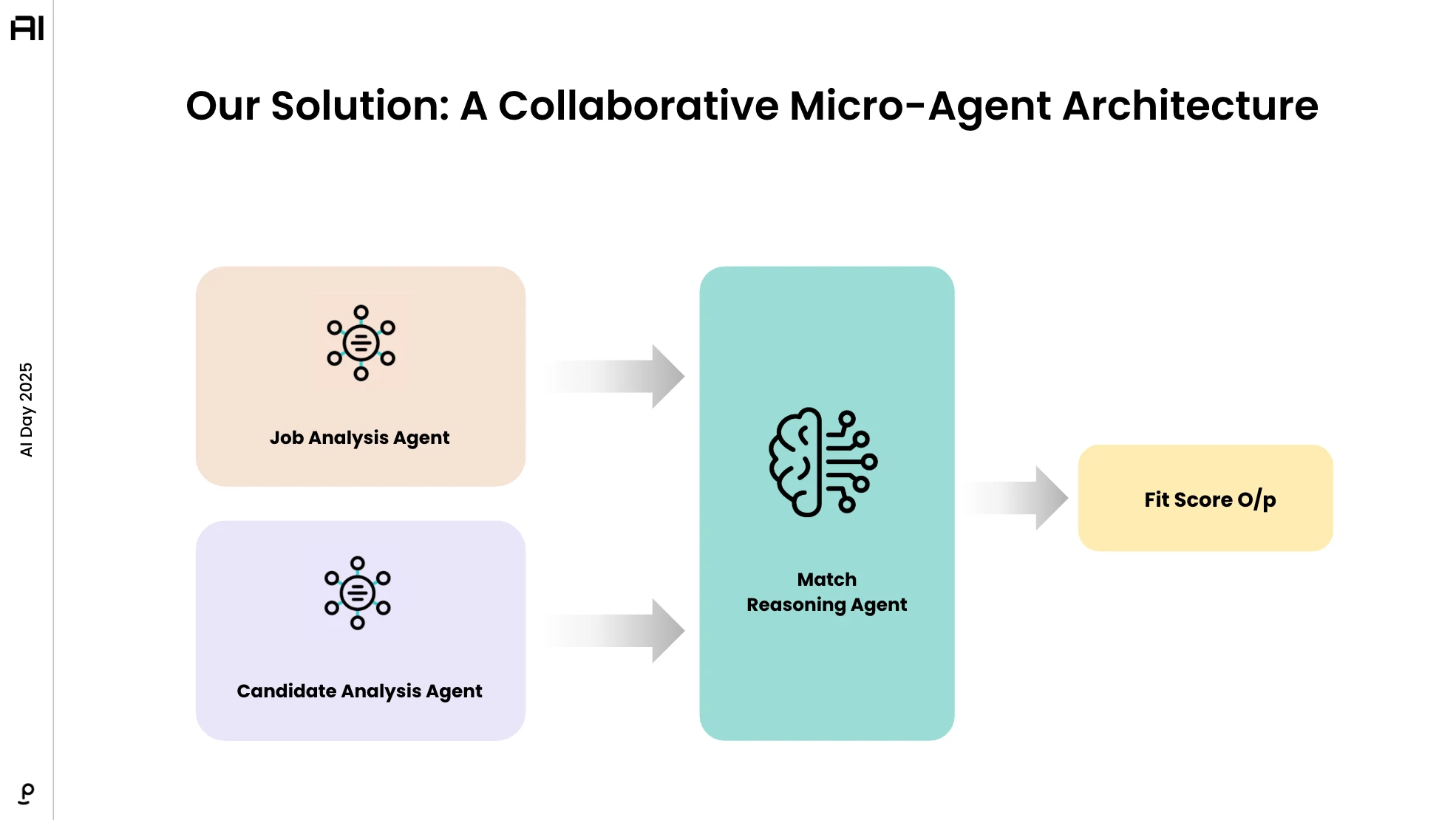
Making Match Scores Transparent: Recruiters often face incomplete job descriptions or resumes that don’t reveal the full picture. “Recruiters want more than a number — they want to understand why a candidate is a fit,” said Vaibhav Bhalla, Director of Engineering at Phenom. That’s why Phenom Fit Score now uses a multi-agent system that analyzes jobs and candidates in depth. It surfaces “ghost requirements,” such as distributed systems experience revealed in past interviews, and builds verified candidate profiles by cross-checking resumes, interviews, and even external data sources like nursing licenses. “It creates a transparent, explainable process recruiters can trust,” Bhalla added.
Learning From Real Decisions: Fit Score is also becoming more adaptive with reinforcement learning. “We built a reasoning model that learns from recruiter feedback and historical data,” said Shankar Moturi, Product Development Engineer III at Phenom. For example, the system can detect if all successful past hires for a dentist role had state medical licenses and recommend it as a must-have requirement. In defense hiring, it can infer security clearances from intake transcripts and flag them upfront. Trained with verifiable rewards, the model improves consistency while reducing errors or hallucinations. “This helps recruiters align criteria with reality and make fairer, more consistent decisions,” Moturi noted.
Turning Questions Into Instant Answers: Recruiters spend countless hours piecing together data from multiple systems. With the Ask Anything X+Agent for recruiters, that changes. “Instead of 45 minutes of filters and spreadsheets, recruiters can now type a single question and get the answer in seconds,” said Balaram Bhukya, Product Engineering Manager at Phenom. By coordinating specialized agents behind the scenes, Ask Anything delivers instant summaries from candidate histories to hiring analytics, cutting manual clicks by more than 90%. “Recruiters don’t have to be data clerks anymore. They can spend less time hunting for answers and more time closing great hires,” Bhukya emphasized.
If smarter matching and instant insights help recruiters hire faster, the next question is clear: how do you set new employees up for success right from day one? That’s where the Onboarding & Automation Engine comes in.
Streamlining Onboarding with AI and Automation
Hiring the right talent is only half the battle — bringing them on board efficiently and keeping HR workflows running smoothly is just as important. Yet, HR teams often lose time due to manual checks, scattered data, and rigid systems that can’t adapt to real-world new hire onboarding challenges. The following breakthroughs highlight how AI is raising the bar for HR productivity and decision-making.
Orchestration Engine: From Steps to Outcomes
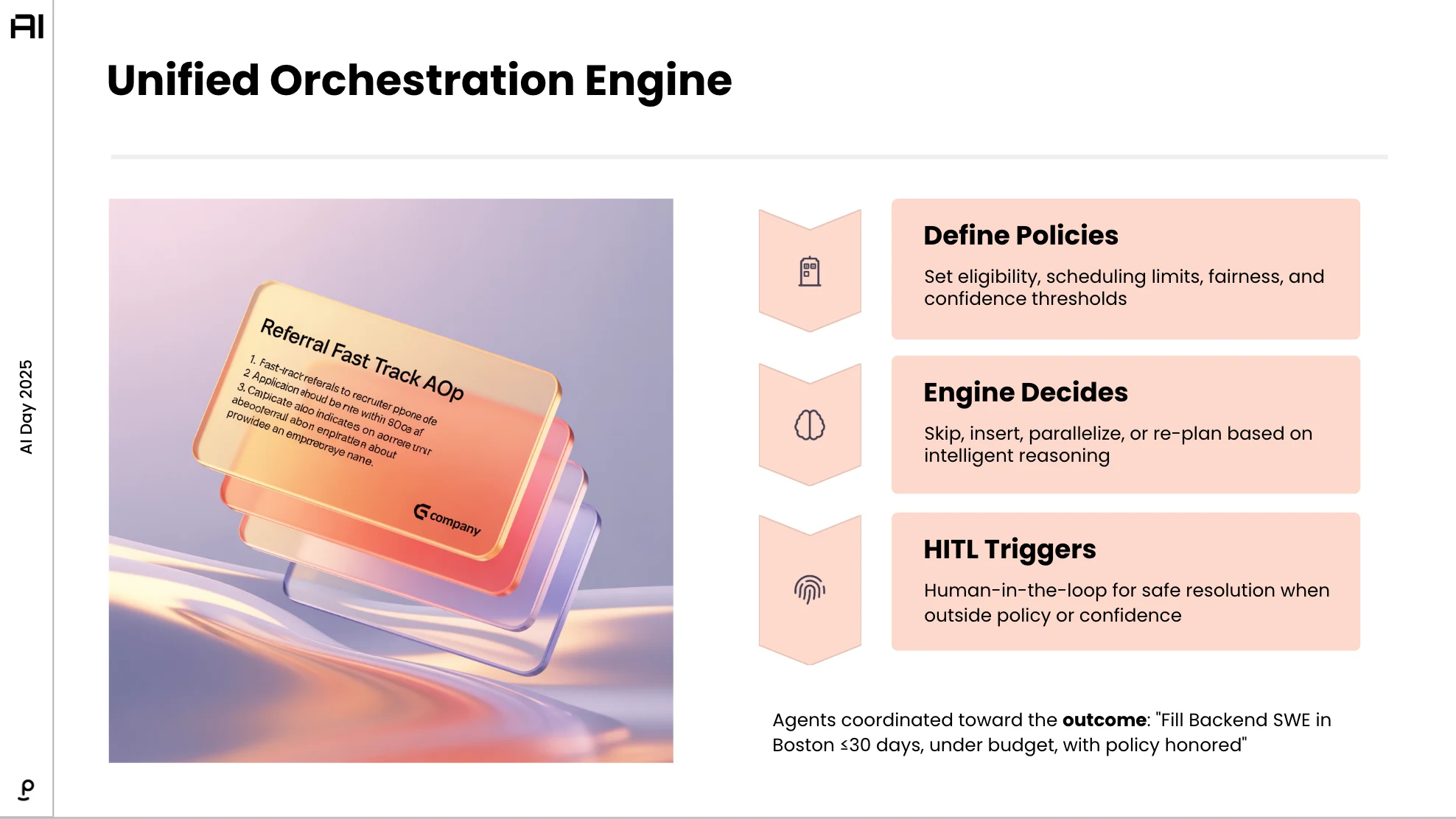
Traditional automation tools follow a linear path: they complete one step, then the next. But talent processes aren’t always that simple. “The real value is in how agents work together. Traditional automation engines finish steps, but they don’t pursue goals. Orchestration doesn’t just execute, it reasons toward an outcome,” said Venkat Kolli, Executive Director of Engineering at Phenom.
Phenom’s Unified Orchestration Engine changes the game for Phenom Onboarding. It coordinates multiple X+ Agents dynamically, adjusting as conditions change, whether that’s fast-tracking a task, applying compliance rules, or balancing workloads. Every decision is logged for transparency, so teams know what the system decided and why.
The result? Safer, more flexible workflows that keep talent processes like onboarding on track.
Document Management: Simplifying Onboarding
For many candidates, the hardest part of onboarding isn’t the interviews — it’s the paperwork. For example, uploading 15 documents, waiting days for approvals, and going back and forth over small errors can quickly sour the experience. Recruiters, meanwhile, spend hours manually reviewing and verifying forms instead of focusing on people. “With our AI-powered parsing, the onboarding experience is seamless. The agent instantly checks documents, flags anomalies, and even pre-fills forms so recruiters can focus only on exceptions,” explained Suresh Babu Devineni, VP of Engineering at Phenom.
The Phenom Document Parsing Agent automates verification across more than 100 document types. The system instantly validates documents upon upload — checking identity, document type, and expiration dates that previously required manual recruiter review. When issues arise, candidates receive immediate notifications explaining exactly what's wrong rather than waiting days for feedback while recruiters are notified of missing information or inconsistencies that need to be addressed.
The technical architecture combines multiple approaches for optimal accuracy. A hybrid parsing system blends OCR's reliability with Vision Language Models' semantic reasoning and specialized modules for tables and handwriting, achieving 90-98% accuracy while maintaining compliance traceability. Additionally, content-aware routing adapts based on document type:
Clean text PDFs flow through fast LLM parsing
Documents with embedded images route through OCR and table extraction before VLM reasoning
Scanned documents undergo preprocessing, OCR tokenization, and evidence-grounded validation
Instead of treating every form the same, the system adapts, processing simple scans quickly while applying deeper checks to complex or handwritten forms. This also scales to high-volume environments. By training smaller, faster models that mimic the accuracy of large ones, Phenom cut processing time from 30 seconds to just 2-3 seconds per document, while lowering costs.
“We needed the accuracy of large models, but the speed and efficiency of small ones,” said Arun Kumar Patala, Product Principal Engineer at Phenom. For recruiters and candidates, this means faster hiring cycles, fewer mistakes, and less frustration.
HR Enterprise Search: Answers That Fit the Context
Even after a candidate is onboarded, employees and HR leaders face a different challenge: finding information buried in countless systems. Policies, performance reviews, learning data, and job histories are often siloed across platforms, forcing people to waste hours searching.
“An enterprise with a thousand knowledge workers spends about $2.5M a year simply because employees cannot efficiently find information,” said Shrikhar Kayitham, Senior Director of Engineering at Phenom.
Phenom HR Enterprise Search is built to solve this. Instead of a one-size-fits-all search, it tailors answers to the individual asking:
A candidate asking about work-from-home policies sees a general overview
An employee sees rules specific to their role and office location
A manager preparing for a review instantly gets a summary of an employee’s goals, feedback, and contributions from multiple systems
“This isn’t just about finding information. It’s about understanding who is asking, why, and delivering the right answer instantly,” Kayitham added. The benefit: recruiters, managers, and employees spend less time looking for data and more time acting on it.
Driving Measurable Impact from All Sides
The results transform onboarding across all stakeholders. Recruiters realize 70-80% fewer manual data entry steps, with processing time dropping from 10 minutes to 2 minutes per document. Candidates experience faster cycles with fewer errors and transparent feedback. Enterprises gain 95% accuracy ensuring HR compliance, cost savings from reduced manual verification, fraud detection catching ID mismatches, and the ability to scale to thousands of hires without bottlenecks.
Phenom currently supports over 100 document types, processes more than a million documents daily, and continuously learns from every execution — automatically retraining models and tightening guardrails over time. This proves that enterprise-scale onboarding automation delivers both accuracy and efficiency, transforming friction-filled bottlenecks into a seamless, trust-building experience that accelerates time-to-productivity for new hires.
Context-Aware AI Powering Intelligent Talent Management & Development
Phenom Applied AI is redefining talent management by connecting roles, tasks, and skills through contextual data. Instead of rigid frameworks and fragmented systems, the platform adapts dynamically to employee aspirations and business priorities, enabling personalized learning, performance tracking, and predictive workforce planning.
Living Skills Ontology & Knowledge Graph
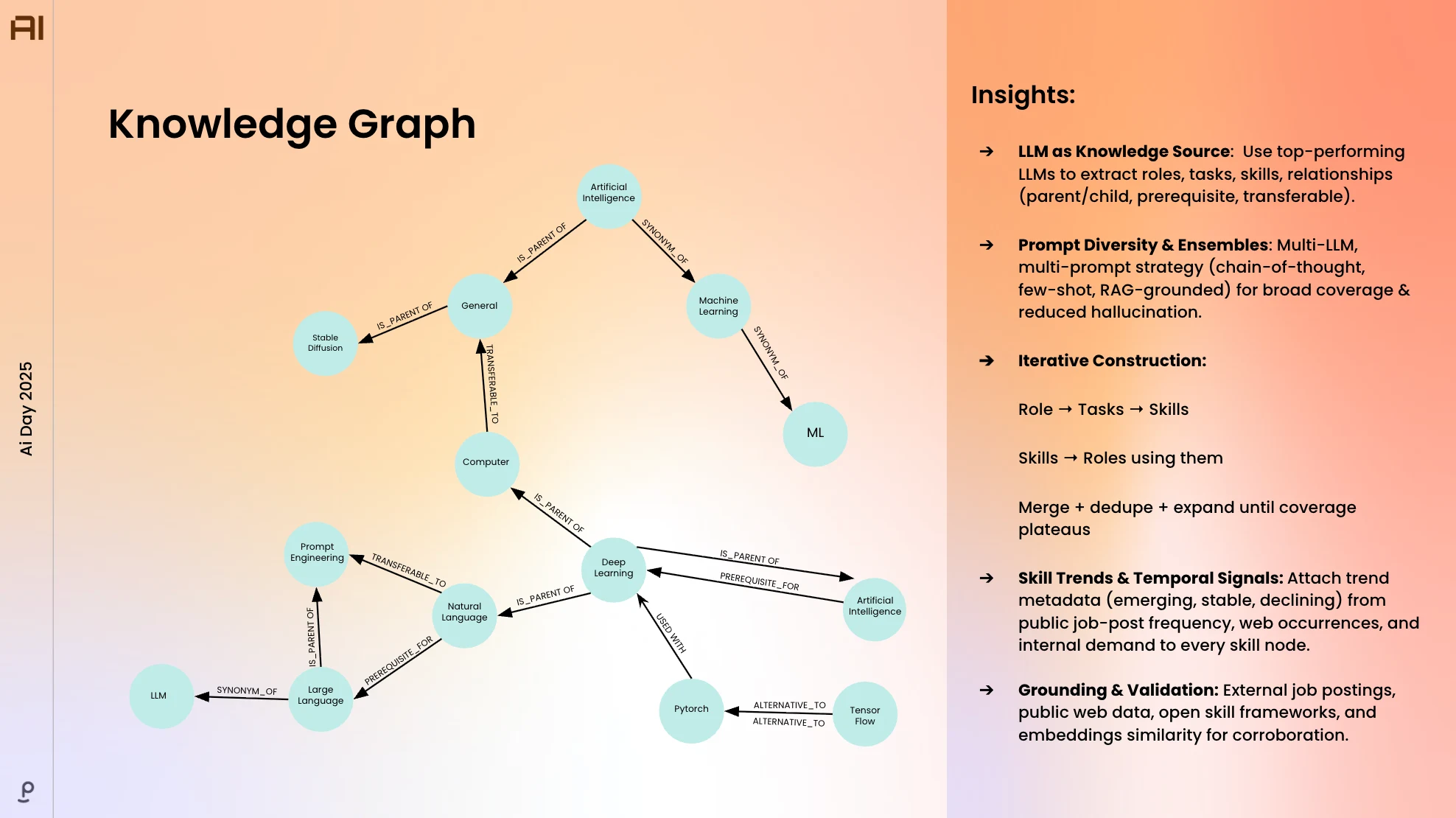
Traditional job frameworks often collapse under noisy data and inconsistent titles. Phenom solves this with normalization pipelines, multi-LLM enrichment, and continuous updates from public signals. By linking roles, tasks, and skills in a continuous loop, the ontology reflects both organizational needs and market demand.
Companies can also “Bring Your Own Frameworks,” layering their proprietary terminology without losing alignment. The outcome is a living foundation for accurate recommendations, succession planning, and workforce strategy.
An Easier Way to View Skills
One of the toughest challenges in workforce planning is turning scattered skills data into decisions leaders can act on. During the Phenom Employee Relationship Management demo, Mark Feneis, Senior Director & Manager, Solutions Consulting at Phenom, showed how live signals now appear in dashboards at the organizational, team, and individual level. These insights integrate not only employee profiles, but also assessment data, giving managers a validated view of readiness and development needs.
What makes this powerful is the feedback loop into Phenom's living ontology. As skills are captured and updated through employee input and assessments, the ontology becomes more accurate, sharpening future recommendations and predictions.
For leaders, this means they can anticipate shortages, shape succession plans, and decide when to hire versus reskill with confidence. In practice, the dashboards turn skills intelligence into business impact by shifting planning from static reporting to real-time workforce intelligence.
Career Development Powered by X+ Agents
Employees often face a wall of options — courses, mentors, projects — and stall without clear direction. Phenom Employee Experience and Career Pathing remove this hurdle by giving employees clear visibility into role paths, tailored training, and mentor matches. At the same time, managers gain team-level visibility into strengths and gaps, helping them guide more meaningful development conversations without adding extra administrative burden.
Building on this, the Career Coach Agent tackles the activation challenge directly. It doesn’t just suggest options — it orchestrates a dynamic plan. Using a Start, Stick, Scale model, the agent:
Collapses noise into the single best next step
Keeps employees on track with timely nudges and micro-learning
Scales progress into tangible outcomes like gigs, certifications, and mentorships
Powered by multi-agent reasoning and layered memory (short-term context, episodic history, organizational knowledge), it adapts in real time when priorities shift or schedules slip. In practice, this means career growth isn’t a one-shot recommendation — it becomes a guided, personalized habit that compounds weekly wins into long-term advancement.
Together, these tools form a continuous flow to surface opportunities and help sustain career growth momentum. For organizations, the result is a workforce that keeps moving forward with employees growing into new roles and managers equipped to have development conversations that are specific, data-driven, and future-focused.
Career Development Powered by X+ Agents
Momentum is the biggest barrier to employee growth. The Career Coach Agent addresses this by collapsing noise into one best next step, nudging employees weekly, and scaling progress into gigs, mentorships, and certifications. Powered by multi-agent reasoning and memory, it transforms development into a continuous habit.
The Employee Experience and Career Pathing modules extend this by giving employees clear visibility into role paths, training, and mentors, while providing managers with team-level skills insights. Actionable recommendations highlight vertical and lateral opportunities, making development conversations more specific and strategic.
Predictive Insights and Responsible AI
By distinguishing between skills that are emerging or declining, AI helps leaders anticipate shortages, shape succession plans, and prioritize reskilling. Conversations become data-driven, not generic. Behind the scenes, Phenom’s risk-based governance framework ensures compliance, digital ethics, and privacy, aligning with standards like the EU AI Act and building employee trust.
A leading science and technology company shared that the absence of transparent career and development opportunities was a key reason employees previously left the organization. To change this, they launched Phenom Talent Marketplace to unify the discovery of internal jobs, development opportunities, short-term growth assignments, and mentoring across 65 countries and 63,000 employees. Within the first year, they saw measurable results, including:
50,000+ employees registered
21,000 skills profiles created
1,800 mentorship pairings
By 2025, the marketplace had enabled over 330 growth assignments, opportunities that were once scattered and invisible. “When our people grow, our business grows,” noted their CEO, underscoring how cultural transformation and AI-powered technology can go hand-in-hand.
Meanwhile, this trusted health insurance company’s challenges were twofold: employees wanted more ownership of their careers, while managers struggled to make development conversations meaningful in the face of limited time. With Phenom, employees receive personalized paths tied to training, mentorship, and projects, while recruiters act as “internal sourcers,” filling roles faster from within. “We can now say every employee has the opportunity for a personalized development journey and every leader is equipped to nurture that talent,” said their VP People Strategy.
Responsible AI Governance and Compliance Frameworks
AI is transforming how organizations hire and develop talent, but trust remains a critical factor. A recent Gartner survey found that only 26% of candidates trust AI to evaluate them fairly. The challenge for companies is clear: how to innovate responsibly while keeping people at the center of every decision. The following perspectives show how responsible AI can be put into practice — from adopting people-first frameworks and validating the science behind Fit Score to aligning with evolving global regulations.
Building a People-First Framework
A global management consulting firm addressed this by launching what they call their AI Talent Promise — a framework designed to guide responsible AI across the talent journey. “With transformation comes a challenge: How do we make sure AI is used responsibly, fairly, and with humans still at the center?,” asked their global recruiting leader.
The promise is built on six commitments:
Transparent
Accountable
Learning
Ethical
Notified
Trustworthy
A seal signals that the company is committed to human-centered AI. “It’s our way of putting people at the center of AI innovation while setting a standard we hope the entire industry will adopt,” explained its senior director of talent acquisition transformation.
The impact has been tangible. Personalized career sites and conversational AI now guide candidates to roles more intuitively, while still giving them the freedom to choose. Recruiters spend less time on admin and more time connecting with people. Managers have saved thousands of hours with new feedback tools, and candidate satisfaction scores have risen significantly.
Testing Reliability and Validity
Responsible AI also means proving that tools work as intended. “Reliability and validity are the foundations of trust in assessment tools — without them, you can’t make confident hiring decisions,” said Vignesh Murugavel, Data Scientist and Industrial-Organizational Psychologist at Phenom.
To validate Phenom Fit Score, we analyzed data from over 100 customers and 1.5 million applicants in a single quarter. Results showed Fit Score consistently aligned with hiring outcomes across industries. A Hiring Progression Indicator confirmed that candidates flagged by Fit Score were more likely to advance in the process, demonstrating its predictive strength.
Fairness was equally important. Using psychometric testing, we evaluated differential validity across race, gender, and age. The findings were encouraging: “Fit Score has less bias than the average recruiter,” Murugavel noted, reinforcing the importance of combining AI with human oversight.
Download the 2025 Fit Score Report today to see how it drives fair hiring practices and shapes more equitable talent decisions.
Aligning with Global Standards
For AI to scale, governance must keep pace with regulation. “Responsible AI means that we do self-governance. We define a standard and we hold ourselves to that standard,” said Ilya Goldin, PhD, Head of Data Science at Phenom.
Phenom is preparing for EU AI Act compliance, conducting conformity assessments to meet “high-risk” system standards well before deadlines. U.S. regulations, such as California’s new AI data retention rules are also being built into the platform. “Some compliance requires independent auditors, and others can be self-attested. At Phenom, we’re pursuing both,” added Cliff Jurkiewicz, VP of Global Strategy at Phenom.
By aligning with the NIST AI Risk Management Framework and ISO 42001, Phenom structures governance across four pillars: Govern, Map, Measure, and Manage. This ensures customers gain AI systems that are transparent, fair, and compliant.
Key Trends and Lessons Across AI Day 2025
AI Accelerates Hiring & HR Outcomes: AI is accelerating HR and talent workflows — 45% of applications come from AI recommendations, voice screening cuts evaluation time by more than half, and agentic AI compresses 40-minute tasks into just 5 minutes.
Turn Data Into Intelligence With Context-Aware Tech: Phenom’s ontology-driven architecture connects people, roles, skills, and processes, turning fragmented data into actionable intelligence tailored to each organization.
Deploy Persona-Driven X+ Agents To Elevate Experiences: From guiding candidates through search and application to autonomous role-specific agents, AI removes friction, improves engagement, and automates routine workflows while escalating nuanced decisions to humans.
Boost Recruiter Impact With AI-Powered Productivity: Transparent Fit Scores, Ask Anything instant insights, and AI-powered onboarding reduce manual work, speed decision-making, and allow recruiters to focus on high-value tasks.
Unlock Growth With AI-Driven Talent Management: Living skills ontologies, career pathing, and predictive workforce insights enable personalized employee growth, succession planning, and reskilling at scale.
Build Trust Through Responsible, Compliant AI: Governance frameworks, fairness testing, and compliance with global standards (EU AI Act, NIST, ISO 42001) ensure ethical, transparent, and human-centered AI use.
Transform HR With Measurable AI Impact: Organizations see faster hires, higher-quality candidates, improved employee engagement, and more strategic HR decision-making, proving that AI is transforming HR from transactional to strategic.
Explore AI Day 2025 Innovations Further
AI Day 2025 showcased how applied, purpose-built AI is transforming HR and talent management today — not in some distant future. From intelligent job recommendations and conversational candidate guidance to autonomous persona agents and AI-driven career development, these innovations are accelerating processes, improving decision-making, and enhancing experiences for candidates, employees, and recruiters alike.
By combining context-aware architectures, specialized agents, and responsible governance, organizations can unlock measurable business impact: faster hires, higher-quality talent, reduced administrative burden, and strategic workforce planning. The message is clear — AI is no longer just a tool; it’s a collaborative partner that empowers HR teams, elevates human expertise, and reshapes the future of work.
Ready to find out how you can leverage applied AI in your business? Book a personalized demo with our team to discover how you can stay at the forefront in this era of AI.



Get the latest applied AI insights delivered to your inbox.
Sign up to stay up-to-date on the latest original content from Phenom, including new podcast episodes, events, and more.


