

What is Recruiting Automation and What Are the Benefits?
Summary
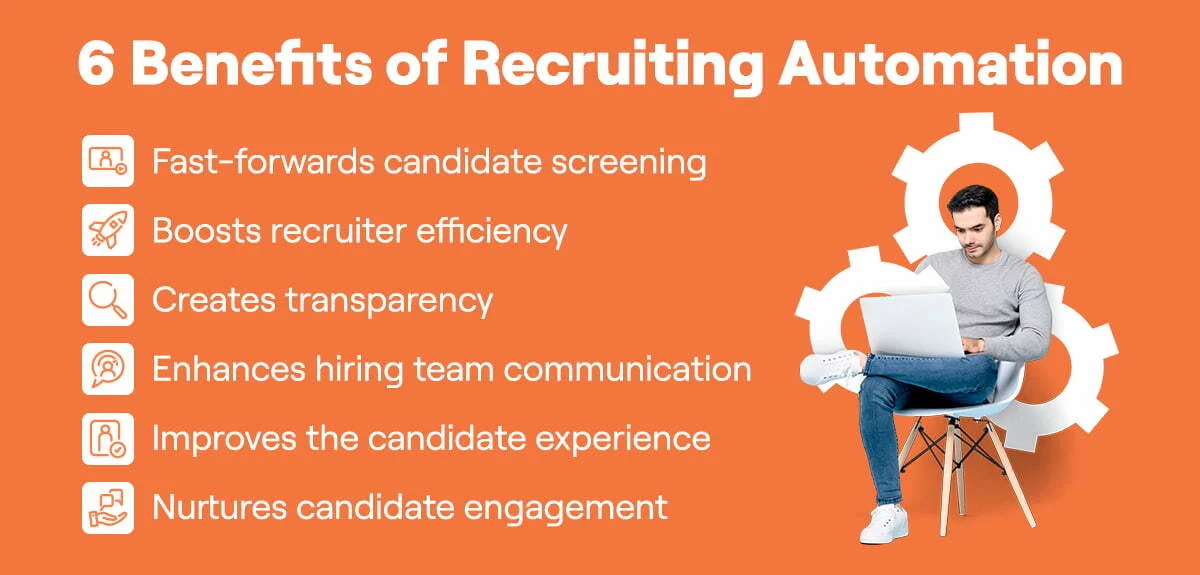
Recruiting automation autonomously performs recruiting tasks such as screening, scheduling, and candidate communication. Instead of spending 32 to 68 days on manual coordination, hiring teams can hand routine recruiting to automation and focus on the parts of the job that need human judgment. Recruiting automation delivers value across six areas of the hiring process. It speeds up screening, removes the back-and-forth of scheduling, makes evaluations more consistent and transparent, gives hiring teams a shared view of candidates, improves how candidates experience the process, and it keeps candidates engaged over time through personalized outreach. This guide explains what recruiting automation is, walks through each of these six benefits, and answers common questions about how it works.
In this Article:
What is Recruiting Automation?
According to recruiters, finding a candidate that fits a specific job role can take an average of 32 to 68 days, depending on job level. But what if that time could be cut down to mere minutes?
By automating recruitment processes, it can be.
Recruiting automation is technology that performs recruiting tasks such as screening, scheduling, and candidate communication automatically, without a recruiter completing each step manually. It gives recruiters more time for higher-value work, like building relationships with candidates, while also creating a faster and more transparent experience for job seekers.
This automation doesn't just benefit companies — it also creates a smoother, faster experience for job seekers, who can receive timely updates and feedback throughout their hiring process.
And it can do much more, like improving screening, scheduling, and more. Here are six benefits of automating recruitment processes, paired with technology you can adopt tomorrow to help you hire quality candidates faster.
Six Benefits of Recruiting Automation
Each of these recruiting automation benefits solves a specific bottleneck in the hiring process, but together they compound. A screening delay pushes back scheduling. A scheduling delay pushes back the candidate's decision to stay in your pipeline or take another offer. Automating one stage removes friction from every stage after it, which is why companies that automate recruiting broadly tend to see bigger gains in time-to-hire and candidate quality than companies that automate a single step in isolation.
The six benefits below build on each other, from the first candidate touchpoint through long-term engagement.
1. Fast-forwards Candidate Screening
With companies competing for top talent, who wouldn't want to speed up the screening process and hire quality candidates quicker? One way to do this is by implementing recruiting automation technology. A video interviewing tool is one example, as it helps to create a more consistent, structured, and automated approach to screening.
Phenom X+ Screening, for example, features flexible screening options including audio, text, and video that hiring teams can use to boost hiring efficiency and reduce time in their screening process. For example, with video screening candidates can prerecord their responses, with or without timers, ensuring they have the opportunity to craft their answers just right and showcase their personality. Each person on the hiring team then evaluates the responses and provides a score based on specific criteria allowing them to hone in on the best-fit candidates.
By automating manual hiring tasks, X+ Screening allows recruiters to screen more candidates in less time, easily collaborate with hiring managers, and better align on candidate fit and must-haves.
Automating recruitment processes like these helps speed up the hiring process because candidates and recruiters alike don’t need to find time for a first — or sometimes second — interview. Candidates submit their responses when convenient for them and hiring teams review on their own time.
Related Customer Story: 1000+ Hires, 6 Weeks: Alight's High-Volume Automation Story
2. Boosts Recruiter Efficiency
A top recruiting challenge is the back-and-forth of trying to schedule an interview between a candidate and the hiring team. Whether through email or via phone, the back-and-forth can take days, and the candidate may be spending time considering other job opportunities.
Recruiting automation helps by handing over scheduling processes to automation and AI.
With scheduling tools like Phenom Automated Interview Scheduling, recruiters can be hands-off and worry-free when it comes to syncing calendars and booking interviews. It works by integrating the calendars of recruiters, hiring managers, and candidates and analyzing individual calendar data. The automation then produces suggested meeting times based on availability and adds them to all parties' calendars. This self-service scheduling empowers candidates to set times based on their availability, reducing delays and increasing candidate satisfaction.
Automated Interview Scheduling can help candidates reschedule interviews when conflicts come up by using AI and automation to resolve scheduling needs 24/7 without requiring recruiter intervention.
Automated Interview Scheduling removes the coordination loop entirely, so the time between "let's talk" and a confirmed slot is a candidate picking one, not a recruiter chasing three calendars.
Related reading: What is an Automated Interview Scheduling Tool and What are the Benefits?
3. Creates Transparency
By using AI-assisted interview technology, companies can revolutionize recruitment by consistently and objectively assessing candidates to easily identify top talent while significantly reducing bias. This innovative approach creates standardized evaluations that level the playing field for all applicants — ensuring every candidate is assessed using identical criteria — leading to more transparent hiring decisions.
Phenom Structured Interviews, for example, allow companies to:
Equip their hiring teams with structured guides to evaluate candidates based on key skills and behaviors.
Leverage a vast interview question library, enhanced with generative AI to create personalized and impactful interviews.
Use interview scorecards to standardize evaluations, ensuring fair and objective assessments of candidates' skills and fit.
Receive interview guidance with streamlined access to process tracking, candidate profiles, and documents.
Capture and review interview notes with ease, enabling seamless collaboration and shared insights among hiring teams.
Enable hiring team collaboration by sharing scorecards and evaluations for streamlined decision-making.
Enhance hiring team collaboration by sharing scorecards and evaluations for streamlined decision-making.
By creating a more open, consistent, and intelligent recruitment workflow, AI-assisted interview technology not only streamlines hiring but also creates transparency between employers and potential employees. The result is a more equitable, efficient, and strategic approach to identifying and securing top talent.
Related resource: Interview Intelligence Guide
4. Enhances Hiring Team Communication
Using recruiting automation here can quicken the hiring process. Companies that use a Candidate Relationship Management (CRM) tool with fit score technology and analytics can leave much of the heavy lifting to AI and automation. Phenom Talent CRM is one example.
A CRM can rank candidates based on their experience, skills, and location to determine who's the best fit for the job. It presents top candidates to the team, who can move them forward in the hiring process.
If a hiring team chooses not to move forward with a specific candidate, the CRM can move that candidate into a talent pool and automatically recommend them later if their skills and experience match another job.
With recruiting automation like this, hiring teams aren't spending hours pouring through resumes or reviewing interview notes. Technology collects that information automatically and presents it all in one place, making collaboration a breeze.
Phenom Hire gives hiring managers direct access to the candidates in their open reqs, so feedback and next-step approvals don't wait on a recruiter to relay them.
5. Improves the Candidate Experience
Every company wants a candidate experience that inspires talent to join their team.
One of the best ways to use recruiting automation to boost the candidate experience is through a conversational chatbot. But not all chatbots are created equal, so it's important to choose one that works best for your team.
Phenom Talent Companion connects candidates with relevant jobs by asking about skills, location, and experience, and then surfaces the roles that fit. It can also serve up customized content and proactively answer FAQs so candidates aren't spending time trying to reach customer support or find answers to their questions online. Finally, it can remember individual job seekers and greet them by name the next time they visit your career site, making for a very personalized and streamlined experience on the candidate's end.
By automating these recruitment tasks and workflows, candidates find what they're looking for quicker, while recruiters have insights into best-fit candidates without the need for time-consuming manual processes like sourcing or screening.
The frictionless, streamlined application process eliminates bottlenecks, allowing candidates to apply and advance with minimal effort.
Related read: How Personalized AI-led Processes Helped a Major U.S. Healthcare Company Meet Chronic Staffing Demands
6. Nurtures Candidate Engagement
Email and text campaigns have become invaluable recruiting automation tools for teams seeking to enhance candidate engagement. By leveraging email campaigns, recruiters can establish consistent communication with potential candidates, ensuring a steady flow of relevant information tailored to individual preferences and career interests. And with 1:1 or one-to-many SMS campaigns, you can meet candidates where they are — immediately.
These kinds of campaigns not only foster a more personalized connection but also allow recruiters to strategically nurture relationships over time. Drip campaigns enable the delivery of timely updates about job opportunities, company culture, events, FAQs, and industry insights — keeping candidates informed and engaged throughout their journey.
By personalizing campaigns, recruiters are empowered to boost candidate engagement, increasing the likelihood of successful placements and fostering long-term relationships within the talent pool.
Phenom Talent CRM gives teams real-time visibility into pipeline health and campaign performance. More importantly, it tells recruiters where candidates stall, including application completion, stage conversion, and interview attendance. This data transparency enables better hiring outcomes and allows for continuous optimization of the hiring process.
Related reading: The Definitive Guide to AI Recruiting
The Long-Term Payoff of Recruiting Automation
Recruiting automation touches every stage of hiring, not just one. Faster screening feeds directly into faster scheduling. Consistent, transparent evaluations give hiring teams the shared context they need to decide quickly. And once a candidate accepts an offer, the same automation that got them there continues working, keeping the broader talent pool engaged for the next opening.
That's the real value of automating recruitment. It's not a single tool solving a single problem. It's a connected system that removes friction at every handoff between recruiter, hiring manager, and candidate, which is why teams that automate across the process see bigger reductions in time-to-hire than teams that automate one step alone.
As hiring volume grows and candidate expectations for speed and communication keep rising, this kind of end-to-end automation becomes less of an advantage and more of a baseline requirement. Companies that build it into their hiring process now put themselves in a stronger position to compete for talent going forward.
See how these benefits play out in practice.
Explore our sessions on recruiter efficiency for real customer stories, and product tours where industry leaders share how they've put recruiting automation to work.
Frequently Asked Questions
Recruiting automation is technology that performs recruiting tasks on its own n, from screening resumes to booking interviews to keeping candidates updated, so hiring teams spend less time on manual coordination. Common examples include automated screening tools, interview scheduling software, chatbots, and email or SMS campaigns.
Teams that automate recruiting typically see faster candidate screening, expedited scheduling, consistent hiring decisions, easier collaboration across the hiring team, a more engaging candidate journey, and stronger candidate relationships n. Companies that automate multiple stages of hiring, rather than just one, see the largest gains in time-to-hire.
It takes over the repetitive parts of hiring, like reviewing applications, coordinating calendars, and sending updates, so recruiters can put their time toward evaluating fit and connecting with candidates instead. For example, automated scheduling tools can cut interview coordination from several days down to minutes.
Automated systems let a hiring team handle more applicants without adding headcount, while keeping every candidate's experience consistent and on schedule, something that gets harder to do manually as volume grows. This matters most for companies with high-volume or seasonal hiring needs, where recruiter time is the biggest bottleneck.
Automated sourcing scans existing talent pools and matches candidates to open roles based on skills, experience, and location, which means qualified past applicants don't get overlooked. It also reduces the manual work of searching multiple channels for every new requisition.
Within talent acquisition, automation cuts down time-to-hire, lightens the administrative load on recruiters, and gives candidates a more responsive experience no matter which role they're applying to. It also gives talent acquisition leaders more consistent data on where candidates drop out of the pipeline.

Devi is a content marketing writer passionate about crafting content that informs and engages. Outside of work, you'll find her watching films or listening to NFAK.


Get the latest applied AI insights delivered to your inbox.
Sign up to stay up-to-date on the latest original content from Phenom, including new podcast episodes, events, and more.


