

Inside a Global Consulting Firm's Candidate Concierge Agent Pilot for High-Volume Administrative Hiring
At a global consulting firm where culture is both the product and the competitive advantage, consistency matters. So when that company hires executive assistants (EAs) and administrative assistants (AAs) across 50+ countries, the answer to a candidate's simplest question — "What does this role actually look like here?" — can't depend on who they happened to ask.
That was the problem the firm’s Senior Manager of Global Talent Branding set out to solve.
At IAMPHENOM 2026, she walked through her team’s personalized pilot of Phenom Candidate Concierge Agent for a better, more consistent administrative hiring experience, including what they built, what broke, and what they'd do differently.
Explore the highlights below!
What Challenges Impact High-Volume Administrative Hiring?
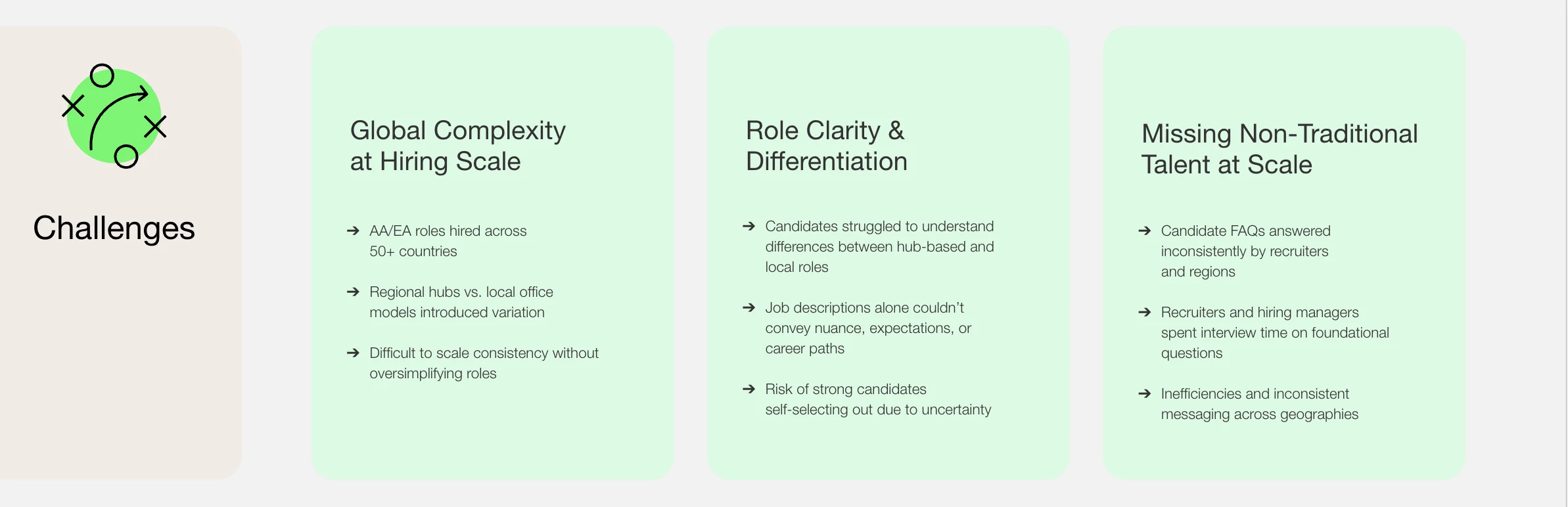
The firm hires administrative and executive assistants across three operating model structures: regional hubs, local office support, and a hub-and-spoke model that blends both. Each structure has its own expectations around scope, seniority, and day-to-day work. Given their robust global presence, the 'What is this job exactly?' question doesn't have one right answer. It has dozens.
Job descriptions alone weren't capturing that nuance, and recruiter and hiring manager responses varied depending on who the candidate interacted with. Candidates who needed more information before applying were dropping off, and those who made it to interviews often spent the first portion of the conversation getting educated on the role rather than being assessed for it. As a result, good candidates were lost before the process started, and recruiter and hiring manager time was being spent on context-setting instead of connection-building.
The goal was to give candidates a consistent, reliable source of truth about the role before they ever talk to a human. "The question isn't can we do it. It's can we scale it globally, consistently, and in a way that still feels human and not generic," the leader said.
How Do You Design an AI Candidate Concierge for Complex Global Hiring?
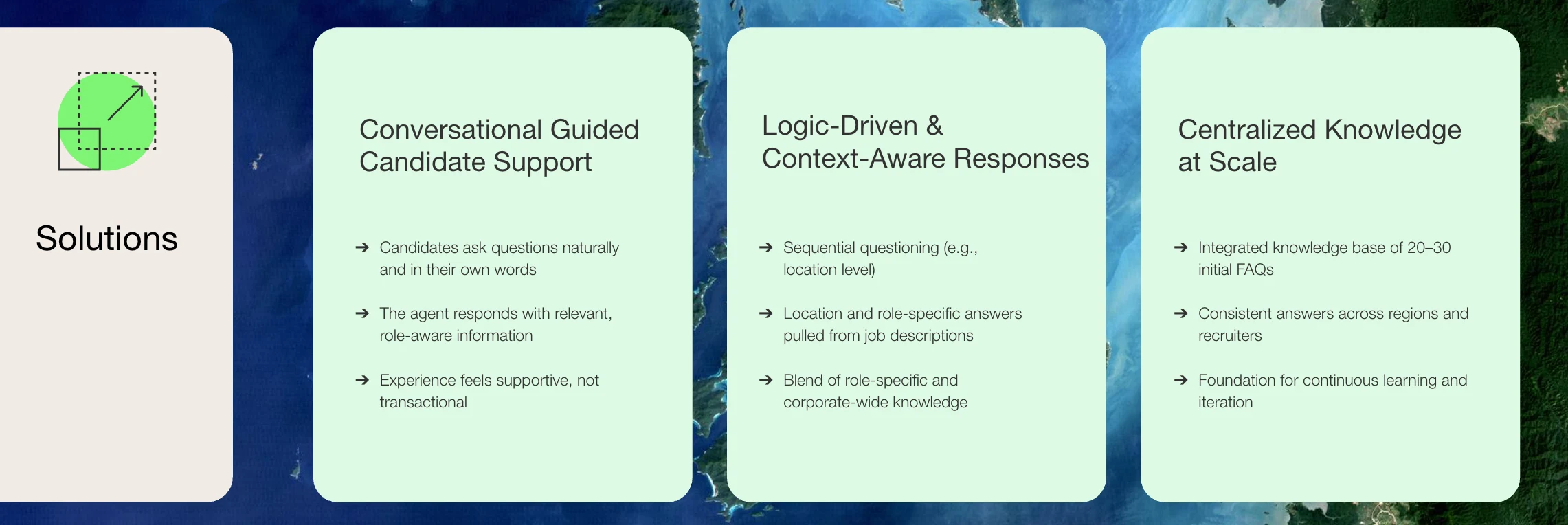
That clarity had to come from somewhere, and a traditional chatbot wasn't going to deliver it. The team partnered with Phenom to pilot its Candidate Concierge Agent — an AI experience built to turn every career site visit into a guided journey toward the right role, matching candidate intent to opportunity and pulling from a unified knowledge base so answers stay consistent no matter how the question is asked.
The design was agentic from the start. The team wasn't looking for a scripted FAQ bot that pattern-matches keywords. They wanted a conversational experience that felt supportive rather than transactional, and that could guide candidates through role complexity without making the complexity visible.
Three design choices defined the build:
Natural language input. Candidates ask questions in their own words, not by clicking through pre-written prompts.
Context-aware logic. The agent asks for location first, so every follow-up answer is specific to that office and operating model rather than generic.
A centralized knowledge base. The team started with 20 to 30 FAQs as the foundation. They were structured enough to deliver consistent answers and flexible enough to grow with iteration.
What Are the Biggest Lessons From Deploying Agentic AI at Global Scale?
The pilot launched in the weeks leading up to the session, so post-launch performance data was still accumulating. But the process of getting there surfaced lessons the leader described as more valuable than any deployment metric.
Stakeholder alignment is the work, not a checkbox. Reaching consensus on "what does good look like for this role in this region?" consumed more time than any technical configuration. The underlying message was often the same across regions, but the exact words mattered, because the agent would say exactly what the knowledge base contained. Transparency with stakeholders throughout the process was what built the trust to keep moving.
Sequential logic matters more than it looks. Building a simple candidate experience requires significant thought about how candidates move through questions and what happens when they go off-script. Edge cases multiply faster than expected at global scale, and journey mapping upfront pays for itself many times over.
Iteration is the operating model, not the recovery plan. Starting with 20 to 30 FAQs and expanding from there isn't a compromise; it's the strategy.
What Metrics Track Whether a Candidate Concierge Agent Is Working?
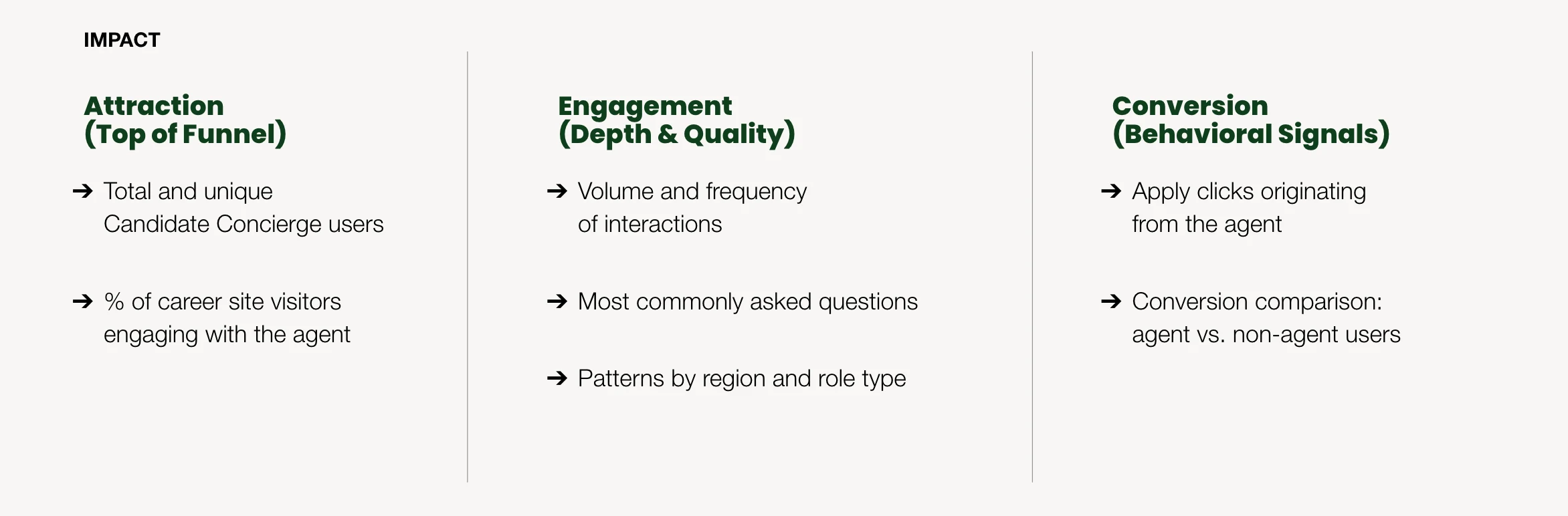
The team designed success metrics to mirror the recruitment funnel:
Attraction and adoption. Total and unique users interacting with the Candidate Concierge, plus the percentage of career site visitors who engage with the agent.
Engagement depth and quality. Interaction volume and frequency, the most common candidate questions, and patterns across regions and role types — insights that feed the next round of FAQ expansion.
Conversion impact. Apply clicks originating from the agent, plus a side-by-side comparison of conversion rates between candidates who engage with the agent and those who don't.
Quarterly reviews will keep the knowledge base growing against real candidate questions rather than assumed ones.
Related Resource: Beyond Automation: How Agentic AI Transforms the Candidate Journey
How Do You Scale Agentic AI in Administrative Hiring?
The company’s near-term agent roadmap has three moves. First, a launch-and-learn phase using live candidate questions to shape the next wave of FAQs. Second, expanded agent capabilities including job recommendations and application transfers, with a full agentic workflow as the longer-term destination. Third, scaling the model itself: using pilot insights to drive strategy for a dedicated EA/AA career site page already in build, and extending the approach to other high-volume functions across the firm.
Measurement is the through-line. The post-launch plan centers on what the pilot was built to prove. Do candidates arrive at interviews better prepared? Does the recruiter and hiring manager experience improve? And does answer consistency actually hold across regions and operating models? The knowledge base is designed to grow with every gap the pilot surfaces.
What Should HR Teams Know Before Deploying an AI Agent?
The broader takeaway for teams is not to underestimate the organizational work. "If anyone tells you it's plug and play, they either haven't started the journey yet, or they're not fully telling the truth," the leader said.
Technology configuration is the easier half. What determines whether an agent delivers consistent value is the quality of the knowledge and logic underneath it, and that requires cross-functional alignment, realistic timelines, and a willingness to be transparent with stakeholders about every challenge along the way.
In a business built on the consistency of how its people think and show up, the candidate experience can't be the one place that consistency breaks down. The companies getting ahead with agentic AI aren't the ones waiting for a perfect roadmap. They're the ones piloting, learning, and iterating in the open — and trusting their stakeholders enough to bring them along for the messy parts.
Phenom's Candidate Concierge Agent is built for exactly that kind of iteration. It’s a foundation teams can launch, learn from, and grow against real candidate questions over time.
Meet the Candidate Concierge Agent today! Book a demo

Branka’s a marketer with flair, a teacher turned Phenom player. She loves products that shine, making candidates’ paths fine and turns job hunts into a winner.


Get the latest talent experience insights delivered to your inbox.
Sign up to the Phenom email list for weekly updates!


