

No Pain, Big Gain: Serco Talks Strategies To Simplify IT Implementations
Enterprise HR technology implementations have earned their difficult reputation. Delayed go-lives, frustrated end users, fragmented regional rollouts that stretch for years, and features that never quite work as advertised plague organizations attempting to modernize their talent systems.
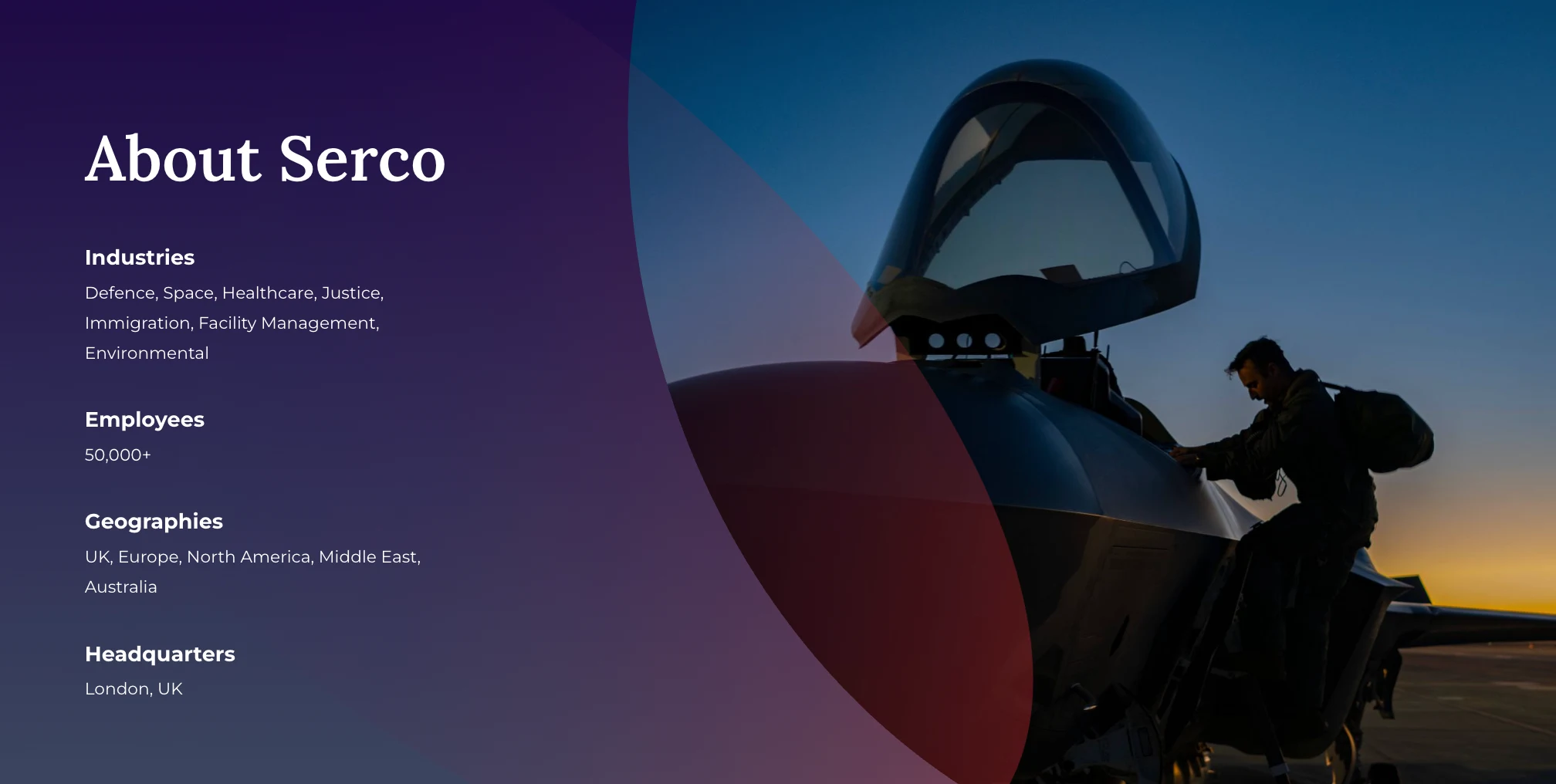
Serco took a different path. The 50,000-employee government services company completed a comprehensive global implementation of Phenom in just two phases across four continents. Their approach prioritized preparation over speed, unified global teams instead of siloed regional efforts, and built user confidence before deploying any new technology.
Steve Smith, Chief of Staff & Group Director for Talent Acquisition at Serco, shared his strategies for simplifying complex HR technology rollouts. His insights offer practical guidance for talent teams and HRIT professionals facing similar challenges: how to prepare organizations for change, manage global UAT testing effectively, navigate governance hurdles, and drive adoption across diverse user groups.
Watch the entire session here, or read on for the full recap!
What business problem led Serco to invest in enterprise HR technology?
For Serco, a government services company operating across four continents with more than 50,000 employees, attrition wasn't just a recruitment problem. It was a safety crisis.
Smith explained the connection: "Where our people work, competence is everything. They need to bring that competence into a team because competence forms part of the whole risk control system in which they operate."
Working in dangerous and exposed environments—from naval operations to critical government infrastructure—Serco's employees depend on experienced teammates for their safety. Hight turnover creates gaps in that protective competence.
In 2023, substantial leadership changes in Serco's people and culture function brought renewed focus to two critical metrics: over 600 lost-time incidents annually (injuries severe enough to keep employees away from work) and an attrition rate that had climbed to 26%. The company's leadership made an unconventional decision: stop treating attrition as separate from workplace injuries. "To stop looking at attrition as either a recruitment problem or it's a problem with retention," Smith recalled. "For us, it's a safety problem, and it's a big one."
The leadership team set audacious goals: 50% reduction in both attrition and workplace injuries within three years. Smith embedded these targets into leadership incentive frameworks to ensure alignment across the organization.
At that point, they had no clear pathway to get there. But Smith emphasized that setting stretch targets without knowing the exact route forward can still drive the innovation needed to find solutions. "You have to trust in the fact that if you set yourself a stretch target, you have to find a way to get there," he explained.
That urgency, combined with the recognition that their existing recruitment systems couldn't support the transformation, set the stage for a comprehensive technology implementation.
Why did Serco decide to invest in technology rather than outsource recruitment?
When Serco reviewed its recruitment function in 2023, every traditional option was on the table. The team benchmarked against other providers and explored outsourcing models that many similar-sized organizations use.
The numbers told one story, but Serco's identity told another.
"We are a 50,000-strong organization, and we're a people services company. So that means that our people are delivering our revenues," Smith noted. "It made no sense to outsource what we did. It made sense to invest in technology and empower and enable our people better."
This decision reflected a fundamental truth about Serco's business model: their people don't just support the work, they are the work. Government services delivery depends entirely on having competent, trained employees in the right roles at the right time.
Outsourcing recruitment would have meant losing control over the very pipeline that feeds their revenue engine. Instead, Serco chose to equip their internal recruitment teams with enterprise technology that could match their ambition.
What recruitment challenges was Serco facing before implementing Phenom?
Serco's recruitment teams were working harder and harder for incremental gains. The gap between open vacancies and monthly hires remained stubbornly wide, despite continuous effort across all regions.
"The team—I mean the wider TA team across the world—they worked harder and harder and harder to find every incremental gain and improvement they could to close the trajectory of those two trend lines," Smith described.
But hard work alone couldn't solve the structural challenges:
Fragmented global operations: Four independently thinking TA teams operated across ASPAC, Middle East, UK/Europe, and North America with limited collaboration
Manual processes at scale: Recruiters were manually scheduling interviews that would eventually total 75,000 per year
Diverse hiring needs: From frontline government services roles to specialized positions, each with different requirements and workflows
High-volume hiring complexity: The sheer scale of hiring for 50,000+ employees demanded automation that didn't exist
Limited visibility: Without unified analytics, identifying improvement opportunities across regions was difficult
The fragmentation was particularly costly. Each region had developed its own approaches, which meant lessons learned in one geography rarely benefited others. Great recruiters were working in silos rather than as a unified global force.
How did Serco prepare for Phenom implementation?
Most organizations approach major technology implementations incrementally, rolling out one region or feature at a time. Serco's recruitment leadership took the opposite approach — but not before doing critical groundwork.
"A brand new system will not solve your problems. It will just surface any dysfunction much, much faster," Smith emphasized. "So all of that work that our teams did, it distilled into something very powerful, and that was a much higher level of confidence as they approached this IT implementation."
The preparation strategy had three essential elements:
Get close to current problems. Before touching any new technology, Serco's teams squeezed every possible improvement from their existing processes. They analyzed workflows, identified bottlenecks, and manually optimized wherever possible, ensuring they wouldn't import broken processes into the new system.
Create unified alignment across regions. Serco flew TA directors from all regions to one location for intensive problem-solving sessions. Everyone gathered in a conference room to hash out the problem statements together. This proved invaluable as the main challenges became crystal clear, and everyone aligned on priorities.
Build confidence for bold action. The thorough preparation gave teams confidence to abandon Serco's typical incremental approach. "Instead of doing this incrementally, which is what our instinct in Serco would be to do, the team said, 'Uh-uh, we can do this. We're all in 100%. We're going to do this in two big phases,'" Smith noted.
This groundwork transformed what could have been a hesitant, prolonged implementation into a confident sprint.
What was included in Serco's accelerated implementation timeline?
Serco's organizational instinct runs toward incremental change, consensus-building, and democratic decision-making. Choosing a compressed, two-phase global implementation represented a significant cultural shift. But the decision came from confidence built through preparation.
The approach also led to an unexpected benefit: forced global collaboration. "By concentrating the effort of the whole global team into this global implementation and going for the big bang, it brought four independently thinking TA teams and turned it into one unified global team that was now effectively collaborating on a daily basis."
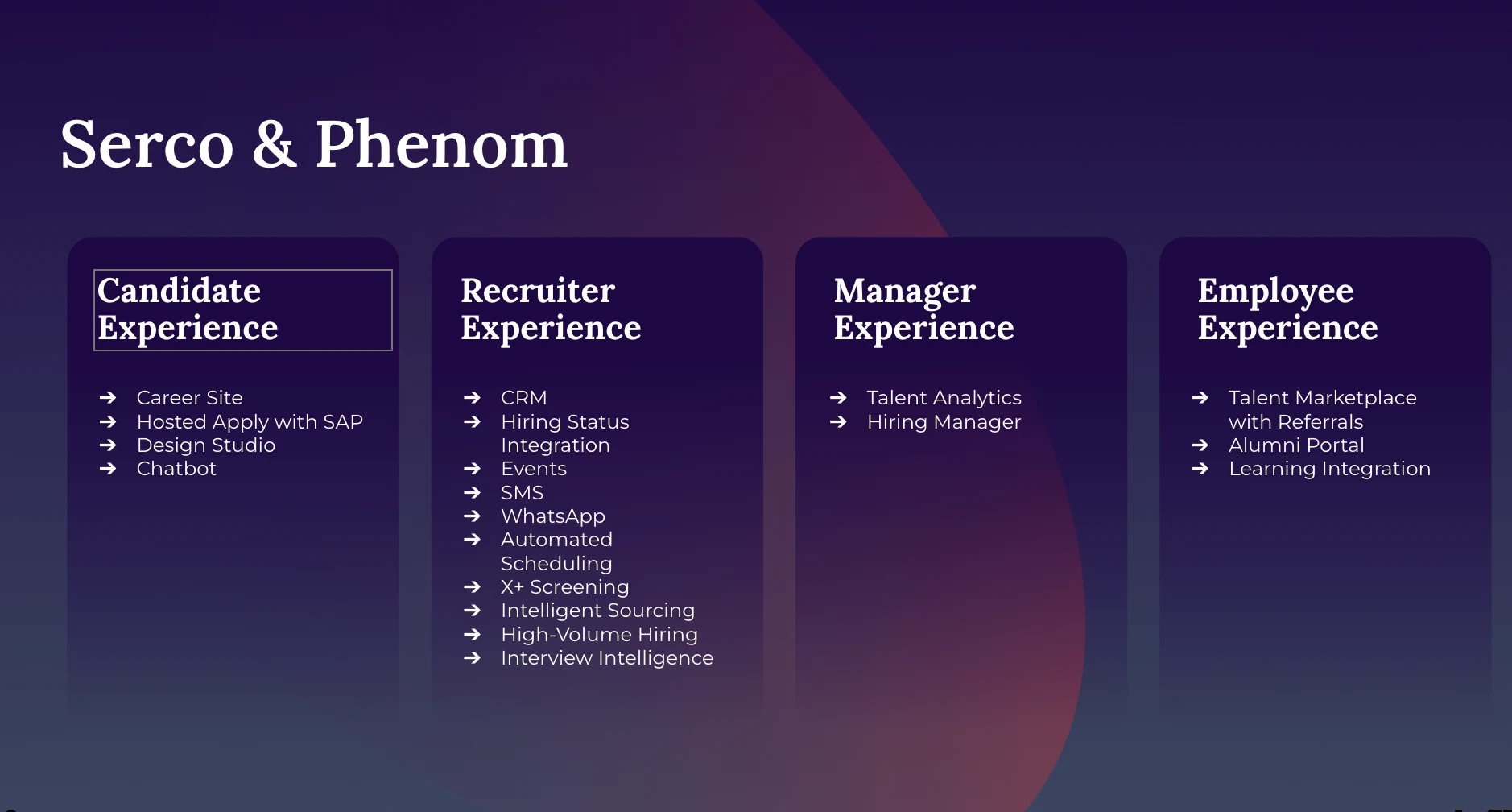
The implementation scope was substantial: Phase One launched in July across APAC, the Middle East, the UK, and Europe, covering the complete talent experience from candidate attraction through employee development. Serco implemented everything from Applied AI recruiting and retention tools to products dedicated to hiring managers — all integrated with their existing SAP SuccessFactors platform.
Phase Two followed shortly after for North America. Working with government clients adds a layer of complexity, and Serco needed a separate US-based instance to meet stringent security and data residency requirements. The team integrated SAP SuccessFactors components first to establish a standardized platform, then deployed the same comprehensive feature set as the other regions.
"We trusted in the fact that we had a really great partner to work with," Smith explained. That trust, combined with thorough preparation, made the accelerated timeline possible.
How did Serco manage global user acceptance testing?
With more than 30 people participating in user acceptance testing (UAT) across multiple time zones and regions, coordination could easily have become chaotic. Instead, Serco created a structured discipline that kept everyone aligned. Every single tester joined a daily cadence to report on anything they encountered and ask questions.
The testing strategy included several critical elements:
Regional representation: Every region nominated participants, ensuring no one felt left out and all local nuances were captured in testing scenarios.
Detailed test plans: Rather than ad hoc testing, teams followed comprehensive test plans drafted well before UAT began, with clear scenarios for each workflow.
Daily cadence meetings: Regular touchpoints kept everyone synchronized and surfaced issues immediately rather than letting them accumulate.
Clear communication channels: Formal structures ensured feedback flowed efficiently to the right people who could resolve issues.
Designated champions: Points of contact in each region served as local experts who could answer questions and troubleshoot for their teams.
This structure proved essential when challenges emerged, and the partnership between Phenom, Serco, and implementation partner Alliance Connections made the difference when it mattered most.
What results has Serco achieved since implementing Phenom?
The results vindicate both Serco's ambitious goals and its bold implementation approach. Four months after Phase One went live on time in July, the numbers tell a compelling story.
The financial impact was substantial: £1,025k saved on agency fees, technology platforms, and marketing, plus nearly £570k in headcount reduction enabled by automating 75,000 annual interviews that were once scheduled manually.
Voluntary attrition dropped dramatically from their previous 26% — addressing an annual drain that had been costing the organization roughly £30 million. "Today we're retaining 4,000 people more than we were," shared Smith.
Lost-time incidents declined in direct correlation with improved retention, validating the hypothesis that attrition and workplace safety are intrinsically linked. When experienced employees stay, fewer accidents happen in dangerous environments.
Perhaps the most profound change wasn't captured in spreadsheets. Four previously independent regional TA teams now operate as one collaborative global function, sharing insights and improvements across geographies daily.
What unexpected challenges did Serco encounter during implementation?
Even well-planned implementations encounter friction. Serco's journey revealed organizational challenges that don't appear on Gantt charts but can significantly impact progress.
"We're wanting to go faster, and colleagues are wanting to push back, and we're both right, and we land somewhere in the middle. But the friction isn't helpful — it slows us down," Smith reflected on navigating overlapping governance structures as a people and culture team unaccustomed to frequent IT implementations.
Serco's collaborative, democratic culture — typically a strength — sometimes conflicted with rapid implementation timelines. "Our appetite for governance in Serco within a culture that is about consensus and democracy can be a real strength in our organization. It can, but it can also be overplayed," Smith noted candidly. The desire to get everyone comfortable and excited added layers of approval and discussion that extended timelines.
Cost allocation created its own challenges. When implementation began, enthusiasm ran high. As invoices arrived for enterprise software, some stakeholders who initially championed the project developed "a little bit of amnesia." Clear financial commitments established upfront helped, but the challenge persisted.
End users (recruiters and hiring managers) naturally wondered how the new system would affect their roles. "It would be naive to think anything different," Smith acknowledged. "Whenever you're considering any form of change like this, people think 'How's it going to impact me? Does it impact my role?'"
The solution? "Engagement works every time. People are generally pretty grown up, and they'll take it so long as they're listened to and their fears are otherwise allayed."
What advice does Serco offer other organizations planning similar transformations?
Smith's reflections distill into practical wisdom for organizations considering major HR technology implementations.
"Get close to the problems that you really hope the IT will fix and solve them manually first where you can," Smith advised. "That difference is profound because you will not bake problems into the future solution." The improvements Serco achieved through pre-implementation optimization carried forward, making the new system even more effective.
Leadership from the executive level proved essential. "Having someone on the executive team waving the flag for this implementation solidly" made a critical difference in navigating organizational challenges and maintaining momentum.
But Smith emphasized that regional proficiency mattered just as much. "We were lucky enough to have exceptional expertise in every region in the recruitment functions who are so adept at recruiting a variety of roles at speed," he noted. "Without them at the heart of it, I think the project would have really struggled."
His final piece of advice addressed the cultural factors that don't appear in project plans: "Think about how your culture either supports or hinders what it is that you're trying to achieve and think of ways to calibrate for that. These aren't things that easily sit on a Gantt chart.”
How is Serco building on this foundation?
For Serco, the Phenom implementation represents a beginning rather than an endpoint. The organization remains on a growth trajectory that demands continued innovation in how it attracts, hires, and retains talent.
"We're an organization that is on a mission to grow. To do that, we must continue to innovate. We must continue to invest," Smith explained. The company sees talent technology as core to that growth strategy, particularly as AI capabilities expand across talent intelligence, career intelligence, and cultural intelligence.
The unified global TA team that emerged from the implementation — arguably as valuable as the technology itself — positions Serco to continuously improve. What four regional teams struggled to achieve independently, one collaborative global team can accelerate.
"We will continue to improve the employment experience for colleagues in Serco going forward," Smith relayed. With attrition cut dramatically, 4,000 more people retained, and workplace injuries declining, that improved employment experience extends beyond individual careers to the safety and well-being of everyone who depends on Serco's employees to do their work competently and carefully.
For a company where talent strategy is literally a matter of life and death, that's not just implementation success. That’s transformation.
Discover more successful HR Tech implementation stories.
View Customer Obsession Day on demand

Fariya Banu is a content marketing writer at Phenom who loves decoding buyer psychology and crafting stories that convert. With engineering and marketing expertise, she brings analytical thinking to creative storytelling. When not writing, she's snorkelling, cooking, or diving into any adventure that sparks curiosity.



Get the latest talent experience insights delivered to your inbox.
Sign up to the Phenom email list for weekly updates!


