

Interview Intelligence Basics: How to Hire Confidently in a High-Risk World
Interviews are where hiring decisions get made, and where new risks are emerging at an alarmingly rising rate. As AI advances, so does the sophistication of candidate fraud: auto generated responses, misrepresented credentials, and proxy candidates are becoming harder to spot in a live conversation. At the same time, compliance expectations regarding what is asked, recorded, and retained are becoming more complex across many markets.
Most recruiting teams are already doing a good job managing a high volume of interviews under real-time pressure. Phenom Interview Intelligence is built to support that work by bringing structure, real-time guidance, and post-interview insights into a process that has traditionally relied on memory and manual notes. This blog covers what the product does at each stage and how to get more out of the features that make the biggest difference.
In this Article:
Why Are Interviews the Highest-Risk Hiring Stage?
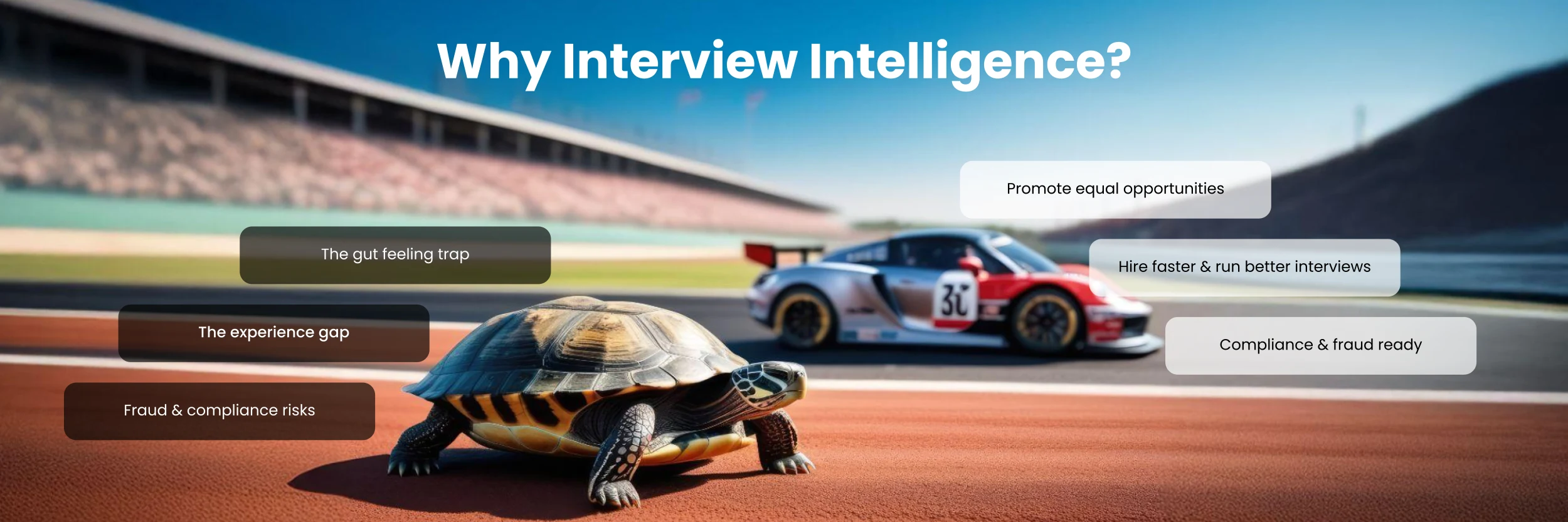
Most of the compliance exposure in hiring doesn't come from job postings or application forms. It comes from the interview itself: questions that shouldn't be asked, notes that are inconsistent across candidates, decisions made on instinct with no supporting record, and fraud that only surfaces after someone is already onboarded.
The problem compounds when hiring managers are running interviews without structure. Paying attention to a candidate, asking the right questions, and taking accurate notes at the same time is genuinely difficult. When attention splits, details get missed, gut feelings fill the gaps, and unconscious bias creeps into evaluation without anyone noticing. Interview Intelligence replaces that fragile process with one that is recorded, guided, and auditable from start to finish.
What Does Interview Intelligence Do Across Every Hiring Stage?
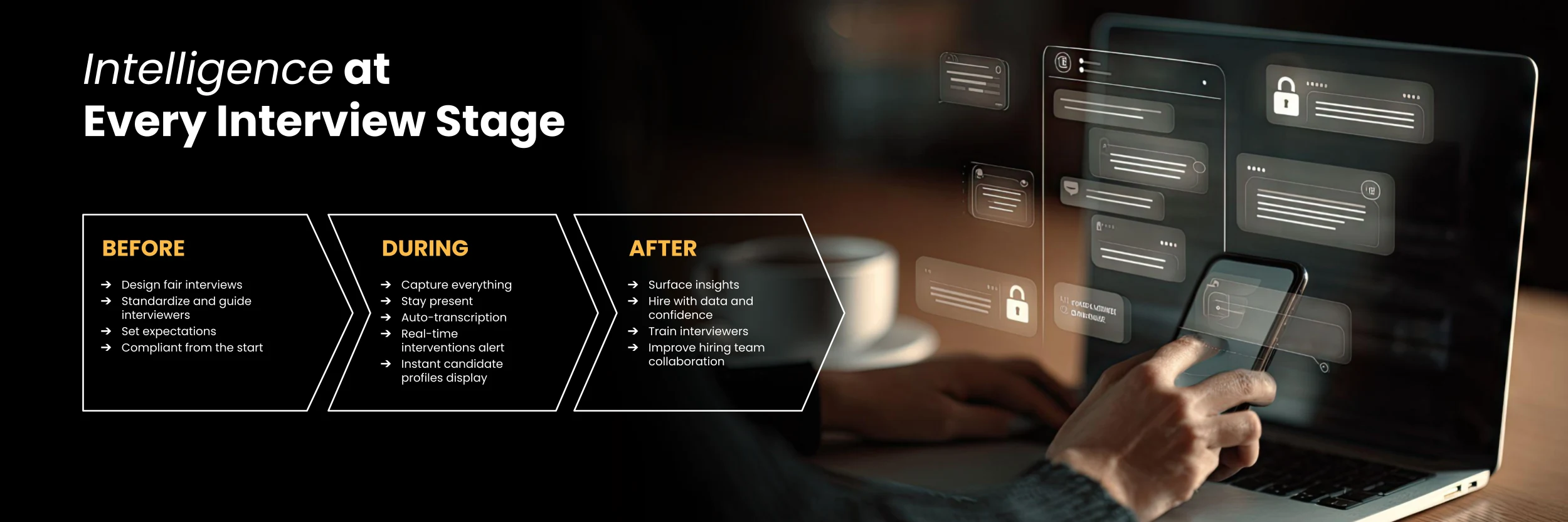
Interview Intelligence works across three connected stages of the interview process. The following is what each stage covers and what it makes possible.
Before the interview
This is where fair interviews are designed, not improvised. Scorecards combine an evaluation form with an interview guide, giving every interviewer a consistent structure to work from. Attributes like motivation, problem-solving, or a specific skill can be built into the guide so hiring managers know exactly what to assess and which questions to ask. Every participant is also informed ahead of time that the interview will be recorded, with the ability to opt out at any point, including during the interview itself. Consent and data retention rules are configured in the back end, including automatic deletion timelines for regions with specific compliance requirements.
During the interview
Once the interview starts, auto-transcription runs in the background so interviewers can focus on the candidate rather than their notes. The interview assistant guides the hiring manager through the session, surfaces the questions from the interview guide, and suggests follow-up questions when a candidate's answer needs probing. If a response sounds unusually polished or shows signs of being AI-generated, the system flags it and prompts a follow-up question to verify whether the candidate is answering from their own knowledge. Real-time fraud detection runs alongside the conversation, monitoring for behavioral signals like sudden pauses, off-screen glances, or response pattern anomalies.
After the interview
Post-interview is where insights become actionable. Transcripts, highlights, and AI-generated summaries are available immediately after the call, so decisions don't depend on fading memory or selective notes. Hiring managers get a structured view of how each candidate performed against the scorecard criteria. The data from the interview can also be used to coach interviewers, flagging when a hiring manager is dominating the conversation, asking non-compliant questions, or not giving candidates adequate time to respond.
How Does the Fraud Detection Agent Work for Hiring?
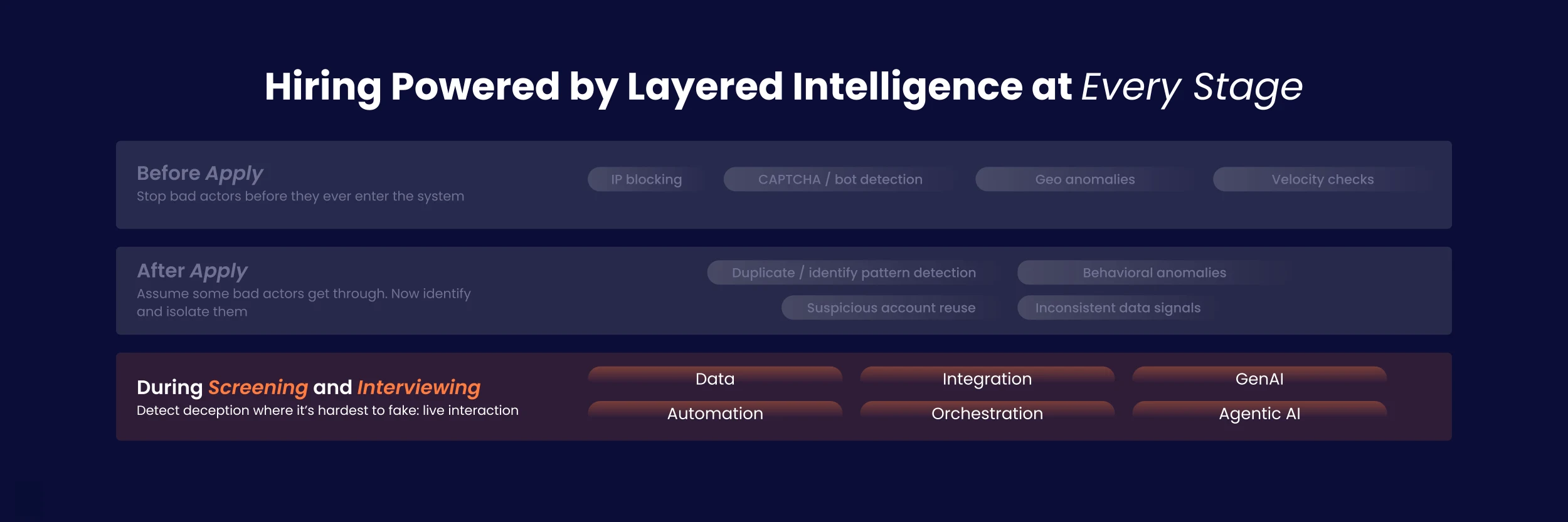
AI has made it easier than ever for candidates to misrepresent themselves during interviews. Generated responses that sound polished and rehearsed, proxy candidates appearing in place of the actual applicant, and off-screen prompts feeding answers in real time are becoming so common that 90% of detected fraud cases now involve exactly these behaviors.
The fraud detection AI agent runs as a real-time layer during live interviews, monitoring for behavioral signals like unusual pauses, response patterns that mirror AI-generated language, or sudden shifts in how a candidate is engaging. When something surfaces, the system suggests a follow-up question rather than automatically disqualifying the candidate, keeping the recruiter in control. A face overlay check can also verify that the person on screen matches the candidate from earlier in the process. Signals are evaluated at the individual level, not against a universal baseline, and recruiters can dismiss any flag, with the system learning from those decisions over time.
Where Does Interview Intelligence Apply Across Role Types?
Interview Intelligence isn't limited to technical or corporate roles. It can be configured to fit virtually any position where structure, consistency, and compliance matter. The following role categories are where teams are currently applying it:
Frontline and hourly hiring: Customer service representatives, warehouse associates, and medical assistants. Consistency is the primary value here, ensuring every candidate gets the same structured experience regardless of the interviewer.
Early career roles: Interns, graduate trainees, campus hires. Interview guides help less experienced interviewers ask the right questions, and scorecards give hiring teams a shared framework for comparing candidates who may have limited professional experience.
High-volume professional roles: Sales representatives, operations coordinators, support specialists. At volume, the time saved from automated note-taking and structured evaluation compounds significantly across the talent pipeline.
Knowledge worker and regulated roles: Software engineers, financial analysts, data scientists, nurses, claims processors, compliance analysts. These are the roles where fraud risk is highest, and compliance exposure is most significant. Layered intelligence at the interview stage is particularly valuable here.
The Business Case: AI-Powered Interviewing Impact
Structure and intelligence at the interview stage produce measurable results beyond just faster hiring. The following figures reflect what teams using Interview Intelligence have seen across different organizations and role types.
90% of fraud signals involved off-screen reading or non-authentic responses, catching what manual review consistently misses.
30% decrease in biased interview questions, driven by structure embedded directly in the workflow rather than policy reminders alone.
10,000+ compliance risks identified by hiring managers in real time, before they become post-hire problems.
50,000 hours saved through automated note-taking, freeing recruiters and hiring managers to focus on evaluation.
Four Practical Steps to Build From Here
Getting more out of Interview Intelligence doesn't require rolling it out across every team at once. The following steps are the most effective way to expand from where you are now.
Start with one role or hiring team: Test with a focused scope, gather feedback from the interviewers who use it, and iterate before expanding. This is how adoption sticks.
Use it to replace note-taking, not add to it: The value disappears if hiring managers keep taking manual notes alongside the auto-transcription. The change management piece matters: interviewers need to be trained to trust the system so they can stay present in the conversation.
Set clear guidelines for consent and use: Every participant should understand that the interview is being recorded before it starts. Internal guidelines on how recordings are stored, who can access them, and when they're deleted protect both candidates and the organization.
Turn post-interview insights into coaching: The data generated after each interview is useful beyond the hiring decision. Patterns in how interviewers ask questions, how much of the conversation they dominate, and whether they're staying within compliant territory are all visible in the system. Using that data to develop hiring managers is where the long-term value compounds.
The Path Forward
The interview stage carries more risk than any other point in the hiring process, and it's also where the most value can be unlocked. When interviews are structured from the start, guided in the moment, and analyzed after the fact, hiring teams stop relying on memory and instinct alone. Decisions become faster, more defensible, and fairer across every candidate who goes through the process. Interview Intelligence doesn't replace the judgment that experienced recruiters and hiring managers bring to the table; it gives that judgment something real to work with.
Watch the full session on demand for a complete walkthrough, or head to the Phenom community knowledge base for setup guides, scorecard templates, and configuration examples your team can apply right away.

Devi is a content marketing writer passionate about crafting content that informs and engages. Outside of work, you'll find her watching films or listening to NFAK.


Get the latest talent experience insights delivered to your inbox.
Sign up to the Phenom email list for weekly updates!


