


Whataburger’s Sizzling-Hot High-Growth Hiring
Whataburger has been a Texas institution since 1950. The quick-serve restaurant's founder was an aviator, and the brand's signature orange was chosen for the same reason it's used on airfields — you can spot it from a mile away. For Nicki Tafolla, Group Manager of Talent Acquisition, that visibility has taken on a different meaning over the past several years: figuring out how to build Whataburger’s employer brand in seven states where most candidates have never heard of the brand, let alone eaten there.
The scale behind that challenge is significant. Whataburger has grown from 10 to 17 states in four years, adding entirely new markets and candidate pools. The company hires more than 50,000 people annually across 52,000 employees, receiving upwards of 700,000 applications a year.
At IAMPHENOM 2026, Tafolla walked through how Whataburger is building its talent acquisition (TA) infrastructure to keep pace with that growth, and what it took to shift the team from reactive to proactive.
Watch the full session here, or explore the highlights below!
What QSR Hiring Challenges Emerge When Expanding Into New Markets?
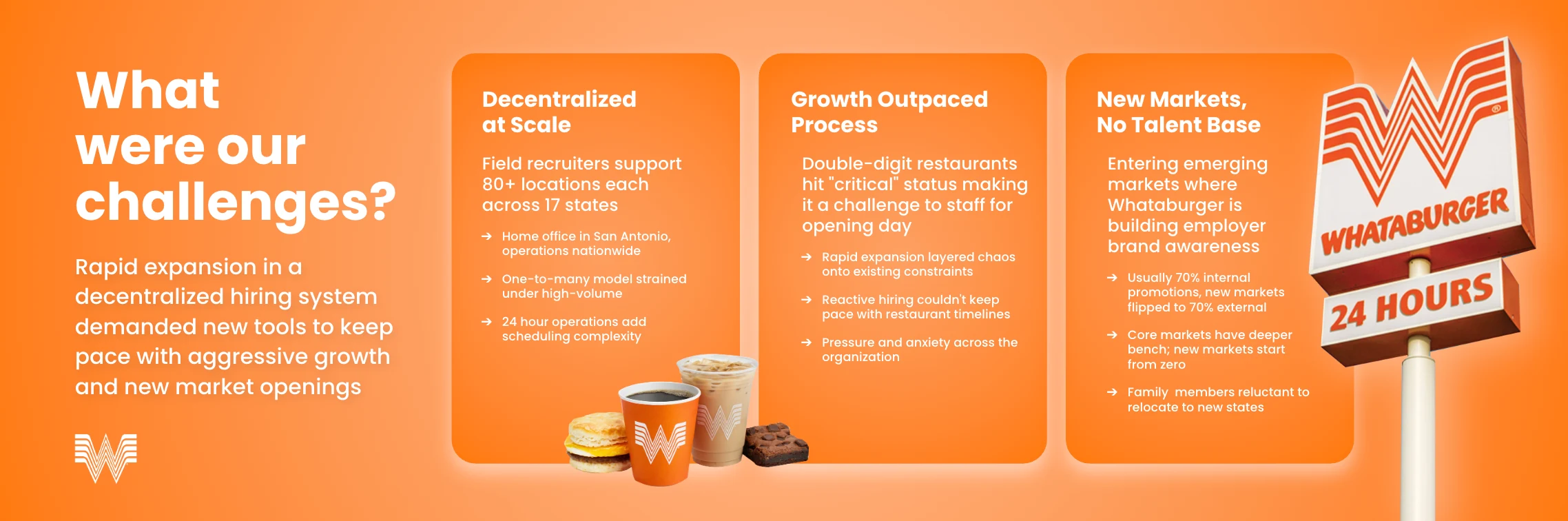
Whataburger’s high internal promotion rate (consistently 70%+) is one of the brand’s most distinctive workforce facts. At established locations, the pipeline almost builds itself: people who grew up eating there apply, advance, and sometimes bring their own families into the business. Generations of Texas families have worn orange. But that flywheel doesn’t exist in a state where Whataburger just opened its first restaurants.
In new markets, Tafolla’s team recruits against a baseline of little employer brand awareness. Candidates may have heard of the company if they’ve traveled through Texas, but they don’t know what it’s like to work there, what the culture looks like, or why Whataburger might be a better choice than the restaurant next door. During the early phases of entering a new market, every application has to be earned through proactive outreach and deliberate brand-building, not just posting a job and waiting.
Compounding that challenge: Whataburger’s field TA team is decentralized, with each recruiter covering 80 to 120 restaurants. Growth outpaced the processes in place, and there was no more room to absorb volume through manual effort alone.
How Does Phenom Talent CRM Help Build Stronger Candidate Pipelines?
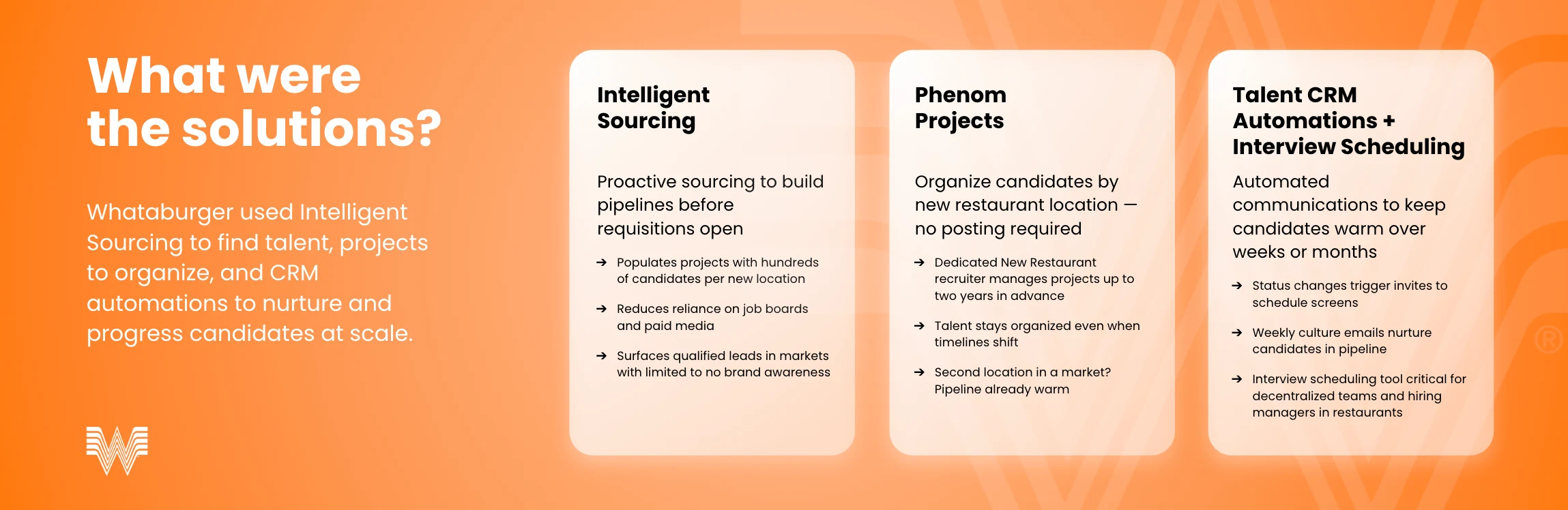
As Whataburger expanded into new markets, Tafolla's team began using Phenom Talent CRM to get ahead of hiring demand. With around 50 new restaurant openings per year, waiting until a role is officially open to begin sourcing would leave the team perpetually behind. Projects, a capability within the Talent CRM, gives recruiters a structured way to organize and engage candidates before a requisition is ever posted.
Kelly, Whataburger’s dedicated new restaurant opening recruiter, is the clearest example of this in practice. When a new market is on the horizon, she begins identifying and engaging candidates for store manager and multi-unit leadership roles well before construction is finished. By the time the requisition goes live, a qualified pipeline is already engaged and in communication. “We already have people in the interview process,” Tafolla said. “Now we’re just looking for the extra toppings on the burger.”
The same logic applies to multi-unit roles with market leaders overseeing up to 12 restaurants and regionals overseeing up to 80. These are high-bar positions that open infrequently. Tafolla’s team runs ongoing projects for these roles so that when a vacancy opens, a nurtured pipeline is already waiting. Fill time for multi-unit vacancies using recruited external talent used to run around six months. With projects and nurture in place, it’s now immediate.
Related Resource: HR Product Evaluation Checklist for Retail
How Can Talent CRM Automations Nurture Candidates at Scale?
Multi-unit and leadership candidates sometimes sit in Whataburger’s pipeline for three to six months or longer, waiting for the right opening in the right market. Tafolla pushed for nurture automations when others in the organization were initially hesitant about keeping candidates in an uncommitted state that long. Her argument: the current approach wasn’t going to scale, and staying silent with a good candidate is a choice with consequences. Without consistent engagement, strong candidates could easily lose interest or move on to other opportunities before the right role opens.
Talent CRM automations handle the ongoing communication in the background: check-ins, role updates, relevant brand content, and scheduling prompts when a position opens. Recruiters configure the workflow once; Phenom runs it continuously. Tafolla described the mindset behind it plainly: “I’m just planting the seed. I’m getting to know you today. One day you’ll be wearing orange. I know it.” That orientation — relationship first, vacancy second — is what the automation is built to support at scale.
How Does Intelligent Sourcing Save Field Recruiters Time?
Building those early pipelines also required a more efficient way to find candidates. Tafolla’s team uses Phenom Intelligent Sourcing, which uses applied AI to surface external candidate profiles based on role criteria like skills, experience level, and location, helping recruiters quickly identify prospects who can be added to projects and nurtured ahead of hiring demand.
Before, Kelly was spending full days doing manual sourcing outside the platform, searching profiles, building lists, and reaching out individually. That time has a cost measured not just in hours but in everything else that didn’t get done while she was searching.
Intelligent Sourcing changed that by pulling qualified external profiles into the Talent CRM based on project criteria: role type, skills, experience level, and location. Rather than building lists from scratch, Kelly reviews a filtered set already matched to what the project requires, acts on the candidates that fit, and moves on. The sourcing still requires judgment, but it no longer requires hours of manual work before that judgment can be applied. For a recruiter covering 80 to 120 restaurants, that recovery of time has been substantial, giving recruiters more time to build relationships and advance conversations with qualified prospects.
Related: Modernizing the Restaurant Hiring Experience: What Today’s Workers Really Want
What Results Can QSR Recruiting Teams Expect from Proactive Pipeline Management?
Whataburger went live with Workday and Phenom Applied AI simultaneously in December 2023, a significant undertaking by any measure. The first year focused on establishing a strong operational foundation in Workday. In the second year, the team began expanding how they use Phenom, introducing projects, automation, and sourcing workflows that support hiring at scale.
Once the platform was fully in place, the impact showed up across sourcing, pipeline management, and hiring speed. "The interview scheduling has been phenomenal for us," Tafolla said. "That was a huge, huge impact to the processes that we do." The outcomes reflect how the team now supports both everyday hiring demand and large-scale restaurant expansion.
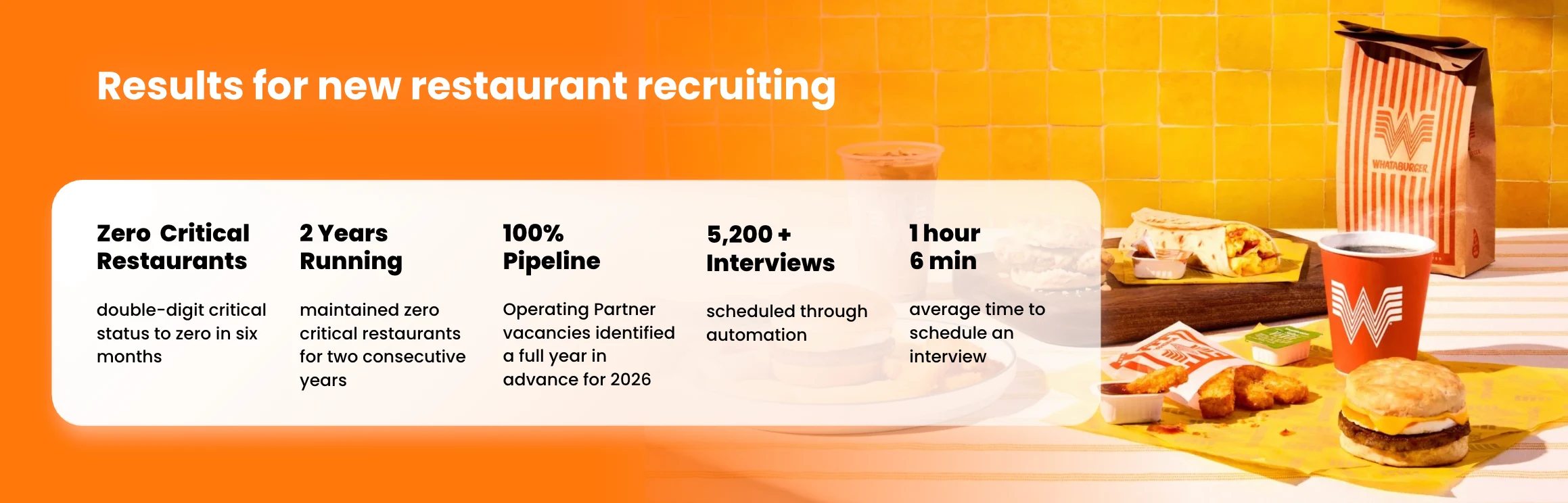
Reduced critical restaurant vacancies from double digits to zero in six months
Maintained zero critical restaurant vacancies for two consecutive years
Identified 100% of Operating Partner vacancies a full year in advance
Scheduled 5,200+ interviews through automation
Automated interview scheduling to an average booking time of 1 hour 6 minutes
Reduced multi-unit time to fill from six months to immediate
What's Next for Whataburger’s Talent Strategy?
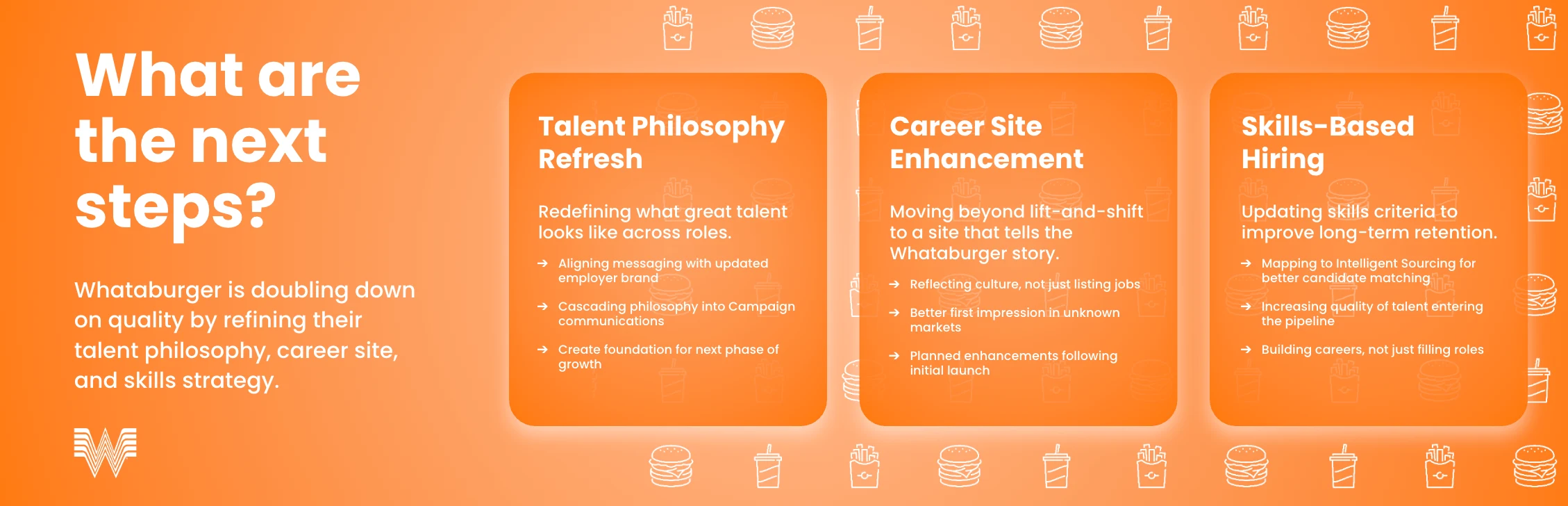
Two priorities are shaping Whataburger’s next phase with Phenom. The first is a career site refresh tied to a recently completed overhaul of the company’s talent philosophy. Seven new states in four years means the brand’s identity as an employer has outrun the content representing it online. The refreshed site will close that gap, showing candidates in unfamiliar markets who Whataburger is as a workplace, not just what’s on the menu.
The second is skills-based hiring. Rather than relying solely on traditional job descriptions, skills-based hiring focuses on identifying the capabilities required for success in a role and matching candidates accordingly. Within Phenom, this approach connects skills data to sourcing and candidate matching, helping recruiters surface candidates whose experience aligns with what the role actually requires.
With thousands of hiring managers across 800-plus corporate restaurants and a growing franchise footprint, the goal is to build a framework where the right job description, criteria, and structured process are already in place. As Tafolla put it: “All they need to know is that the person sitting across from them is the right one to come in on day one and make a Whataburger.”
Stay ahead of QSR growth with an always-on talent solution. See what Phenom can do for you!


Get the latest talent experience insights delivered to your inbox.
Sign up to the Phenom email list for weekly updates!


