


High Tech Meets High Touch: How Southwest Is Scaling Hospitality-Driven Hiring
A flight attendant posting at Southwest Airlines generates thousands of applications. During one recent cycle, 5,000 arrived within 35 minutes. For a company whose frontline employees are the living embodiment of its hospitality promise, moving fast on that volume without losing the human element is as much a recruiting challenge as an employer brand challenge.
At IAMPHENOM 2026, Joanna Ferrara, Manager of Talent Acquisition and Recruitment Marketing at Southwest, walked through how the airline created a screening process that handles thousands of candidates, cuts no-shows to as little as 3%, and still gives candidates the experience they’d expect from Southwest.
Watch the full session here, or explore the highlights below.
What Challenges Arise When High-Volume Hiring Outpaces the Screening Process?
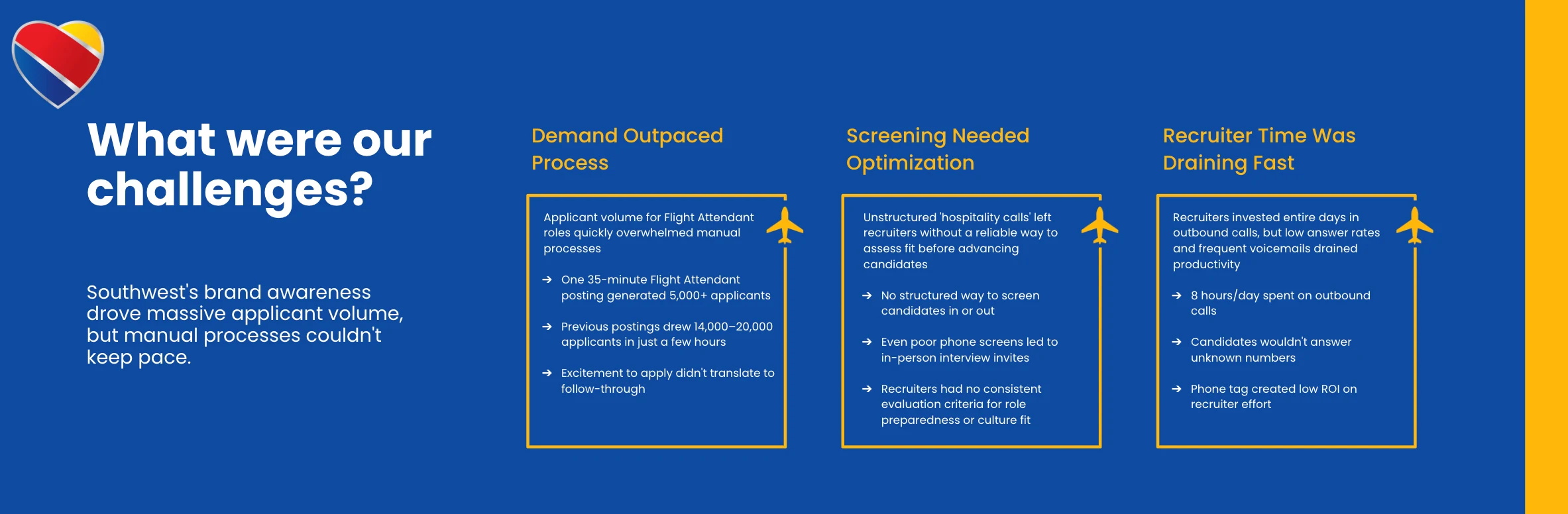
In the post-pandemic surge, Southwest’s flight attendant team was moving candidates from application to in-person interview as fast as possible, and speed was the priority. The “hospitality call” — a five-minute check to confirm minimum requirements and training date availability — wasn’t an assessment. It was a logistics screen. Fit wasn’t evaluated until the in-person interview, which meant Southwest’s in-flight blitz events (large-scale hiring days that brought in roughly 500 candidates per session) had no real filter on quality going in.
The operational cost was recruiters spending the majority of their day on phone screens, playing tag with candidates who worked non-traditional hours. No-show rates climbed to 30–40% as time-to-reach stretched out and candidate interest cooled. Each recruiter could handle about 10 to 15 interviews per day at peak capacity. And when candidates didn’t show, that time was simply gone. Without any investment on the candidate side, commitment wasn't signaled until the day of the blitz.
One-way screening changed that dynamic. As Ferrara put it: "Now they've put some skin in the game."
Another challenge the team had to overcome was resistance from within. The in-flight hiring team was skeptical that a digital screening process could work for a role as interpersonally demanding as a flight attendant. How do you assess hospitality and warmth through a screen?
How Can One-Way Screening Improve Hiring Speed Without Compromising Candidate Experience?
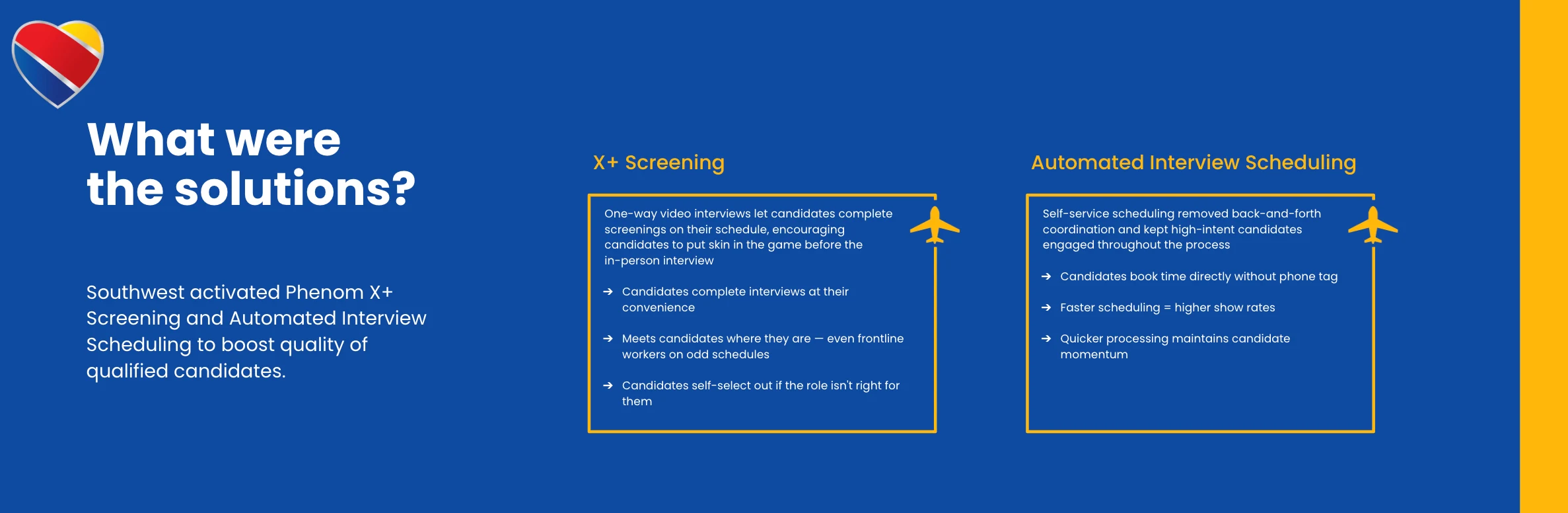
Southwest’s answer was Phenom X+ Screening, a one-way video interview and pre-screening questionnaire that candidates can complete on their own schedule, at any time of day or night.
For Southwest, the goal was never efficiency for its own sake. As Ferrara explained: "We use technology not to replace a human touch, but to protect it."
With customizable question types, it surfaces deeper insights into candidate qualifications, skills, and behavior early in the process — helping teams identify the right candidates and move them forward faster. Southwest layered in knockout questions to handle the basics automatically: work authorization, airport availability, and availability for training class dates. The questions that required human judgment were reserved for the in-person process.
The candidate experience was designed to reflect Southwest’s employer brand. The screening page lives on Southwest’s career site, so the context never breaks from their employer brand. A welcome video from a member of the hiring team opens the experience, giving candidates a human face before answering a single question. Phenom provides 24/7 chat support for candidates going through the process, which was built specifically to absorb the recruiter inbox volume that had been a problem in earlier technology rollouts.
Phenom Automated Interview Scheduling runs in parallel. Once a candidate completes screening and advances, scheduling happens automatically rather than through back-and-forth outreach. SMS was added as a communication channel to reach candidates on the device they were most likely to check, which significantly reduces time to respond.
Related Resource: Trends Shaping Candidate Screening in Today’s Hiring Landscape
What Impact Does One-Way Screening Have on No-Shows, Time To Hire, and Engagement?
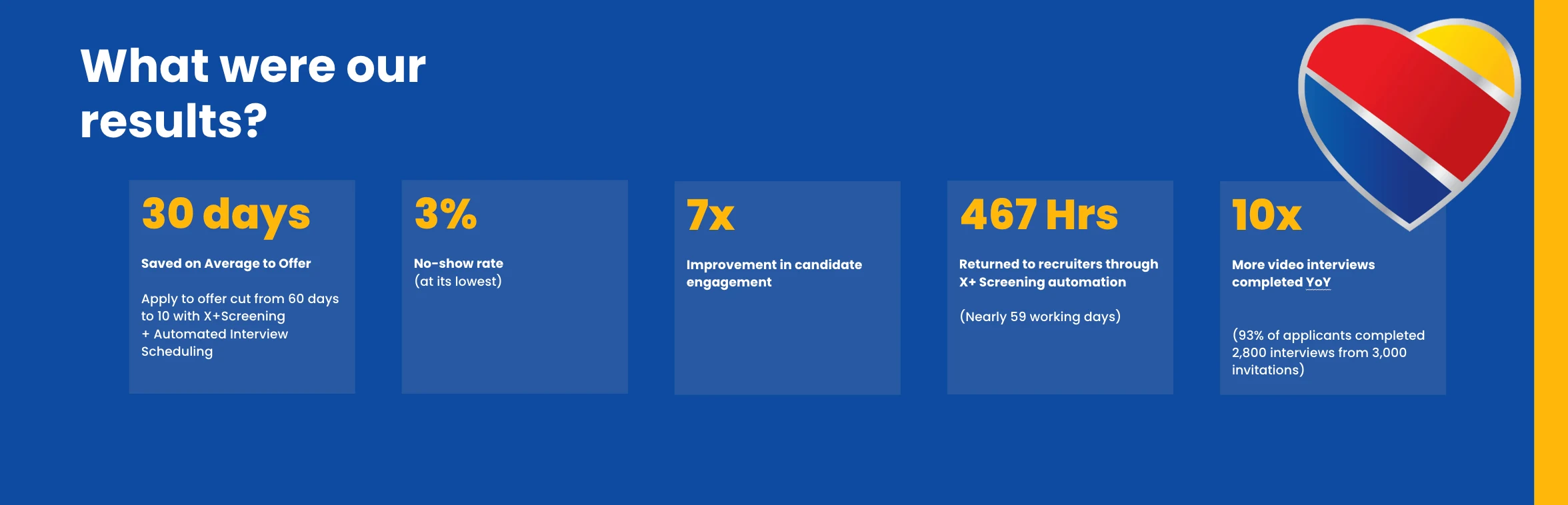
The before-and-after on Southwest's flight attendant hiring metrics tells a clear story: when the right technology meets a high-volume hiring process, speed, quality, and candidate experience all move in the right direction. Results after implementing X+ Screening and Automated Interview Scheduling include:
30 days saved on average time to offer (50 days saved when combined with Automated Interview Scheduling)
3% no-show rate (at its lowest)
7x increase in candidate engagement
467 hours returned to recruiters through X+ Screening (nearly 59 working days)
10x more video interviews completed YoY
2x increase in daily interview capacity (from 10–15 to 20+ per recruiter)
10 minutes saved per screening and 10 minutes saved per scheduled interview
4.8/5 candidate rating for the screening experience
90%+ completion rate (peaking at 93%)
Ferrara pointed to the no-show improvement as one of the most tangible wins. Candidates who completed a screening had already demonstrated investment — and that, she noted, predicted in-person attendance in a way a passive application simply couldn't.
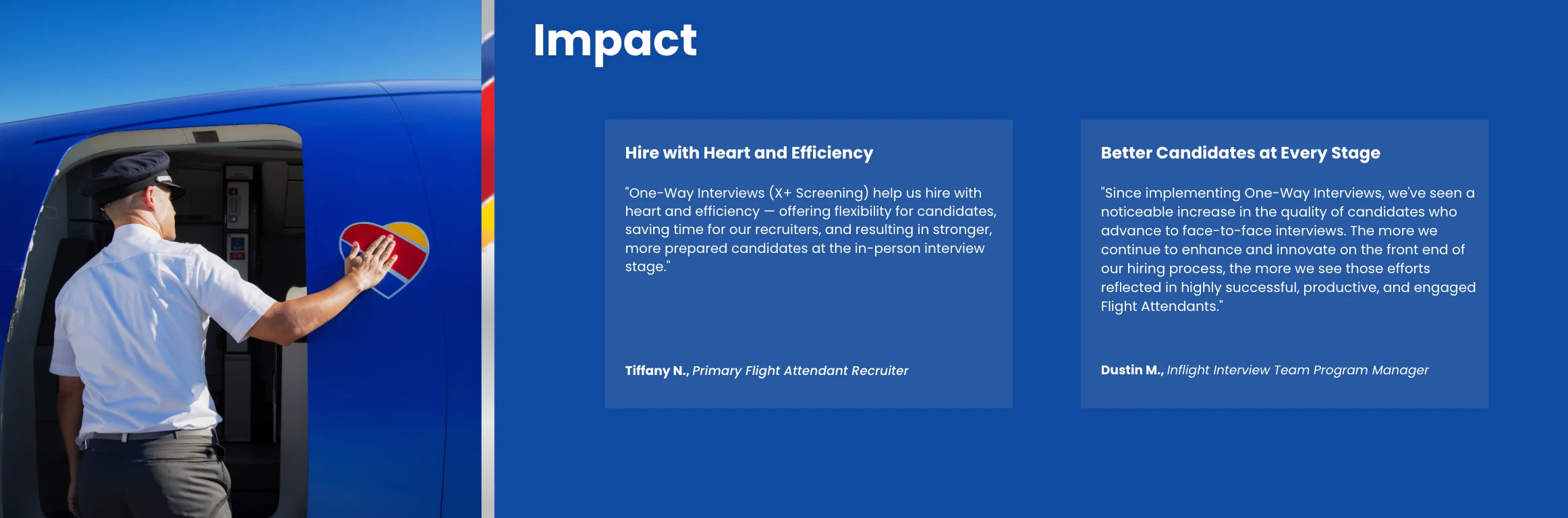
That same shift changed how recruiters spent their time. Instead of coordinating logistics and chasing candidates, they could focus on what actually requires human judgment, evaluating fit, building relationships, and running high-quality in-person interactions.
Related Resource: Smart Candidate Screening: More Options, Better Results.
Where Is Southwest Taking Its Screening and Sourcing Strategy Next?
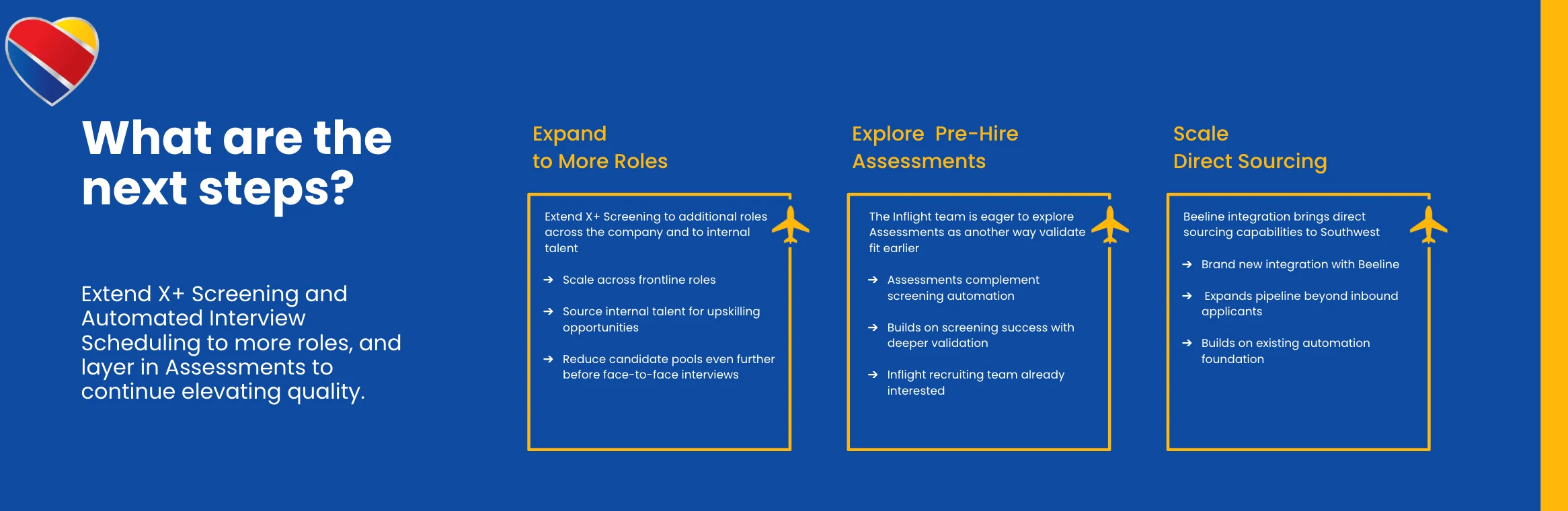
Moving forward, Southwest plans to expand X+ Screening to roles beyond its flight attendant program. Automated candidate summaries and additional pre-hire assessments are on the roadmap, which will extend the quality signals available before an in-person conversation happens. Southwest has taken a measured approach on additional technology, and Ferrara acknowledged this: “We have had a conservative posture at Southwest.” The focus has been on getting clear value from each feature before adding more.
One newer initiative is direct sourcing: Southwest brought its contingent workforce and contractor population into the same Phenom ecosystem as its full-time candidates. For an airline that runs 24/7 and depends on flexible staffing, having that population in a unified system rather than a separate list is a meaningful structural improvement.
Related: Taking Total Talent to a Higher Level: Southwest's Direct Sourcing Journey
The Southwest story is ultimately about protecting something non-negotiable — the brand experience — while operating at a scale that makes pure human-touch processes impossible. Automation did not replace the human element at Southwest. It created the conditions for it to survive at volume.
Enhance the way you hire with Phenom X+ Screening


Get the latest talent experience insights delivered to your inbox.
Sign up to the Phenom email list for weekly updates!


