

Types of AI Agents Explained: The Complete Guide for HR Innovation (With Real-World Examples)
If a department head mentions "we're deploying AI agents," many HR leaders realize they're looking at a shift that's already happened, not one that’s still on the horizon. Numerous organizations find themselves in this exact position, and that number is only increasing. Research indicates 25% of enterprises deploying GenAI are launching AI agents in 2025, with that number projected to reach 50% by 2027. The challenge? Understanding which agents actually solve your talent problems versus which are general AI solutions.
There are 7 main types of AI agents: simple reflex agents, model-based reflex agents, goal-based agents, utility-based agents, learning agents, multi-agent systems, and hierarchical agents. Each type varies in decision-making logic, memory capacity, and learning capability. In HR technology, these agent types map to distinct talent workflows, from single-task automation to end-to-end talent lifecycle orchestration.
What Are AI Agents and Why Do They Matter in HR Tech?
An AI agent is an autonomous system capable of perceiving context, making decisions, and taking meaningful action toward goals. Unlike typical prompt-based Large Language Models (LLMs) that generate responses based on a user asking for something each time, AI agents operate continuously, reasoning through challenges and executing tasks.
Think of the AI evolution this way: AI rapidly processes information you give it and returns answers. Generative AI predicts and generates responses based on patterns, but still waits for you to ask. Agentic AI goes a step further, acting as a personal assistant. It monitors your environment, identifies opportunities, makes decisions, and takes action without waiting for instructions.
In this article:
An important distinction is that an AI agent handles a single, well-defined task. Agentic or applied AI is the orchestration system that coordinates multiple agents across data sources, tools, and workflows. This allows AI to execute complex, multi-step processes spanning teams and systems. Confusing the two leads to misaligned expectations and stalled ROI.
So what is agentic AI in human resources? Below are common agent categories in HR tech that operate with distinct characteristics and applications:
LLM Agents: AI systems built on LLMs to handle conversational interactions and text-based tasks like candidate inquiry chatbots and interview question generation.
Task Agents: Specialized agents executing single, well-defined tasks autonomously, such as interview scheduling, compliance document scanning, and candidate screening calls.
Workflow Agents: Sophisticated agents orchestrating multiple connected steps across systems for complex, multi-stage talent operations like end-to-end recruiting workflows and comprehensive onboarding journeys.
How AI Agents Differ from Traditional Automation
Traditional HR automation relies on rule-based logic: If this condition exists, then execute this action. These systems are strict, requiring predefined workflows for every scenario that don’t. adapt when circumstances change. AI agents operate differently. They're adaptive and context-aware, capable of real-time decision-making based on evolving conditions.
For instance, when a candidate becomes unavailable, a traditional system might flag an error. Alternatively, an agent reschedules interviews, notifies stakeholders, and adjusts the pipeline. This contextual intelligence is what separates today’s agentic systems from legacy automation. It allows for real-time adjustments that shift as your data sets acquire new or updated information.
Why HR Teams Need AI Agents Now
HR workloads are expanding faster than team capacity. With agents, teams can reduce manual administration and free professionals for strategic work. Beyond efficiency, agentic AI addresses evolving talent expectations:
Candidates research employers thoroughly before applying
Employees expect 24/7 support matching consumer-grade experiences
HR teams need tools to keep up with growing responsibilities and application lists
Traditional HR systems aren’t designed to scale this delivery while delivering quality experiences.
Related Watch: Can AI Agents Actually Fix HR's Problems?
Unlike LLMs that respond to queries, agentic systems orchestrate across Candidate Relationship Management (CRM), Applicant Tracking Systems (ATS), Human Resource Information Systems (HRIS), Learning Management Systems (LMS), and benefits platforms simultaneously, eliminating data entry friction and system fragmentation. Autonomy creates immediate value across two common operational models:
Augmentation agents: Propose actions, generate drafts, and request human approval before execution. A sourcing agent identifies top candidates and presents recommendations for recruiter confirmation before outreach. This approach maintains human oversight and judgement while accelerating workflow.
Semi-autonomous agents: Execute complete tasks end-to-end with periodic human oversight rather than per-action approval. A scheduling agent automatically coordinates interview times across candidates and hiring managers, notifying all parties without individual authorization requests. A compliance agent scans documents and flags issues in real-time. These systems operate independently within defined guardrails, scaling operations without creating approval bottlenecks.
What are the 7 Core Types of AI Agents in HR Tech?
How an agent makes decisions, what it remembers, and whether it can learn are what separate one type of AI agent from another. The seven types of AI agents below cover the range from the simplest rule-based systems to sophisticated architectures that improve over time.
Type 1 · Simple Reflex AI Agents
A simple reflex agent chooses actions based only on what it currently sees, using fixed if-then rules. It has no memory of past states and no ability to learn. Every decision follows the same pattern: if a specific input is detected, execute a predetermined response. This makes simple reflex agents fast and reliable for predictable tasks, but they break down the moment a situation requires any context beyond the immediate input.
HR application: Candidate FAQ chatbots that answer standard questions about application status or office location. Rule-based filters that flag applications with missing required fields.
Type 2 · Model-Based Reflex AI Agents
A model-based reflex agent keeps an internal picture of the world, which it updates as new information comes in. This allows it to make better decisions even when it cannot see the full picture at once. Where a simple reflex agent only knows what is in front of it right now, a model-based agent remembers what it has seen before and uses that context to inform its next move. The trade-off is that the internal model needs to be kept accurate, which adds design complexity.
HR application: Candidate-matching systems that build a complete profile across multiple touchpoints over time. ATS bots that track where a candidate is in the pipeline and adjust next steps based on history.
Type 3 · Goal-Based AI Agents
A goal-based agent works backward from a target outcome. It evaluates different possible sequences of actions and picks the path most likely to reach its goal. These agents combine an internal world model with a defined objective and use planning logic to figure out the best route. They handle multi-step scenarios well, though they are more computationally demanding than reactive agents.
HR application: Interview scheduling agents that coordinate across candidate availability, hiring manager calendars, and interviewer preferences. Pipeline agents that move candidates systematically toward a qualified offer.
Type 4 · Utility-Based AI Agents
A utility-based agent goes further than simply asking "Did I reach the goal?" It asks "how well did I reach it?" by assigning scores to different possible outcomes and choosing the action with the highest expected value. This makes utility-based agents well-suited to decisions with competing priorities or resource constraints, where hitting a goal is not enough and the quality of the outcome matters. Getting the utility function right is critical because a poorly designed one produces optimisation in the wrong direction.
HR application: Candidate ranking systems that score applicants across weighted dimensions such as experience, skills, location, and availability. Compensation modelling agents that balance budget constraints against offer competitiveness.
Type 5 · Learning AI Agents
A learning agent improves through experience and feedback. Rather than following fixed rules, it updates its behavior based on outcomes, getting better at a task the more it does it. Modern learning agents use techniques like reinforcement learning from human feedback (RLHF), fine-tuning, and retrieval augmentation to continuously sharpen performance. The key dependency remains the same: feedback quality determines whether the agent improves in the right direction.
HR application: Sourcing agents that refine candidate targeting as they learn recruiter preferences over time. Performance coaching agents that personalise development recommendations based on each employee's history, engagement patterns, and career trajectory.
Type 6 · Multi-Agent AI Systems (MAS)
A multi-agent system brings together multiple specialised AI agents that work toward a shared goal. Each agent handles its own area, and the combined output is greater than what any single agent could produce alone. Agents can cooperate, compete, or work in hybrid arrangements depending on how the system is designed. Coordination protocols govern how they share information, divide tasks, and handle conflicting priorities. The more agents involved, the more governance is needed to manage complexity and prevent unpredictable behaviour.
HR application: A full talent acquisition pipeline where a sourcing agent finds candidates, a screening agent evaluates fit, a scheduling agent books interviews, and an offer management agent handles negotiation. Each is specialised; together they run the entire process.
Type 7 · Hierarchical AI Agents
Hierarchical agents are organized in layers. Higher-level agents set a strategy and break it into subtasks. Lower-level agents carry out those tasks and report results back up the chain.
This structure makes it possible to manage complex, large-scale operations without losing coordination. The challenge is in the architecture: the interfaces between layers need to be well-designed, otherwise a failure at the lower level can cascade upward.
HR application: Talent lifecycle platforms where a top-level agent oversees overall hiring strategy and timeline, while specialised agents independently handle sourcing, screening, scheduling, and compliance tasks. Phenom X+ Agents operate on this hierarchical model.
Related: Agentic AI in HR: When to Use Agent Autonomy & When to Stay Human
How AI Agents Work: The Perception–Reasoning–Action Loop
Every AI agent, regardless of type, runs on the same core cycle: perceive, reason, and act. In learning-capable agents, a fourth step is added. Understanding this loop helps explain why agents behave so differently from traditional software.
Perceive: The agent takes in data from its environment. This could be structured records, text input, system states, API responses, or live signals. In HR, that might be a resume, a calendar event, a screening call transcript, or an employee engagement score.
Reason: The agent processes that input against its internal model, goal, or utility function to decide what to do next. This is where agent type matters most. A simple reflex agent executes a rule. A utility-based agent runs an optimization calculation. A learning agent draws on a model refined through thousands of past interactions.
Act: The agent carries out an action: sending a message, updating a record, calling an API, scheduling an event, or triggering another agent in a pipeline. That action changes the environment, which the agent perceives again in the next cycle.
Learn (if capable): In learning agents, the outcome of each action is measured against a performance standard. The learning element uses that feedback to update the internal model, improving future decisions without any human reprogramming. This is what makes learning agents get measurably better over time, something static rule-based systems can never do.
Agentic AI Frameworks: The Models HR Teams Should Understand
Now that we understand the different types of AI agents that exist and how they solve specific challenges, knowing which framework powers those agents is critical for making implementation decisions that work for your organization.
General-purpose frameworks prioritize extensibility across industries and empower teams with AI resources to build solutions tailored to unique workflows. However, they require extensive development effort to translate these concepts into agent logic, encode recruiting workflows, and build governance. Phenom's approach differs fundamentally.
Rather than providing tools to build agents, Phenom builds industry-specific, verticalised agents optimized to help solve your talent challenges. Here’s what makes us different:
General-Purpose Frameworks: Platforms from OpenAI, Microsoft AutoGen, and LangChain provide flexible building blocks for developers to construct custom agents across any industry. Organizations gain maximum control over agent design and can theoretically build solutions for non-standard workflows. However, they require substantial development resources, extensive custom programming to encode HR logic, and deep expertise to navigate recruiting workflows, compliance requirements, and job taxonomy. Implementation timelines extend 6-12 months, with ongoing responsibility for bias auditing, governance architecture, and regulatory alignment.
Phenom X+ Agents: Rather than providing development tools, Phenom delivers pre-built agents optimized for specific and nuanced talent challenges. These agents require zero custom development because HR domain expertise is already embedded. Phenom X+ Agents deploy within weeks, with foundational governance and compliance rather than bolted on. The platform uses X+ Agent Studio, which features a comprehensive library of components designed to eliminate bottlenecks while driving operational efficiency, seamless automation and augmentation, and human-centric interactions. X+ Ontologies bridge business objectives and HR execution, and orchestration allows agents to work in unison across recruiting, onboarding, and talent management workflows.
Use the chart below to take a closer look at how vertical HR AI agents stand up to general-purpose agentic AI frameworks:
Dimension | General-Purpose Frameworks | Phenom X+ Agents |
|---|---|---|
Deployment Model | Build from scratch with developer expertise | Deploy pre-built agents optimized for your industry and job zones |
Configuration | Requires custom development and integration | Zero-setup deployment; configure through platform UI |
Time to Value | 6-12 months of development before agents handle live workflows | Weeks to deploy agents handling recruiting, onboarding, and talent management |
Governance & Compliance | Must architect bias detection, audit trails, EEOC/GDPR alignment from the ground up | Built into agent architecture; tested across several applications for bias |
Expertise Required | A dedicated AI engineering team to build and maintain | HR domain knowledge; agents are already trained on your industry-specific requirements. |
Industry-Specific Logic | Must encode voice screening criteria, sourcing taxonomy, and compliance rules manually | Agents already understand frontline vs. knowledge worker hiring, compliance nuances, and job-specific workflows |
The difference compounds across your talent lifecycle stage. When agents work in unison, from intake through sourcing, screening, scheduling, onboarding, and development, they need a shared understanding of your organization's talent challenges. Pre-built, orchestrated agents designed for these workflows move faster and require less oversight than agents you build from a general framework.
Related: Applied AI for HR: Build Smart, Deploy Fast, Scale Strategically
How to Use AI Agents in HR: Practical Implementation
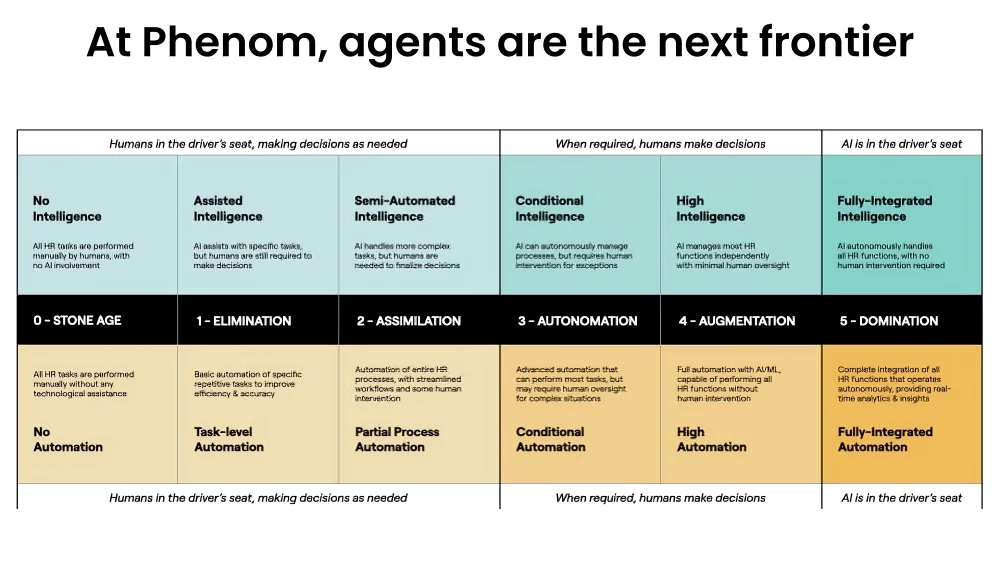
Challenges to implementing agentic AI in HR often stem from complexity, but adopting structured approaches can reduce friction. Implementation typically advances through three stages, each representing measurable movement up the maturity level. The following highlights how the implementation progresses:
Challenges to implementing agentic AI in HR often stem from complexity, but adopting structured approaches can reduce friction. Implementation typically advances through three stages, each representing measurable movement up the maturity level. The following highlights how the implementation progresses:
Task-level Use Cases (Level 1: Elimination)
Voice screening agents conducting candidate interviews, scheduling agents automating calendar coordination, and chatbots answering candidate questions operate independently with a defined scope. This stage removes administrative friction and delivers immediate value. Most organizations start here, identifying where single-task automation creates the quickest wins before tackling broader workflows.
Workflow-level Integration (Levels 2-3: Assimilation to Autonomation)
Multiple agents connect across systems and processes. Talent acquisition workflows orchestrate sourcing through screening to offer management. Onboarding workflows span pre-boarding communication, compliance documentation, and team introduction. This stage requires more sophisticated agent coordination and crosses the autonomation threshold where agents operate independently while humans retain oversight of exceptions.
End-to-end Talent Agent Ecosystems (Levels 4-5: Augmentation to Domination)
Multiple specialized agents collaborate across the entire talent lifecycle, from attraction through development and retention. Agents work in unison with a shared understanding of your organization's talent challenges, requiring governance frameworks, data integration, and cross-functional alignment. This represents mature operations where AI augments human judgment across all talent functions.
Begin with pilots on bounded workflows to validate agent performance and governance. Establish monitoring for bias, quality, and escalation patterns. Scale progressively as confidence grows and processes stabilize.
How Do AI Agents Function in HR
Successful agentic AI HR case studies demonstrate tangible impact:
Voice screening agents have reduced screening time from days to hours, cutting time-to-hire by 40 percent in high-volume hiring environments
Onboarding agents personalize new hire journeys while automatically flagging compliance issues
Career success coaches provide continuous development guidance to deskless workers at scale, improving retention and engagement
Sourcing agents identify passive candidates through sophisticated matching, learning recruiter preferences over time to refine outreach
What success looks like varies by use case, but common KPIs include time-to-fill reduction, improved offer acceptance rates, decreased cost-per-hire, increased internal mobility, higher employee engagement scores, and lower attrition rates.
Related: AI Recruiting in 2025: The Definitive Guide
What are the Risk, Ethical & Compliance Considerations for AI Agents in HR
Top agentic AI tools for HR operational efficiency must address responsible deployment. Bias mitigation remains paramount. Data governance and privacy requirements mandate compliance with GDPR, CCPA, and emerging AI legislation. Human-in-the-loop requirements ensure critical decisions involving hiring, performance evaluation, or termination retain human judgment and accountability. Key safeguards include:
Bias monitoring: Continuous evaluation of AI outputs to detect and mitigate discrimination.
Data governance: Proper handling of employee and candidate information with necessary consents.
Audit trails: Documentation of every agent decision for regulatory scrutiny.
Regulatory alignment: Compliance with EEOC anti-discrimination mandates and NIST AI Framework guidance.
Escalation protocols: Clear pathways for edge cases and sensitive decisions requiring human review.
FAQs About Types of AI Agents & HR Automation
1. What are the main types of AI agents?
The 7 main types of AI agents are: (1) simple reflex agents that respond to current inputs without memory, (2) model-based reflex agents that maintain an internal world model, (3) goal-based agents that plan toward objectives, (4) utility-based agents that optimise for best outcomes, (5) learning agents that improve through feedback, (6) multi-agent systems where multiple agents collaborate, and (7) hierarchical agents that manage complex tasks through layered control. In HR technology, these map to chatbots, scheduling agents, sourcing agents, coaching agents, and full talent lifecycle ecosystems.
2. What is the difference between a simple reflex agent and a model-based agent?
A simple reflex agent only responds to what it currently perceives. No memory, no history. A model-based reflex AI agent maintains an internal picture of the world, allowing it to make decisions even when current perception is incomplete. The core difference is memory: simple reflex agents have none; model-based agents track context over time, making them better suited to complex, multi-step tasks.
3. What is the difference between goal-based and utility-based agents?
Goal-based agents evaluate whether a goal was reached. The result is binary: achieved or not. Utility-based agents measure how well the goal was achieved, enabling trade-off optimisation. A goal-based agent fills an open role; a utility-based agent fills it with the best possible candidate while also managing time-to-fill, cost, and quality simultaneously. Utility-based reasoning fits decisions with competing constraints.
4. What are multi-agent systems in AI?
A multi-agent system is an environment where multiple AI agents interact to accomplish goals that no single agent could handle alone. In enterprise HR, a multi-agent recruiting ecosystem might include a sourcing agent, screening agent, scheduling agent, and compliance agent. Each is specialised; together they run a coordinated pipeline that delivers results beyond what any individual agent could achieve.
5. How are vertical AI agents different from general-purpose AI agents?
Vertical agents are built for a specific domain and come pre-loaded with its terminology, compliance requirements, and workflow logic. General-purpose agents need extensive customisation to work effectively in specialised contexts. Phenom X+ Agents already embed recruiting taxonomy, EEOC compliance requirements, and talent workflow intelligence, which is why they can be deployed in weeks rather than the 6 to 12 months it takes to configure a general-purpose framework to the same level.
6. What is an agentic AI framework, and why does it matter for HR?
An agentic AI framework is the underlying architecture that governs how agents perceive, reason, and act. HR-specific frameworks embed domain expertise, governance, and compliance from the start rather than adding them later. The framework you choose determines how fast you can deploy, how well governance is covered, and how deeply HR domain intelligence is built in. General-purpose frameworks like LangChain and AutoGen require teams to encode HR logic manually; Phenom's X+ delivers that logic pre-built.
7. What type of AI agent is a chatbot?
Basic chatbots are simple reflex agents. They match inputs to predefined response patterns. Advanced enterprise chatbots built on LLMs add model-based capabilities, like retaining conversation context, and goal-based reasoning to steer conversations toward outcomes such as completing an application or booking an interview. The Phenom Talent Companion operates as a goal-based agent with LLM capabilities, maintaining candidate context across sessions.
8. What is the difference between AI agents and agentic AI?
An AI agent handles one well-defined task: scheduling an interview, answering a candidate's question, or scanning a compliance document. Agentic AI is the system that coordinates multiple agents, data sources, and tools to run broader, multi-step workflows across systems and teams. A scheduling agent is an AI agent. The system managing the entire recruiting pipeline from requisition to offer letter is agentic AI.
9. Is it safe to use AI agents for hiring decisions?
Yes, with the right governance in place. Agents work well for screening, scheduling, initial assessment, and workflow coordination. Final hiring decisions should retain human review. Best practices include continuous bias monitoring, full decision audit trails, EEOC and GDPR compliance validation, and human escalation protocols for high-stakes outcomes. Choose vendors with third-party-audited, explainable AI, not just self-reported compliance claims.
10. How can HR teams start using AI agents quickly?
Start with bounded, task-level use cases that have clear success metrics: scheduling automation, candidate inquiry routing, or compliance document scanning. Phenom's AI & Automation Bootcamp is structured exactly for this — mapping your current-state workflows on Day 1, running live prototypes in a staging environment by Day 2, and locking in a focused proof-of-concept scope before anyone leaves the room. Put governance protocols in place, then expand to workflow-level integration. With pre-built vertical agents like Phenom's Intake, Screening, and Scheduling Agents, the Bootcamp compresses what typically takes 6 to 12 months of custom development down to a production-ready state in 4 weeks.
The Future of AI Agents in HR Tech
AI agents aren't on the rise; they're already here. Vertical AI agents will continue specializing, handling increasingly sophisticated talent workflows. General frameworks will evolve toward greater transparency and easier customization. The competitive advantage will shift toward organizations that implement agents thoughtfully, balancing automation with human oversight. Organizations that recognize AI agents as force multipliers for HR teams, not replacements, will be the most successful in entering into this new world of work.
When assessing how to use AI agents, start with understanding your highest-friction workflows, then identify which agent types address those challenges. Forbes suggests that choosing a trusted, enterprise-ready vendor is critical in agentic AI implementation. The vendor should demonstrate proven deployment across your industry, transparent governance frameworks, measurable customer outcomes, and commitment to responsible AI practices. The right partnership transforms agents from theoretical capabilities into tangible competitive advantages.
Ready to see AI agents in action?
Explore the Phenom Digital AI and Automation Lab to experience agents built for your talent challenges — no theory, just results.

Devi is a content marketing writer passionate about crafting content that informs and engages. Outside of work, you'll find her watching films or listening to NFAK.


Get the latest applied AI insights delivered to your inbox.
Sign up to stay up-to-date on the latest original content from Phenom, including new podcast episodes, events, and more.


