

Before You Add More AI to HR, You Need to Know Where You Stand
Most human resources leaders are under pressure to move faster on AI. The mandates come from the top, the technology is moving quickly, and the fear of falling behind is real. But speed without direction tends to produce the same result: scattered point solutions that don't connect and leadership asking why the investment isn't showing up in the numbers.
The missing ingredient usually isn't more technology. It's clarity about where you actually are and which gap is actually worth closing next. Phenom's AI & Automation Maturity Model was built to answer exactly that question.
At IAMPHENOM 2026, Bradley Cooper, AVP of Technology at SASR Workforce Solutions, shared how they used the framework to assess their own processes and revealed what happens when "Where do we want to be?" finally gets paired with an honest answer to "Where are we now?"
Watch the full session here, or explore the highlights below!
What Is Phenom's AI & Automation Maturity Model?
The challenge most organizations face when approaching AI actually is directional, not technical. Without a shared framework, conversations about automation stay abstract. Leaders talk about “implementing AI” without a way to assess where they currently sit or what incremental progress looks like. The result is either analysis paralysis or scattered point solutions that don’t add up to a cohesive strategy.
Phenom’s AI & Automation Maturity Model was created to address this gap. The model is built on two axes: automation and intelligence. Automation is about efficiency or how you remove manual work from your workflows and give time back to recruiters. Intelligence is about effectiveness or how AI helps your team make better, more informed decisions. Combine high automation with high intelligence, and the payoff is genuine productivity: not just doing things fast, but doing the right things fast.
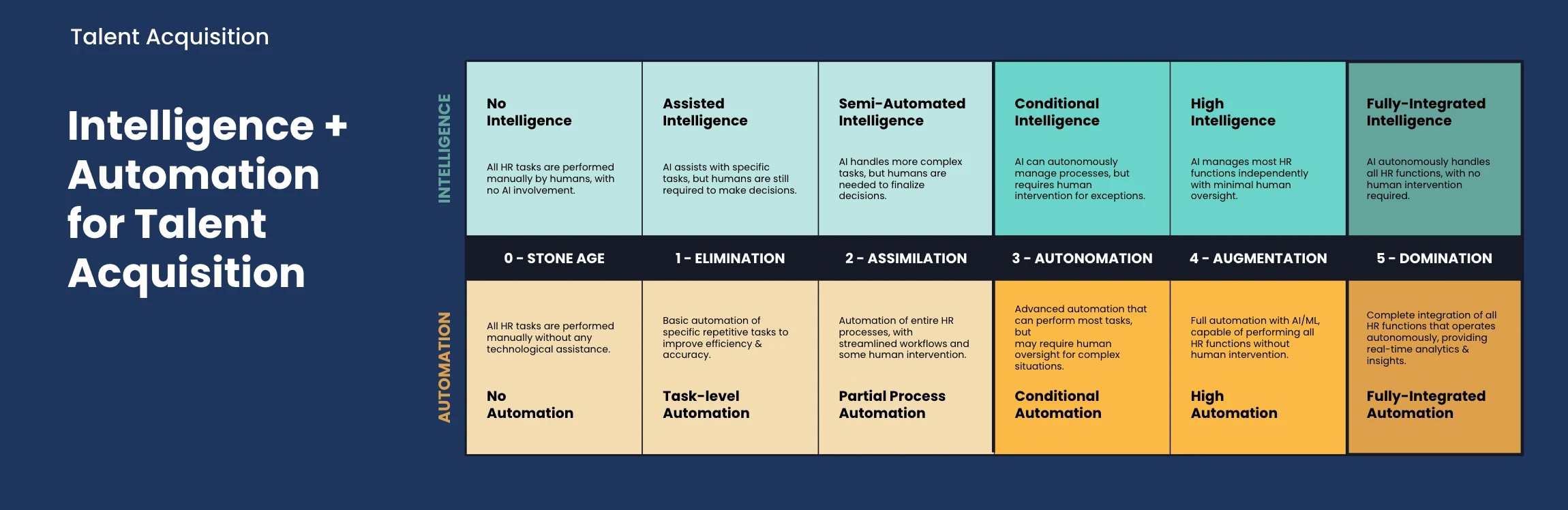
Each axis runs from 0 to 5. At zero, everything is manual. At five, AI operates autonomously across all HR functions. Most organizations should be targeting a 3 or 4. Level 5 is an aspirational state that no organization has fully achieved today. The goal, however, isn't to reach a five everywhere; it's to understand where each part of your workflow currently sits, where it realistically could go, and what moving the needle is actually worth.
Before Phenom, SASR's recruiting funnel barely existed. Candidates came in, got lost, and might receive an onboarding call 45 or 90 days later, if at all, Cooper recalled. There was no structured candidate journey, no automation, and no way to measure what was working. And that points to something the model makes explicit: you cannot automate a process that doesn't exist. SASR wasn't just optimizing a workflow; they were building one from scratch.
How Does the Model Work in Practice?
On the automation side, the lower end of the scale covers campaign automations, email reminders, and notifications. Moving up into the twos and threes brings in AI scheduling and structured candidate workflows. Voice agents and fully agentic AI capabilities sit at the four-to-five range. The intelligence dimension runs a parallel track: how candidates are matched to roles, how fit scoring works, and how AI-driven signals inform recruiter decisions.
Importantly, the two axes don't always move together. An organization can be highly automated but still making decisions without much AI intelligence, or vice versa. Knowing where each axis stands independently is what gives the assessment its precision.
The model also functions as a shared language. When Cooper brought it back to his leadership team, he described it as a map the whole organization could reference to get on the same page. “Everybody can look at the same things ... everybody’s talking the same language.” That alignment is what makes the model actionable rather than theoretical.
Related: What the 2026 AI & Automation Benchmarks Reveal About HR Maturity
What Did SASR's Self-Assessment Uncover — and What Did They Do About It?
When SASR mapped their recruiting process against the maturity model, the gap was hard to miss. On the automation side, they had made real progress. Scheduling, high-volume hiring, and structured candidate workflows had moved them to roughly a three. But the top of the funnel was still leaking. Candidates were applying, making it through to a live recruiter interview, and only then revealing they wouldn't accept a travel requirement or an overnight shift. Those were knockout questions that should have been asked on day one. The screening stage had no automation, no intelligence, and no filter, and every misaligned candidate cost a recruiter an interview slot that was already 4 to 5 days out.
Rather than overhauling the entire process, SASR made a targeted move to deploy Phenom Voice Screening Agent “Phoebe” at the exact point where the bottleneck was worst. A candidate lands on the career site, learns about the company, applies, and within minutes receives a prompt to either schedule an interview with a recruiter or complete a voice screening with Phoebe right now. Most chose immediately.
Since launching Phoebe, SASR has seen shifts across every stage of that journey:
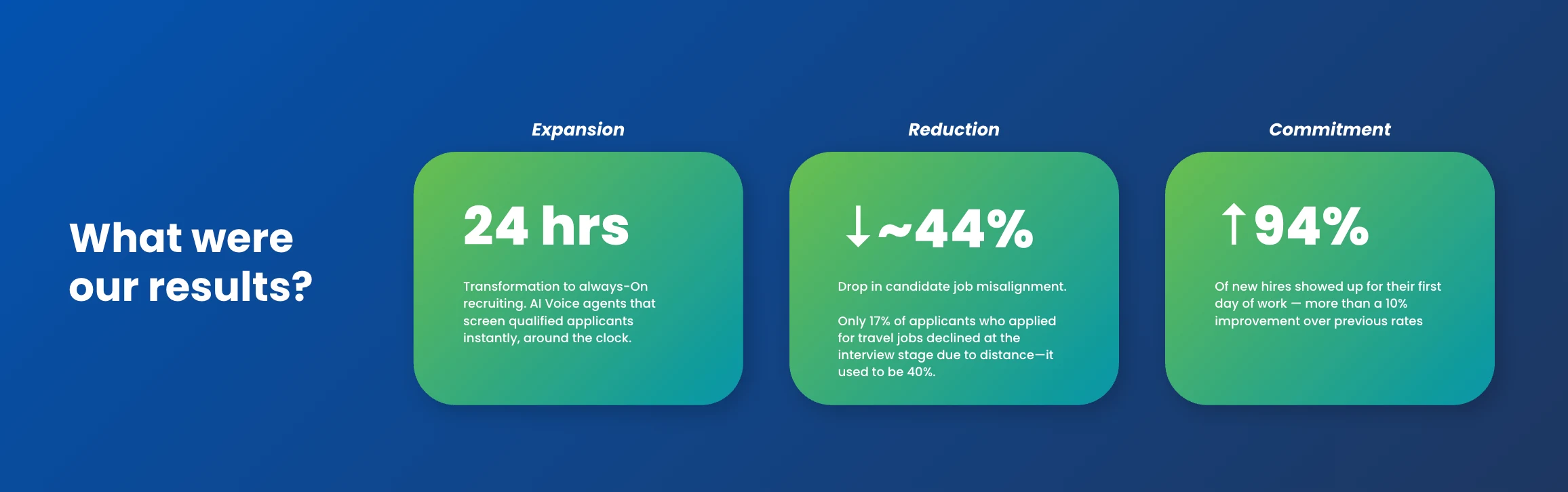
24-hour recruiting coverage: AI voice screening operates around the clock. Roughly 85% of applicants opt into an immediate screening, with the full journey from career site visit to completed screening happening within 30 minutes.
~44% drop in candidate job misalignment: Recruiters previously spent a live interview slot (with first availability 4–5 days out) discovering a candidate wouldn't accept a travel requirement. Phoebe surfaces that disqualifier upfront, protecting interview time and accelerating offer conversations.
94% first-day show rate: New hires are showing up and getting to work faster. In 2023, the average time from hire to first day on the job was 57 days; by 2025, that dropped to 20. The end-to-end process that once spanned roughly 120 days now runs in under 30.
The job misalignment stat captures what recruiter time actually costs when there’s no pre-screening. Multiply 20 minutes by 850 candidates, and you have the equivalent of a part-time recruiter’s annual output gone to conversations that were never going to result in a hire. With Phoebe handling the knockout questions, that time moved back to meaningful work, as evidenced by the team.
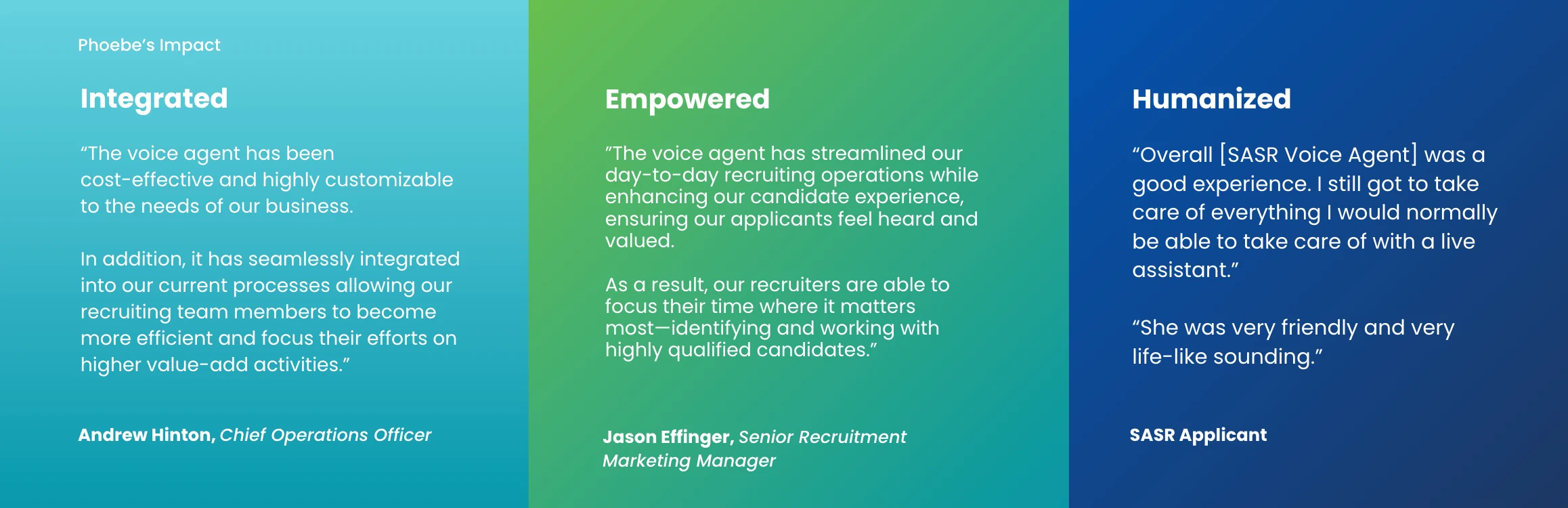
The show-rate improvement was the result Cooper called most meaningful. When placed, employees show up fully staffed on day one; the downstream effect isn’t just operational. It shapes how SASR’s clients view them as a partner. “The intangibles there that I can’t measure is, how much is that helping our brand?”
How Do You Turn an AI Maturity Assessment Into a Long-Term Roadmap?
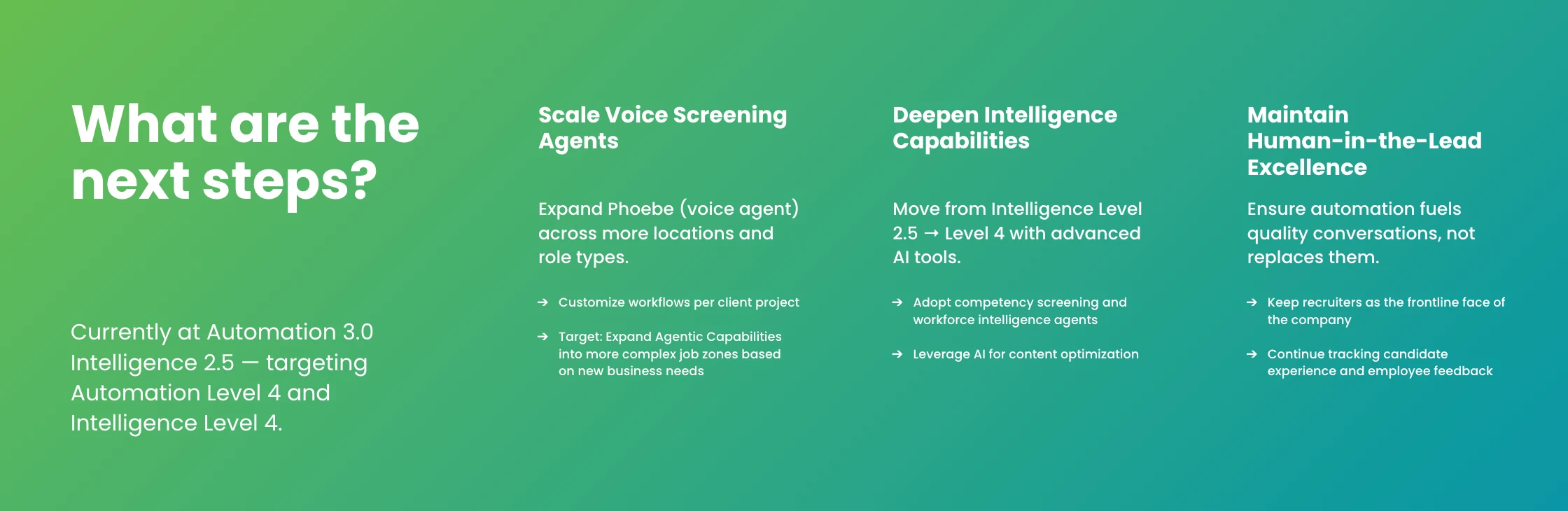
For SASR, the answer to that question is already in motion. With screening resolved, the next gap became visible: onboarding. That's where their focus is now, applying the same logic of identifying the constraint and addressing it before moving on.
The model exists to give organizations a common language for having honest conversations about the current state and realistic next steps. SASR's story is a practical illustration of what that looks like over time. Their conversation started in 2021 with a career site and a talent CRM. Five years later, they have a voice screening agent qualifying candidates at 2 a.m. The distance between those two points wasn't a single leap. It was a series of deliberate steps, each one built on knowing exactly where they stood and what the next step would be worth it.
Download the 2026 AI & Automation Benchmarks for HR to learn more

Gautami is a Product Marketing Manager at Phenom. She loves twisted thriller movies and is passionate about bringing creativity to life through crafting.


Get the latest talent experience insights delivered to your inbox.
Sign up to the Phenom email list for weekly updates!


