What the 2026 AI & Automation Benchmarks Reveal About HR Maturity
AI is everywhere in HR right now, and while getting started is as easy as swiping a credit card, true maturity is a longer journey. New tools promise faster hiring, smarter decisions, and immediate impact. Yet there’s a wide gap between introducing AI into your stack and applying it in ways that truly reshape how HR work gets done, and that gap is where most organizations find themselves today. Most HR leaders know their teams are experimenting with AI in some form, but understanding where they truly stand compared to peers, and what meaningful progress looks like, is far less clear.
In a recent episode of Talent Experience Live, host Devin Foster sat down with Joanna Keel, Product Marketing Manager at Phenom, to unpack what’s really happening with AI and automation in HR today. The conversation drew on insights from the State of AI & Automation for HR: 2026 Benchmarks Report, an in-depth study of nearly 500 organizations in over 12 industries, designed to illuminate real-world AI usage.
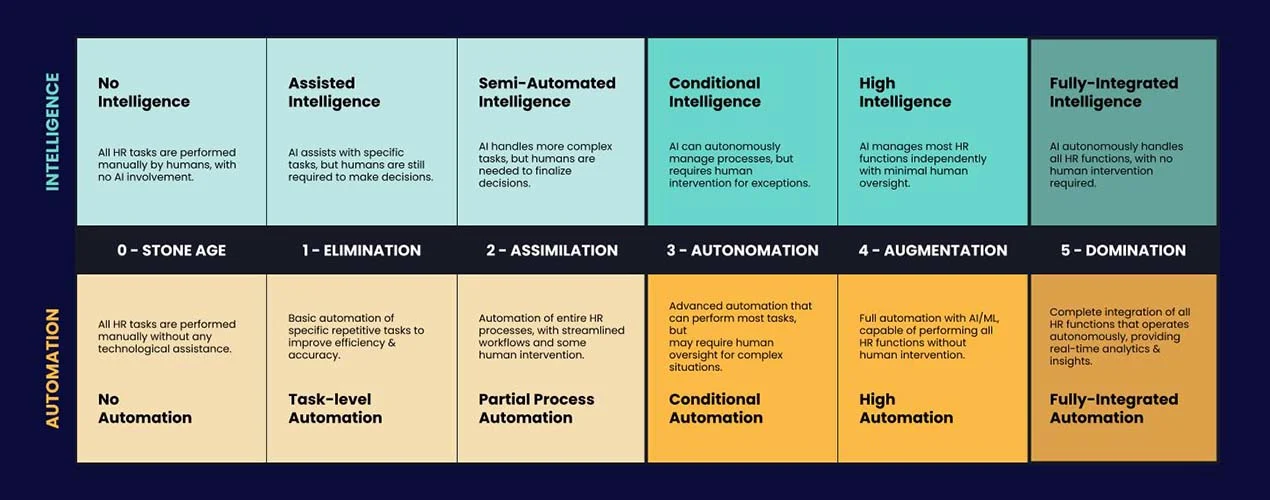
The report evaluates AI maturity across two distinct dimensions: automation and intelligence. Organizations often progress unevenly across the two, advancing in one while lagging in the other. This matters because maturity is not a single ladder to climb, but a combination of how much work is automated and how intelligently decisions are supported across workflows.
Watch the full conversation here and continue reading for the highlights!
Why Is There Such a Gap Between AI Aspiration and Application in HR?
AI adoption in HR often sounds further along than it actually is. Most platforms now include AI-driven capabilities, and many teams can point to pilots, feature testing, or early use. From the outside, it can appear that AI is already embedded in everyday work.
However, when you double-click beyond the headlines, the data shows that while AI is widely available, consistent application across teams is still developing. Most organizations have moved beyond fully manual processes, but AI has not yet become part of their end-to-end workflows. This gap becomes clearer when maturity levels are examined more closely.
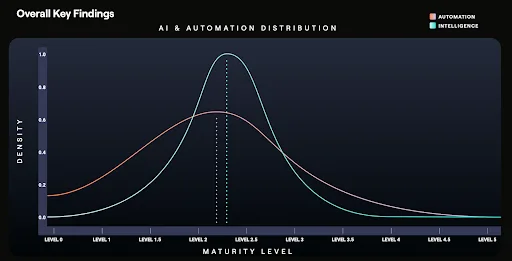
That gap becomes clearer when you look at where organizations sit on the maturity curve. Across the organizations analyzed:
83% fall between Levels 1.5 and 2.5 for Automation, indicating early efforts to reduce repetitive tasks
86% operate at Level 2.5 or below for Intelligence, where insights exist but are not yet driving action
Only 5% have reached Level 4 Automation (optimized / high automation)
Less than 1% have achieved Level 4 Intelligence (optimized / high intelligence)
These figures suggest that most organizations are still determining how to apply AI in ways that meaningfully change how work is done.
This progression mirrors how enterprise technology adoption typically unfolds. Initial use is often limited and exploratory, followed by broader adoption as teams build confidence to understand where technology can deliver true business impact. Maturity in AI or any new technology never happens all at once, but rather develops over time as organizations identify where automation fits, connects workflows, and applies consistent insights.
Even at early stages, organizations begin to see value beyond time savings. Usage data surfaces patterns in drop-off, bottlenecks, and candidate behavior that were previously invisible, giving teams clearer signals about where friction exists and what to improve next.
Understanding this gap is important because it reframes the conversation. The question is not whether an organization is using AI. It is whether AI is being applied in ways that support the work HR teams are responsible for today. That context sets up the next question the report helps answer: if most organizations begin in similar places, what allows some to progress while others remain in the middle?
What Separates High-Maturity AI Leaders in HR from Everyone Else?
The report shows that most organizations begin AI adoption in similar ways. Differences in maturity emerge later, based on how use evolves after initial activation.
High-maturity organizations are not defined by the tools they purchase. They are defined by how AI is used in day-to-day operations. When usage extends beyond pilots and one-off experimentation. When AI becomes part of standard workflows and is shared across roles rather than concentrated with a small group of users.
Lower-maturity organizations show a different pattern. AI capabilities may be enabled, but usage remains uneven. Activity is often limited to specific features or individuals, with little consistency across teams or stages of work.
There are several clear distinctions between low and high maturity:
Dimension | High-Maturity Organizations | Low-Maturity Organizations |
Team Adoption | Usage is distributed across teams | Usage is limited to a single champion or a small group |
Workflow Application | AI is applied at defined points in the workflow | AI is added opportunistically or inconsistently |
Workflow Visibility | Workflows are connected, enabling visibility into delays and bottlenecks | Workflows remain fragmented, limiting visibility into bottlenecks |
Performance Management | Outcomes are reviewed, measured, and adjusted | Outcomes are assumed once activation occurs, with little iteration |
One theme from the conversation and the report was clear: maturity is not driven by individual power users or insular teams. High-maturity organizations see adoption spread across recruiters, hiring managers, and HR teams. When usage is isolated to a single champion or group, progress stalls. When AI becomes a shared practice, maturity accelerates.
These differences explain why progress slows after early adoption. Moving beyond the middle of the maturity curve requires operational change and adoption, not additional tools.
What Does a “Middle-Maturity” HR Group Look Like, and Why Do They Get Stuck with AI?
Most HR organizations fall into the middle range. They automate individual tasks such as recruiter scheduling or basic campaign follow-ups, while the majority of screening, coordination, and decision-making remains manual.
The common issue is not capability, its consistency. Teams often activate a feature and then move on. Results are not reviewed in a methodical cadence, and workflows are not refined based on data. Without timed feedback loops, adoption levels fall off and maturity stalls.
The report draws a clear distinction here. Activation only creates limited progress. Iteration and perseverance determine whether that progress continues. What keeps organizations in the middle is rarely a lack of capability, but rather the absence of change management. Without clear ownership, feedback loops, and shared expectations for how AI fits into daily work, early activation rarely turns into sustained progress.
What Are the Biggest Misconceptions HR Leaders Have About AI and Automation?
Several misconceptions contribute to AI stalling and appear consistently across organizations.
#1 AI replaces HR. It changes how work is executed, not who owns it. Decision-making and accountability remain with HR teams. Even as organizations adopt AI agents, responsibility does not disappear. Agents handle execution at scale, while humans retain oversight, judgment, and control over outcomes.
#2 Value only appears at advanced maturity. Early-stage adoption delivers measurable benefits, including time savings and reduced friction
#3 Results should be immediate. Progress occurs in phases as teams address one bottleneck at a time and expand usage based on outcomes
These misconceptions reflect the hype around AI, not the practical osmosis into an organization’s DNA. HR teams hesitate when clarity around impact, control, and accountability is lacking. Taken together, these patterns explain why many organizations remain in the middle of the maturity curve, while a smaller group continues to advance. The next section examines how this maturity gap varies across industries facing different business pressures.
Which Industries Are Leading in AI and Automation Maturity, and Why?
When maturity data is reviewed across industries, adoption patterns become clearer. Progress does not happen evenly. It accelerates where hiring pressure creates immediate operational risk and slows where inefficiency can be absorbed longer.
The report analyzes AI and automation usage across several industries, and the results show that maturity aligns closely with business urgency rather than interest or intent. Industries that feel the cost of open roles most acutely tend to advance faster.
Healthcare consistently ranks among the most mature industries in the benchmarks. Staffing shortages directly affect patient care, safety, and compliance. Delays are visible and costly. As a result, healthcare organizations apply automation and AI earlier across sourcing, screening, and engagement to reduce friction and keep roles moving.
Other industries show different maturity patterns based on their operating realities.
Industry | Where Maturity Shows Up First | Why |
Healthcare | Automation across sourcing, screening, and engagement | Staffing gaps directly affect care delivery and safety standards |
Financial Services | AI-driven matching and fit | Hiring accuracy, risk management, and regulatory scrutiny |
Transportation | Interview scheduling and workflow coordination | Always-on operations and dependency on timely staffing |
Retail | Mixed and uneven adoption | High volume hiring, fragmented processes, seasonal demand |
One retail organization discussed during the session illustrates how maturity progresses in practice. The team started by automating interview scheduling, removing manual coordination, and saving hundreds of recruiter hours in high-volume hiring workflows. When they reviewed their progress using the maturity framework, they saw a clear imbalance: automation had advanced faster than intelligence. Rather than randomly stacking new tools, they used insight to expand deliberately, adding voice-based screening to improve candidate throughput while maintaining recruiter oversight for review and decision-making.
Not surprisingly, different industries show maturity in different places, shaped by what creates the most risk or pressure in their hiring processes.
Financial services show stronger adoption of intelligence than automation. These organizations focus first on improving decision quality through matching and fit. Regulatory scrutiny and risk management place greater emphasis on accuracy than speed, especially in the early stages of adoption.
Transportation shows higher maturity in scheduling automation. Delays ripple quickly across shifts, locations, and routes, making coordination essential to daily operations. Automation here supports continuity rather than experimentation.
Retail remains closer to the middle of the maturity curve. Despite constant hiring needs, advanced screening and high-volume workflows are underused. The opportunity to scale is significant, but adoption varies widely by organization due to fragmented processes and seasonal demand.
Taken together, these patterns do not suggest that some industries are inherently more advanced. They reflect how quickly the cost of manual work becomes unacceptable in different operating environments.
The report reinforces an important caution. Industry benchmarks are directional, not prescriptive. A retail organization should not measure itself against a healthcare system, just as a financial services firm should not evaluate progress using frontline hiring metrics solely.
Related: AI and Automation in HR: The Roadmap to Intelligent Operations
Where Can HR Teams See Real ROI From AI and Automation?
Across the report and the conversation, one point is consistent: early ROI does not come from broad transformation. It comes from reducing friction in work recruiters already do every day.
The benchmark data shows that organizations seeing early returns tend to focus on a narrow set of workflows. Screening, scheduling, and matching rise to the surface repeatedly because they are high-volume, repetitive, and easy to measure. Improvements in these areas are visible quickly and easy to validate internally.
What Early ROI Looks Like in Practice
The report includes several examples where targeted automation produced measurable gains without altering recruiter ownership.
In one healthcare environment using automated screening for clinical roles, the results were clear:
85% completion rates for screening interactions
60% faster screening, reducing time per candidate from 20 minutes to 8
2x improvement in candidate quality, with hire ratios improving from 7:1 to 3:1
The work itself did not disappear. Recruiters still reviewed candidates and made decisions. What changed was how the work was executed. Instead of spending hours on repetitive phone screens, recruiters reviewed completed screenings and focused on qualified candidates.
The data also reinforces a common lesson: solving isolated problems with disconnected tools often creates new problems elsewhere. Organizations that progress avoid stacking point solutions. Instead, they focus on connected workflows that allow measurement, iteration, and visibility across multiple stages of work.
Knockout questions prevent time spent on clearly ineligible candidates. Automated scheduling removes manual back-and-forth coordination. Even modest intelligence, when applied consistently, reduces manual effort.
What separates momentum from stagnation is focus. Organizations that progress select one bottleneck, apply automation or intelligence to that problem, and measure what changes. Once the value is visible, confidence grows, and expansion becomes easier to justify. This approach also addresses hesitation. Many HR professionals want assurance that workflows will not break, decisions remain transparent, and intervention is always possible. That concern reflects accountability, not resistance. As candidate behavior evolves, this need becomes more urgent.
The report notes that a growing number of organizations have encountered candidate fraud, including inflated applications and AI-assisted interview responses. Manual processes struggle to detect these issues at scale. Automation and intelligence help surface inconsistencies earlier while keeping judgment with HR teams. Taken together, the data points to a straightforward conclusion. ROI follows clarity. Teams that define what they are solving, measure outcomes carefully, and expand deliberately build momentum without overwhelming their organization.
Governance plays a central role in sustained adoption. Teams need confidence that AI is transparent, auditable, and aligned with internal policies. Organizations that establish oversight early, define escalation paths, and work with trusted partners move faster over time because confidence replaces hesitation.
Related: Build and Measure HR Tech ROI Across the Talent Lifecycle (Before and After Go-Live)
What Advice Does the Report Offer CHROs Leading With AI?
AI maturity should be considered a leadership responsibility, not a technology initiative. Progress depends on how clearly CHROs sequence decisions, set expectations, and choose where to invest first.
Organizations that advance do not chase isolated use cases. They avoid solving today's problem in ways that limit tomorrow’s options. Instead, they build foundations that allow AI to expand as needs change, moving from screening and scheduling into matching, engagement, and workforce insights over time.
The guidance is practical and consistent:
Invest in scalable infrastructure, not one-off fixes. Solve immediate bottlenecks without creating constraints that slow future adoption.
Expect progress to happen in phases. Tackle one real problem, measure outcomes, and decide what to expand next.
Address change management early. Clarify how AI fits into existing work, retain human oversight, and define governance from the start.
Choose partners that can prove impact. Use real usage data and benchmarks to set expectations and guide investment.
Lead with progress, not perfection. Start where pressure is highest, learn from results, and build forward deliberately.
AI maturity is not the finish line. It’s an ongoing progression shaped by leadership choices. CHROs who lead effectively create room for learning, align teams around evidence rather than aspiration, and expand AI use at a pace the organization can sustain.
Over time, those decisions determine whether AI remains an experiment or becomes part of how HR work gets done every day.
Related: From AI Investment to Impact: The CHRO’s Guide to Bridging the Performance Gap
What AI Maturity Looks Like in Practice
The benchmarks report make one thing clear: most organizations are still in the early stages of adoption, but not all will progress at the same pace. The difference is not access to AI, but how deliberately it is applied, measured, and expanded across teams.
AI maturity is not a finish line. It is an operational journey shaped by leadership choices. Organizations that treat progress as shared practice, invest in scalable foundations, and learn from real usage data turn AI from an experiment into part of how HR work gets done every day.
Download the 2026 AI & Automation Benchmarks for HR to explore how organizations across industries are applying AI today, and where the next phase of maturity is taking shape.

Apurba is a writer who specializes in creating engaging content, backed by storytelling, data, SEO and a cup of coffee. When she’s not writing, she’s reading, cooking fusion food, or curiously traveling like a local.


Get the latest talent experience insights delivered to your inbox.
Sign up to the Phenom email list for weekly updates!


