

Applied AI in HR Tech: What It Means, How It Works & Real-World Case Studies
Summary
Applied AI: It deploys machine learning, AI, and automation to solve specific business problems. It operates with a narrow, outcome-focused scope and is designed for measurable impact, unlike theoretical or research-stage AI.
Applied AI versus generative AI: Generative models create content and are a subset of Applied AI. Applied AI leverages not only generative AI but also other AI/ML models to inform better decisions and automate processes across recruiting, retention, and workforce planning, yielding measurable business outcomes.
Infrastructure requirements: HR teams require robust systems, including unified data, model management, and compliance layers, to deploy AI reliably and ethically.
Implementation success: Real wins happen when HR leaders start small, measure ruthlessly, and scale with governance in place.
Many HR organizations struggle with a fundamental gap. That gap is the difference between having access to AI tools and implementing AI that transforms talent operations. Organizations with an AI-first strategy will achieve 25% better outcomes by 2028, according to Gartner. Yet strategy without execution remains theoretical. Applied AI fills this gap by providing a structured methodology that moves from AI-first intentions to measurable business results.
This blog explains what applied AI means for HR technology, how it differs from generative AI (GenAI), and how to identify and implement it across your organization’s talent lifecycle.
In this Article:
What Is Applied AI?
Applied artificial intelligence directs machine learning and large language models toward specific, measurable business outcomes. It operates with a narrow scope, solving specific problems exceptionally well rather than broad or general challenges. Applied AI runs in production environments where it integrates into workflows to deliver quantifiable ROI. Research AI explores what is possible. Applied AI asks what is profitable, safe, and scalable right now.
Why the term “applied” matters
This distinction separates real capability from experimental hype. A research lab may create a model that identifies patterns in employee data. An applied AI system takes that model, embeds it in your HR system, monitors its accuracy, and adjusts it based on hiring outcomes and internal mobility.
Why applied AI is highly relevant in HR tech
HR operations generate large amounts of structured data, such as applications, performance reviews, training completion, engagement surveys, and attrition patterns. There is also a lot of unstructured data in the form of resumes, 1-on-1 notes, and more. Applied AI turns both these types of data into actionable recommendations and insights. It successfully reduces time-to-hire, identifies flight risks early, and personalizes learning paths that people actually follow.
Unlike broad generative tools, applied AI in HR focuses on key stages in the talent lifecycle, such as recruiting, onboarding, retention, and employee development. The outcomes are measurable and tied directly to business results.
Related: AI Recruiting in 2025: The Definitive Guide
Applied AI vs. Generative AI
AI terminology often holds important differences. Understanding the distinction between narrow AI, general AI, and generative AI helps you choose technology that transforms operations instead of simply generating content.
Narrow AI (applied AI): It solves a specific challenge in a defined domain. Examples include a voice screening agent that conducts interviews, a workforce planning model that predicts headcount needs, or a retention prediction system analyzing employee data. These systems learn HR-specific patterns, integrate into workflows, and produce measurable outcomes.
General AI (strong AI or AGI): This refers to a theoretical capability where one system reasons at the human level across any domain.
Applied AI and general AI pursue different goals. While applied AI solves current, specific problems, general AI aims for human-level intelligence and remains theoretical.
What generative AI is and how it differs
Generative AI creates new content by learning from patterns in training data. Examples include ChatGPT for text, DALL-E for images, and models that generate code or audio. GenAI is powerful, but it represents only one technique within the broader applied AI landscape.
The table below shows how applied AI includes GenAI but also covers automation, prediction, decision support, and workflow orchestration.
Dimension | Generative AI | Applied AI |
|---|---|---|
Core purpose | Generates new content by learning patterns in training data | Solves specific business problems with clearly measurable outcomes |
Capability range | Produces text, images, code, and audio content | Automates decisions, supports human judgment, predicts outcomes, orchestrates workflows, and generates content |
HR applications | Drafting job descriptions, creating training modules, and generating onboarding materials | Screening candidates, predicting employee attrition, personalizing learning paths, automating interview scheduling |
How success is measured | Output quality, relevance to the request, and customization capability | Business impact through ROI, model accuracy, cost reduction, and time savings |
System integration | Can function independently without connecting to other systems | Requires integration into existing workflows and systems to deliver business value |
Outcome orientation | Depends on how it is applied; the outcome is not guaranteed | Built into the design from inception, every system is designed around measurable business outcomes |
A GenAI model producing personalized onboarding content becomes applied AI when its output connects to business outcomes, such as standardizing and customizing onboarding journeys based on role. A screening agent making hiring recommendations is applied AI. A predictive attrition model is applied to AI. A generative system that creates content without influencing business results is exploratory, not applied AI.
Related: Types of AI Agents Explained: A Practical Framework for HR Innovation
Why HR-tech companies should care about the distinction
Choosing the right technology vendor is critical to your applied AI success. Technology selection depends on understanding what each AI approach delivers. When evaluating a vendor, ask questions such as:
What problem does this solve?
How is success measured?
How is accuracy monitored?
Does it integrate into my existing systems?
Critically, choose vendors with comprehensive approaches to explainable and ethical AI, validated by third-party audits and testing. Applied AI demands measurable outcomes and requires ROI, governance protocols, and bias auditing before deployment. Generative AI offers creative capabilities, and evaluation focuses on output quality and relevance. The frameworks for assessing them differ fundamentally.
Organizations that blend these often invest in GenAI without linking it to business results or ignoring the governance required for applied AI. Clear distinctions prevent hype-driven spending and strengthen alignment to strategic talent outcomes.
Infrastructure for Applied AI in HR Tech
Applied AI cannot operate on its own. It needs systems that connect data, run workflows, and support compliance. Strong infrastructure determines whether your AI systems produce reliable insights or struggle to integrate into daily operations.
Why infrastructure matters for applied AI
Accuracy, speed, and reliability depend on foundational systems. Weak non-standardized data can reduce model accuracy, and limited computing resources will slow decision-making. Integration layers that do not connect systems force manual work and break workflows. While organizations treating infrastructure as secondary struggle to scale applied AI, those who invest early see better model performance and smoother deployment.
Core infrastructure components HR tech teams need
Data infrastructure: Unified HR data across Applicant Tracking Systems (ATS), Human Resource Information Systems (HRIS), Learning Management Systems (LMS), Candidate Relationship Management Systems (CRM), and benefits platforms. Real-time data ingestion enables models to work with current information, while APIs connect disparate systems so screening agents, retention models, and learning platforms see complete candidate and employee profiles rather than siloed data.
Model infrastructure: Reliable hosting environments, version control, and MLOps practices that track accuracy, catch drift, and signal when retraining is needed.
Security and compliance: Access controls for sensitive data, encryption for data in transit and at rest, and audit trails for regulatory review. Alignment with SOC2 and ISO standards.
Integration infrastructure: Scalable APIs, event-based triggers, and workflow automation so that applied AI appears inside the systems HR uses every day.
How Phenom's infrastructure addresses HR tech requirements
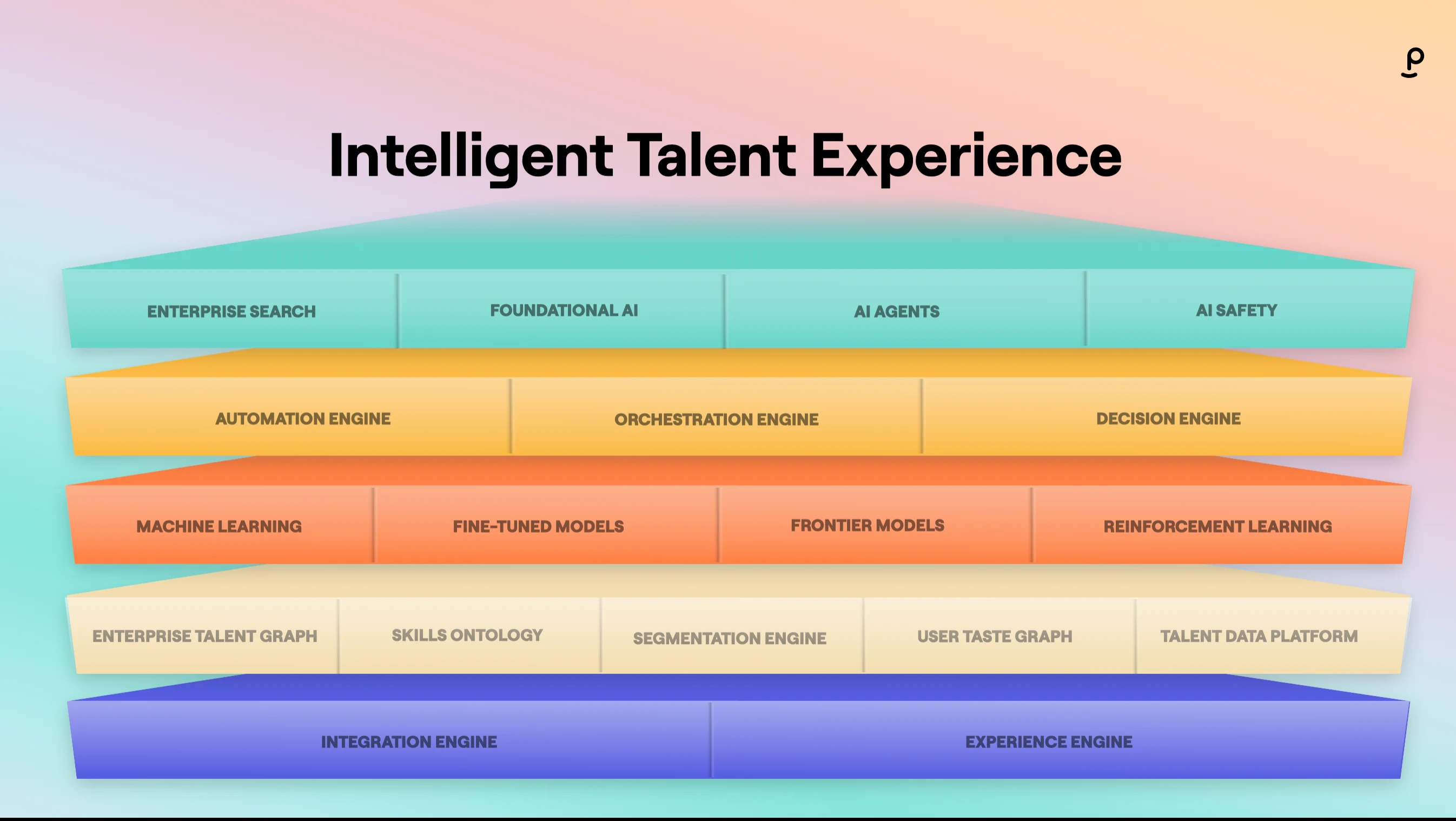
Building a layered infrastructure that meets all HR tech requirements is complex. Organizations must unify disparate data sources, map organizational context through ontologies, deploy models that understand HR-specific logic, orchestrate workflows with governance embedded throughout, and integrate across systems seamlessly. Most HR technology platforms address one or two of these layers in isolation. Phenom's architecture integrates all five layers as a unified, coherent system designed specifically for talent operations.
Unified data foundation: It connects disparate data from your ATS, HRIS, LMS, and benefits systems into a unified engine. This foundational knowledge layer eliminates data silos that prevent applied AI from working effectively. A screening agent cannot operate without complete candidate profiles. A retention model fails without employee performance data. Unified data ensures models see the complete picture.
Industry-specific ontology layer: Once data flows together, an ontology layer maps your organization's talent language: skills taxonomies, job families, career progression patterns, and user preferences into an enterprise talent graph. This is where industry knowledge becomes embedded. A healthcare organization's skills architecture differs fundamentally from a technology company's. Your manufacturing role progression paths are unique to your business. Phenom's ontology learns from your data and user feedback, continuously refining the model to match your specific industry context and organizational realities.
Specialized HR models for pointed use cases: Generic AI models miss HR-specific logic that matters. Phenom deploys specialized models trained on recruiting workflows, compliance requirements, and job taxonomies. These models power concrete, measurable applications: sourcing agents that identify passive candidates, screening agents that evaluate fit, intake agents that streamline hiring manager conversations, and scheduling agents that coordinate interviews. Each model targets a specific workflow friction point where applied AI creates immediate value.
Orchestration with governance: An orchestration engine coordinates data, ontology, and models while enforcing governance, testing, and explainability protocols. Every decision gets audited: Is it compliant? Does it align with your talent strategy? This layer ensures that applied AI in hiring, promotion, and retention decisions remains legally defensible and ethically sound.
Seamless integration: Finally, integration and experience engines connect the entire system to your existing workflows. Applied AI only works when embedded where work actually happens, not isolated as a separate tool. Phenom's infrastructure connects to your ATS, HRIS, and communication systems so agents operate inside your existing processes.
This architecture enables intelligence that learns from your industry context, adapts to your organizational needs, and acts on pointed use cases where applied AI delivers measurable business outcomes.
Infrastructure challenges unique to HR
Sensitive data governance: Employee and candidate data require strict privacy controls and compliance with GDPR, CCPA, and emerging AI regulations.
Ethical review requirements: AI models influencing hiring or promotions must undergo ethical review and bias auditing before launch.
Explainability: Decisions affecting careers must be understandable. Systems must document how decisions were made for review and accountability.
The Applied AI Approach in HR Tech
Implementing applied AI requires a staged framework from problem identification to scaling. The six stages outlined below move from identifying your highest-impact challenge through measurement and eventual scaling, ensuring data quality, ethical safeguards, and measurable outcomes at each step.
Stage 1: Pinpoint one high-friction HR challenge. Specificity is key. For example, “improve recruiting” is too vague. “Reduce time-to-hire for engineers by 30%” is actionable.
Stage 2: Collect clean, representative data related to the problem. Data quality influences model performance more than model choice. Address gaps or historical biases before continuing.
Stage 3: Choose a model or approach suitable for the problem. Screening requires different models from retention prediction. Decide whether to build custom systems or use vendor solutions.
Stage 4: Place the model inside real workflows. Many implementations fail because teams treat integration as optional. Test in parallel before going live.
Stage 5: Measure and define KPIs upfront and track results. Compare pre- and post-deployment data.
Stage 6: Expand once the pilot proves value and governance is established.
How HR-Tech Teams Can Apply AI Today
Moving from understanding applied AI to implementing it requires prioritization, decision-making about build versus buy, and careful integration planning. The following sections outline a practical approach to apply AI evaluation, selection, deployment, and measurement :
Prioritizing use cases: Use an impact-versus-ease matrix. Screening, scheduling, and document processing often offer quick wins.
Vendor versus in-house decisions: Choose vendors that have pre-built, tested solutions for your specific use case and proven ROI in your industry. Critically, prioritize vendors with comprehensive approaches to explainable and ethical AI, validated by third-party audits and testing. The vendor should demonstrate proven deployment in your industry, transparent governance frameworks, and measurable customer outcomes. They have already solved data integration, compliance, and bias testing challenges.
Scaling applied AI: Integration with ATS, LMS, and HRIS systems is essential. Plan for training and change management. Start small and expand gradually.
Measuring ROI: Track cost-per-hire, time-to-fill, offer acceptance rate, new-hire retention, internal mobility, learning completion, and engagement. Compare before and after deployment. Strong results usually appear within 6 to 9 months.
Related: Beyond the Buzz: How to Identify Authentic AI in Hiring Technology
FAQs About Applied AI in HR Tech
Can generative AI be an applied AI use case in HR?
Yes. Generating personalized onboarding content, drafting job descriptions, or creating training modules all constitute applied AI scenarios if they drive quantifiable business outcomes. The distinction rests on outcome orientation and measurable impact, not the underlying technology used.How do we handle ethics and bias?
Run bias audits before deployment, use explainability tools, maintain human oversight, and perform ongoing reviews.How is applied AI different from machine learning?
Machine learning (ML) is a technique — a method for training models. Applied AI is the deployment philosophy and business-outcome orientation. Machine learning answers "How does the model work?" Applied AI answers "What business problem?”.Is all AI “applied” once used in business?
No. Applied AI specifically targets measurable business outcomes with clear success metrics. Implementing AI without outcome focus constitutes exploration, not applied AI. The distinction matters enormously because it changes how you evaluate, implement, and measure success. Applied AI demands accountability and ROI.
The Future of Applied AI in HR Tech and Next Steps
Applied AI will expand across HR operations. Agentic systems will manage end-to-end workflows. Voice AI will become standard in screening. Hyper-personalized employee experiences will influence development, engagement, and mobility. The competitive advantage shifts toward HR leaders who pair automation with human expertise, prioritize governance, and treat applied AI as an ongoing capability rather than a one-time implementation.
The path forward begins with assessment and action. Evaluate your HR operations and identify areas with immediate opportunity. Start with a focused workflow, partner with a trusted vendor, and measure outcomes consistently. Organizations succeeding with applied AI share common traits: they start with clear, measurable problems; they partner with vendors who demonstrate expertise and ethical governance; and they treat governance as essential rather than optional.
Ready to move forward with applied AI?
The AI & Automation Toolkit gives you practical guidance to implement AI and automation where it matters most. What’s inside:
✅ A clear roadmap for applying AI across your talent operations
✅ A maturity model that shows your current and future state
✅ A quick assessment to identify your organization’s AI level

Devi is a content marketing writer passionate about crafting content that informs and engages. Outside of work, you'll find her watching films or listening to NFAK.


Get the latest applied AI insights delivered to your inbox.
Sign up to stay up-to-date on the latest original content from Phenom, including new podcast episodes, events, and more.


