

Future-Ready Talent: Building a Unified Workforce at Bouygues
Internal mobility isn't just an HR nice-to-have — it's a retention strategy that directly impacts your bottom line. When employees can't see career paths within their own organization, they look elsewhere. The cost? Losing institutional knowledge, paying replacement costs, and watching competitors benefit from the talent you developed.
For large, multi-brand organizations, the challenge intensifies. How do you help employees discover opportunities across different business units when each operates independently? How do you build career bridges between construction and telecommunications, or media and energy? Most critically, how do you prevent your internal application process from being harder than applying as an external candidate?
Cédric Meyer, HR Digital Transformation Senior Manager at Bouygues, faced these exact issues and shared how he and his team are addressing them.
Watch the entire session here, or read our full Q&A below!
What are the biggest challenges companies face while building internal mobility programs?
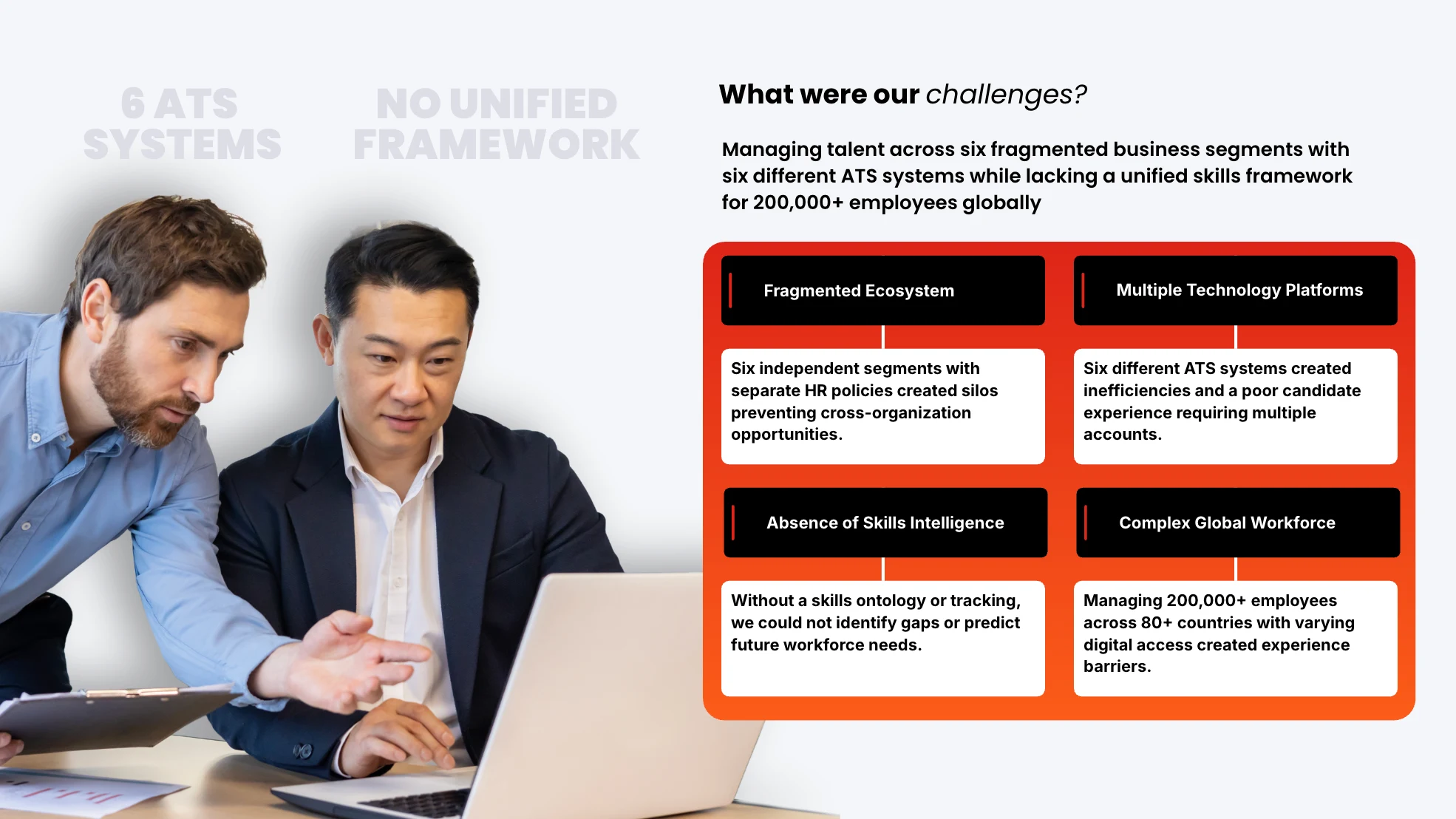
Bouygues operates across six distinct brands spanning construction, media, telecommunications, road and civil works, and property development. We employ 200,000 people globally, with half our business in Europe and the rest spread worldwide.
What's particularly challenging is the diversity of our workforce. The people working in telecom are completely different from those building roads or working on construction sites. Each of our six brands has historically operated autonomously with its own systems, processes, and identity.
The feedback we received was brutal but honest: "It's really complicated to apply for a position internally. This is maybe more complicated to apply internally than coming from the external." That was our wake-up call.
How do fragmented HR systems impact employee retention?
We had multiple career sites, multiple ATSs — mostly SAP SuccessFactors, but not all of them. So we didn't have any skill intelligence before we started with Phenom. Even the concept of a skills ontology wasn’t really there.
Our exit survey data told a compelling story: 30% of people leaving said, "I don't see any opportunity for me in the future." That's nearly one in three employees walking out the door because they couldn't see a path forward.
From a candidate and employee perspective, finding opportunities within Bouygues meant visiting separate career sites for each brand, trying to understand what each company did, and navigating completely different application processes. For employees who had been with us for 20, 30, even 40 years, this fragmentation was incredibly frustrating.
How do you build executive sponsorship for talent experience transformation?
In construction, where we face real talent shortages and need people with specialized expertise, our existing employees represent our most valuable talent pool.
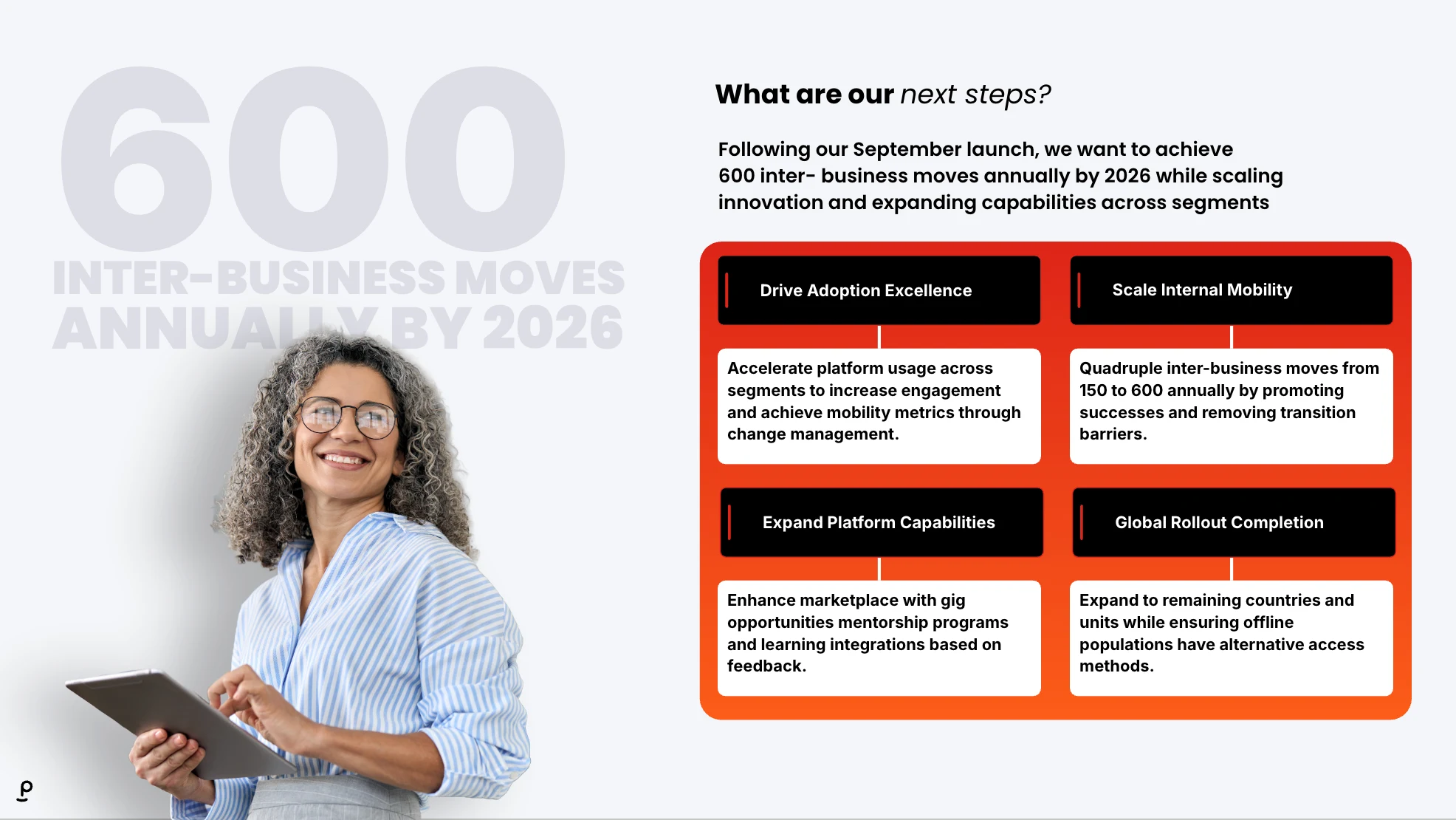
Our CEO's vision was clear: having people move from telecom to media to construction to energy — that ability to build careers across our brands — that's what we needed to enable. He set an ambitious numeric target: move from 150 internal mobility transitions per year to 600. That's a 4x increase, and he made sure executive compensation was tied to hitting these mobility metrics.
We had three strategic objectives: First, ensure every employee could discover opportunities across all six brands; second, radically improve the candidate and employee experience; and third, build skill intelligence into our talent strategy for the first time.
To maintain momentum, we built accountability into the system. When you index part of each brand CEO's bonus to internal mobility, you get everyone's attention. Quarterly reviews with our leadership team focus on internal mobility KPIs and skills capture rates. When you create sustained focus at the executive level with measurable outcomes, cultural change becomes possible.
What’s the benefit of a solution like Phenom?
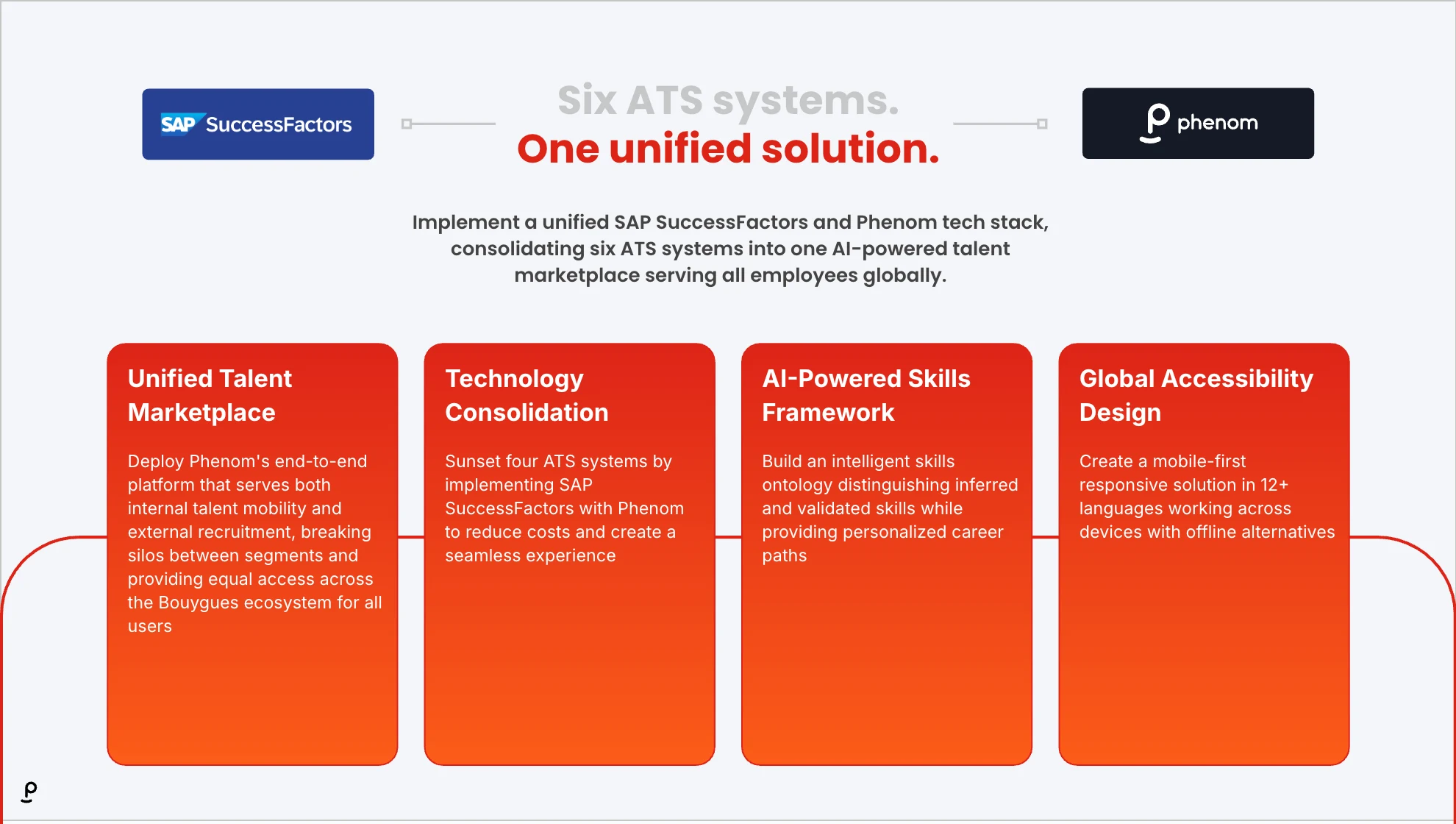
We needed a unified platform that could handle our complexity while being intuitive enough for employees who might be on construction sites with limited technology access. The solution had to work across eight languages since we operate globally and face legal requirements for local language support.
The ability to give recruiters a 360-degree view was crucial. They needed to see external candidates, internal employees who had applied, and potential internal candidates who matched a role but hadn't applied yet — all in one place. That comprehensive visibility simply didn't exist before.
Phenom could deliver the full candidate journey (external career site, CRM, intelligent sourcing, marketing and outreach campaigns) while also providing internal mobility.
How does Bouygues’ internal talent marketplace work?
We launched "Boost," our internal talent marketplace, with every job opening across all six brands visible to every employee worldwide. That had never existed before. An employee in France can now see opportunities in Munich or the Czech Republic. They can filter by company, set alerts for specific roles, and let the AI recommend positions based on their skills and preferences.
The profile setup is straightforward. Employees upload their resumes, and the system extracts their education, work experience, and skills. They can set proficiency levels and even ask colleagues to validate their skills, though we deliberately made this optional.
The AI analyzes employee profiles — their skills, job preferences, preferred locations, and work history — against our job descriptions. It considers job titles, required experience, skills, and location to generate personalized recommendations. Most employees received B-level matches in the first six weeks, meaning a good fit but not perfect.
How do you build a skills ontology from scratch?
We started with shared job families (HR, finance, administration) because those were easier to standardize across brands. We put generic role descriptions into Phenom's Employee Relationship Management (ERM) backend, and the AI suggested relevant skills based on industry benchmarks and internal job descriptions.
Then we conducted reviews with business leaders to validate the skills, adjust proficiency level requirements, and weight which skills mattered most for each role. The AI gave us the starting point, but business leaders provided the reality check and refinement.
We're still building this out. We just started working on field operation roles, which are more complex because they're so specialized and vary by brand. We expect to complete the initial skills architecture by the first or second quarter of 2026.
We're probably 30-40% complete, which is why we focused the initial launch on corporate and administrative functions where we had clearer definitions. As we add more field roles with proper skills mapping, the recommendation engine will become even more powerful.
What is cross-lingual skills matching and why does it matter?
What's interesting is the cross-lingual capability. If we have a position open in Germany written in German, and an employee in France has relevant skills tagged in French, the system can match them. We debated whether to enable this — after all, many field positions require speaking the local language — but we decided the AI should surface the opportunity and let the individual and hiring manager make that determination.
The search functionality isn't magic; it's just filtering. But the AI recommendations on top of the employee profile — that's where the real value emerges. People can search and filter all they want, but the system proactively suggesting relevant opportunities they might not have considered? That changes behavior.
We enabled the platform in eight languages because we operate everywhere and need, sometimes by law, to have local language support. The skills ontology can cross various languages — French to English, German to English work particularly well for us.
How do you protect employee privacy in internal mobility programs?
The career intentions feature was particularly important. Employees can signal whether they're actively looking, passively open, or just exploring future possibilities. Recruitment teams can see these signals, but managers cannot.
That was the number one question during our kickoff: "Can my manager see my career intentions?" The answer is no. We built in that confidentiality by design.
We needed managers to understand their role in facilitating movement, not preventing it. The message was clear: "We trust you. We want you to grow. It's okay to explore. It's okay to fail and find another opportunity later. Your manager should support your ambitions, not block them."
What metrics are you using to measure internal mobility success?
In our first six weeks live with Phenom, we've already seen significant voluntary engagement that validates our investment:
14,000 employees logged in to our new platform
4,000 completed full profiles with skills and preferences
30% received AI-powered job recommendations based on their skills
500+ employee referrals generated organically with no bonus incentive
These early metrics tell us the platform is resonating. But the ultimate ROI metric is achieving our CEO's goal: moving from 150 to 600 internal mobility transitions annually. When you track not just platform engagement but actual career moves that prevent attrition, you're measuring real business impact.
The quarterly reviews with our leadership team focus on these KPIs — internal mobility numbers, skills capture rates, and quality of matches. When executives see data showing employees staying because they found internal opportunities, the ROI becomes undeniable.
What change management strategies work for internal mobility adoption?
We knew launching a platform wouldn't automatically change decades of siloed thinking. The technology was the easy part. Shifting mindsets about internal mobility, about manager responsibilities, about career development — that required a comprehensive approach.
We dedicated an entire People Development Week to the launch. Since we own media infrastructure, we produced a one-and-a-half-hour live streaming event. More than 15,000 employees connected from around the world to watch our CEO and CHRO explain not just how to use “Boost”, but why internal mobility matters and what it means for our culture.
We created a comprehensive internal marketing campaign with videos showcasing the values we're building around internal mobility — diversity, fairness, efficiency, confidentiality. We established clear commitments: all job vacancies posted online, all applicants receive answers, no more than three interviews, and final decisions within one month of the first interview.
What surprised you most about employee engagement with internal mobility tools?
The referrals. We soft-launched the employee referral feature without much communication, and within six weeks, we had more than 500 referrals. There's no referral bonus. No incentive. No reward. People are referring candidates purely because they feel good about it and want to help their colleagues and the company.
That told us something profound: when you create the right experience and build trust, people naturally want to contribute. The referrals were a proof point that our cultural messaging was landing. Employees feel good about working here, and they're willing to stake their reputation on recommending others.
The other pleasant surprise was profile completion. We have 130,000 employees who can access the platform — some employees aren't digitized and don't have easy technology access. In six weeks, 14,000 logged in and 4,000 completed full profiles. That's significant voluntary adoption for a brand-new system with minimal mandatory requirements.
How do you enable internal mobility for blue-collar and field workers?
This is still a work in progress. Phenom has a one-time password solution that works with email or phone number, potentially using personal contact information. But we need to validate with works councils and HR leaders whether employees are comfortable using personal devices and information for professional services.
The bigger challenge is data quality. Some blue-collar workers in field operations — we simply haven't collected their personal contact information historically. Now that we're building these platforms, we're realizing we don't know how to reach some of our own people. We're running internal marketing campaigns to gather this information over time.
The reality is many field workers already use personal devices for work — they have WhatsApp groups to share information from job sites. So there's precedent. We're working through the privacy and works council considerations, but the technical capability exists.
How do you get buy-in for unified HR technology across autonomous business units?
Executive sponsorship from the CEO was essential. When the top leader says this is a strategic priority and ties compensation to mobility metrics, brand leaders pay attention. But we also had to respect each brand's autonomy and existing systems.
We didn't mandate that everyone rip out their ATS or abandon their processes overnight. We created a unified layer on top — one internal talent marketplace, one place where all opportunities are visible, one candidate experience regardless of which brand you're applying to or coming from.
We also focused on quick wins. Getting referrals, working early, seeing employees complete profiles voluntarily, and watching the live kickoff attendance numbers — these created momentum. Project teams need to feel the wind in their sails, too. When you deliver something tangible that people actually use and appreciate, it becomes easier to justify the next phase.
What are your next steps?
We're evolving from an internal mobility platform to a comprehensive talent development platform. Next month, we're adding mentoring capability to create connections between people — leaders with emerging talent, experts with those building skills, experienced employees with new hires.
We need these interactions to happen organically across brand boundaries. A construction engineer mentoring someone in property development. A telecom specialist sharing expertise with someone transitioning from media. The platform needs to facilitate these relationships, not just job matches.
Career pathing is coming later this year. Remember that 30% of exits due to lack of visible opportunity? We're convinced that showing people potential career trajectories will help. Even if someone doesn't see their next role today, if they can see a path forward over the next three to five years, they're more likely to stay and invest in developing the skills they'll need.
What advice would you give companies building internal talent mobility programs?
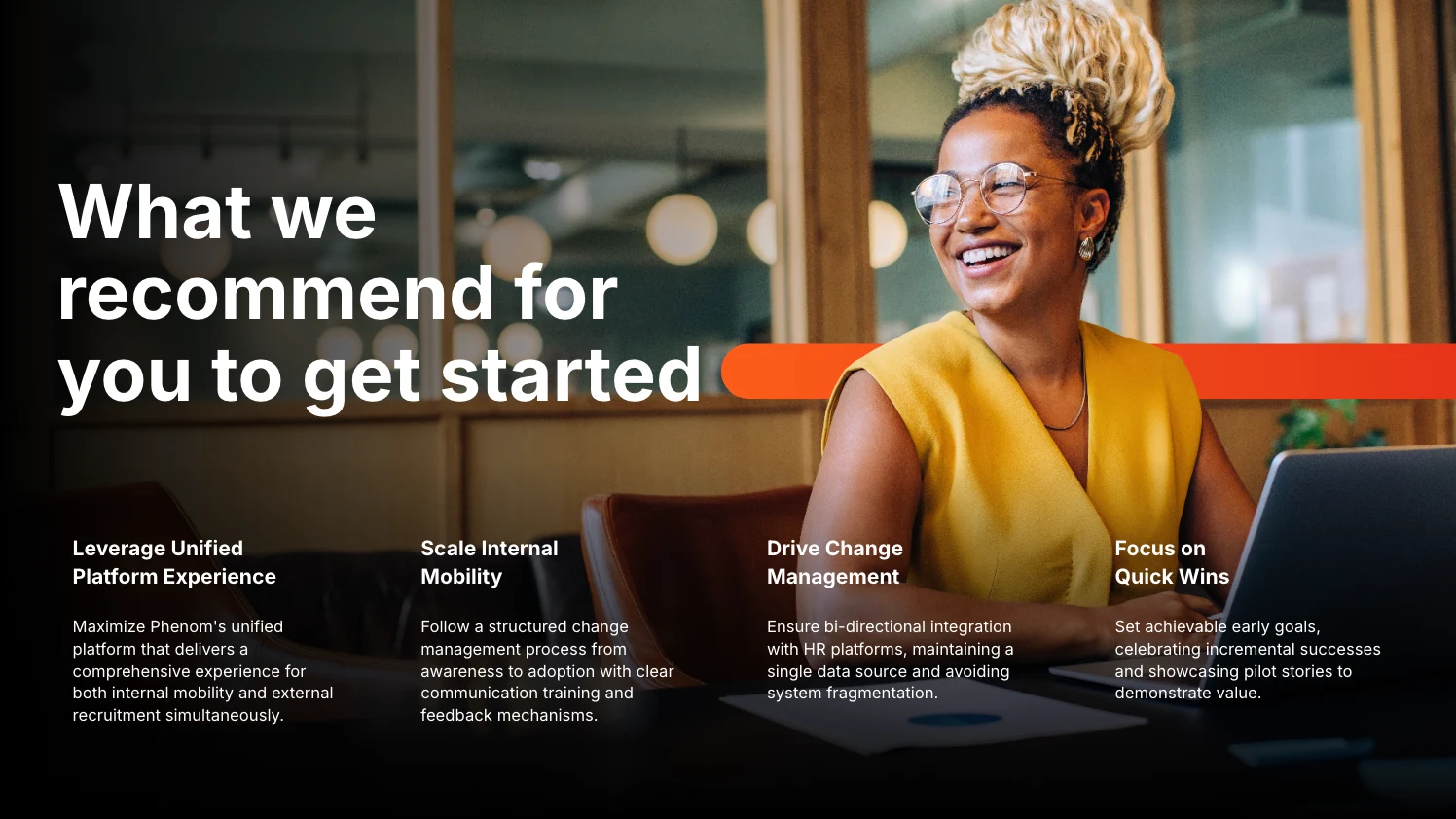
First, harmonize your systems in a way that's scalable for the future. You can do some tactical things now, but think long-term. When you give yourself the ability to harmonize systems properly, everything becomes future-proof.
Second, don't underestimate change management. If you don't help people adapt to the new systems, you'll face internal struggles, especially in fragmented organizations where brands already have their own established processes. Communication to stakeholders and leadership needs to be constant and multi-channel.
Third, focus on quick wins. If you try to do everything simultaneously without a large team, you'll struggle. Set ambitious but achievable objectives. Deliver something tangible, feel good about it, promote it internally, gain traction, then move to the next phase.
Finally, you need real executive sponsorship. Not lip service — actual accountability tied to outcomes. When brand CEOs have mobility metrics in their bonus structure, they take it seriously. When you cascade that accountability to middle managers who might otherwise block internal moves, you create alignment throughout the organization.
Ready to transform internal mobility at your own organization?
Access our Talent Marketplace Buyers Guide now!

Fariya Banu is a content marketing writer at Phenom who loves decoding buyer psychology and crafting stories that convert. With engineering and marketing expertise, she brings analytical thinking to creative storytelling. When not writing, she's snorkelling, cooking, or diving into any adventure that sparks curiosity.


Get the latest talent experience insights delivered to your inbox.
Sign up to the Phenom email list for weekly updates!


