

Primetals Technologies Is Driving Career Mobility in a Change-Averse Industry — Here’s How
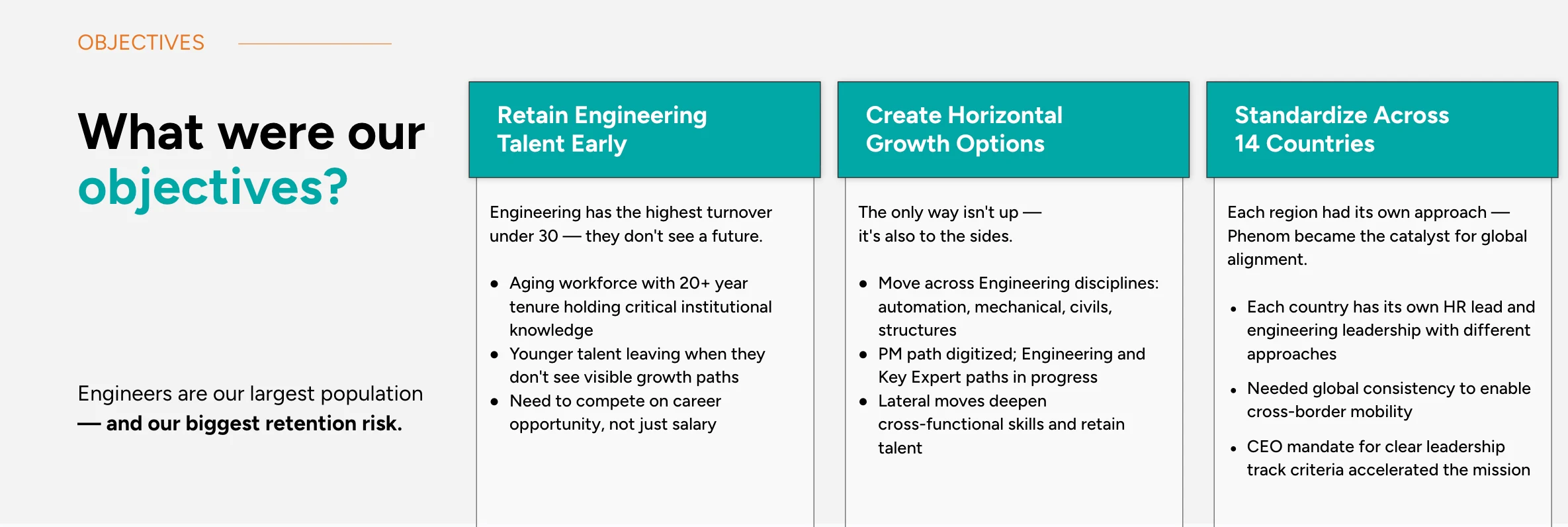
Engineering cultures are built around expertise depth. You join as a mechanical engineer, you grow as a mechanical engineer, and that’s the path. The challenge for Primetals Technologies — a 7,000-person engineering solutions firm serving the global steel industry — is that a single-ladder model was contributing to a retention issue among younger employees who couldn’t see how to move laterally, change disciplines, or grow beyond the path they started on.
At IAMPHENOM 2026, Primetals’ Leanne Jubb, Head of Global Talent Management and Employee Experience, shared how the company is building a global career mobility framework across 23 countries, multiple business units, and a culture shaped by years of independent local operations.
It’s not a finished story, but it offers a practical look at what it takes to drive change in a technical, change-resistant environment.
Watch the full session here, or explore the highlights below.
What Was Causing Engineer Attrition?
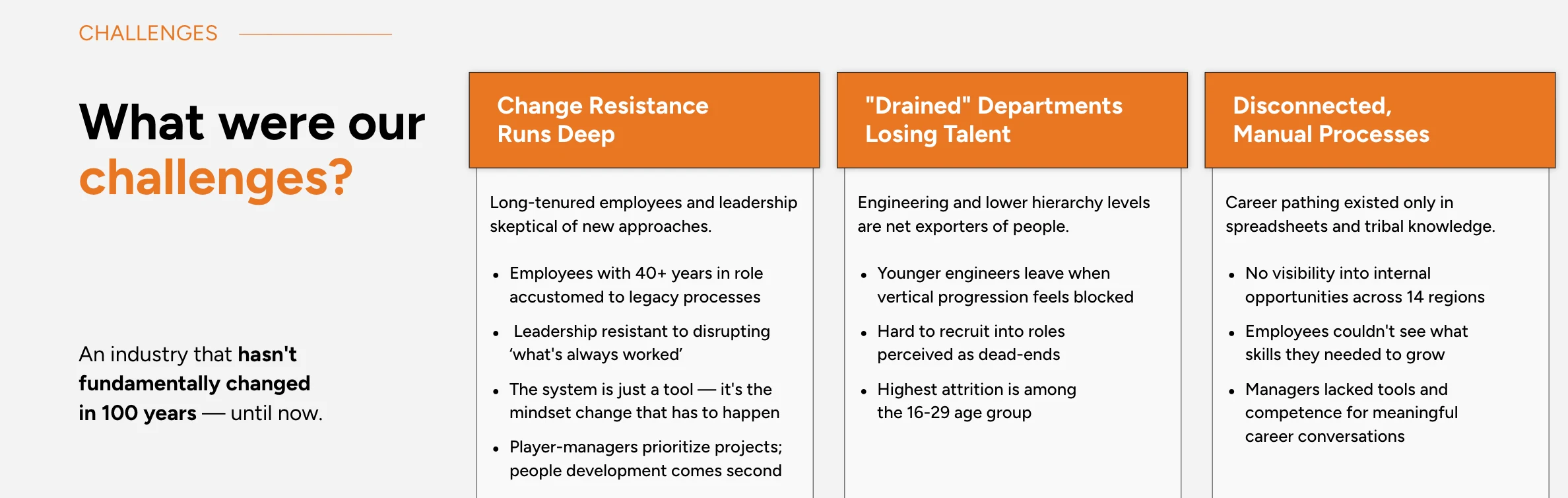
Primetals' biggest attrition was concentrated in the 16–29 age group — employees who were staying 18 months to two years and leaving when they couldn't see a path forward. On the other end, the company had a significant cohort of long-tenured employees with 20, 30, or even 50 years of service carrying critical knowledge and expertise. When either group left, it meant losing institutional knowledge and succession depth that engineering-led organizations can't quickly replace.
An employee survey backed up what the attrition numbers suggested: development opportunity, collaboration, and training all scored in the lower tier, even for a company that outperforms on most engagement metrics. The core issue wasn't compensation; it was a lack of visibility into career growth. Engineers at Primetals could only see the path they were already on. Moving from electrical to structural engineering, or from engineering into project management or sales, was theoretically possible but practically opaque.
Compounding that was the structure of the organization itself. Since becoming a Mitsubishi division a decade ago, each of Primetals' 23 country operations had been running talent processes their own way. Career paths existed, just not the same ones. Getting a global framework in place meant asking teams that had built their own systems for 10 years to adopt something centralized, which touched culture as much as technology. Engineering managers made it harder still. Although technically strong, people management was rarely their priority, and many didn't have the skills to run development conversations with their teams.
How Can AI-Powered Career Pathing Address Retention?
Primetals partnered with Phenom three years ago on the talent acquisition side, first rolling out Phenom Talent CRM and a Phenom Career Site. They then expanded into talent management when it became clear that hiring alone wasn't going to solve the retention problem. Phenom Talent Marketplace and Phenom Mentoring have been live for about a year, connecting employees to internal opportunities and personalized upskilling opportunities using Phenom's robust applied AI infrastructure.
Phenom Career Pathing, the capability Jubb described as the centerpiece of the whole effort, had just entered its pilot phase at the time of this session.
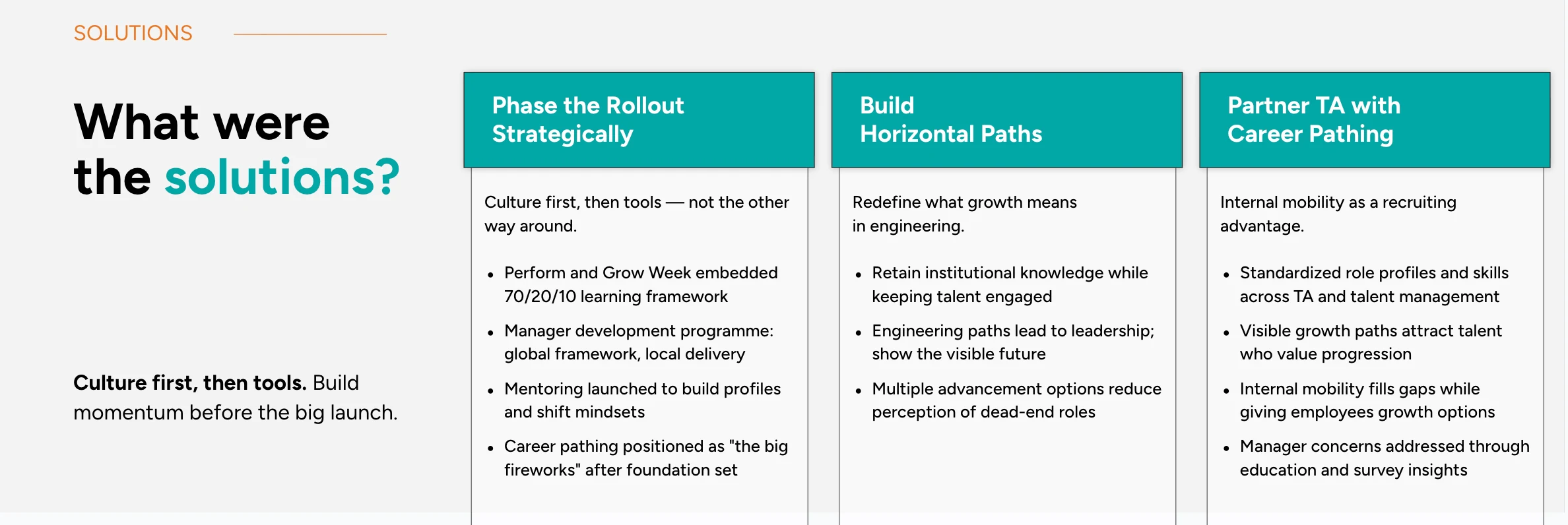
Career pathing built on a skills-based role architecture gives employees clearer visibility into growth and upskilling options. Jubb called it the "big impact firework moment" for Primetals. The insight behind it came from letting AI suggest paths rather than having HR prescribe them. When the Phenom platform analyzed skills across Primetals' engineering community, it surfaced cross-disciplinary paths that the engineering team initially pushed back on. Moving from electrical to structural engineering? The engineers said it wasn't realistic. When Jubb showed them the skill overlap, they reconsidered. As she put it: "It opened up opportunities that they hadn't really thought of in engineering because they were so siloed in their own areas."
The job architecture behind it is being built collaboratively, not imposed centrally. The global head of engineering, working with country representatives and business unit leads, is defining roles, levels, and required skills together. HR is supporting from the background, not leading. The intent is deliberate: when rollout happens, the engineering community owns it. "If it were the global head of engineering just by himself, he wouldn't get anywhere," Jubb noted. Cross-functional ownership is what makes adoption viable in a company where local autonomy has been the norm.
A Learning Management System (LMS) integration in eight languages is planned as the next phase, completing what Primetals envisions as the full connected experience.
Related: Take a quick click-though tour of Phenom Career Pathing
What Does a Global Career Mobility Rollout Actually Look Like?
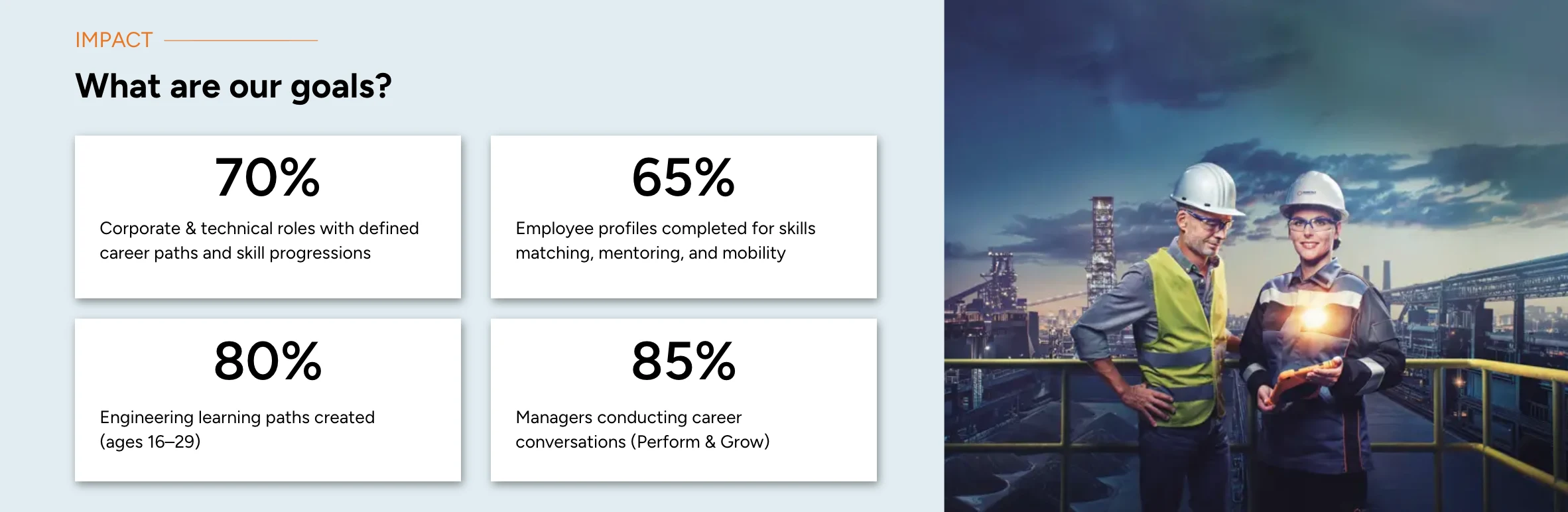
Employee profile completion — the foundation that powers skills matching, Career Pathing recommendations, and mentoring connections — sits at 25%, a number that reflects where adoption naturally lands before a coordinated global push. The full rollout, planned for later in 2026, will bring Career Pathing, the LMS integration, and Primetals' "Perform and Grow" culture week together as a unified moment. The team has defined clear targets to measure adoption and impact when it does:
70% of corporate and technical roles with defined career paths and skill progressions
65% employee profile completion to enable skills matching, mentoring, and mobility
80% of engineering learning paths created, focused on employees aged 16–29
85% of managers conducting structured career conversation
How Does Manager Enablement Factor Into a Career Mobility Strategy?
When the full rollout lands, it will be the company's first global, unified presentation of career mobility as a connected experience: profiles, skill-based paths, manager development, and the LMS integration working together. A key part of that rollout is enabling managers to lead meaningful career conversations — shifting the focus from systems alone to behavior change across the organization.
Blue-collar roles remain unresolved. Jubb acknowledged that figuring out how career pathing applies to that population is still an open question, one she hopes to return to a future conference to answer.
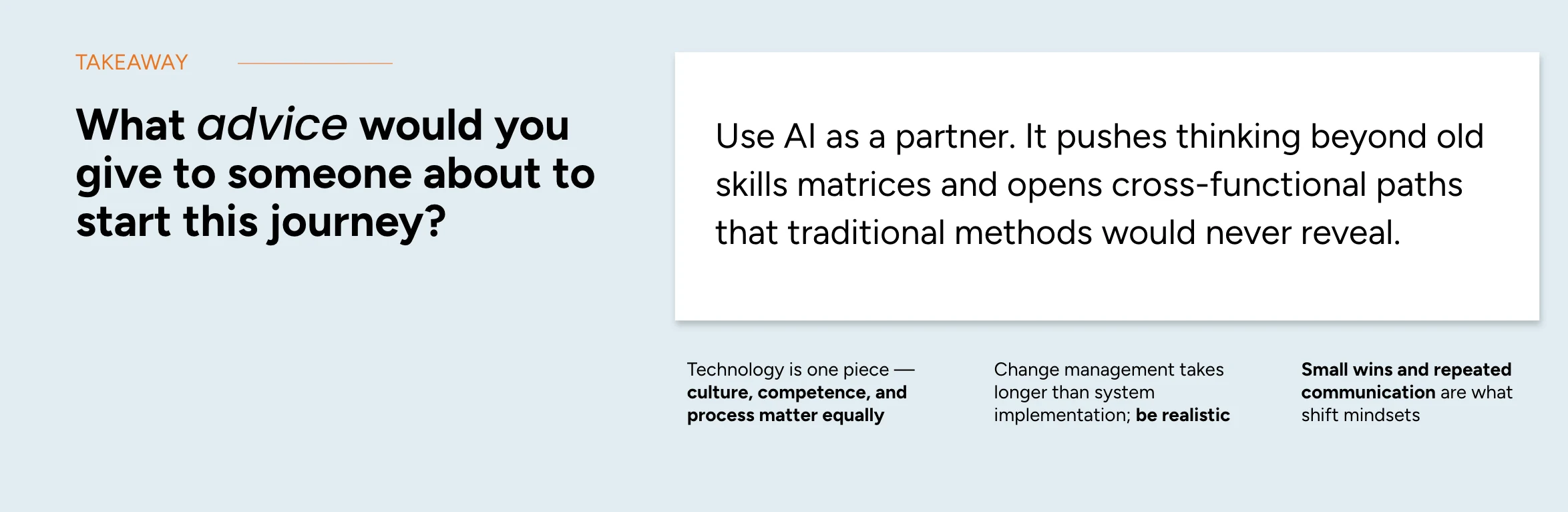
Her advice for teams working in technical, legacy-culture organizations: use AI as a thinking partner before you use it as a tool. When the system surfaced career paths across engineering disciplines, it didn't just create options — it changed the conversation. Let the data challenge assumptions that have been treated as fixed. As Jubb acknowledged directly: "The system rollout has been so much quicker than the actual change in the business. So I've had to be patient and more realistic."
That gap between technology and culture isn't a sign that something is wrong. It's the work.
Download the AI & Automation Toolkit for Talent Management to learn more about career pathing



Get the latest applied AI insights delivered to your inbox.
Sign up to stay up-to-date on the latest original content from Phenom, including new podcast episodes, events, and more.


