

Meet the Unified Orchestration Engine: The AI-Powered Workflow Orchestrator Built for Adaptive Talent Processes
Automation feels reliable until real conditions intervene. A referral bypasses the designated link, a hiring manager forgets to update their out-of-office settings, or a critical hire faces a licensing deadline that the system cannot interpret. Traditional workflows collapse under these scenarios because they cannot adapt to ambiguity or make decisions beyond predefined steps.
Phenom Unified Orchestration Engine introduces an adaptive intelligence layer that coordinates multiple agents, interprets context in real time, and applies your organization’s compliance policies to keep work moving. It transforms rigid automation into responsive decision-making that mirrors how experienced talent teams actually operate.
In this Article:
The Workflow Challenges Traditional Automation Misses
Talent processes rarely behave like linear checklists. They branch, pause, restart, and require judgment calls that static rule-based automation cannot anticipate. Many organizations still rely on workflows designed for predictable environments, assuming that every scenario will proceed according to plan. Automation in these systems works only when nothing unexpected occurs; requisitions move, candidates progress, and offers go out, then any deviation breaks the chain entirely.
In HR, these process roadblocks can show up as:
A qualified referral applies without using the referral link, causing the system to treat them as a standard applicant, even though the policy indicates they should be routed faster
A hiring manager sets calendar availability but forgets to update an out-of-office status, resulting in interviews being placed in unusable time slots
A healthcare candidate’s professional license expires in two weeks, raising the question of whether onboarding should accelerate even though the standard workflow is not designed for urgency
A resume parser fails, and a top candidate is not cleared for the following rounds despite having the right skills
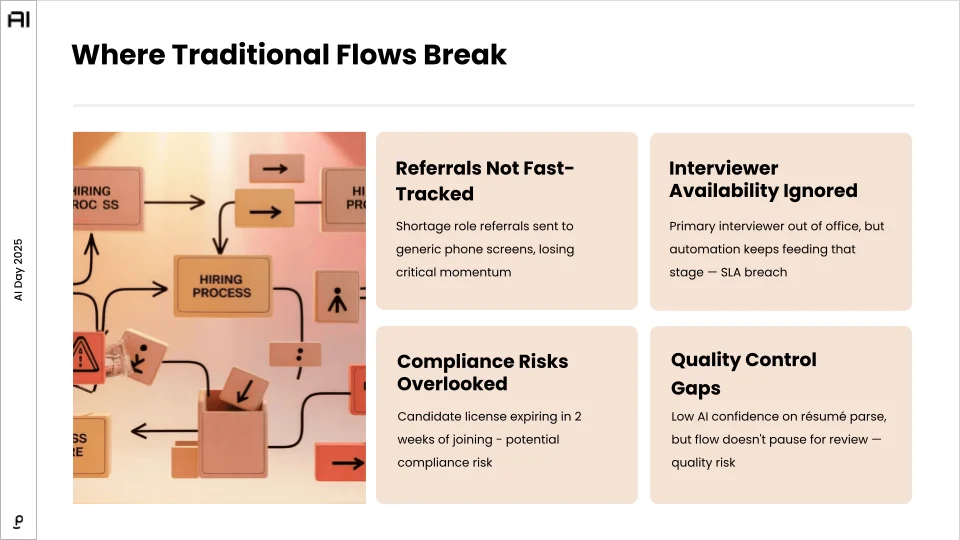
These scenarios are not rare disruptions; they happen constantly and highlight the limits of predictable, rigid automation engines. The core issue is architectural: traditional automation engines run steps as written — they don’t reason toward outcomes, compare options, or assess whether each action still aligns with the goal.
How Unified Orchestration Engine ‘Orchestrates’ Intelligence
Unified Orchestration Engine is a layer of adaptive reasoning that oversees your existing automations and agents, applying natural-language policies and context so workflows progress even when conditions change.
Instead of living inside the automation engine itself, it works on top of it, as a conversational orchestration layer, continuously monitoring what’s happening, directing the right agent to take action, and alerting humans when a judgment call is needed.
By replacing rigid step-based execution with contextual reasoning, the engine eliminates the old trade-off between inflexible automation and manual intervention. It behaves like an experienced HR operations leader — interpreting policies, analysing multiple paths, and deciding on actions that balance speed, compliance, and strategy.
This approach delivers three core outcomes:
Workflows adapt to real-world complexity: Exceptions no longer break processes; rather, the system evaluates alternatives, interprets organizational policies, and identifies viable next steps that keep work moving
Humans maintain meaningful control: Agents operate within set boundaries, guided by the policies you have defined. Anything outside those limits is escalated with full context so people can make informed decisions.
Policies shape behavior consistently: Instead of embedding logic in hard-to-maintain rules, you express expectations in natural language. The engine interprets those policies, applies them uniformly, and learns from how your team uses them.
The AI Infrastructure To Make Orchestration Possible
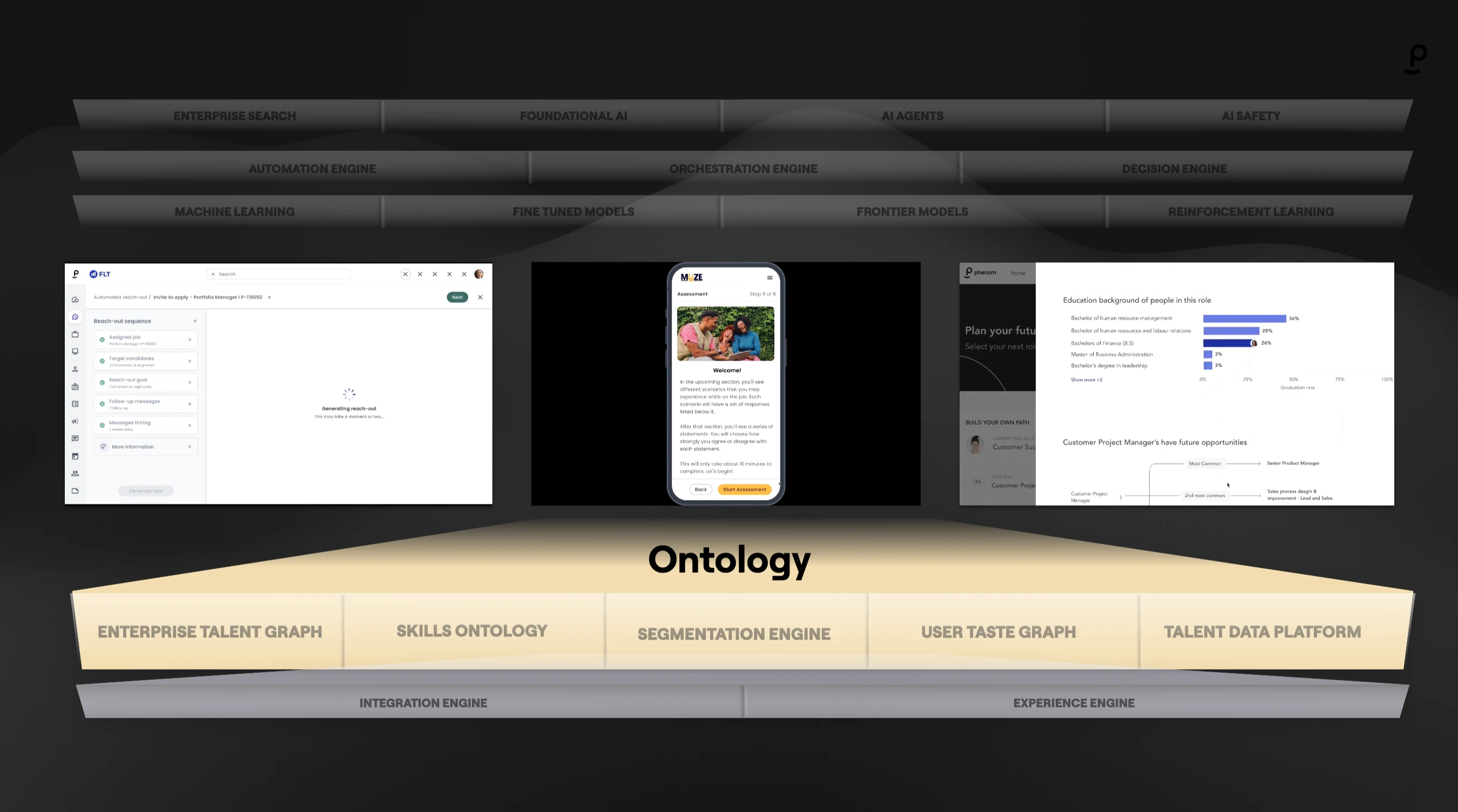
The Unified Orchestration Engine resides as the fourth layer of five interconnected layers that form Phenom’s AI infrastructure. Because it draws on structured data, skills relationships, and AI models beneath it, the engine understands what’s happening in real time and guides agents and workflows accordingly. It connects your business's data, skills, and models underneath it to understand context, and then coordinates agents and workflows so processes stay on track, even when conditions change."
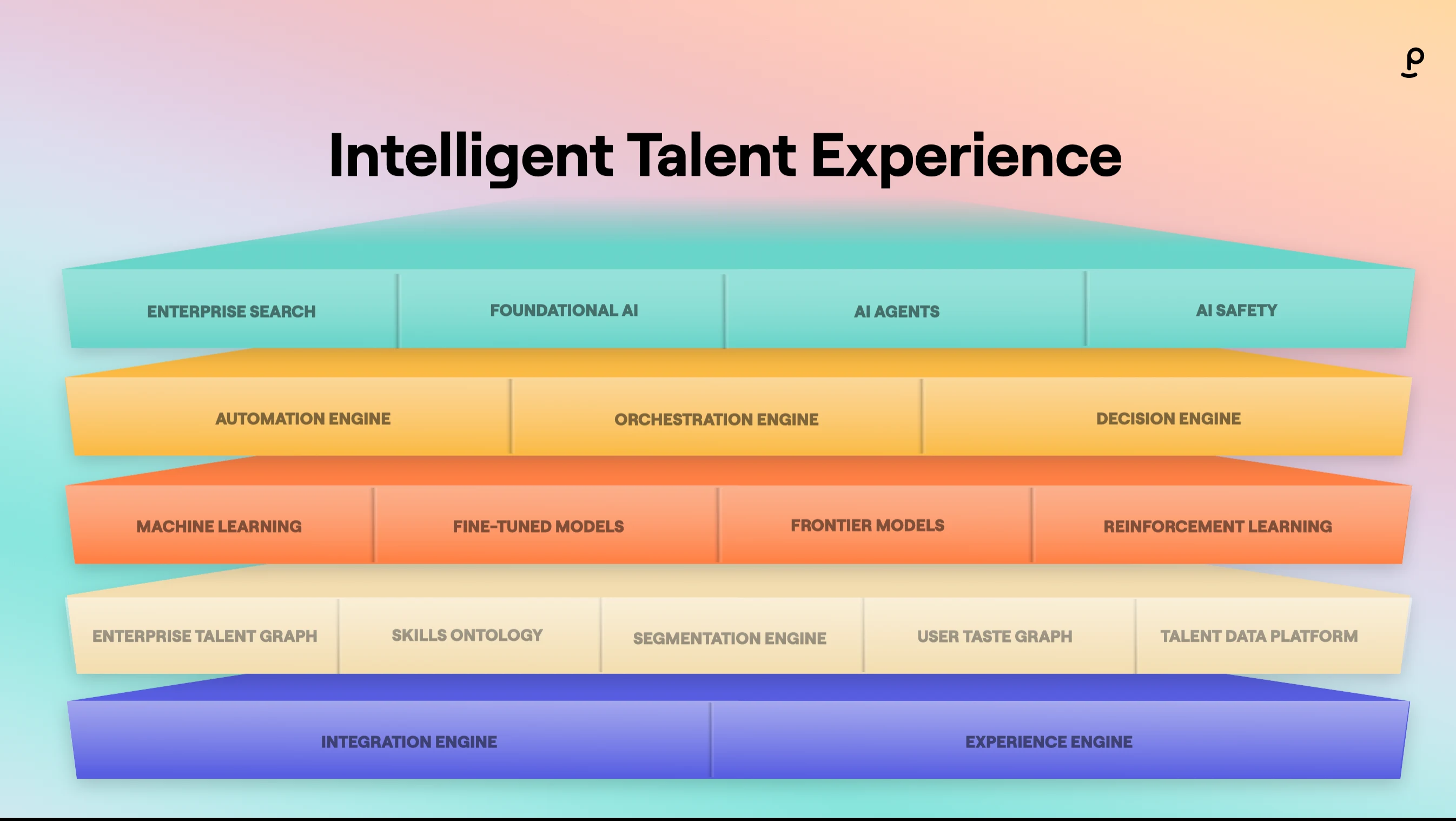
Once organized, the ontology layer maps skills and user preferences, and those relationships are mapped into an enterprise talent graph. From there, LLM reasoning and intelligence are applied, drawing insights out from your business-specific logic, while specialized Models power domain reasoning.
The Orchestration Engine then lives on top of the LLM reasoning layer by coordinating your organization's data, context, and insights, and applying that reasoning to how agents and automations are executed. This orchestration layer applies rigorous testing and safety governance to ensure every decision is explainable, compliant, and aligned with your strategy.
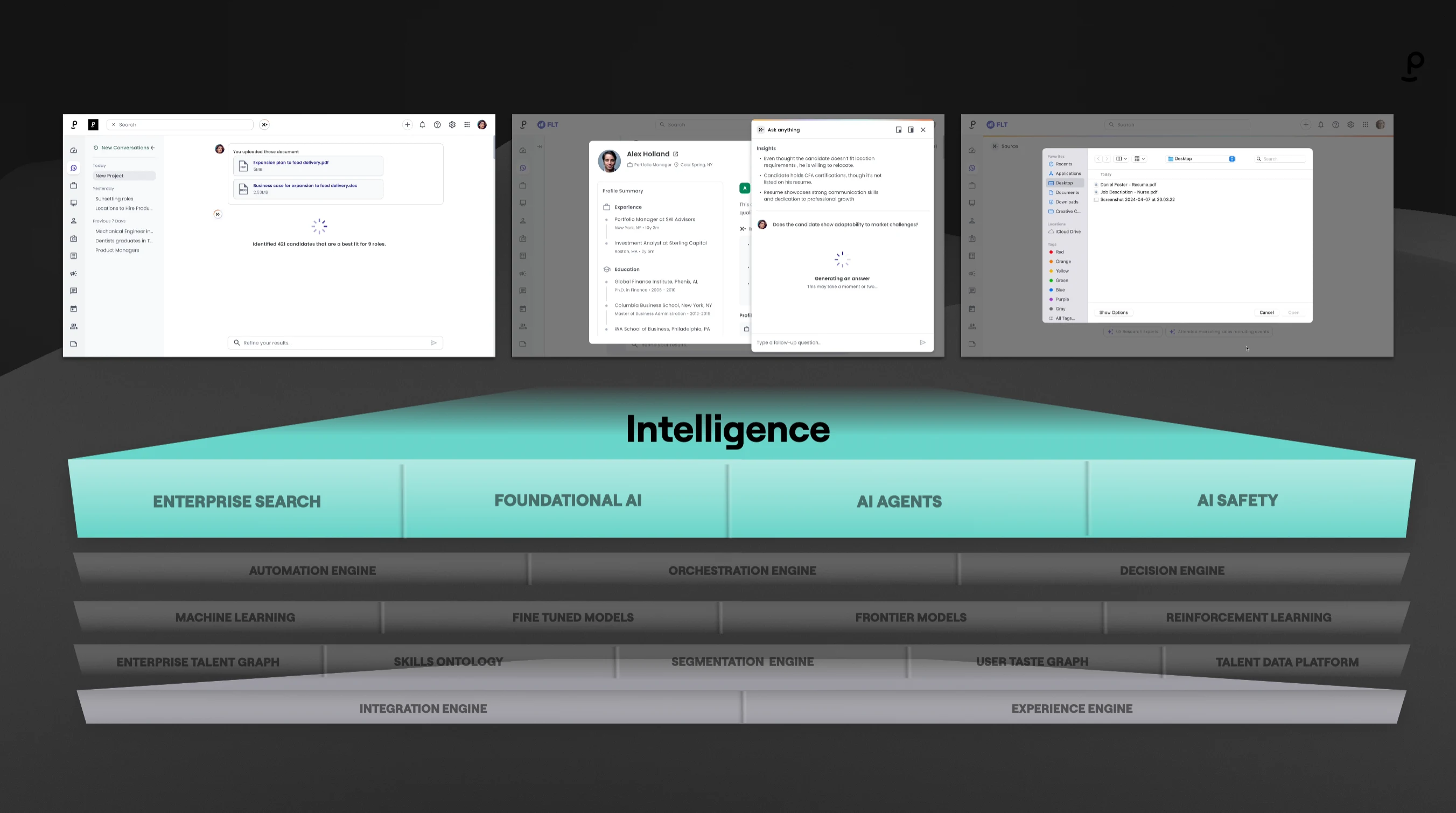
This architecture is what allows the engine to move beyond rigid automation into genuine intelligence that learns, adapts, and acts over time.
How the Unified Orchestration Actually Works
Understanding how Unified Orchestration Engine works requires looking at how it actually keeps your business in control while enabling intelligent automation. The framework rests on three connected principles that work together to balance speed with governance.
Define Policies in Simple Language
Instead of asking your HRIT team to translate business logic into code, you define policies in clear, conversational language.
"Referrals who don't use the referral application link should be fast-tracked if they meet core qualifications."
"No manager should have more than four interviews scheduled in a single day."
"Licensed healthcare roles must complete background verification before day one."
The orchestration engine understands these policies and applies them intelligently as rules, updating its approach as your business priorities shift.
Specialized Agents, Intelligent Coordination
Each specialized agent works within well-defined boundaries. For example, the Scheduling Agent manages rescheduling, the Sourcing Agent oversees matching, and the Compliance Agent evaluates regulatory requirements. Unified Orchestration Engine selects the appropriate agent for each situation and decides which one should step in based on the situation.
Humans Escalate at the Right Moments
When decisions fall outside policy, involve conflicting priorities, or require human judgment, the engine escalates the issue with all relevant context. A hiring manager might receive: “Standard policy indicates rejection, but this candidate has unique experience in X. Would you like to proceed?” With context provided upfront, decision-making becomes faster and more informed.

What Changes With Intelligent Orchestration
Hiring Faster While Staying Compliant
Your healthcare system wants to accelerate hiring for critical roles. You define a natural language policy: "Fast-track candidates for open ICU positions, but don't overload any manager with more than three concurrent interviews." The orchestration engine understands this policy. When a qualified ICU candidate applies, it checks interview capacity in real-time. If a manager is at capacity, it either distributes interviews to another qualified interviewer or suggests rescheduling lower-priority interviews to create space. The system reasons through the constraint rather than simply failing.
Handling Manager Availability
A candidate is scheduled for Thursday with a manager who forgot to set their out-of-office. Instead of the interview disappearing into a calendar black hole, the orchestration engine detects the conflict. It immediately recognizes another qualified candidate who's ready for that same time slot and notifies the hiring manager: "Your Thursday slot opened up. Would you like to interview a different candidate who's ready?" The hiring manager approves in seconds. The workflow continues without delay, without manual coordination, without frustration.
Meeting Compliance Deadlines
Your team is hiring a healthcare professional whose license expires in two weeks. Standard onboarding takes three weeks. The orchestration engine understands the timeline constraint through your policies. It automatically escalates certain verification steps, coordinates with background checking, and flags documentation that can run in parallel rather than sequentially. The process has compressed from three weeks to two without sacrificing thoroughness. The system is reasoning toward an outcome (compliant hire before deadline) rather than blindly following steps.
Recovering From Parse Failures
Your resume parser struggles with an unusual resume format from an excellent candidate. Instead of the application stalling in a failed-parse queue, the orchestration engine recognizes the failure and orchestrates alternatives. It might invoke a different parsing approach, route the resume to a specialized sub-agent, or flag it for recruiter review with high priority because other signals indicate fit. The system finds pathways forward rather than creating dead ends.
Impact Across Your Talent Operations
Organizations adopting the Unified Orchestration Engine can see measurable improvements across their talent ecosystems, including:
Fewer workflow failures, as exceptions stop breaking processes, often cutting manual exception handling
Faster hiring cycles, with many teams improving time-to-hire, depending on role complexity
Stronger compliance as policies apply consistently across workflows
Better use of recruiter time, with less effort spent chasing down stalled or broken processes
Improved manager experiences, thanks to clearer visibility, faster approvals, and workflows that adapt to their constraintsGreater scalability, as higher hiring volumes no longer require proportional increases in HR operations staffing
Making it Work Moving Fast while Staying in Control
Talent processes demand both structure and flexibility. They need to be fair enough to maintain compliance and trust, and adaptive enough to handle real-world exceptions. Traditional automation breaks under complexity, leaving your team drowning in exceptions and broken automations that no rigid system can navigate. Unified Orchestration Engine changes this by coordinating agents, interpreting policies, and escalating thoughtfully; treating workflows as responsive team members rather than static executors.
The impact is larger than it might appear. With adaptive orchestration, processes stay nimble, compliance holds steady, and managers gain time for strategic work. It marks a shift from systems that simply execute steps to systems that reason toward outcomes and collaborate closely with people. That’s why orchestration is becoming essential.
Discover how adaptive intelligence powers every stage of your talent journey. Book a demo to explore personalized solutions for your organization.
For additional insights, watch the Applied AI & Automation: Product Innovation Keynote on demand to learn more about Unified Orchestration Engine and learn how organizations hire, develop, and retain talent.

Devi is a content marketing writer passionate about crafting content that informs and engages. Outside of work, you'll find her watching films or listening to NFAK.


Get the latest talent experience insights delivered to your inbox.
Sign up to the Phenom email list for weekly updates!


