

Phenom Launch Best Practices: How UAB Medicine Built Recruiter Buy-In One Dose at a Time
UAB Medicine is the fifth-largest hospital in the United States. It runs on three ATSs, three HRISs, and a talent acquisition team split across two distinct health entities. When it came time to implement a robust new AI solution, UAB leaders knew that getting widespread buy-in across such a large and complex organization would be a formidable challenge. But Natalie Harper, Manager of Talent Acquisition at UAB Medicine, was able to meet the challenge.
At IAMPHENOM 2026, Harper spoke about how she used an efficient but gradual implementation process — and what the outcome looked like 90 days post-go-live.
Watch the full session here, or explore the highlights below.
How Do You Unify Hiring Across a Complex, Multi-System Healthcare Organization?
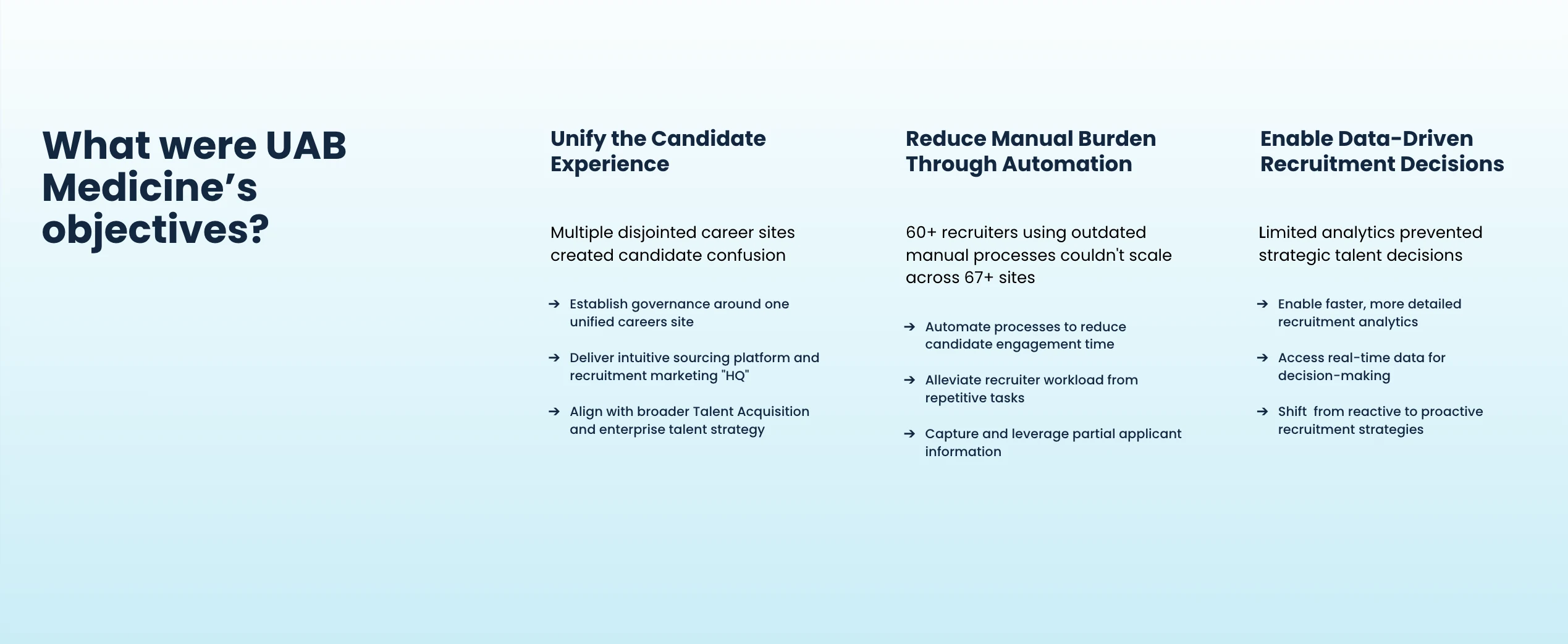
UAB became a Phenom customer in 2022 and took a purposeful, phased approach before going live in November 2025 — a timeline shaped by the scale of what they were taking on, not a delay. Academic and community entities have different needs, different workflows, and different recruiter profiles. Some team members had been with UAB for 20 or 30 years. Others joined mid-implementation. The same system had to work for all of them.
Compounding that challenge: the organization's data was complex. With three ATSs and three HRISs each defining terms differently, vital tasks like pulling reliable metrics for C-suite reporting was difficult. “We couldn't rely on our own data because it's being pulled from three different systems,” Harper said. “We were just getting no headway because our data was really non-existent and frankly very surface level.”
Fragmented systems meant fragmented insight. Using Phenom’s tools, Harper fixed that. UAB deployed a connected set of Phenom tools to replace the fragmented recruiting stack they'd operated on for years.
Their Phenom Talent CRM anchors day-to-day work for the 60+ person talent acquisition team, integrating with three separate ATS environments and tailored to individual recruiter preferences. "We really focused on how customizable the CRM is to each recruiter," Harper said.
A unified career site is replacing disparate landing pages across the health system's academic and community entities so candidates see one UAB Medicine rather than multiple disconnected brands.
Automations and screening questionnaires within Phenom’s Automation Engine were built in direct collaboration with recruiters themselves — a decision Harper credits as central to adoption. "They dictated every single screening questionnaire. They dictated a lot of our automations," she said.
Candidate sourcing tools, including Phenom AI Discovery, pipeline projects, and active outreach, all give recruiters time back from administrative work to build relationships with candidates and hiring leaders. And analytics, previously pieced together manually across three systems, were now unified to provide UAB Medicine with real-time insight for recruiters.
How Do You Prepare Recruiters for a Phenom Rollout?
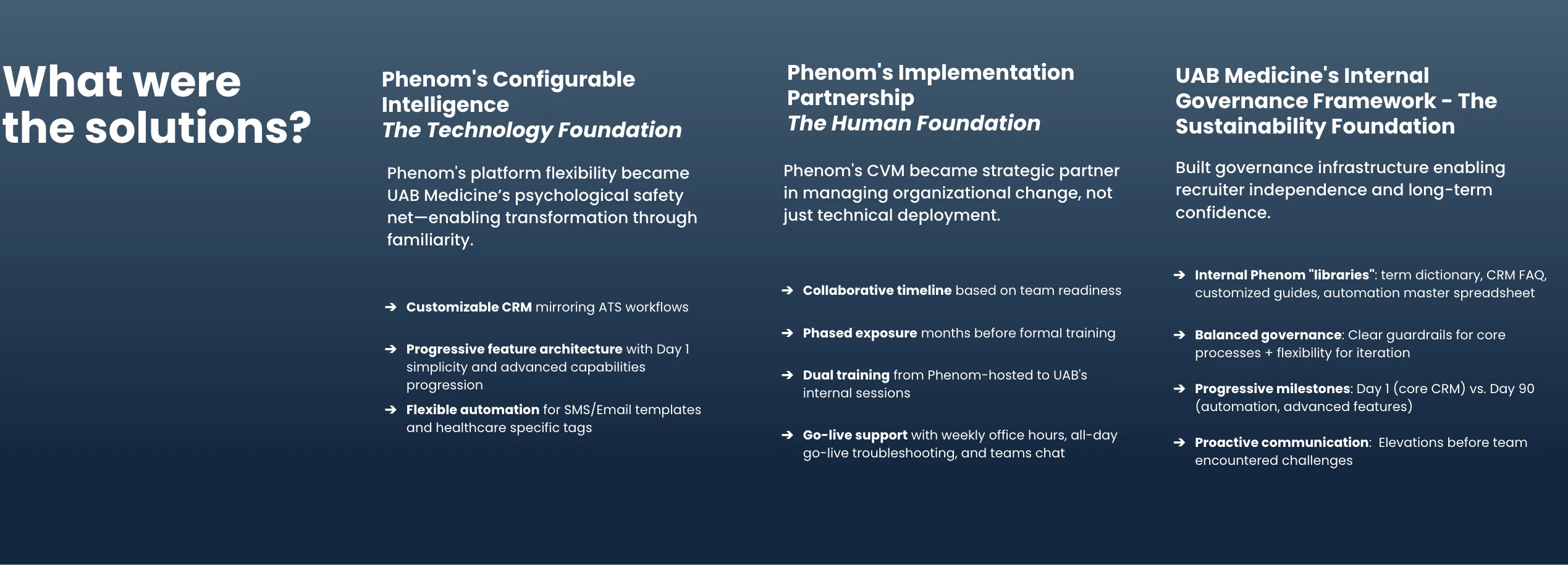
Harper's team started introducing Phenom to recruiters eight months before go-live, well before anyone knew the exact launch date. "When we talked about going into a complete process change, we decided the best way was to introduce them to it in microdoses," Harper said.
Context and early education was critical. UAB built a term library so recruiters walked into their first formal training session already knowing what a “Spotlight” was, what “Candidate Hub” meant, and what Phenom's core vocabulary looked like. That foundation meant training time could go toward hands-on practice rather than memorizing definitions.
Recruiters then got access to a staging environment, so they could practice with real requisitions before the system went live.
One of the most effective tactics was a configuration spreadsheet. Before launch, each tab covered a specific capability, such as automations, screening questionnaires, and pipeline stages. Recruiters were shown what was possible and asked to build it themselves. They dictated their own screening questionnaires and identified which automations would actually help their workflows. UAB's super users then entered the configurations into the Talent CRM.
The result? Recruiters arrived at go-live owning the system they'd helped design.
Related Read: Implementation Lessons Learned – Building Success Through the Good, the Bad, and the Ugly
What Did Recruiter Adoption Look Like 90 Days After Go-Live?
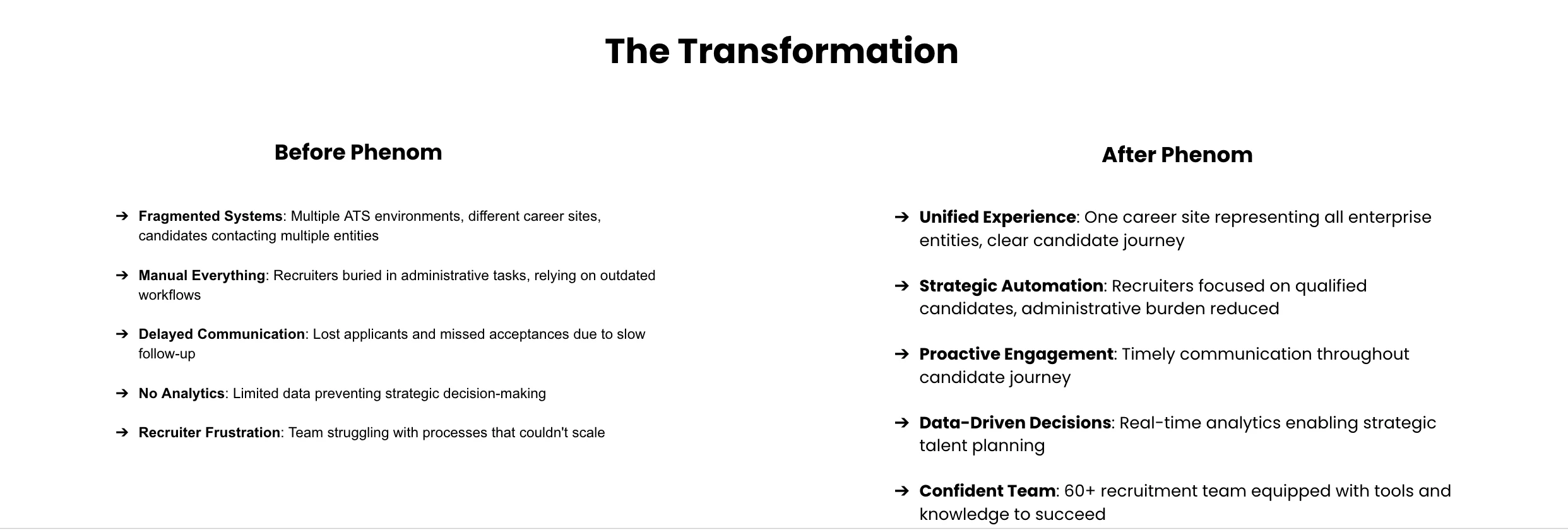
Going in with realistic expectations turned out to be a strategic advantage. UAB didn't measure success by 30-day KPIs. Harper's team set a deliberate baseline: get into the system, source candidates, do some outreach if you're ready. Expectations grew from there.
That was a deliberate contrast with how the team had operated before. Recruiters were stretched across multiple ATS environments, candidates bounced between entities trying to figure out who to contact, and reporting was pieced together manually from systems that couldn't agree on shared definitions.
Ninety days in, the picture looked different:
Adoption came faster than expected. A realistic baseline drove near-immediate buy-in, not weeks of hand-holding.
One career site replaced many. Candidates now land in a single unified experience across the entire health system.
Recruiter time shifted to people. Automation absorbed the manual work, freeing recruiters to focus on candidates.
Analytics earned unexpected buy-in. Real-time dashboards replaced patchwork reporting, and recruiters started paying attention.
Harper credits the outcome to the team as much as the platform. While Phenom delivered the tools, it was the investment in change management and hands-on iterative training that turned a complex, phased go-live into a 90-day win.
Learn more: The Complete Guide to a Seamless AI-Powered Talent CRM Migration
How Is UAB Building on Go-Live Momentum Across Both Implementation Phases?
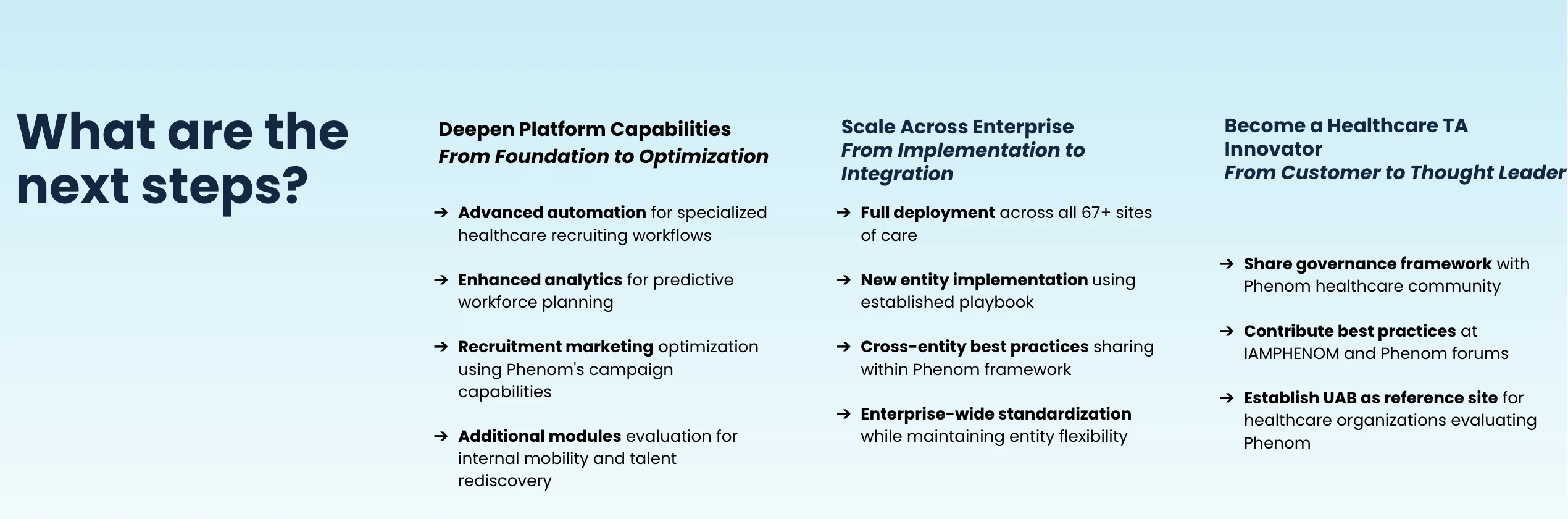
Recruiters who went through UAB's first implementation wave are already operating on a scaled model. As automation frees up time, expectations rise accordingly. Recruiters who were once pushing paper are moving toward what Toler described as the talent strategist role — building pipelines, deepening candidate relationships, and consulting more meaningfully with hiring managers.
Phase two is already underway, bringing the remaining half of the team into the system using the same phased playbook. When it wraps, UAB will have something it has never had in its history: one unified candidate experience across every entity.
“It will be groundbreaking for us,” Harper said. “But more importantly, it will be groundbreaking for our candidates and for our executive stakeholders.”
Navigate the gap between technology and success with a proven implementation roadmap. Learn more here



Get the latest talent experience insights delivered to your inbox.
Sign up to the Phenom email list for weekly updates!


