

AI Agents Keep Talent Strategy Current When Work Moves Faster Than Job Descriptions
Every HR leader is facing living with the same problem: the pace of change inside companies is outrunning HR's ability to keep up. Job family architecture, position descriptions and career frameworks start going stale the moment they're published. And skills data alone can't close the gap.
"Skills only tell you what a role has required historically," said Mark Feneis, Senior Director of Solutions Consulting at Phenom, during AI Day 2026. "They look backward, not forward."
Job descriptions are even less insightful. In a recent survey by MyPerfectResume, almost three-quarters of employees said their formal job descriptions don't reflect the work they actually do.
Here’s how AI agents help HR teams understand work as it changes, and plan for the people who will do it next.
Building a Living Map of the Work
It begins with an ontology layer that combines market data with an organization's own roles, people and history. The result isn't a generic taxonomy. It's a living map of the work being done across that specific organization.
Task intelligence then tracks when and where work is changing. AI agents interview the people who actually do the work and turn those conversations into intelligence about the position.
Nothing changes automatically. A member of the HR team reviews and approves every update. "Your team is there to validate while the agent scales the listening," Feneis said.
From Skills on Paper to Success in the Role
Knowing where work is changing is only part of the picture. Many organizations miss the attributes people need to thrive in a specific role. Leadership, creativity and teamwork are part of who someone is as a person. These attributes can’t be measured from a resume that lists tasks or skills.
Behavioral intelligence fills that gap. It measures and then matches the foundational, durable traits that drive success in a role to an employee’s profile. As Feneis put it, behavioral intelligence moves organizations past “Does this person have the skills on paper?” to “Will this person actually succeed in this role?”
Those traits also matter later. Behaviors are one of the signals that feed succession planning, alongside performance, potential, readiness and career history
Succession Planning Beyond a Handful of Critical Roles
Succession planning means finding candidates from within by connecting signals like skills, career history, performance, potential, readiness, and behaviors.. It’s a highly effective way to fill roles, but because this data often sits across disparate systems, many companies limit the activity to a few critical roles.
“This challenge is not about talent,” Feneis said. “The challenge is about the ability to continuously discover and evaluate the talent at scale.”
That limit has real costs. When a plan names a single successor, one resignation or internal move can leave a critical role with no bench at all. Roles outside the shortlist get no plan, so leaders often don’t know who could step in until a seat is already empty.
There’s a cost on the employee side too. High-potential people in roles without a plan can go unnoticed, even as they build new skills and take on bigger projects. If no one sees their next step, they may look for it somewhere else.
Agents change that. They bring the signals together, apply the organization’s succession policies and surface potential successors for human review. Because agents continually keep evaluating as people grow and roles change, the bench stays current instead of being rebuilt once a year.
How a Global Agricultural Manufacturer Is Rethinking Workforce Planning
A global manufacturer of agricultural machinery and precision farming technology shared how it’s putting this thinking into practice. Facing evolving skills, rising demand, competition for key talent and fast-moving technology, the company wanted workforce decisions tied more closely to business priorities.
It knew how many employees it had and where they sat, but it struggled to answer with consistency which skills they had, which skills the future would require and where the gaps were. It started by mapping external benchmark data on emerging skills to input from business leaders, then launched an internal talent marketplace.
As AI began changing work at the task level, the team looked beyond jobs and headcount to how work happens inside each job. Today, with agents breaking roles down into tasks and skills, it evaluates each role on two dimensions: AI opportunity, or how likely a role’s tasks and skills are to be automated, augmented or otherwise influenced by AI, and organizational readiness, which covers data maturity, process ownership, governance, risk and capacity for change.
“Our goal is not to predict the future with certainty,” said a talent management leader at the company. “Our goal is to understand where deeper conversations need to occur to better understand how work may evolve in the future.”
The agents surface the insights, and business leaders validate the results and challenge assumptions. “AI does not make these decisions for us,” the leader said. “AI helps us really understand the information, surface insights and accelerate our analysis.”
That agentic analysis shows the team what can be augmented or automated and where human skills remain essential, across every role rather than a select few. “We’ve never been able to do these activities at scale,” the leader added, “because we’ve been doing all of these activities manually or with Excel.”
Behind the Scenes: How the Role Analysis Agent Works
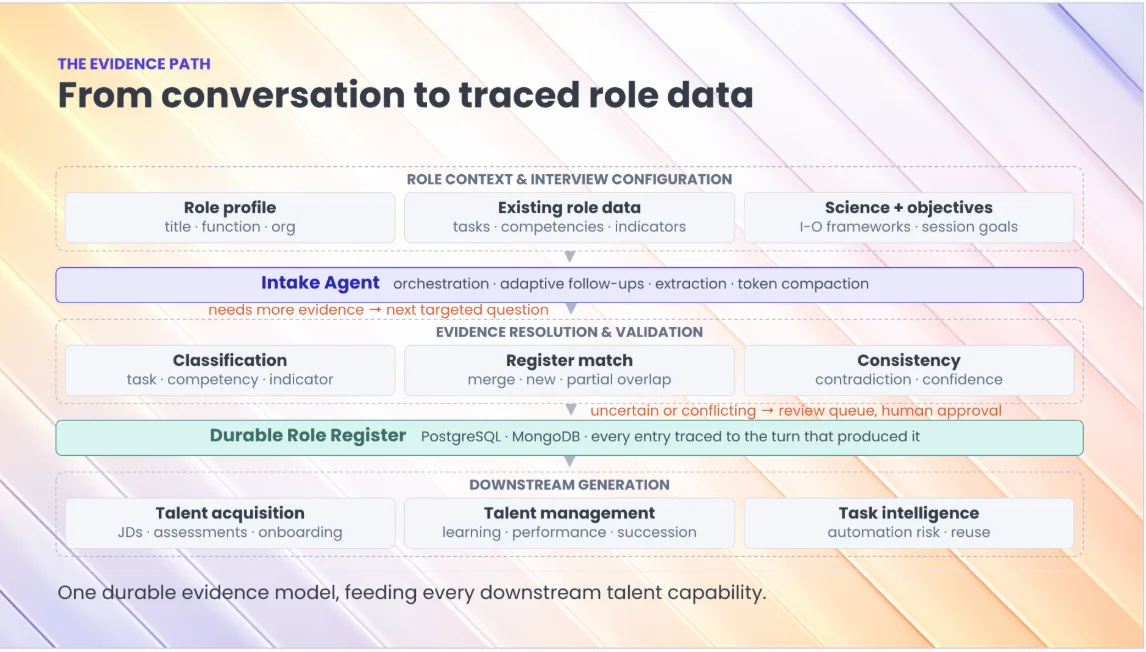
A role analysis agent gathers role knowledge from managers, employees, recruiters and subject matter experts, then turns it into structured job intelligence. In one example, role analysis for a large retail chain revealed that its "team member" role in supermarkets and in liquor stores carried very different responsibilities and needed different assessments.
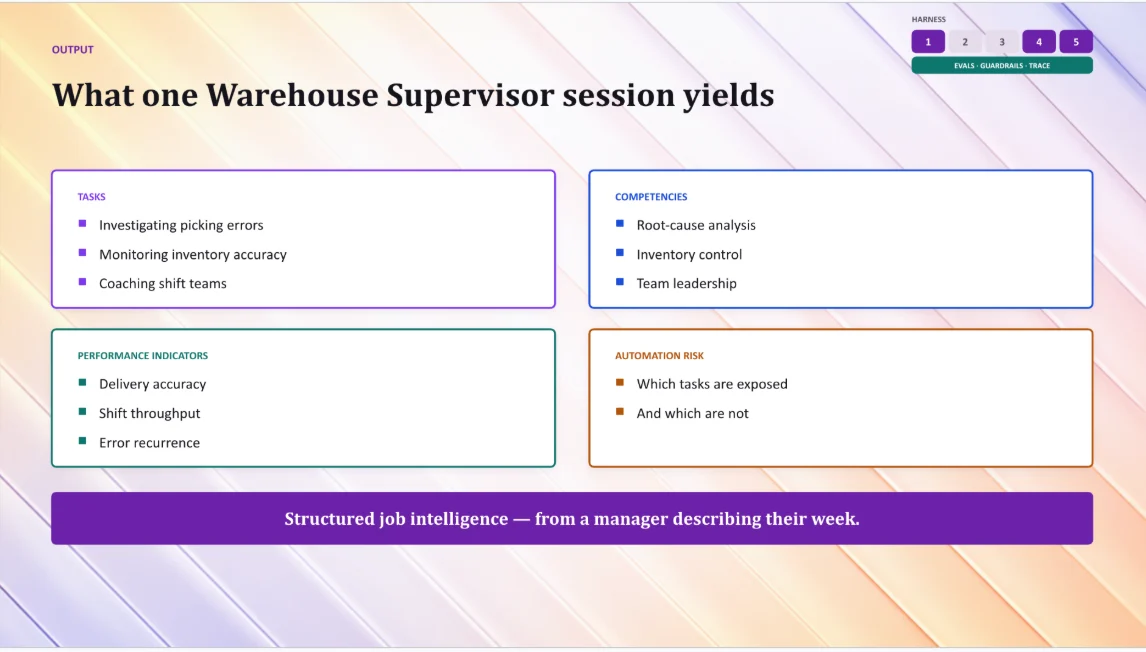
The agent doesn't accept vague answers. If a warehouse supervisor says they spend time "fixing picking issues," the agent asks targeted follow-up questions based on evidence gaps and industrial-organizational psychology frameworks. Is the supervisor identifying root causes, resolving expectations or changing the process? Who do they coordinate with?
The agent starts each conversation with the role's context, historical data and quality guardrails. It checks coverage of key job dimensions, watches for contradictions and avoids repeat questions. The chat logs become a transparent evidence trail.
The agent also consolidates evidence across every conversation about the same role. When it's unsure whether two responsibilities are the same, it creates a new entry rather than merging them incorrectly and flags possible duplicates for human review. The validated data then feeds job descriptions, assessments, learning, succession, career pathing, and workforce planning.
Behind the Scenes: How Succession Recommendations Are Built
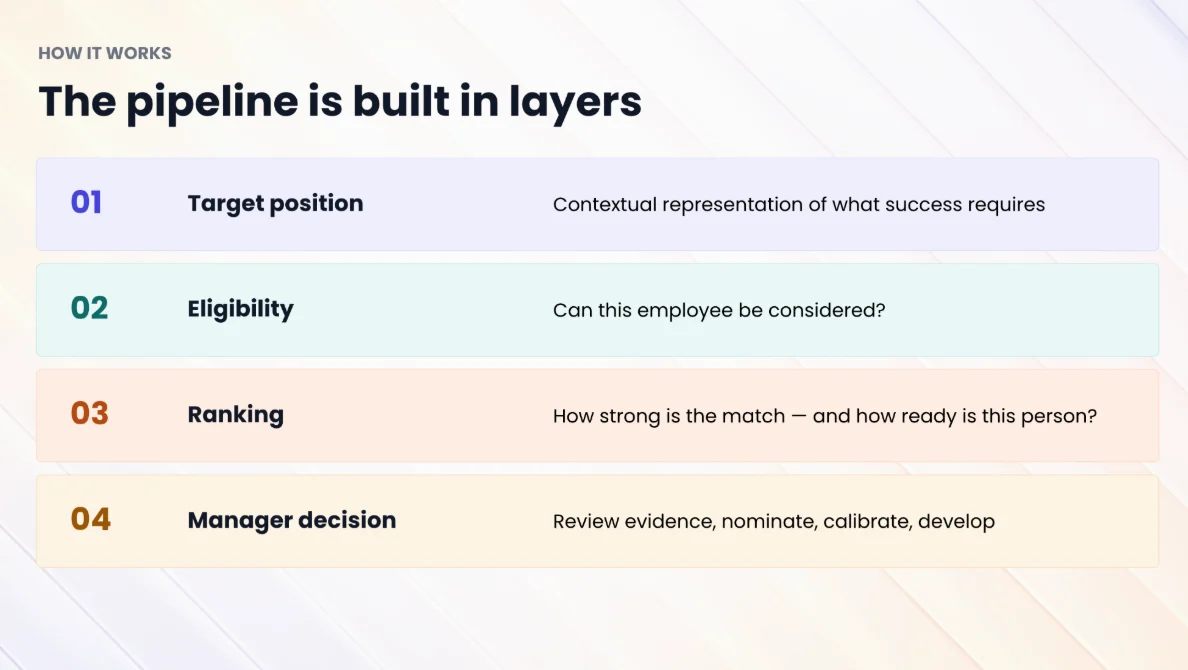
When a user selects a target position, the succession planning engine evaluates a large employee population in layers:
Defines the position. It builds a rich picture of the target role from its level, job family, career track, skills, tasks and competencies.
Finds potential candidates. It combines keyword search with semantic search, which recognizes when the same requirement is described in different ways, to build a broader candidate pool than either method could alone.
Applies succession policy. Configurable rules set by the organization, such as minimum performance, potential and a readiness window, determine who can be considered.
Ranks the matches. It compares each employee with the target across skills, tasks, competencies and career history, then factors in performance, potential, readiness and assessment results. Each recommendation explains the employee's strengths and gaps.
Managers review the evidence, nominate successors and confirm, add or remove employees in calibration discussions. The system then connects each successor to learning, mentoring and projects.
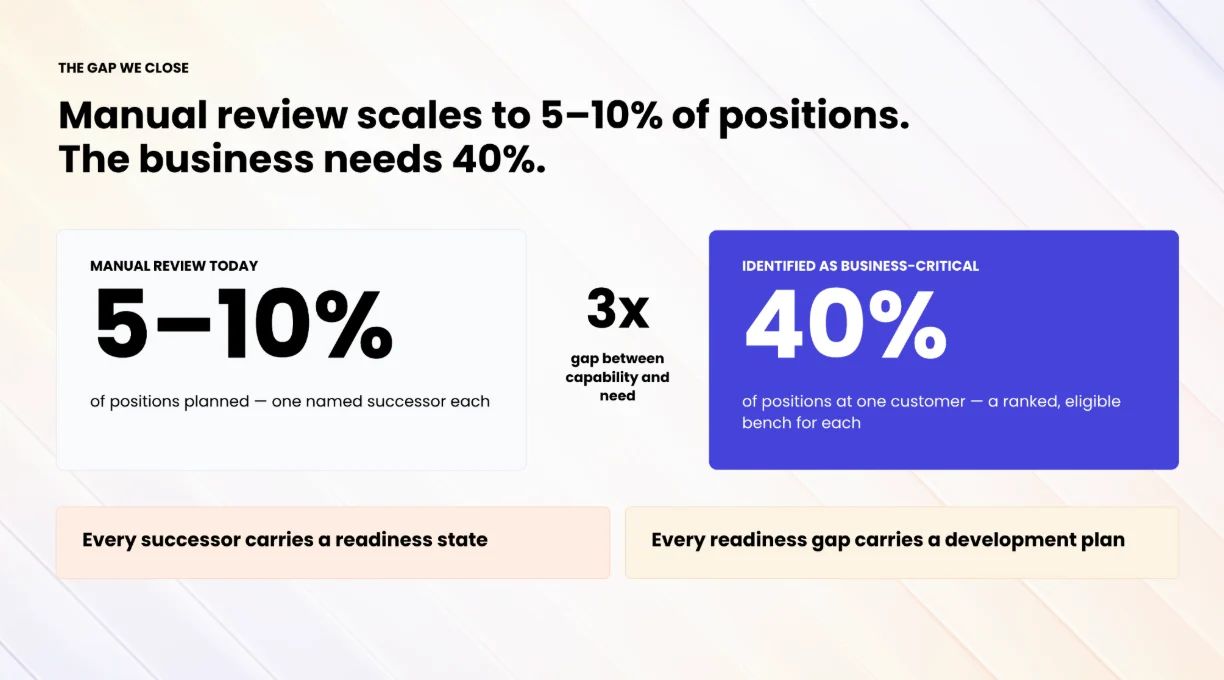
The results address a clear gap. Across pilot customers, succession planning had covered only the top 5 to 10% of positions, with one successor named per plan. One customer identified 40% of its positions as critical to business continuity, a significant gap between current capability and business need. Succession planning provides a ranked, eligible bench for each of those positions, with a readiness state and development plan for every successor.
Agents Set a New Pace for Talent Strategy
Across these capabilities, agents gather evidence at a scale HR teams couldn't reach manually, and people make the final call.
As Feneis puts it, “Instead of asking HR teams and managers to manually find and evaluate every possible successor, agents can bring those signals together, apply the organization’s succession policies, and then surface potential successors for human review.”
Book a demo to see how Phenom’s AI agents keep your talent strategy current, even as work changes faster than your job descriptions.



Get the latest applied AI insights delivered to your inbox.
Sign up to stay up-to-date on the latest original content from Phenom, including new podcast episodes, events, and more.


