Recruiter action
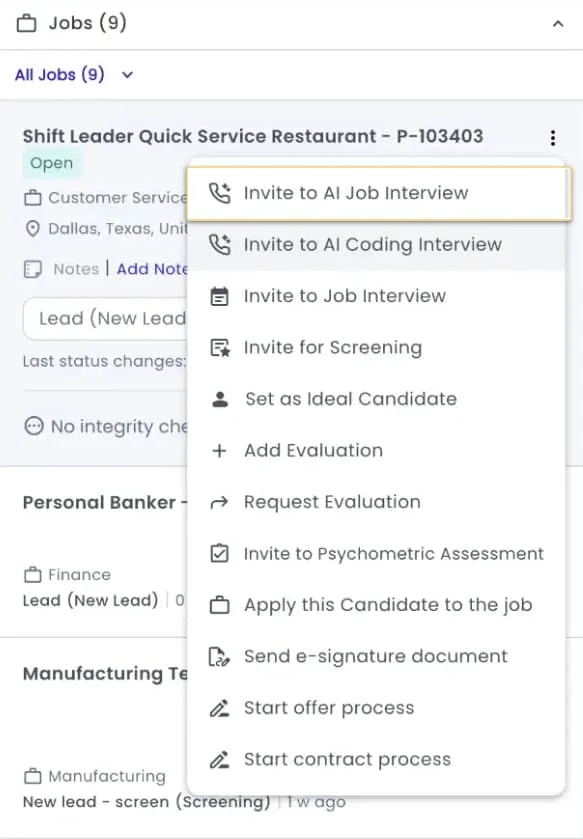
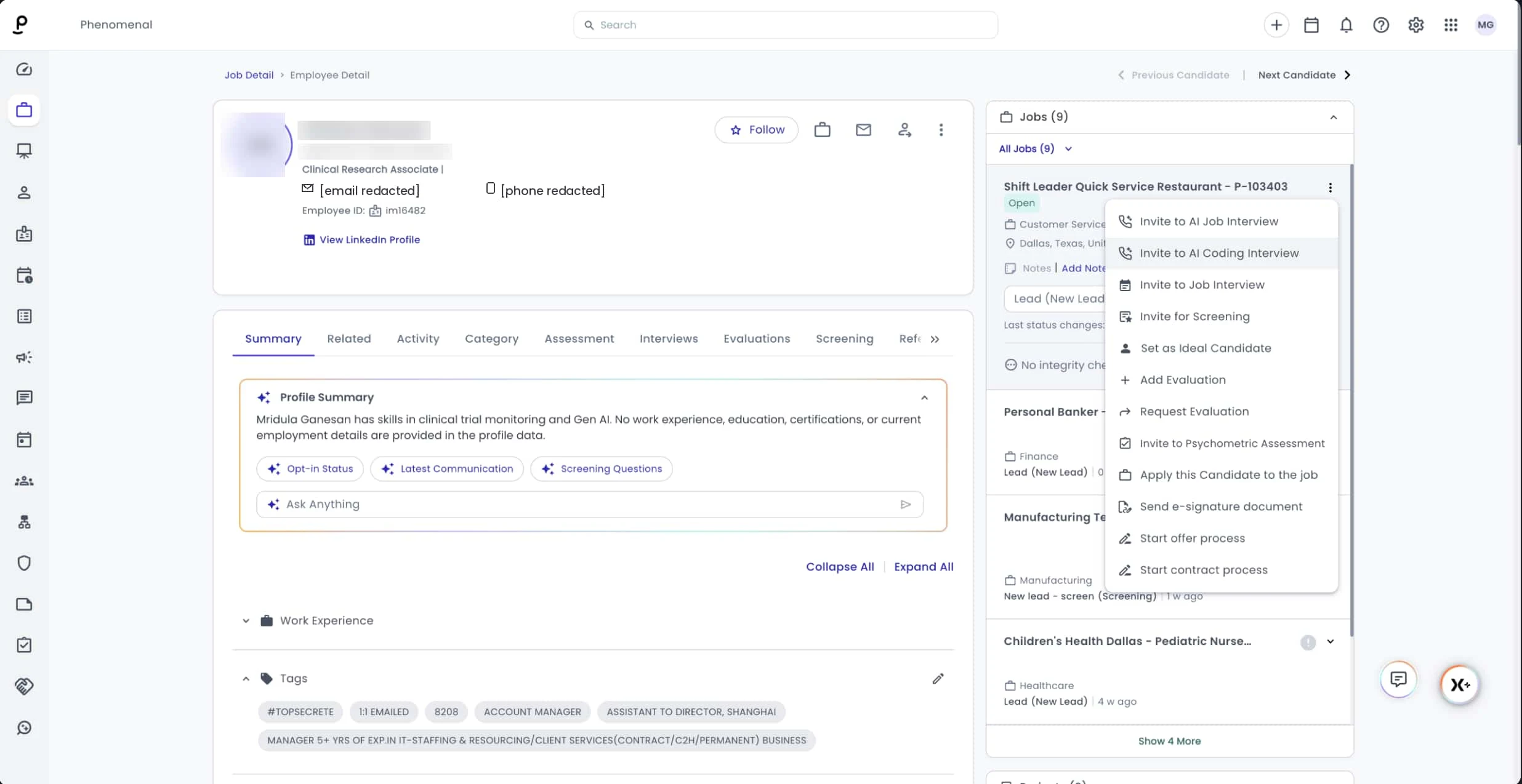
A recruiter starts the interview directly from the candidate's profile, no scheduling step required.
Every candidate gets a structured, real-time interview with Phenom AI Interviewer. Every hiring team gets scored, evidence-backed results, without adding a task to a recruiter's day.

Every open role needs a first conversation before it moves forward, and today that depends on whoever has a calendar slot open. Questions drift between candidates, notes get typed instead of listened to, and busy weeks are when consistency slips most. Candidates wait longer, and teams compare notes never structured the same way twice.

From a candidate's profile, a recruiter starts an interview with no scheduling and no coordinator. The agent builds an interview and evaluation plan, checks it against a quality bar before any candidate hears a question, then holds a real-time voice conversation that adapts to the candidate's answers. When it ends, the conversation becomes a transcript, scores, and a summary the recruiter can act on right away.
Most screening tools generate a script once and run it unchanged. This agent builds an interview plan and an evaluation plan together, then a separate review checks coverage and consistency first. It reasons about what to ask next, but never controls session logic, scoring, or fallback; those stay deterministic. Performance and interview quality are checked separately, against the transcript.
Interview plans are reviewed against a quality bar before a candidate hears them.
Session logic and scoring stay deterministic, never left to open-ended AI judgment.
Every score is checked against the transcript before it reaches a recruiter.

Recruiters can't scale screening without losing signal on every candidate.
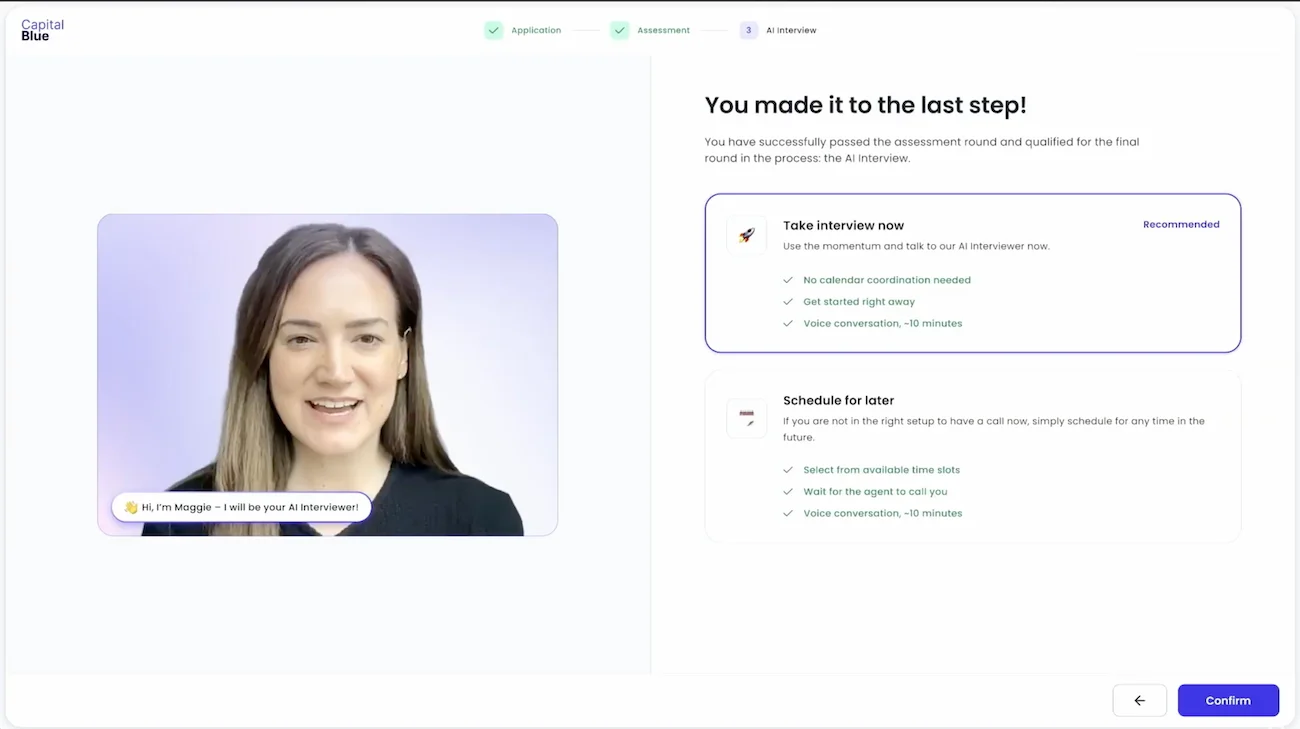
When a role opens, candidates can complete a structured interview as soon as they're ready, day or night, with no scheduling back-and-forth. The agent asks role-specific questions, follows up when an answer needs more depth, and holds every candidate to the same evaluation criteria. Recruiters open a curated, scored shortlist instead of a queue of unreviewed applications.
No scheduling needed Candidates start the interview the moment they're ready.
Every candidate is measured against the same job requirements.
Recruiters review a scored shortlist instead of raw applications.
Instead of relying on a recruiter's memory of a conversation, every interview produces a transcript aligned to the questions asked and the answers given. Scores are grounded in that record, and the system checks its own evaluation for hallucination before it reaches a hiring manager. If a decision is questioned later, the interview can be reviewed or re-evaluated without repeating it.
Every score traces back to a specific moment in the transcript.
Evaluations are checked for hallucination before they're used.
Interviews can be re-evaluated later without another conversation.
Language, voice, and avatar are configurable at the company level, so global hiring teams can offer a consistent interview experience across markets without building a separate process for each one. If a candidate steps away or a connection drops, the interview recovers instead of ending outright, so a technical hiccup doesn't cost a candidate their shot.
Language and voice are configured once, then consistent everywhere.
Network issues and step-aways are recovered, not treated as dropouts.
The same evaluation standard travels across every market.
From trigger to transcript, every step is checked before the next one runs.
No scheduling link, no coordinator, no calendar hold. A recruiter selects a candidate already in the pipeline and starts the interview directly, and the agent takes the conversation from there.
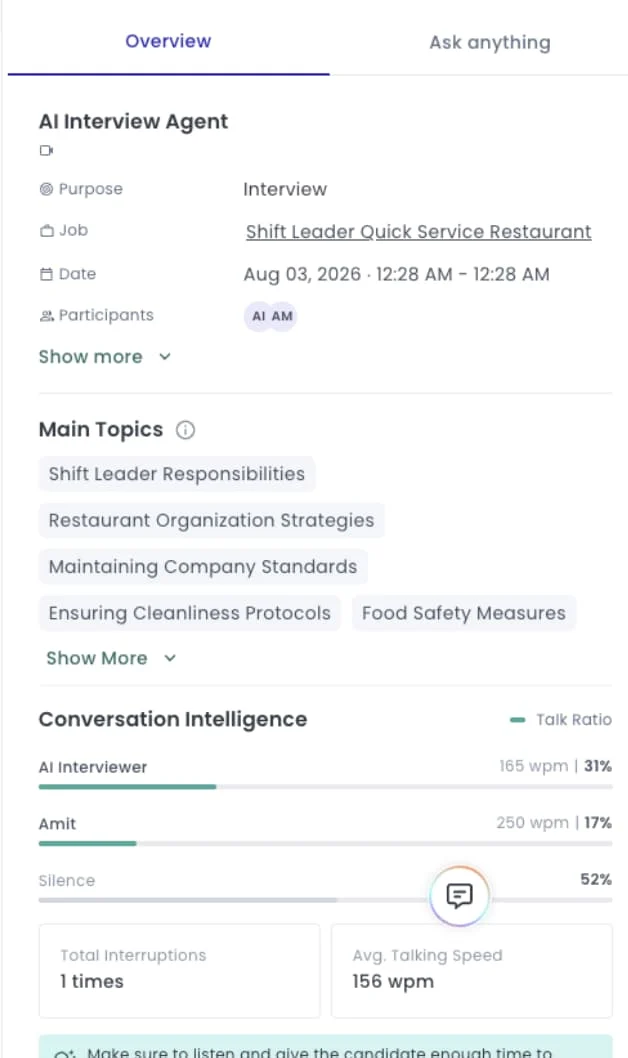
The agent drafts an interview plan and an evaluation plan together, then a separate review checks coverage and consistency before the plan is used. During the live conversation, it listens, reasons about what to ask next, and adapts to the candidate's actual answers in real time.

After the conversation ends, the transcript is normalized and aligned to the approved evaluation plan. The system scores candidate performance, checks its own evaluation for hallucination, and produces a summary the recruiter can act on without listening to the whole recording.
If a candidate steps away, the connection drops, or an optional feature like the avatar fails, the interview keeps running on a lighter fallback rather than closing outright. Anything unusual, such as timing gaps, mute events, or camera state, is captured as a separate signal and never mixed into the candidate's score.

A recruiter starts the interview directly from the candidate's profile, no scheduling step required.
The agent decides what to ask next based on the candidate's actual answers, inside a plan reviewed beforehand.
Anything unusual in the conversation is surfaced to the recruiter as a signal, never as an automatic decision.
Every plan, conversation, score, and integrity signal is logged and available for review or re-evaluation.
The agent conducts and scores the interview, but doesn't decide who advances. Recruiters review the transcript, scores, and flagged responses before moving a candidate forward. Session closure, scoring, and fallback run on fixed platform logic, not AI judgment. Integrity signals reach the recruiter separately, never folded into the score.
AI Interviewer runs on the same platform as the rest of Phenom's recruiter experience, so an interview doesn't sit in a system of its own.
Pairs recorded, human-led interviews with agent-led ones, so every interview format feeds the same evaluation record.
A planning-and-review loop checks each interview before it runs, then a separate evaluation layer checks candidate performance, interview quality, and its own evaluation for hallucination after every conversation.
Configuration, model versions, and policies are managed centrally, with tenant isolation and an audit trail across every interview the agent conducts.
An AI interviewer is an agent that holds a real-time, structured first-round interview with every candidate, so screening no longer runs entirely on recruiter time. Phenom AI Interviewer meets each candidate with an interview plan that's checked before it runs, then turns the conversation into a transcript, a set of scores and a summary. Recruiters review the evidence and make the call, as part of AI candidate assessment and screening at Phenom.
With Phenom AI Interviewer, a recruiter starts the interview from the candidate's profile with no scheduling step, and candidates begin the moment they're ready. Every candidate is measured against the same job requirements, so recruiters review a scored shortlist instead of raw applications. Screening scales with applicant volume without losing signal on each candidate.
For knowledge-worker roles such as engineering, finance, or data related roles, a recruiter’s first-round screen can confirm a candidate’s background but rarely tests technical depth. The one who can test this depth of knowledge, like hiring managers, simply can’t interview every applicant themselves. Phenom AI Interviewer closes that gap. It asks role-specific technical questions and follows up on candidate answers, scoring every candidate against the same job requirements. Only candidates who show the right depth advance to a human interview, so hiring managers spend their time on qualified finalists instead of finding a mismatch ten minutes into a call.
It follows a reviewed plan and adapts within it. Phenom AI Interviewer builds an interview plan for the role, checks that plan before the conversation starts, then decides what to ask next based on the candidate's actual answers. Session logic, scoring and fallback run on deterministic rules rather than open-ended AI judgment, so the interview stays inside the structure your team approved while still responding to what each candidate says.
Trace it back to the conversation. In Phenom AI Interviewer, every score points to a specific moment in the transcript, and evaluations are checked for hallucination before anyone uses them. A separate evaluation layer reviews candidate performance after the interview, and interviews can be re-evaluated later without asking the candidate to talk again. Every plan, conversation, score and integrity signal is logged, so each hiring decision has an evidence trail.
The interview recovers instead of ending. Phenom AI Interviewer treats network issues and step-aways as interruptions to recover from, not dropouts. Language and voice are configured once and stay consistent everywhere, which keeps the interview experience and the evaluation standard the same across every market
No. Phenom AI Interviewer runs the conversation, and the hiring decision stays with your team. Anything unusual in an interview is surfaced to the recruiter as a signal, never as an automatic decision. Configuration, model versions and policies are managed centrally with an audit trail, and Phenom Interview Intelligence pairs recorded, human-led interviews with agent-led ones so every format feeds the same evaluation record.
© 2026 Phenom People, Inc. All Rights Reserved.


