

How Sweetwater Sound Automates Peak-Season Hiring with a Lean Team
Every year, Sweetwater Sound — the nation’s number one online retailer of musical instruments and pro audio equipment — hits a peak season hiring window that most TA teams would find overwhelming: 350+ distribution center hires in just six to seven weeks. The team responsible for making that happen has four recruiters.
Jordan Applegate, VP of Talent Acquisition & HRBP at Sweetwater, walked us through how recruitment automation made that math possible, and how the same Applied AI infrastructure handles 1,200 annual hires without adding a single person to the TA team.
Watch the full session here, or explore the highlights below.
What Was Standing Between Sweetwater and a Scalable Hiring Process?
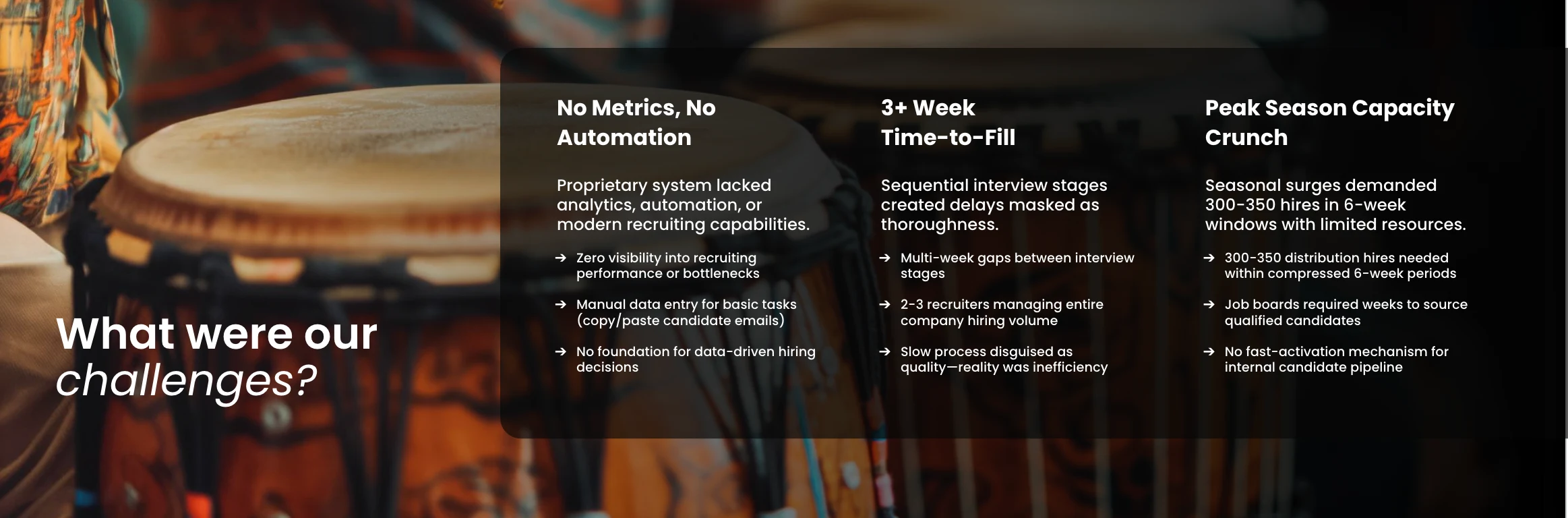
Before Phenom, Sweetwater was running on a legacy database that its in-house software engineering team had built and maintained. There were no metrics, no automation, and no efficiency. Recruiters copied and pasted email addresses manually. Time to fill for hourly roles stretched beyond three weeks, most of it lost to scheduling back-and-forth. Every tool the team needed lived in a different system: Calendly for interview links, a third-party vendor for text messaging, Adobe Sign for offers, manual CSV uploads for background checks.
"What I really hate as a leader of talent acquisition is seeing recruiters having to go out to many different places to do part of their work and then come back into the CRM," Applegate said.
Peak season amplified every one of those friction points. When you need to move 300 people through a six-week hiring window and your recruiting team is four people, there is no slack. Any manual step in the process directly caps throughput. “I am going crazy to try to think of a strategy to make this work,” Applegate said of the pre-Phenom peak season experience.
The other pressure was spend. Job boards were generating thousands of applications, but no-call-no-shows were eating into the ROI, and the team had no clean way to source from the candidate pool they already had.
How Did They Use Automation to Replace External Hiring Tools and Hit Peak Targets?
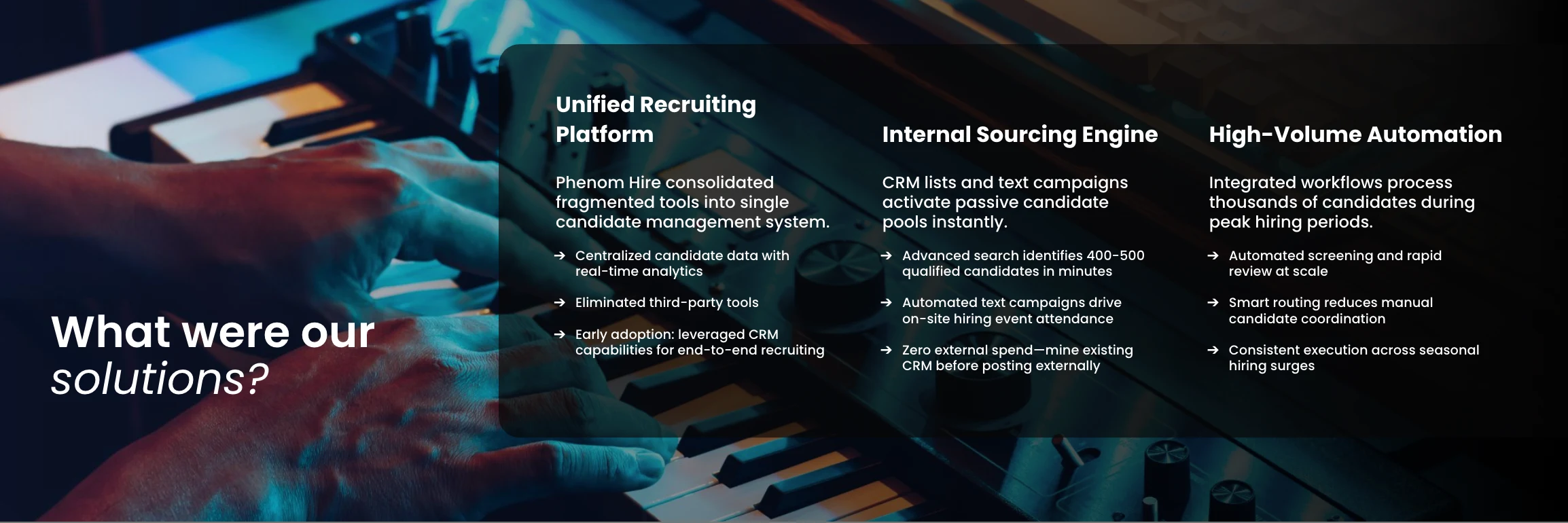
The shift to Phenom Hire gave Sweetwater an end-to-end solution that replaced their fragmented stack. Automation recipes tied to hiring status changes handled the manual steps that had previously consumed recruiter time. When a candidate moved from “considering” to “phone interview,” the system automatically sent a scheduling invite with a built-in calendar link. Every workflow the team had been doing outside the platform was rebuilt inside it, and the external subscriptions were canceled.
The internal talent CRM sourcing strategy became one of Applegate’s most impactful use cases. Rather than paying job boards to generate candidates they already had on file, the team ran an advanced search in Phenom for recent candidates who hadn’t been advanced but had engaged within a defined time window. Those profiles were filtered into a list, and a text campaign invited them to an on-site hiring event. (See below for the results!)
For top-of-funnel volume during peak hiring, Sweetwater layered in Indeed Apply with an automation that fired the moment a candidate clicked apply. Hiring status changed automatically from lead to “not reviewed,” so recruiters had a real-time queue without manual scraping or mass uploads. Offer management went from a multi-step process to three clicks. Background check initiation dropped from a manual coordinator task to a single click.
Related: How Sweetwater Sound Rocks the Candidate Experience
What Results Did Phenom Automation Deliver?
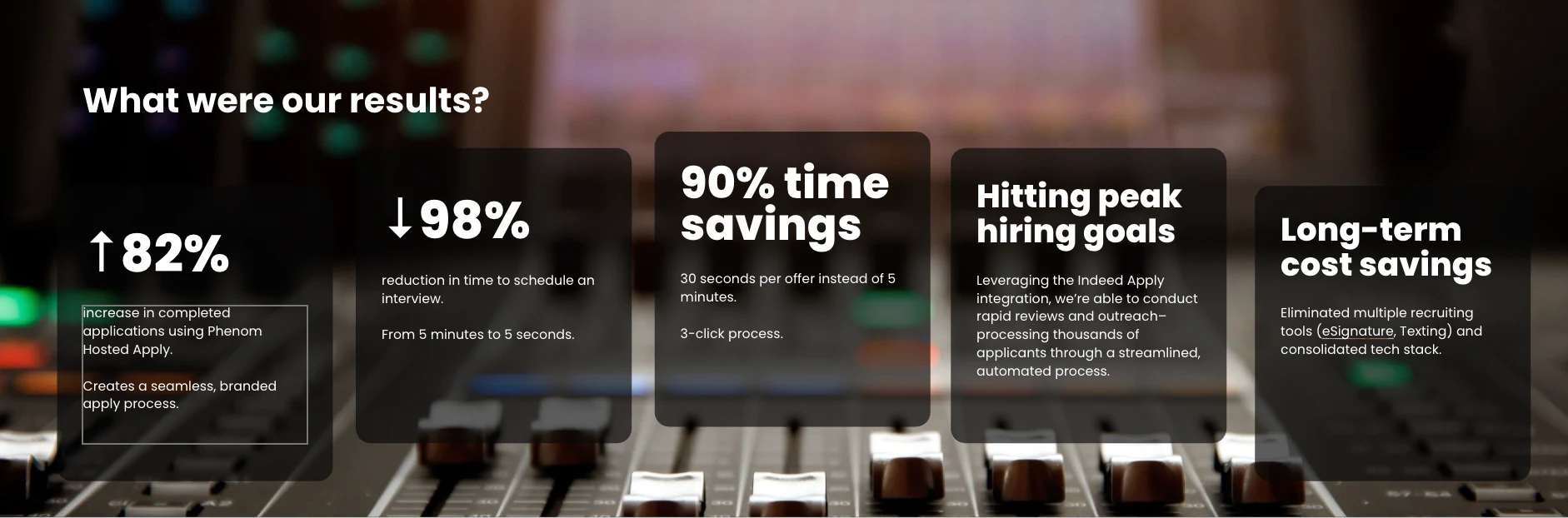
The numbers Sweetwater brought to this session reflect both the headline wins and the structural changes underneath them, including:
82% increase in completed applications
98% reduction in time to schedule an interview (from 5 minutes to 5 seconds)
90% time savings (30 seconds per offer vs. 5 minutes)
65 hires in < 2 days (vs. job board spend)
A branded, consistent apply experience through Phenom Hosted Apply, combined with the automation to handle high-volume inbound, gave the team the confidence to do something they hadn't before: send email campaigns to hundreds of thousands of customers. Many of Sweetwater's best employees start as brand fans, so the audience was already warm. "We had the confidence that we had the tool now to be able to allow us to leverage automation to move through the thousands and thousands of applications," Applegate said.
The same efficiency carried through to offers. "Offer management for us is a game-changer. It really is three clicks once you have those templates set up," Applegate said.
The success of their internal campaign also reinforced that the highest-value candidates weren't always new ones. They were already in the system, waiting to be re-engaged. The automation made that operationally feasible in a way that manual outreach to a database of hundreds of thousands of records never could have been.
What’s Next?
On the horizon is a Workday integration to automate new hire record creation in the HCM directly from an accepted offer in Phenom. That eliminates the last manual step in the hiring-to-onboarding handoff. Augmenting processes with AI screening and interviewing is also being discussed.
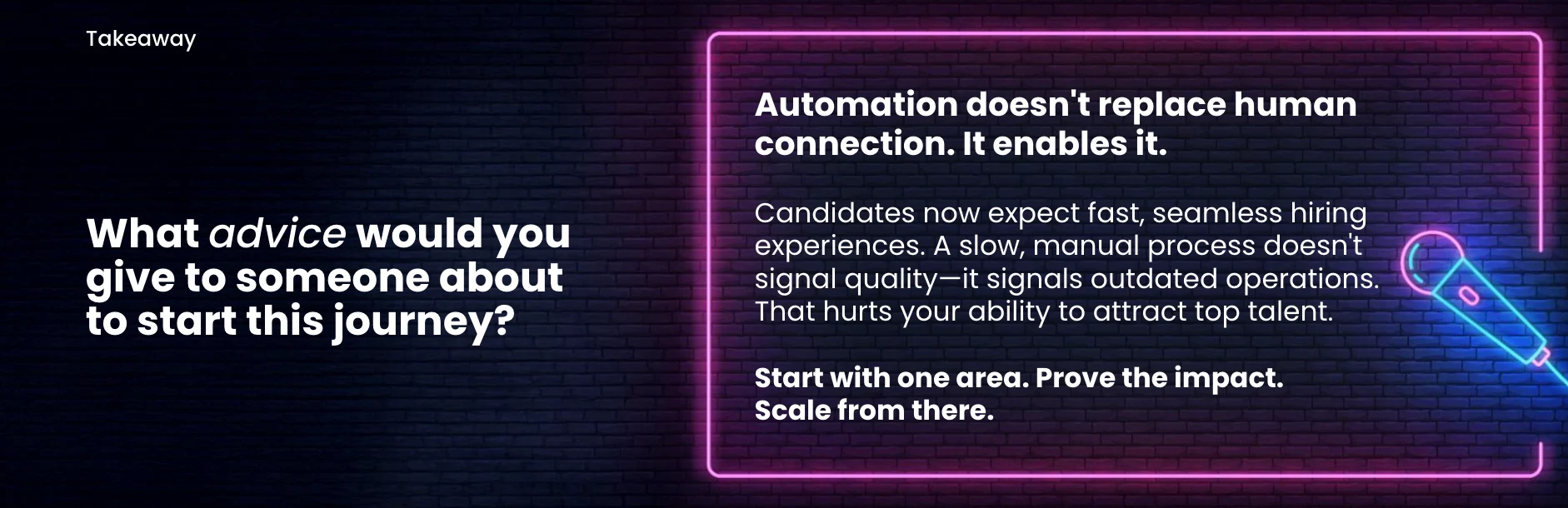
Applegate’s closing message to TA leaders was grounded in the reality of relationship-based hiring. Automation and personalization aren’t in conflict. Sweetwater’s identity is built on one-to-one relationships with customers and candidates alike. That didn’t change when they automated. It just got more consistent.
“Automation still has the opportunity to be a significant tool that keeps that personalization but drives a crazy amount of efficiency.”

Raghu is a Product Marketing Manager at Phenom. Outside work, he experiments in the kitchen and unwinds with a good thriller.


Get the latest talent experience insights delivered to your inbox.
Sign up to the Phenom email list for weekly updates!


