

Beyond the AI Pilot: 7 Realities IT Leaders Need to Plan For
The difficult part of enterprise AI begins after the buying decision. By the time an initiative reaches an IT leader's desk, the budget is often approved, the vendor chosen, and the pilot has already impressed the people who will be using the system, not those who have to keep it running. What's rarely defined is who operates the system, governs its decisions, and answers for it when production behavior diverges from the demo.
IT is also increasingly the one asked a harder question earlier: is an existing system's built-in AI actually fit for the task, or does it need to be replaced or augmented? Getting that call wrong in either direction is costly, whether that means forcing a team to work around a system's limits or layering in redundant infrastructure.
This article examines seven of those decisions. Each points to a different part of the operating model that needs to be considered before an AI initiative moves from demonstration to dependable enterprise capability.
In this Article:
1. Automating a Broken Process Only Makes It Broken Faster
Three decades of HR and enterprise software, from ATS platforms and HCM suites to the consulting ecosystems built around them, have optimized many organizations for process adherence. Screening throughput, ticket closure rates, form completion, and approval cycles can tell us whether the prescribed steps were followed, but they don't tell us whether the intended business outcome was achieved. Over time, organizations can become highly proficient at executing tasks without stopping to examine whether the process itself still makes sense.
That gap between adherence and outcome is exactly what pushes teams outside the system in the first place. When an ATS can't handle a nuanced sourcing criterion or an HCM workflow can't accommodate how a role actually gets filled, people don't wait for the platform to catch up. They simply take a job elsewhere. When intelligence is layered onto a poorly designed workflow, the result is a faster version of the same underlying problem. Greater speed may improve throughput, but throughput alone does not create better decisions, better experiences, or better business outcomes.
This makes process assessment an important part of AI planning.. An implementation roadmap should distinguish between workflows that are genuinely ready for automation and those that first require redesign, simplification, or better data. Doing that work upfront gives AI something worth accelerating instead of asking it to reproduce inefficiency at a greater scale.
2. AI Investment Must Follow the Problem, Not the Platform
Understanding where friction sits changes the economics of an AI program. If most investment is concentrated on execution, an organization may be funding the most visible layer of a problem while leaving the other constraints untouched. This can produce a collection of successful automation projects that each deliver incremental savings while failing to create meaningful change across the broader operating model.
The issue is often less about whether those individual projects work and more about whether those projects holistically address the right problems. A system that removes ten minutes from a process may have limited strategic value if the larger constraint is poor data, fragmented communication, or a decision that consistently requires expert judgment. Conversely, improving the quality or speed of a high-value decision can have an impact that is not captured by a simple measure of hours saved.
This is why AI investment needs to be connected to business outcomes versus platforms, features, or automation volume. Technology leaders can create a more durable investment model by mapping each initiative to the specific operational challenge it addresses, the business outcome it is expected to influence, and the level of risk associated with that outcome.
3. One AI Foundation Model Can’t Carry Enterprise Risk
Foundation models have fundamentally expanded what enterprise software can do, and their breadth makes it tempting to treat a single powerful model as the central answer to a wide range of business use cases. At enterprise scale, however, capability is only one part of the equation. The more important consideration is whether an organization can understand, evaluate, govern, and control the outputs that capability produces.
A model that performs well in a demonstration may still behave unpredictably across different data, roles, workflows, or edge cases. Without evaluation infrastructure around it, those failures can remain invisible until they reach a customer interaction, an employee record, a business decision, or a compliance process.
This changes the role of the model within the architecture. The foundation model provides a layer of general intelligence, but evaluation, observability, retrieval, orchestration, governance, security, and human oversight determine whether that intelligence can be trusted in a particular operating environment. The model itself may be available to many organizations, while the systems that govern how it is applied become increasingly specific to each enterprise.
For teams, this means model selection should be considered alongside the infrastructure that surrounds the model. As AI moves into more consequential workflows, the ability to evaluate and control behavior becomes as important as the underlying model's capabilities. That infrastructure also has to carry the industry and enterprise context, from licensing requirements, along with the ontological understanding of how a specific organization's roles, teams, and workflows actually relate to one another.
4. AI Model Economics Should Follow Role Risk and Complexity
Not every enterprise decision requires the same depth of reasoning, level of verification, or degree of human oversight. A high-volume, lower-risk task can have very different requirements from a decision made by a senior specialist where an error carries financial, regulatory, or reputational consequences. Treating both through identical infrastructure may simplify the architecture, but it can create unnecessary cost in one area and insufficient safeguards in another.
Model routing provides a way to align intelligence with the nature of the work. Different models, reasoning depths, retrieval strategies, and verification mechanisms can be assigned according to the complexity and consequence of the decision rather than applying the most capable configuration everywhere.
This approach also changes the economics of AI infrastructure. The objective is not to maximize model power across every workflow, but to match compute, reasoning, and verification to the value and risk of the outcome being produced. In practice, that can mean using lightweight models for high-volume tasks while reserving deeper reasoning and stronger verification for decisions that warrant it.
5. AI Operational Cost isn’t Just Tokens
The operating environment around an AI system doesn’t remain static. New data arrives, roles evolve, customer behavior shifts, regulations change, language patterns develop, and new edge cases emerge that were absent from the original training and evaluation data. Over time, the distance between what a system learned and what the business now looks like can become a meaningful source of risk.
Retraining and continuous evaluation should therefore be treated as part of the operating model rather than as evidence that an implementation has failed. The cost of maintaining an AI capability includes monitoring its performance, evaluating new data, refining prompts and workflows, retraining models where appropriate, and determining when the underlying architecture needs to change.
This is particularly important because traditional enterprise technology budgets are often structured around procurement and implementation milestones. AI requires a different financial mindset. The initial deployment is the beginning of an operating cycle, not the point at which investment ends.
Leaders can account for this by building ongoing evaluation, model improvement, data management, and governance into the original business case. Doing so makes the economics more realistic and gives teams the capacity to respond as the system encounters conditions that couldn’t have been fully anticipated during the pilot.
6. Intelligence: The Durable AI Model Advantage
If AI foundation models are broadly accessible and enterprise data is no longer sufficient on its own to create meaningful differentiation, the durable advantage sits in how an organization combines the two. It’s built through the evaluation systems that determine whether outputs are reliable, the routing logic that decides which model should handle a particular task, the domain context that shapes reasoning, and the workflows that connect intelligence to action.
Over time, those layers accumulate institutional knowledge. They reflect the organization's industry, roles, customers, policies, workflows, risk tolerance, and lessons from previous model interactions. Each evaluation cycle can strengthen the system, provided the organization captures what it learns and feeds that learning back into the architecture. This creates a form of enterprise-specific intelligence that can’t simply be acquired by selecting the same foundation model as a competitor. The AI model may be shared, but the operating context, evaluation history, decision pathways, governance mechanisms, and accumulated feedback are specific to the organization.
This is where AI strategy moves beyond procurement. The long-term opportunity is to build an intelligence layer that becomes more useful as the organization learns, rather than treating every AI deployment as an isolated technology purchase.
Friction Has to Be Placed, Not Eliminated
Once the underlying workflow has been examined, the next step is understanding where friction exists. . Enterprise environments rarely contain only unnecessary obstacles. Some forms of friction represent waste, while others provide control, introduce accountability, catch errors, or give people an opportunity to intervene before a consequential decision moves forward.
Removing all of it in pursuit of a seamless experience can create a different kind of operational risk. The objective should be to understand where friction originates, determine whether it protects or impedes the desired outcome, and then use AI selectively to reduce the parts that add unnecessary drag.
Enterprise workflows typically carry six distinct forms of friction:
Type | The question it answers |
|---|---|
Knowledge | Do people have access to the information they need to understand what should happen next? |
Skill | Does the team have the capability to complete the task or make the decision? |
Cognition | How much information can a person reasonably process before decision quality begins to decline? |
Communication | What information is lost or distorted as work moves between teams, channels, and systems? |
Operational | Is the underlying data structured, accessible, and reliable enough to support action? |
Execution | Did the intended outcome actually happen, regardless of how many process steps were completed? |
AI pilots naturally gravitate toward execution because it’s the easiest layer to demonstrate. Faster processing, automated handoffs, and reduced manual effort make for compelling pilot metrics, but they don’t necessarily address the knowledge gaps, skill limitations, cognitive burden, communication breakdowns, or data quality issues surrounding the task.
For technology leaders, mapping these different sources of friction provides a more useful starting point for AI investment. It moves the conversation away from simply asking where automation is possible and toward understanding where intelligence can change the quality of the underlying operation.
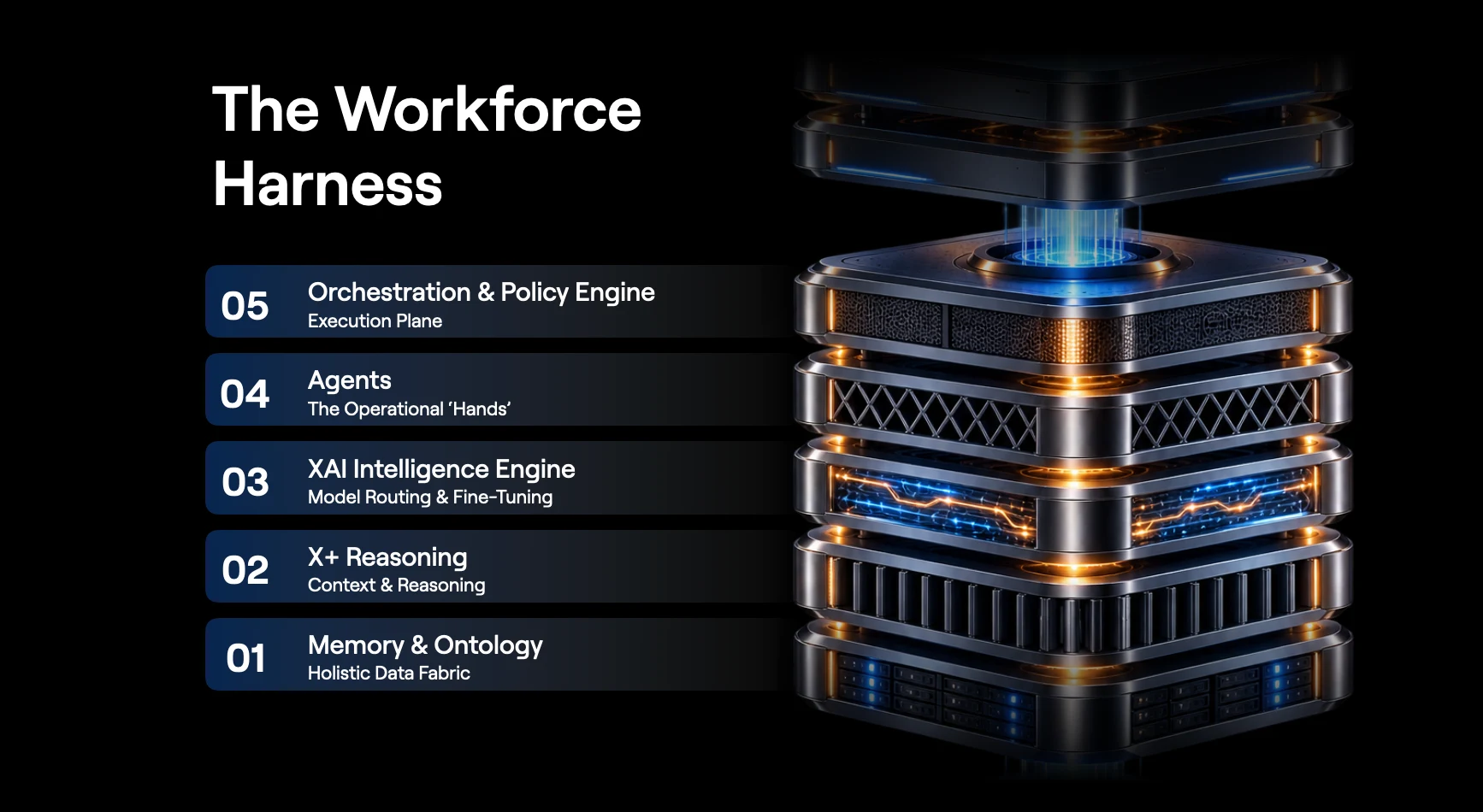
Phenom's Five-Layer AI Harness for Enterprises
Knowing where these seven truths break down is one thing. Seeing how Phenom's platform is actually built to address them is another, and that's where the AI harness underneath Phenom comes in.
Memory and ontology: curates data at three levels at once: the specific company, the broader industry, and the general talent infrastructure, giving every agent an understanding of where a particular business actually sits
Reasoning infrastructure: brings context into the decision, working out what reasoning a specific company's situation actually calls for rather than applying a generic answer
Intelligence engine: routes work through model sensing, where domain managers identify which model is responding most effectively to a given task. Reinforcement learning then strengthens that routing over time, cost-optimizing the infrastructure as it goes
Agents: the execution layer, acting as extended hands across the talent ecosystem. 25 agents currently carry out HR pathways in different spots across the workflow
Orchestration: governs how humans and agents work together, driving what gets sensed, what pathway gets taken, how execution happens, and how it gets verified
Moving From AI Pilots to AI Operations
Taken together, these seven truths point to a broader shift in how enterprise AI should be approached. The question is no longer simply how quickly an organization can move a promising use case from pilot to production. It’s how deliberately it can build the operating conditions that allow AI to remain reliable, economically viable, and increasingly valuable once it gets there. Start with the business outcome rather than the model, redesign processes where automation would otherwise accelerate existing weaknesses, map the different forms of operational drag across critical workflows, and align investment to the problems that matter most. From there, build an architecture that can route decisions according to risk, surround models with evaluation and governance, and account for continuous improvement as a recurring operating requirement.
The organizations that approach AI this way will move beyond isolated pilots toward capabilities that can evolve with the business. The real opportunity isn’t simply to deploy AI at scale, but to build the infrastructure, intelligence, and operating discipline that allow the business to reach its ultimate goals.
Book an AI and automation conversation with our advisors to identify the right opportunities and shape a practical path from implementation to scale.

Devi is a content marketing writer passionate about crafting content that informs and engages. Outside of work, you'll find her watching films or listening to NFAK.


Get the latest talent experience insights delivered to your inbox.
Sign up to the Phenom email list for weekly updates!


