

Architecting the Enterprise Memory: How Ontologies and Model Routing Drive IT Orchestration
For years, core HR and Talent Acquisition software presented a unique challenge for enterprise IT and systems engineering teams. Traditional systems functioned strictly as record-keeping databases, storing candidate resumes, tracking requisition IDs, and updating application status tables. They handled simple transactional data well, but remained isolated from broader organizational context and enterprise data strategy.
At Phenom AI Day, we showed a new way to give hiring software a memory of the business, so it can connect scattered data and act on its own with the right guardrails.
In this Article:
The Current Architecture Gap in Enterprise HR Systems
When a business opens a new position, traditional software treats it as a single row in a database table. It tracks the requisition ID, target city, and job title, but ignores the underlying operational and strategic dependencies. While engineering leads and strategic executives understand how corporate initiatives interconnect, legacy enterprise software historically operated in a vacuum. Experienced leaders know a store opening in four weeks depends on hiring a general manager first, and that a new market carries more risk than an established one. Legacy HR software knows none of this, so recruiters treat every requisition with the same urgency, critical roles get spotted too late, and openings slip. IT and data analysts absorb the other half of the cost: each time the business needs that missing context, someone builds another integration, exports another spreadsheet, or writes another custom report to stitch it together by hand. Closing this gap requires an enterprise ontology.
What the Ontology Foundation Does
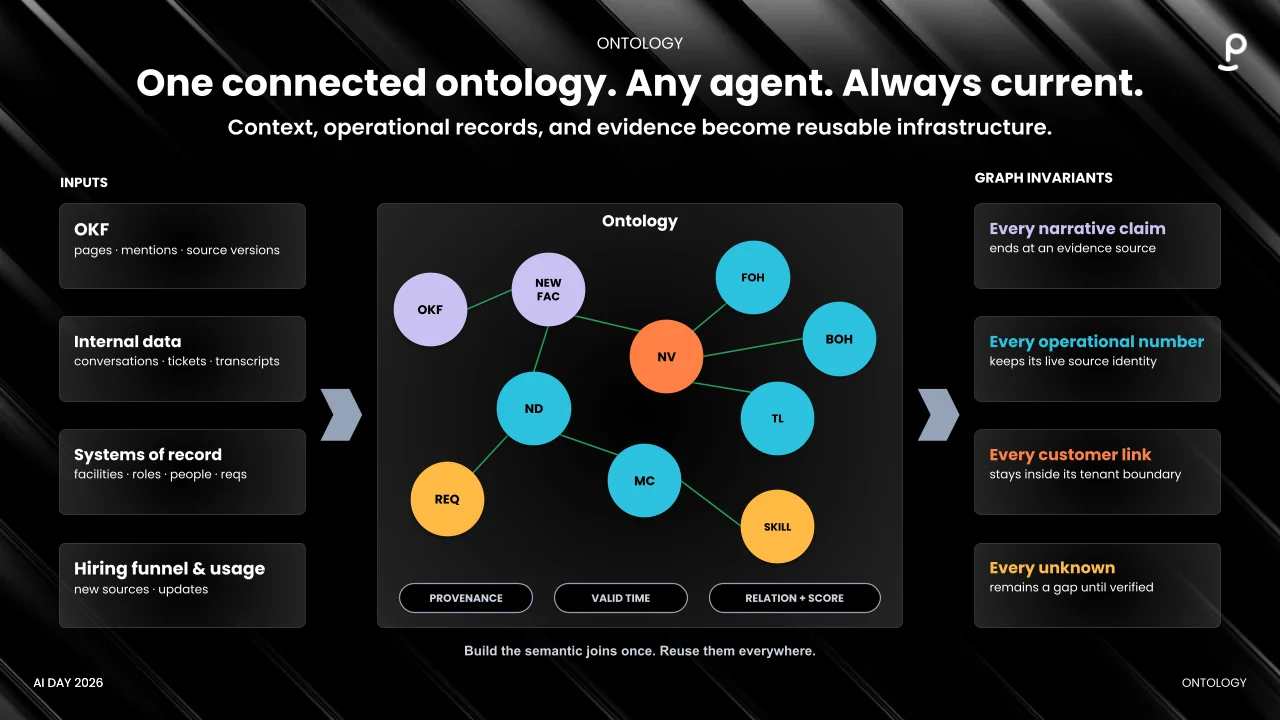
An enterprise ontology works like a shared map of how the business fits together. It draws from four kinds of input without replacing any of them: systems of record that hold facilities, roles, people, and requisitions.
internal knowledge from conversations, support tickets, and call transcripts; documents organized through Open Knowledge Format, such as pages, mentions, and versioned sources. It pulls from four sources without replacing any of them: your systems of record, internal conversations and transcripts, structured documents, and live hiring data. The ontology links all of these into one graph, so a location, the roles it needs, the skills that role requires, and the initiative behind the opening sit connected rather than scattered across systems that were never designed to talk to each other. Every connection in that graph records where it came from, when it was valid, and how strong the link is, so lineage is built into the data instead of reconstructed after the fact.
Related Read: Demystifying Skill Ontologies: Your Roadmap to Clarity
Inside Phenom’s Enterprise AI Harness
The harness is Phenom’s framework for running AI safely across HR. It wraps every agent and application in the same shared context, policies, and monitoring, so whether a recruiter asks a question or an agent sources candidates, the work draws on verified data and follows the company’s rules. The ontology sits at its foundation, with agents, orchestration, guardrails, evaluations, and the HR applications teams use every day built on top.
The table below maps how each of the five components is built and what it changes for the teams who run, secure, and audit the system.
Component | Technical Foundation | Engineering & IT Value |
|---|---|---|
Knowledge Graph | Constructed as a graph database using FalkorDB to map entities, attributes, and explicit relationships. | Provides sub-second, deterministic query performance for core relational structures like headcounts, organizational hierarchies, and active requisitions. |
Unstructured Context (OKF) | Implements Google's Open Knowledge Format (OKF) patterns to ingest and normalize raw documents. | Converts unstructured meeting transcripts, strategic briefs, and corporate filings into indexed, discoverable document blocks. |
Dynamic Model Routing | Automated workload distribution balancing fast, low-cost LLMs against deep-reasoning models. | Optimizes cloud compute expenditure and operational latency by reserving heavy reasoning models strictly for complex planning tasks. |
Glass Box Lineage | Every node and edge in the graph stores its source, valid time, and a confidence score, and each response is saved with the prompt, retrieved context, and reasoning steps that produced it. | Delivers full auditability, allowing security and system administrators to inspect underlying retrieval sources and model reasoning paths. |
Policy Harness & Guardrails | Deterministic rule execution engines layered over agentic execution loops. | Guarantees compliance by enforcing enterprise security policies, access controls, and procedural constraints before executing actions. |
Context Assembly for Scaled Operations
During the live product showcase, engineers demonstrated how this connected framework aggregates disparate enterprise data streams using a real-world scenario with Texas Roadhouse.
A single query on Nevada surfaced that the market belonged to a greenfield expansion while already having three operating locations, along with the critical roles still open there. No one assembled that view by hand or wrote a custom join to produce it; the system traversed the graph and pulled structured records and unstructured notes together in seconds.
Four rules govern what the graph can hold, and each one maps to a question an auditor or security reviewer would ask:
Every narrative claim ends at an evidence source.
Every operational number keeps its live source identity.
Every customer link stays inside its tenant boundary.
Every unknown remains a gap until someone verifies it.
Because those joins live in the ontology, they're built once and shared by every application and agent that needs them. A recruiter's chatbot question, a hiring readiness deck, and an autonomous sourcing agent all draw on the same verified context, so adding a new use case doesn't mean standing up another integration, another data copy, or another system to secure. The components below are what make that foundation fast, traceable, and safe to automate on.
This means leadership teams gain instant visibility into regional hiring health and strategic bottlenecks without spending days manually assembling reports across disparate systems.
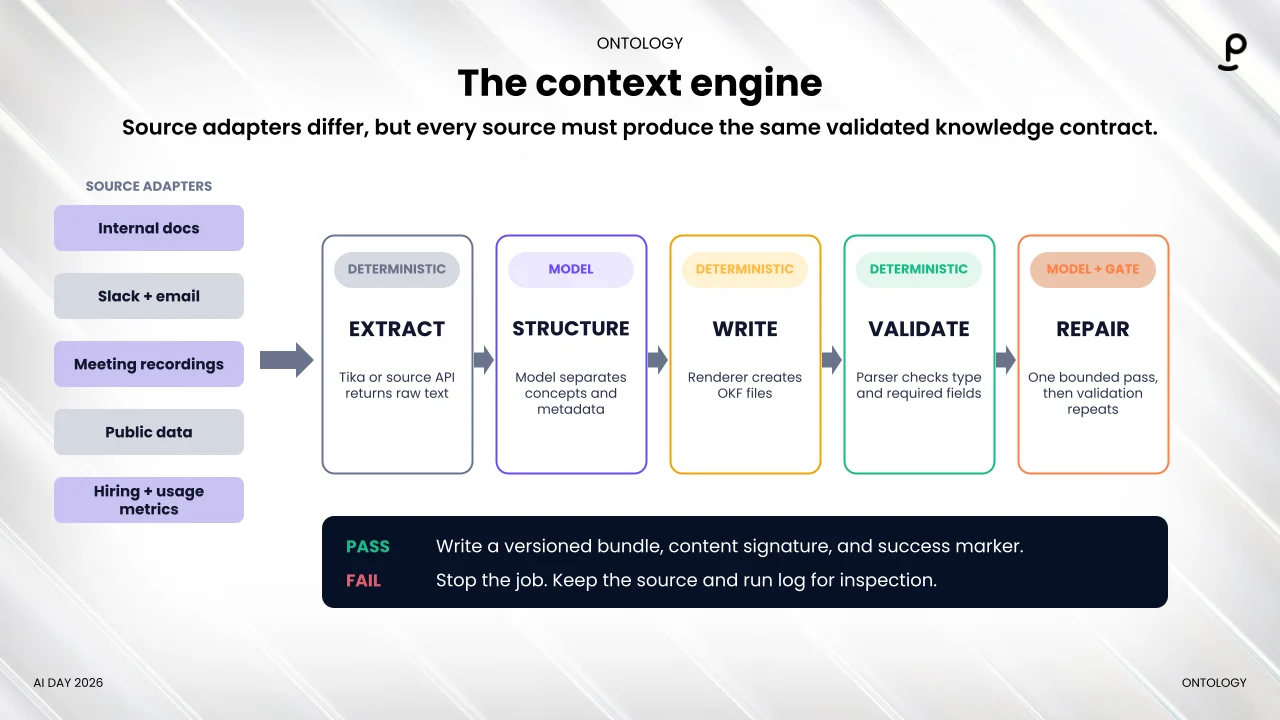
System Traceability and Glass Box Audit Trails
This "Glass Box" auditability lets IT leaders safely approve AI deployments, knowing every output traces back to verified corporate sources. Deploying autonomous systems into production environments requires strict adherence to security, data integrity, and compliance protocols. Black-box decision-making creates unacceptable operational risks for IT infrastructure.
The enterprise harness guarantees transparency by maintaining strict data provenance across every operation:
Source Document Lineage: Every generated output links directly back to its source entity in the FalkorDB graph or the specific OKF text chunk.
Execution Inspection: System administrators can inspect full system prompts, context payloads, and intermediate reasoning steps taken by planning agents.
Data Hydration Workflows: Low-confidence extractions or conflicting records trigger explicit exception handling, routing the data to forward-deployed teams and administrators to validate and hydrate the ontology.
Query Optimization via Dynamic Model Routing
Now that we understand how data is retrieved and verified, let's examine how the system processes queries efficiently without inflating cloud infrastructure costs. To maintain system responsiveness and control API compute expenditure, the framework utilizes an automated routing layer:
Deterministic Lookups: Direct factual requests, such as querying open headcounts or active store roles in North Dakota, bypass heavy reasoning pipelines. The system queries the FalkorDB graph directly using a lightweight, low-cost model, yielding sub-second latency.
Multi-Step Strategic Tasks: High-level requests, such as generating a complete hiring readiness deck, require multi-step planning. The router escalates the request to a long-context reasoning model. A planner agent divides the request into sub-tasks, queries the context layer, evaluates historical velocity, and formats the deck.
This model routing approach ensures users receive fast answers for everyday lookups, while IT departments avoid unnecessary LLM compute costs by using heavy reasoning models only when needed.
Governed Agent Orchestration and Autonomous Sourcing
Having built a contextual memory layer and a query optimization system, the next logical step is connecting autonomous agents to execute operational workflows.
In traditional environments, when a talent pipeline dries up, recruiter intervention is required to identify the gap, check internal mobility pools, and post jobs. Within the harness, autonomous agents continuously monitor pipeline health against defined business goals.
Autonomous Triggering: If a critical role in a new store opening (e.g., Fargo, ND) lacks candidates, the sourcing agent detects the gap automatically.
Policy Enforcement: Before launching external outreach, the agent checks enterprise guardrails. For instance, policy rules mandate searching internal employee databases for transfer opportunities first.
Monitored Execution: If no internal candidates qualify, the agent initiates external candidate sourcing while logging every action to an audit event stream.
For talent acquisition teams, this automates manual sourcing tasks and prevents delays in store openings. For IT, it ensures autonomous agents operate strictly within enterprise security and policy parameters.
Related Read: Ethical AI Principles: Fairness, Transparency, and Trust in HR
Continuous Evaluation and Quality Assurance Loops
Maintaining high data fidelity across dynamic enterprise environments requires continuous validation. As underlying models evolve and knowledge graphs scale, engineering teams must ensure that system outputs remain deterministic and reliable.
When ingestion exceptions occur, data conflicts route directly to deployment teams for resolution. Establishing reliable evaluation parameters requires joint alignment between domain leads and system architects.
Once evaluation standards are defined, they are codified into explicit testing frameworks. Whenever the underlying knowledge graph updates or a model version changes, the evaluation suite executes regression tests against established data snapshots to guarantee data grounding, schema adherence, and ongoing reliability.
The Memory Layer Every AI Agent Will Depend On
Every organization already holds the knowledge to run hiring. It sits in requisition tables, quarterly business reviews, and the heads of experienced leaders. The trouble has always been that no system could see all of that knowledge at once.
An ontology graph changes everything by turning institutional knowledge into shared context that people and software can both draw on. The need for this systemization will only sharpen from here. As organizations hand more work to AI agents, the quality of those agents' decisions will depend on the quality of the context beneath them, and regulators will increasingly expect proof of where each decision came from. Companies that build a governed, traceable memory layer now will be able to automate with confidence, while those that skip it will find each new agent inheriting the same blind spots their software has always had.
Your context already exists. Let's connect it. See how Phenom's ontology turns your systems and conversations into context your teams and agents can act on.

Devi is a content marketing writer passionate about crafting content that informs and engages. Outside of work, you'll find her watching films or listening to NFAK.


Get the latest applied AI insights delivered to your inbox.
Sign up to stay up-to-date on the latest original content from Phenom, including new podcast episodes, events, and more.


