

AI Agents in Insurance, Built for the Context Behind Every Role
A commercial underwriter role in Hartford and a commercial underwriter role in Houston can carry an identical job description while requiring two very different hiring strategies. In Hartford, the challenge may be succession because the company has no plan to identify internal talent. And in Houston, the challenge may be growth, requiring the organization to source external talent. Although the roles share the same title and job family, the business conditions behind each opening create very different hiring problems.
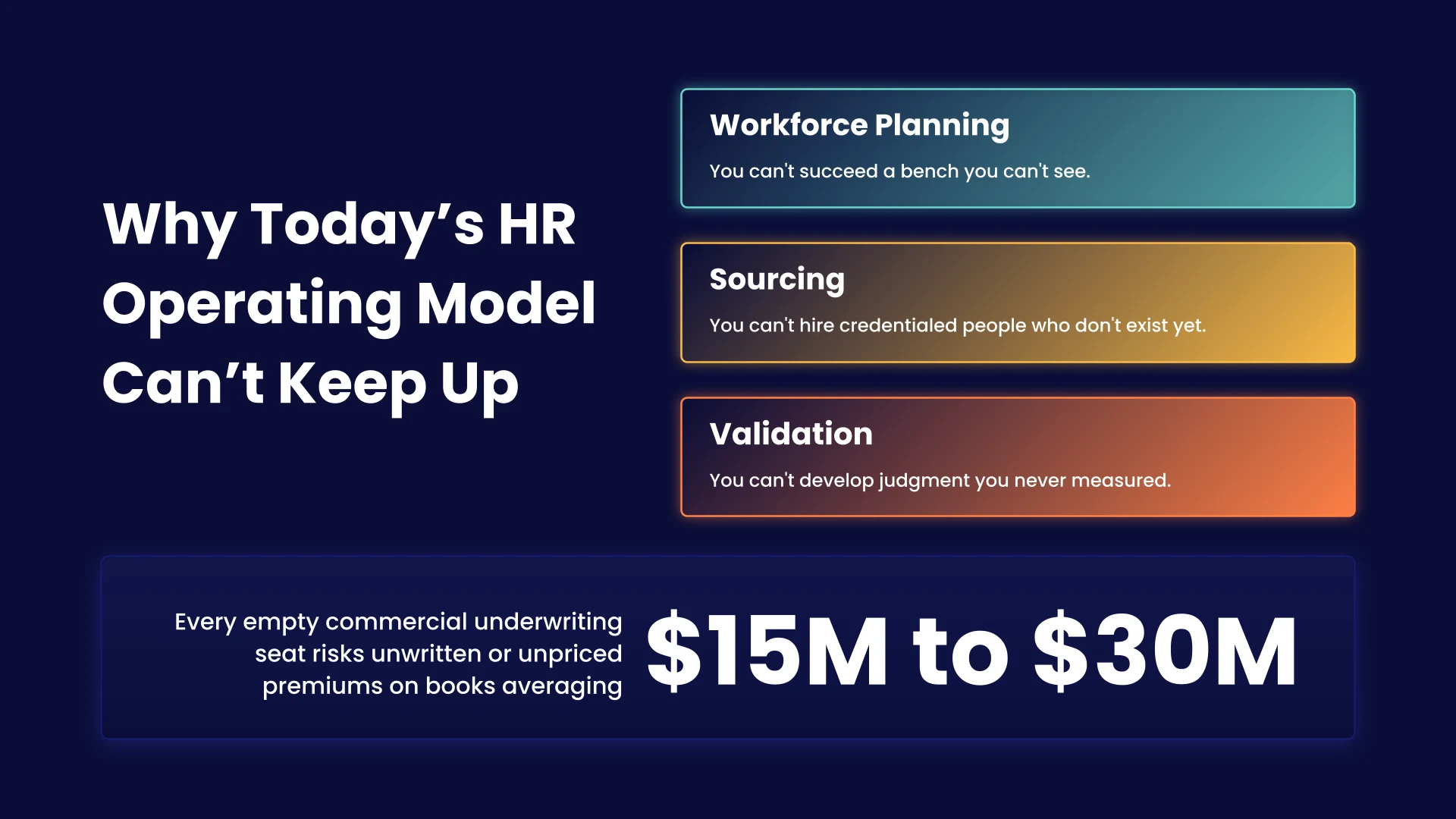
That distinction matters more in insurance right now than it has in decades. Roughly half of the industry's workforce is expected to reach retirement age within the next 15 years, leaving carriers with a shrinking bench of experienced talent and a growing pipeline gap behind it.
Phenom's hypercell approach is designed to distinguish between these situations by looking beyond the job title to the context surrounding each role. John Deal and Raghu Dahagam, members of Phenom's product marketing team, recently walked through how this approach applies to insurance hiring and what it looks like in two real scenarios.
Why a Single AI Tool Can't Solve Every Hiring Challenge
Many organizations respond to a hiring gap by adding point solutions: a chatbot here, a resume screener there, or another tool layered onto an existing applicant tracking system. These tools can automate individual steps, but the approach becomes less useful when the underlying hiring situations require different decisions based on factors such as location, talent availability, workforce composition, and the specific skills a role requires.
"The only way to apply AI effectively is to understand the details of the role, its function inside the organization, its location, and what's happening in it from a talent availability standpoint, and the workflow you're trying to refine," Deal said.
A collection of disconnected tools has limited visibility into that wider context because each system is typically designed to solve one part of the process rather than understand how those pieces relate to one another.
Without connected workforce and skills data, those two pieces of information remain separate, making it harder to identify internal mobility opportunities or understand where external sourcing is actually needed.
Phenom solves this problem with its hypercell operating model.
"We define a Hypercell as a unique hiring challenge based on a combination of industry, role, geography, function, and workflow, not just the job title," Dahagam explained.
Related Read: The 2026 Definitive AI Recruiting Guide
Use Cases That Show How Hypercell Works
The two scenarios below represent opposite hiring challenges.
One involves a scarce external talent pool where the organization must broaden its search beyond the exact job title, while the other involves a known future talent gap where the organization needs to identify and develop people already inside the business.
Looking at both scenarios through the same framework shows why the hiring strategy needs to change with the context surrounding the role.
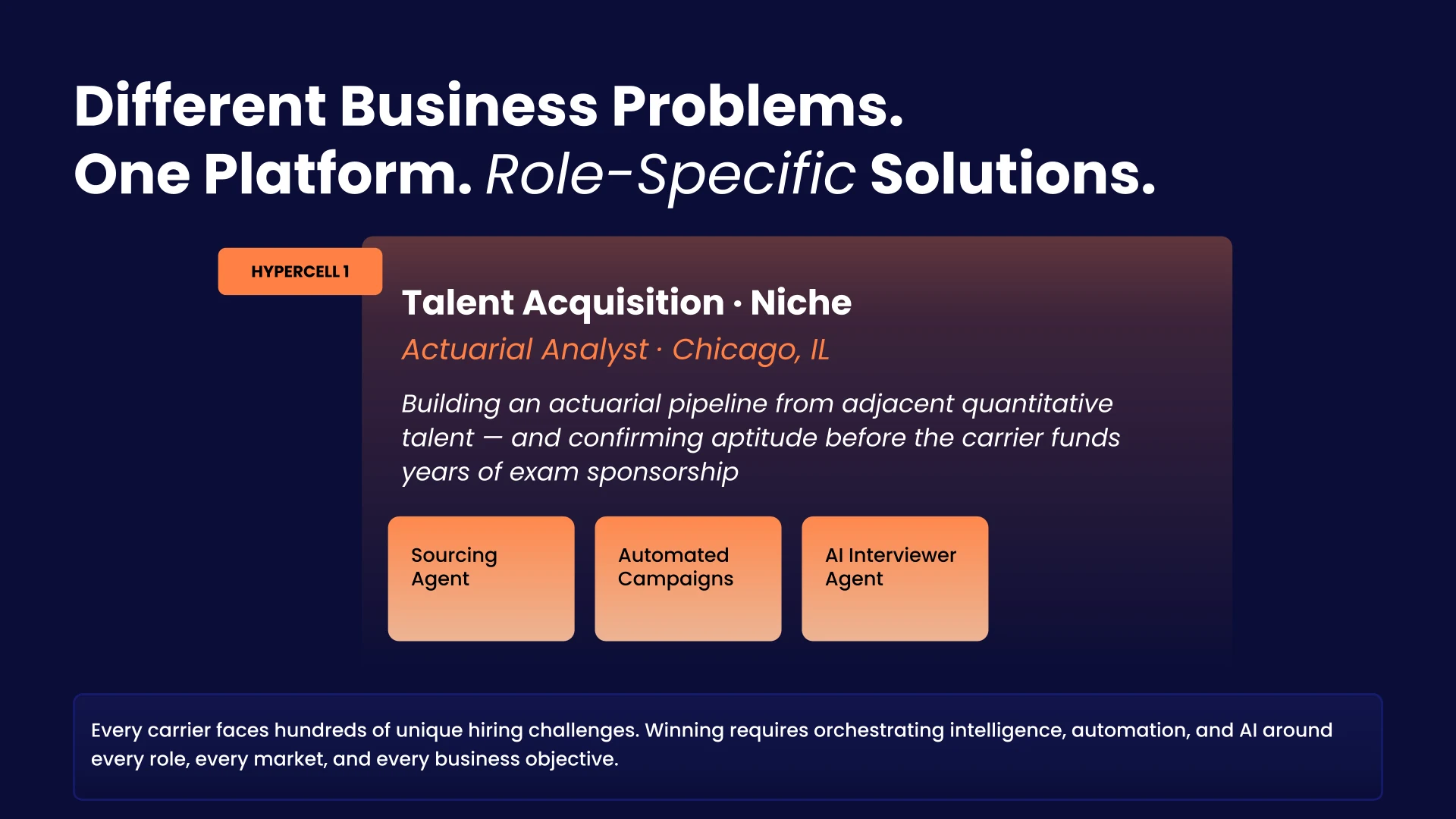
1. Sourcing an Actuarial Analyst in a Thin Talent Market
An actuarial analyst role based in Chicago illustrates the external sourcing side of this problem. The applicant pool was thin, the position had been open for some time, and manual sourcing was not producing enough qualified candidates in the immediate labor market. This type of scarcity is common in specialty roles, where the number of people with required credentials is limited, and several carriers are competing for the same talent.
Rather than continuing to search only for candidates who already carried the title of actuarial analyst, the organization could broaden the search by identifying people with skills from adjacent roles and industries.
Here’s how the AI agents support that process:
Sourcing Agent: Uses ontology-driven skills matching to expand the search beyond actuarial analysts specifically, surfacing adjacent candidates such as data scientists and statisticians who share the statistical modeling skills required for the role.
Automated Outreach: Drafts personalized emails for shortlisted candidates and manages the sending cadence without requiring recruiters to handle each follow-up manually.
AI Interviewer Agent: Conducts a structured, avatar-led screening interview focused on the skills required for the role, then returns a scored summary along with the full transcript.
The value of this approach comes from combining the requirements of the role with the realities of its labor market. Instead of treating the limited number of actuarial analysts in Chicago as a fixed constraint, the organization can use the skills behind the role to identify candidates from adjacent talent pools while still assessing them against the capabilities the position requires. In this scenario, a process that ran to roughly 86 days was compressed to about 34.
2. Building a Commercial Underwriter Bench From Within
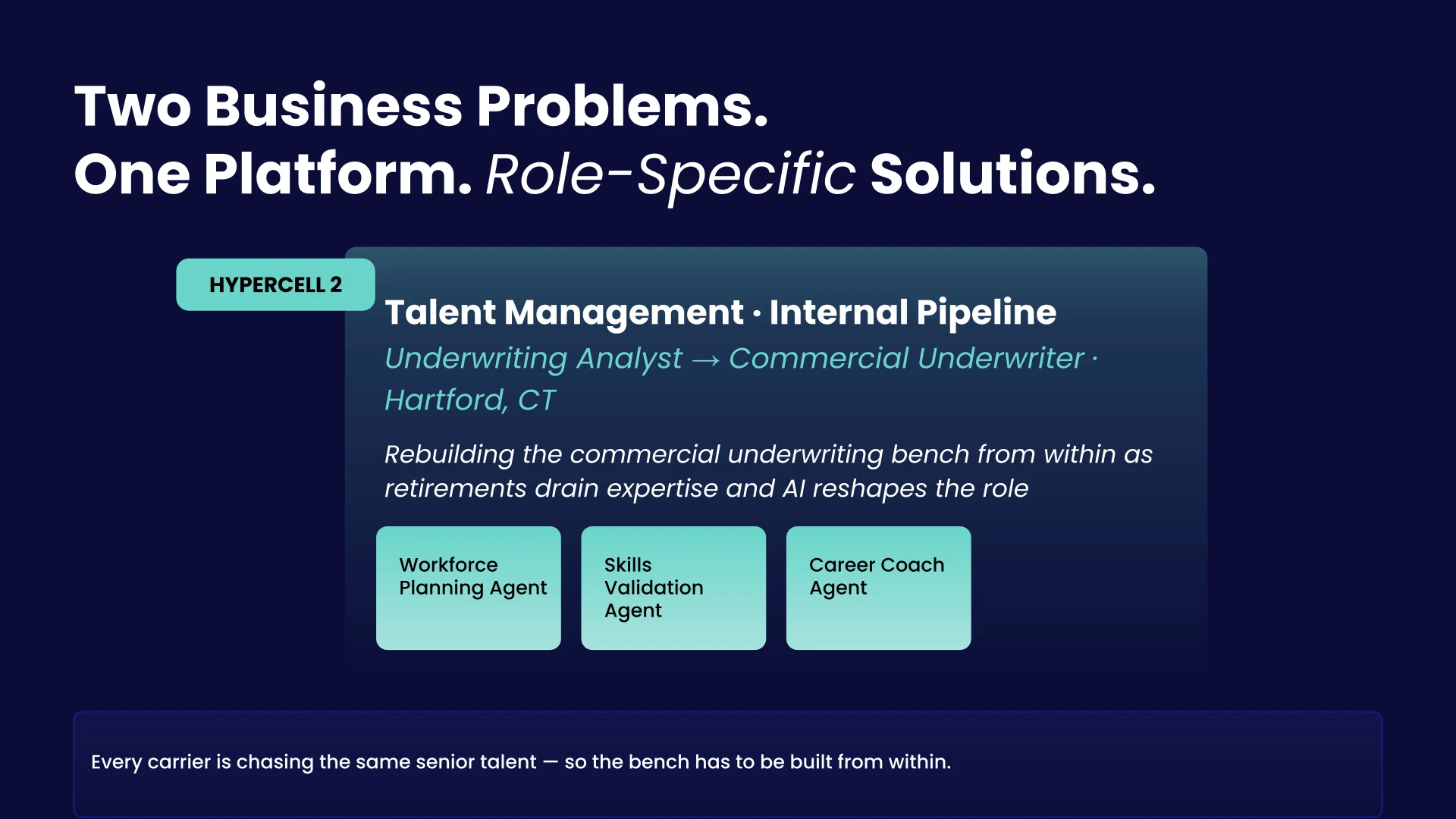
Commercial underwriter succession presents a different problem because the organization may already have potential candidates in its workforce, but it needs to identify them early enough to develop the skills they will need.
When succession planning begins only after an experienced underwriter resigns, the organization can be left with a gap between the employee leaving and the replacement becoming fully productive.
At scale, that becomes particularly difficult as more experienced workers approach retirement because the business is not dealing with one isolated vacancy, but a larger transfer of institutional knowledge across the workforce.
Here, the AI agents focus on identifying and developing internal talent before the retirement departures begin:
Workforce Planning Agent: Continuously monitors retirement timing and current workforce composition to identify where future talent gaps are likely to emerge, then maps existing employees against the role using a fit score and a separate behavioral match score.
Skills Validation Agent: Evaluates employees objectively against the skills the role actually requires, independent of tenure or manager opinion, and can repeat the assessment over time to track whether readiness is improving.
Career Coach Agent: Creates a personalized development plan around the employee's specific skill gaps and connects them with an internal mentor.
Where a reactive backfill ran to roughly 118 days, building the bench ahead of the vacancy removes the gap entirely.
"Most solutions tell you whom to hire. Here, the agent tells you why you should hire someone and what the cost of that decision actually is," Dahagam said.
What Makes This Kind of Precision Possible?
This level of contextual decision-making depends on having a shared view of the workforce rather than separate pieces of information spread across different recruiting and HR systems.
The platform holds the same picture every day for every role, every employee, and every skill in the business,” Dahagam said.
That shared foundation brings together workforce data, skills, and market signals, giving specialized agents the context they need to reason about a role rather than simply match keywords.
This allows a candidate to be a strong match for a role even when their current job title does not resemble the open position, just as an existing employee can be a strong succession candidate even when they are not currently working in the same function.
The same connected foundation can also change when recruiting happens.
Strong underwriting and actuarial candidates are often already employed, which means they may not be available for a screening call during standard working hours.
As Dhagam explains: “42 % are only available after hours, which means you're reaching people who would otherwise never enter your process at all."
Related case study: Global Insurer Narrows Gap Between TA and TM With Applied AI
Where Insurance Hiring Strategies Can Fall Short
Several patterns appear repeatedly across carriers navigating this shift, and each reflects a tendency to treat hiring as a series of isolated transactions rather than as part of a broader workforce strategy:
Starting succession planning after a resignation: Waiting until an experienced employee leaves creates a talent gap that may have been possible to anticipate through workforce planning and retirement data.
Relying on manager intuition: Annual reviews and manager opinions can provide useful context, but they do not always offer a consistent way to assess whether an employee has the skills required for a future role. Repeatable skills validation provides another way to measure readiness over time.
Treating a thin labor market as a dead end: When few candidates have the exact job title or credentials, broadening the search to adjacent skills and industries can reveal a larger pool of people who may be able to perform the work.
Adding disconnected AI tools: Point solutions can automate individual recruiting tasks, but they have less value when the workforce, skills, market, and workflow data needed to make decisions remain fragmented.
Applying This to Insurance Hiring at Scale
Insurance is changing on several fronts at once. Retirements are raising the urgency around succession, and specialty lines are creating demand for skills that are already hard to find. Carriers will need hiring strategies built around the skills, workforce, location, and business conditions behind each role, not just the title on the requisition.
That means moving from a reactive model, where teams start solving a talent problem once a requisition opens, to a continuous view of the workforce. AI agents can support that shift by identifying emerging gaps, validating readiness, and broadening searches while there's still time to shape the outcome.
The question is no longer simply how to fill the next insurance role. It's how early the organization can see what that role will require, where the talent will come from, and what it can do today to be ready.
"Insurance has spent maybe a century getting better at pricing risk. Better models, better data, better discipline," Dahagam said. "But every one of those models still needs a human who can look at the submissions and know what the model doesn't know, and that capability is retiring on a schedule you can already see."
See how AI agents can help you solve your insurance workforce challenges. Book a demo to see it in action for your organization.
Raghu is a Product Marketing Manager at Phenom. Outside work, he experiments in the kitchen and unwinds with a good thriller.


Get the latest talent experience insights delivered to your inbox.
Sign up to the Phenom email list for weekly updates!


