

Turn a Passive Talent Community into an Engaged Pipeline with Phenom Talent Companion
Nearly 3 million people had opted into a global financial services organization's talent community. The problem? Less than 1% of them had signed up for job alerts.
That gap between passive database and active pipeline was the problem their VP of Global Talent Attraction needed to solve. Her team was spending nearly all their capacity on 40 manual email campaigns per month, most of which were essentially job alerts built by hand.
She recently walked through how they deployed Phenom Talent Companion to address that activation gap, and what happened when they turned it on.
Explore the highlights below!
What Are the Biggest Challenges in Scaling Talent Engagement Globally?
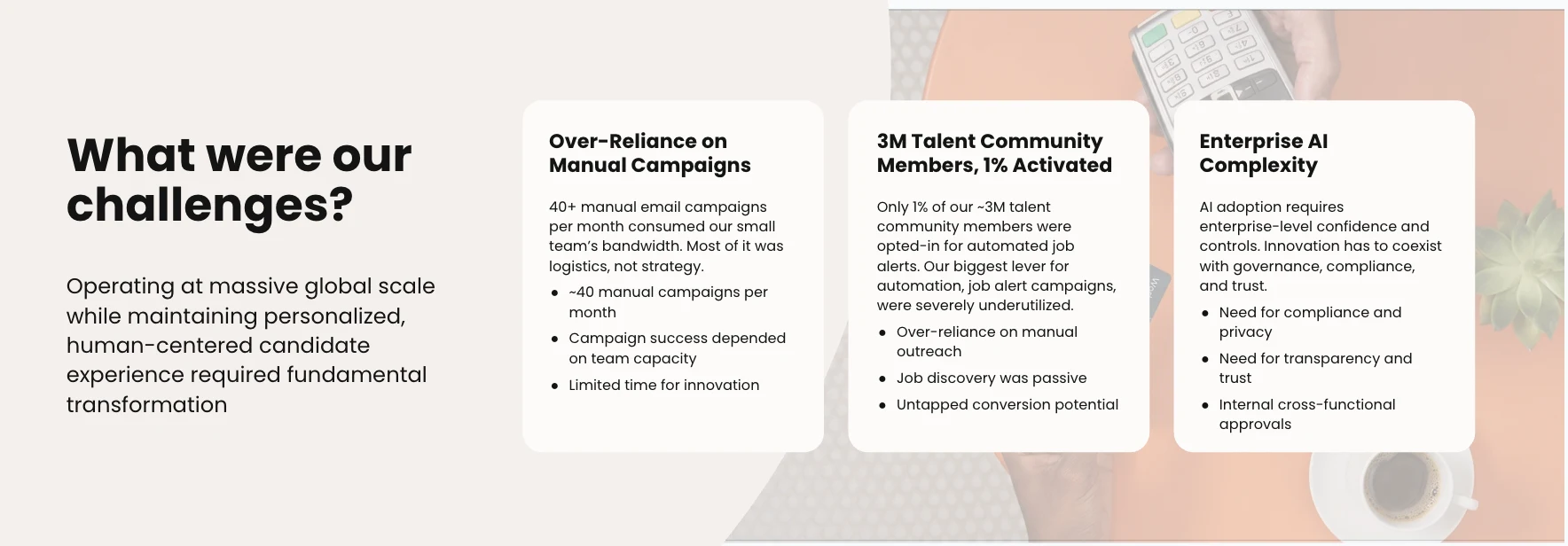
With a two-person talent marketing team managing campaigns for a global talent community, almost all of their effort went into logistics (building lists, sourcing content, and scheduling sends) rather than strategy. When higher-priority work came up, campaigns got skipped, and the impact showed in applicant volume.
“The success of those campaigns depended on our team’s capacity to deliver them,” shared the company’s VP of Global Talent Attraction. The work was entirely dependent on team capacity, which meant it wasn’t scalable.
When she looked at what was actually performing, it was job alerts. The top-performing manual campaigns were essentially doing what an automated alert could do. But less than 1% of 3 million talent community members were subscribed. "I was honestly shocked. I thought it was going to be a little bit higher than that," she said. Candidate interest wasn't the issue, though. Signing up for job alerts wasn't intuitive, and there was no guided path to get there.
Since the company’s AI governance requirements require that any AI tool receives privacy, transparency, and compliance sign-off before it’s deployed, using the technology had to be accounted for from the start.
How Can Employers Use AI to Scale Candidate Engagement?
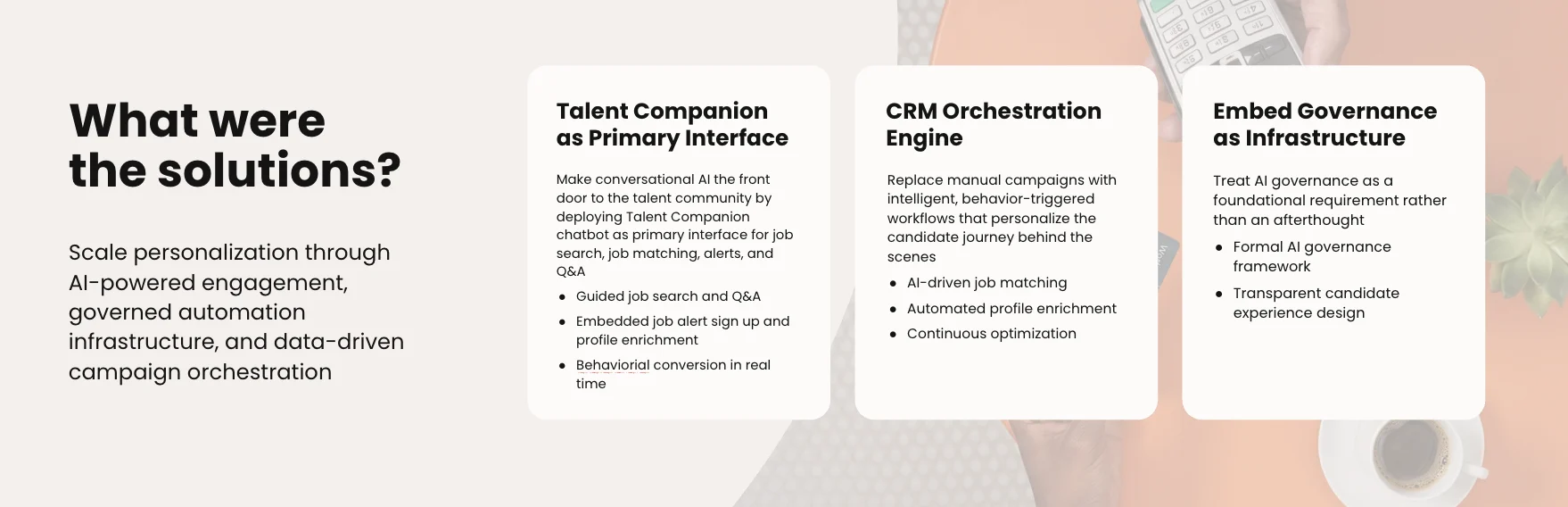
The company turned to Phenom Talent Companion, an LLM-based conversational AI assistant designed to help candidates discover jobs, get answers, and stay engaged throughout the hiring journey. It’s trained exclusively on a company’s own career site content and historical chatbot conversations. It can answer candidate questions, help them search for jobs, match their resume to open roles, and sign them up for job alerts in 40 languages, dynamically switching mid-conversation. The confidence level (how certain the model needs to be before answering a question) is a configurable setting, which was important for the organization's governance review.
The path from introduction to go-live took roughly four months. The bulk of that time was AI governance documentation and legal review — a multi-stage process that Phenom’s team supported directly, bringing in legal, compliance, and privacy expertise. Once the internal team approved the tool, Phenom turned it on in three days. The organization then ran a slow roll: internal testing first, asking team members to try to break it, before messaging the full talent community. A seven-email drip series then introduced each capability individually with job alerts first, then resume matching, FAQs, and so on.
"Bring your governance team in early," their VP of Global Talent Attraction advised. "You'll save time down the road if you bring them along with you and create that relationship."
Take a quick click-through tour of Phenom Talent Companion Chatbot
What Was the Impact of Phenom Talent Companion?
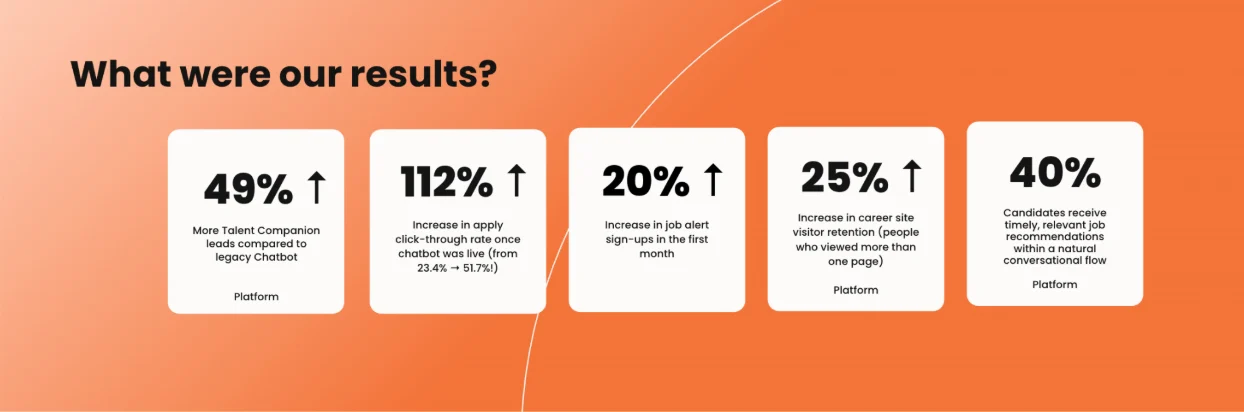
The results came in faster than projected and across more dimensions than the team had planned to track.
Their VP recalled that when the Phenom team first shared projections, a 13% lift in apply click-through rates seemed like a reasonable benchmark. "I specifically remember him saying we would see a 13% increase in our apply click-through rate," she said. "Three weeks later, we hit a 112% increase." That jump, from 23% to 52%, came alongside a 20% increase in job alert sign-ups in the first month — a direct result of making the process conversational rather than buried.
Those weren't the only gains. Across organizations using Talent Companion, the platform data reflected the same momentum:
49% more Talent Companion leads compared to the legacy chatbot
25% increase in career site visitor retention (candidates who viewed more than one page)
40% of candidates received timely, relevant job recommendations within the conversational flow
"We weren't even thinking about all the other things that the Talent Companion ended up doing for us, like the retention rate," their VP said. The lesson learned? Benchmark before you change anything, then check for outcomes you aren’t expecting.
Where Are They Taking Their Talent Technology Next?
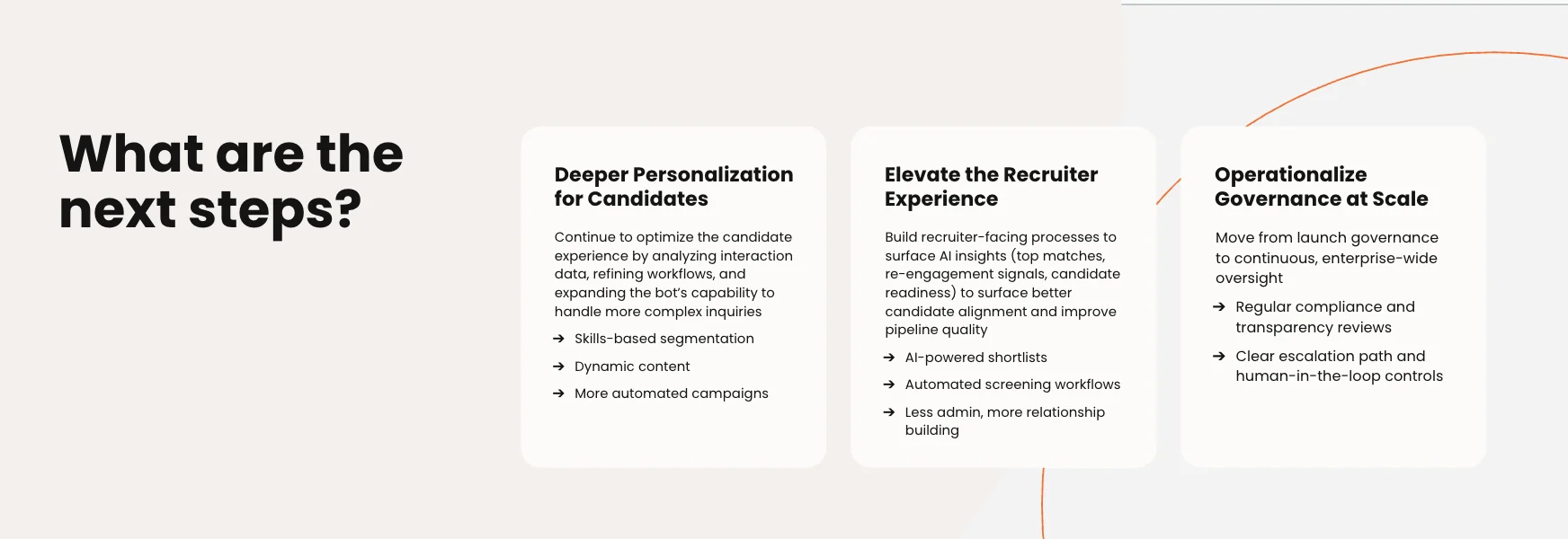
Moving forward, the team is pursuing skills-based segmentation of the talent community, moving from functional groupings to skills-based personas so content delivered to candidates is matched to what they’re actually looking for. Already in motion is Phenom Automated Interview Scheduling, and AI screening is in testing. The direction is consistent: use AI to handle the administrative layer so recruiters can focus on candidate relationships rather than logistics.
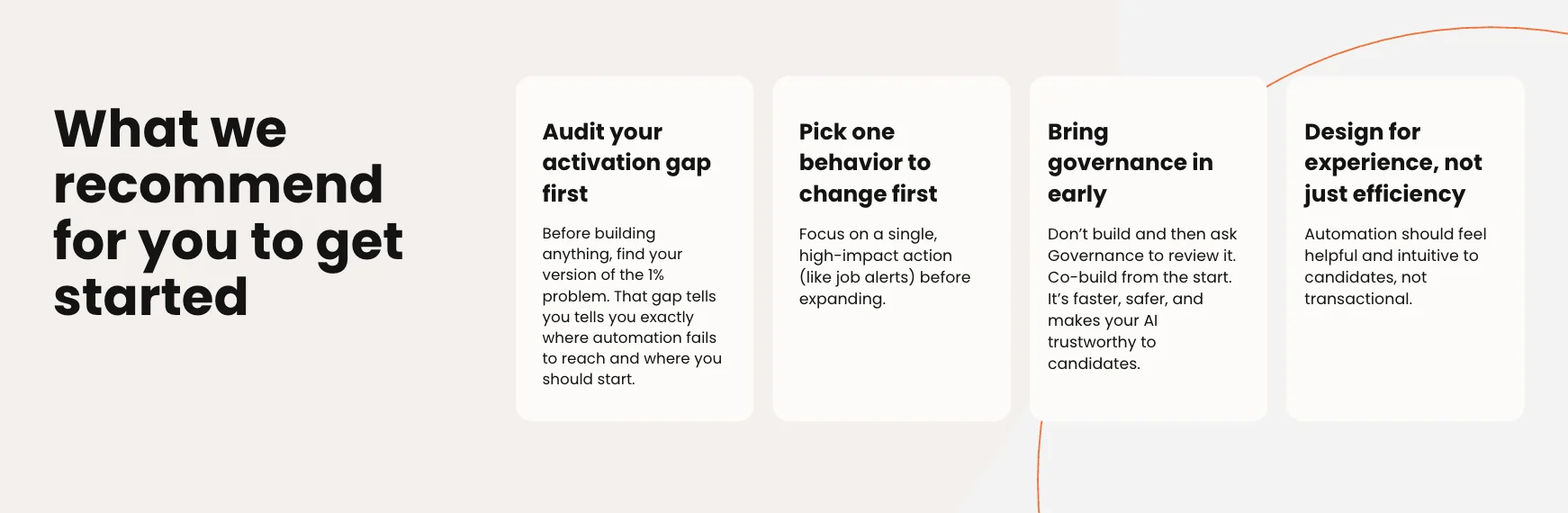
Her closing advice for other TA leaders was grounded in the same principle. "Find your version of the one percent," she said — the activation gap or inefficiency with the most impact potential. From there, solve that before adding more AI capabilities. Each initiative should deliver real value to the team or to the candidate. And measure before you change. The results are often better than you expect.
Learn more about Phenom Talent Companion

Raghu is a Product Marketing Manager at Phenom. Outside work, he experiments in the kitchen and unwinds with a good thriller.


Get the latest talent experience insights delivered to your inbox.
Sign up to the Phenom email list for weekly updates!


