

AI Voice Screening at Scale: What to Verify Before Approval
AI voice screening sounds straightforward: an AI agent calls a candidate, asks a structured set of questions, and gives recruiters a summary and score. While the process is straightforward, there are complex sets of technology making it all happen, and few vendors are up to the challenge of making it happen seamlessly and at scale. Phenom Voice Agent Screening takes that process into real-world enterprise hiring, where the challenge is making thousands of candidate conversations work reliably at scale.
This article breaks down what Phenom revealed during our AI Day about what leaders should verify before approving an AI voice screening agent, from conversation quality and system resilience to integration, governance, and ongoing oversight.
What Makes a Screening Call Sound Natural?
Making an AI phone conversation actually feel like talking to a person is a harder engineering problem than it sounds.
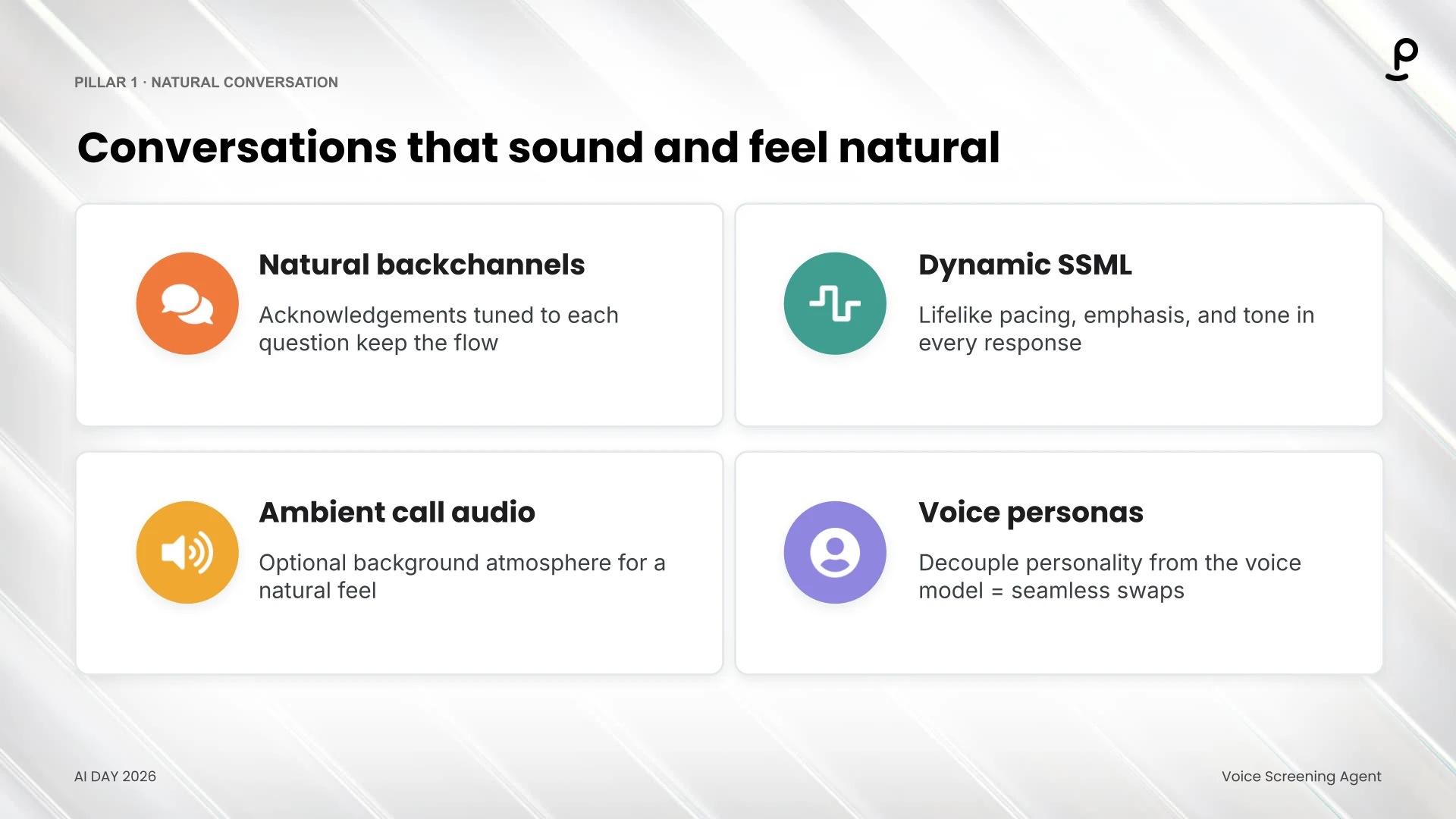
Knowing when someone has actually finished talking: The system listens to the real audio, the pitch, rhythm, and pauses in someone's voice, not just a text transcript of their words. That's the specific mechanism that lets it tell the difference between a candidate who's pausing mid-thought to gather themselves and one who's actually done speaking. The same underlying model also decides in real time whether to keep talking or yield the floor, and extends how much time it gives a candidate to think through a complex behavioral question compared to a simple yes-or-no one.
Adjusting tone and delivery, not just word choice: A separate layer controls pacing and emphasis so the system doesn't read every answer back in the same flat tone. Small verbal acknowledgments, like a "mhm" or a "got it", are generated per question rather than reused from a fixed set, since responding to someone's salary expectations shouldn't sound identical to responding to their shift availability.
One deliberate engineering choice is worth calling out on its own. The agent never signals whether an answer was good or bad. That's not an oversight; it's intentional. Any signal from the AI about answer quality creates a fairness problem, since candidates who pick up on subtle cues might start performing for the system rather than answering honestly.
Recovering from a Bad Call
Demo environments are quiet rooms with cooperative scripts read by people speaking clearly. Real candidate calls aren't. People call in from speakerphone while driving with the windows down. They switch languages mid-sentence without warning. Their connection drops words because of a weak cell signal.
To handle this, the system profiles each call in real time for language, accent, and background noise, then routes it to whichever transcription engine is actually built to handle those conditions. If conditions change partway through a call, say a candidate walks from a quiet room into a noisy street, the system switches which transcription tools it's using mid-call rather than sticking with a mismatched one.
There's also a three-step recovery process for when call quality genuinely degrades:
The system continuously monitors quality signals like dropped audio packets and falling transcription confidence.
When those signals cross a concerning threshold, the system adapts in real time. It slows down, confirms what it thinks it heard, and re-asks anything it captured poorly.
All of this recovery happens automatically within the same call, so a candidate is not told to hang up and call back because the first minute and a half of audio was unusable. If a call genuinely can't be salvaged, it gets flagged for a human to review rather than silently scored as if nothing went wrong.
That distinction, between a system that visibly flags its own failures and one that quietly produces a bad score anyway, is exactly what to test for before rolling something like this out, not something to take on faith from a vendor's marketing materials.
Evaluation and Continuous Improvement
Before any of this ever reaches a real candidate, it's tested against simulated ones, artificial personas designed to mimic messy real-world behavior, background noise, and unpredictable pauses. That's deliberate. Testing a voice AI system against a clean recording and a cooperative script tells you almost nothing about how it'll perform with an actual nervous candidate on a bad connection.
Once live, every single call gets scored on a 100-point quality index that factors in transcription accuracy, how well interruptions were handled, response speed, and whether all the required questions were actually covered. When a call scores poorly, that gets reviewed, and the underlying system, sometimes even the wording of a specific question, can be adjusted in response. If one particular question is consistently confusing candidates, that gets fixed before the next thousand people encounter it, rather than sitting in a backlog for the next scheduled update.
How the Agent Decides What to Ask Next
This is where a lot of the real decision-making actually happens, and it's rarely discussed in the same conversation as accuracy scores or completion rates. At most organizations, early-stage candidate screening still runs through a patchwork of standalone tools or manual processes, and that patchwork tends to create fragile integrations and inconsistent data almost by default. Screening records end up incomplete, scattered across systems, or difficult to reconcile between the applicant tracking system, the scheduling tool, and whatever handles interviews.
That's not just messy data management. It becomes a genuine trust problem the moment hiring analytics or compliance reporting get built on top of information nobody can fully vouch for.
There's a second, quieter cost that adds up over time. If a recruiting team wants to tweak a screening question or change how candidates get routed, and the underlying system wasn't built with that flexibility in mind, that small change becomes a formal request sitting in IT's backlog. That's the real, ongoing cost of a rigid point solution, and it rarely shows up anywhere on the initial price sheet. What's worth checking for instead is a system that lets recruiting teams make those adjustments themselves, without opening a ticket every time something needs to change.
Left unaddressed, this problem compounds. Every new standalone tool added to an already complicated hiring tech stack tends to increase integration risk rather than reduce it, and IT ends up the bottleneck for changes that should reasonably take an afternoon, not a multi-week sprint.
Matching AI Governance to Risk Level
A voice screening tool used early in the hiring process and something used later, like an AI-assisted interview closer to an actual hiring decision, don't carry the same amount of risk, and shouldn't be governed by identical rules.
What's at Stake | Voice Screening | AI-Assisted Interview |
Where it sits in the process | Early, high volume | Later, closer to the final decision |
What it decides | Suggests a ranking only | Scores specific competencies against a rubric |
Human oversight | A person reviews before any negative action | A human interviewer reviews before advancing anyone |
What candidates are told | Told verbally when the call begins, logged | Told in the invite, restated on camera, and consented to |
What gets measured | Only the content of the answer, never vocal tone | Structured evidence tied to each specific skill |
How it's checked | Independent bias audit, once a year | Adverse-impact review for every open role |
Applying one blanket AI policy across both of these would either be too lax where the actual stakes are higher, or so restrictive it becomes impractical to use where the stakes are genuinely lower. It’s worth confirming directly whether a given vendor has actually built for this distinction, rather than assuming any single compliance framework automatically covers every AI tool they offer.
Governance Built Into Every Call
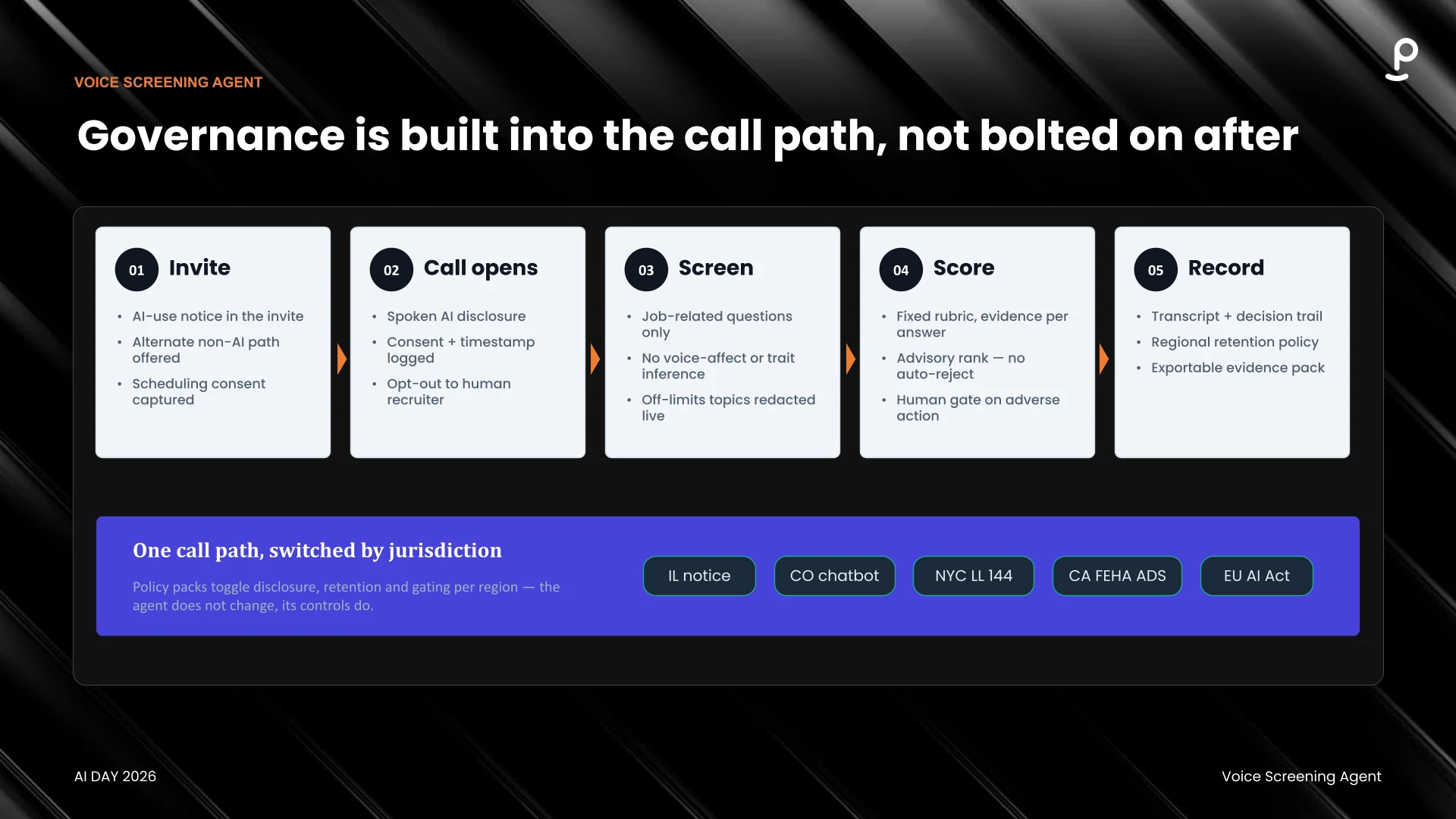
The legal and regulatory landscape around AI in hiring changes constantly, and differently depending on where a candidate is located. The rules around AI in hiring keep shifting, and they differ depending on where a candidate lives. New York City has required annual bias audits of automated hiring tools since 2023. California's civil rights regulations on automated decision systems in employment took effect in October 2025, and Illinois began requiring employers to give notice when AI influences employment decisions in January 2026. Colorado replaced its original AI Act with a narrower automated decision-making law that takes effect in January 2027. In the EU, the AI Act treats recruitment tools as high-risk, with those obligations now scheduled to apply from December 2027. Looking further ahead, California will require anyone conducting AI audits mandated by state law to register with the state starting in 2029. Staying compliant with all of this isn't a one-time review to check off. It's an ongoing responsibility that has to be tracked per law and per AI tool in use.
The way this particular system handles that complexity is by using one consistent process for every call, with adjustable settings that change depending on the candidate's location, rather than building an entirely separate system for every jurisdiction.
Inside the Call Path: Disclosure, Consent, and Records
Every call follows the same five steps regardless of region; only the settings change. The invitation discloses that AI is involved, logs the candidate's consent to be scheduled, and offers an alternative, non-AI path. The call opens with a timestamped spoken disclosure that AI is conducting the screening, and where the employer has enabled it, candidates can opt out at that point. The screening asks only job-related questions and never uses how someone's voice sounds as a factor in scoring. Scoring produces an advisory rank that can never reject a candidate on its own. A full record, including the transcript and the reasoning behind the score, is kept as an exportable audit trail, with retention periods set by region.
The invitation itself discloses that AI is involved and logs the candidate's consent to be scheduled. The call opens with a spoken disclosure that AI is conducting the screening, with a timestamp recorded. The actual screening only asks job-related questions and never uses how someone's voice sounds as a factor in scoring. Scoring produces a rank that's advisory only, meaning it can never automatically reject a candidate outright. A full record, including the transcript and the reasoning behind the score, gets retained as an exportable audit trail.
That last step connects directly back to the integration challenge described earlier. A process that captures clean, structured data at the exact moment the call happens is what makes reliable compliance reporting possible in the first place. Clean data and audit readiness aren't two separate problems here; they're the same underlying requirement, just viewed from two different angles.
Where a Vendor's Responsibility Ends and Where an Organization's Begins
None of what's described above removes an organization's sole responsibility. A vendor typically owns the underlying technical infrastructure, configurable controls, audit logging, and general data protection. The organization deploying the tool typically owns configuring the system correctly, maintaining active human oversight, actually performing the specific regulatory audits that apply in their jurisdictions, offering an alternative path when a candidate requests one, and making sure candidates are clearly told they're speaking with an AI system rather than a person.
A visible internal dashboard, one that shows which sessions are active, which policy checks have been triggered, anything currently waiting on human review, and which version of the underlying AI model is currently running, is what turns that shared responsibility into something an organization can actually verify on an ongoing basis, rather than something they simply have to trust at the point of signing a contract.
Volume Gets Attention. Expert Engineering Gets Great Hires
193,000 completed screenings is an impressive number, and it's the kind of stat that opens a conversation with a decision-maker. But on its own, it says nothing about whether the system recovers gracefully from a dropped call, whether it adds one more fragile integration to an already strained set of tools, or whether the record it keeps would actually hold up if a regulator asked to see it. Phenom’s Voice Agent Screening is now live with more than 50 customers, screening candidates in over 10 countries and 53 languages. It has completed nearly 200,000 screenings, which adds up to roughly 32,000 hours of real candidate conversation.
The engineering underneath the number, how it handles messy real-world conditions, how cleanly it fits into existing systems, and how thoroughly it documents its own decisions, is what actually determines whether this is still the right call a year after signing. That's worth asking about directly, well before any single statistic gets to decide on its own.
Stop dialing. Start deciding. Access the voice screening agent explainer to know more!

Devi is a content marketing writer passionate about crafting content that informs and engages. Outside of work, you'll find her watching films or listening to NFAK.


Get the latest applied AI insights delivered to your inbox.
Sign up to stay up-to-date on the latest original content from Phenom, including new podcast episodes, events, and more.


