


Hiring Quickly Without Compromise: How Phenom Pre-Hire Assessments Strengthen High-Volume Hiring
Frontline industries run on people who can perform under pressure: retail associates, servers, patient care techs, warehouse crews, and everyone who keeps day-to-day operations moving. Attracting candidates to these roles isn’t the challenge; it’s understanding who will actually succeed in fast-paced, customer-facing environments.
Resumes show history, not how someone behaves under pressure. When teams must move fast, that lack of insight leads to rushed hires, early turnover, and operational strain. Candidates notice the disconnect as well. They want early clarity and a chance to show strengths beyond a CV. When screening feels off-target or too long, they abandon the process and many promising applicants never progress.
Phenom Pre-Hire Assessments address the gap by delivering brief, job-specific evaluations inside the application flow. These role-realistic scenarios reveal how candidates think, respond, and work, giving recruiters clearer early signals and candidates a fair way to demonstrate fit. The result: faster decisions, fewer mis-hires, and a steadier path to hiring quality talent at scale.
A New Approach to Early Screening: Pre-Hire Assessments
Phenom Pre-Hire Assessments bring behavioral insight and job-specific scenarios to the earliest stage of hiring. Rather than relying on resume keywords or instinct, teams evaluate cognitive ability, service orientation, situational judgment, and role-specific competencies — the qualities that most influence on-the-job success.
The assessments include situational and behavioral modules, plus specialized evaluations like language proficiency, motivations, interests, and timed typing tests, so teams can match assessment type to role needs. These assessments are not one-size-fits-all, but are tailored to the specific requirements of a unique role to ensure applicants are measured against the actual needs of the job.
This gives candidates more clarity and provides hiring teams with stronger early signals. Preliminary screening is one of the most pivotal stages of the hiring journey, yet it is often the place where misalignment begins. When hiring teams rely on incomplete information or subjective impressions, they can unintentionally introduce inconsistency into the funnel. Over time, these small inconsistencies scale into lower performance, higher churn, and repeated cycles of re-hiring.
As candidates move through short, mobile-friendly scenarios aligned with the role, they gain a realistic preview of the work. Questions anchored in actual situations: assisting a frustrated customer in retail, responding to urgent needs in healthcare, or managing physical tasks in logistics, feel relevant and purposeful. That sense of realism keeps candidates engaged and helps them judge whether the role fits their strengths.
Related: How Hiring Automation Transforms Hiring in Retail, Manufacturing & Hospitality Industries
Pre-Hire Assessments vs. Traditional Resume Screening
Unlike resume-first screening, Pre-Hire Assessments measure job readiness through structured, validated scenarios, and can be combined with other measures of candidate fit to inform hiring decisions. Assessments collect active candidate responses before interviews begin, while Fit Score and Interview Intelligence, for example, use profile and interview data at later stages to form a complete picture of the candidate.
They incorporate situational judgment, behavioral testing, automated scoring, and seamless integration into application workflows to assess candidate fit before interviews begin. This distinction transforms early screening from a credential check into a predictive evaluation. While traditional hiring relies on what candidates claim they can do, Pre-Hire Assessments reveal how they actually respond under conditions that mirror the job.
Traditional Resume Screening | Phenom Pre-Hire Assessments |
Filters based on credentials and experience | Evaluates role-specific competencies and soft skills |
Requires manual review and subjective judgment | Uses automated scoring with objective benchmarks |
Misses qualities like composure, empathy, and problem-solving | Measures behavioral traits that predict performance |
Creates bottlenecks during high-volume hiring | Advances qualified candidates instantly to next steps |
Offers no candidate preview of actual job demands | Provides realistic scenarios that reveal job fit |
Functions as a gatekeeper | Serves as a mutual evaluation tool for candidates and employers |
Related: 4 Ways to Improve Your Frontline Recruiting and Hiring Processes
How Pre-Hire Assessments Create Value
The strongest hiring experiences balance candidate empowerment with employer clarity. Pre-hire assessments that are brief, contextual, and rooted in real work do exactly that.
Here are six ways the experience comes together, starting with helping candidates showcase strengths that resumes can't capture.
1. Inline Experiences Keep Candidates Engaged
Most candidates abandon applications that feel disconnected or time-consuming. Pre-Hire Assessments integrate directly into the application flow, delivered immediately after basic information is submitted. This removes friction, eliminates the need for separate logins or platforms, and creates a consistent experience across mobile and desktop.
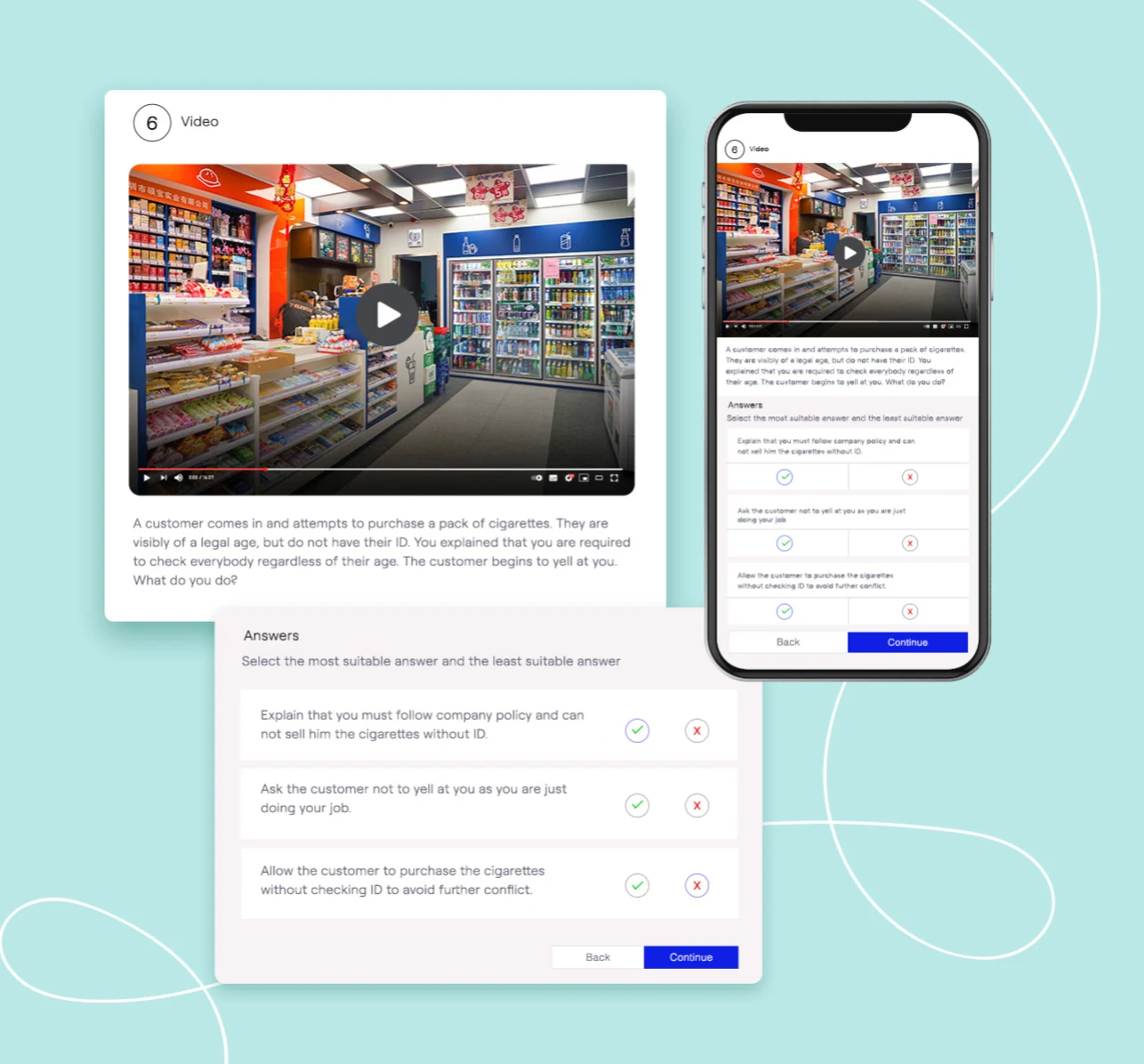
This inline integration improves completion by:
Triggering assessments automatically within the application
Eliminating redirects to third-party platforms
Providing mobile-optimized scenarios candidates can complete anywhere
Pushing assessment status and numerical scores into the CRM so recruiters can sort, filter, and trigger workflows without manual review
2. Brief, Focused Assessments That Respect Time
To keep candidates moving through the application process quickly, Pre-Hire Assessments are intentionally brief (typically 5–10 minutes) and focus only on job-critical competencies.
This accelerates screening by:
Focusing on job-critical traits like stress tolerance and service orientation
Using situational questions rather than abstract personality tests
Keeping candidates engaged through the entire evaluation
Increasing the number of completed assessments in the pipeline
Higher completion rates mean larger, more qualified candidate pools and better conversion from application to hire.
3. Real-World Scenarios Tailored to the Role
Generic personality tests don't capture job requirements. Without role-specific evaluation, organizations risk screening for traits that don't predict performance.
Pre-Hire Assessments use situational and behavioral scenarios designed for frontline roles. These assessments signal qualities like their ability to remain calm under pressure, communication strength, and service orientation, attributes that define success in customer-facing and operational environments.
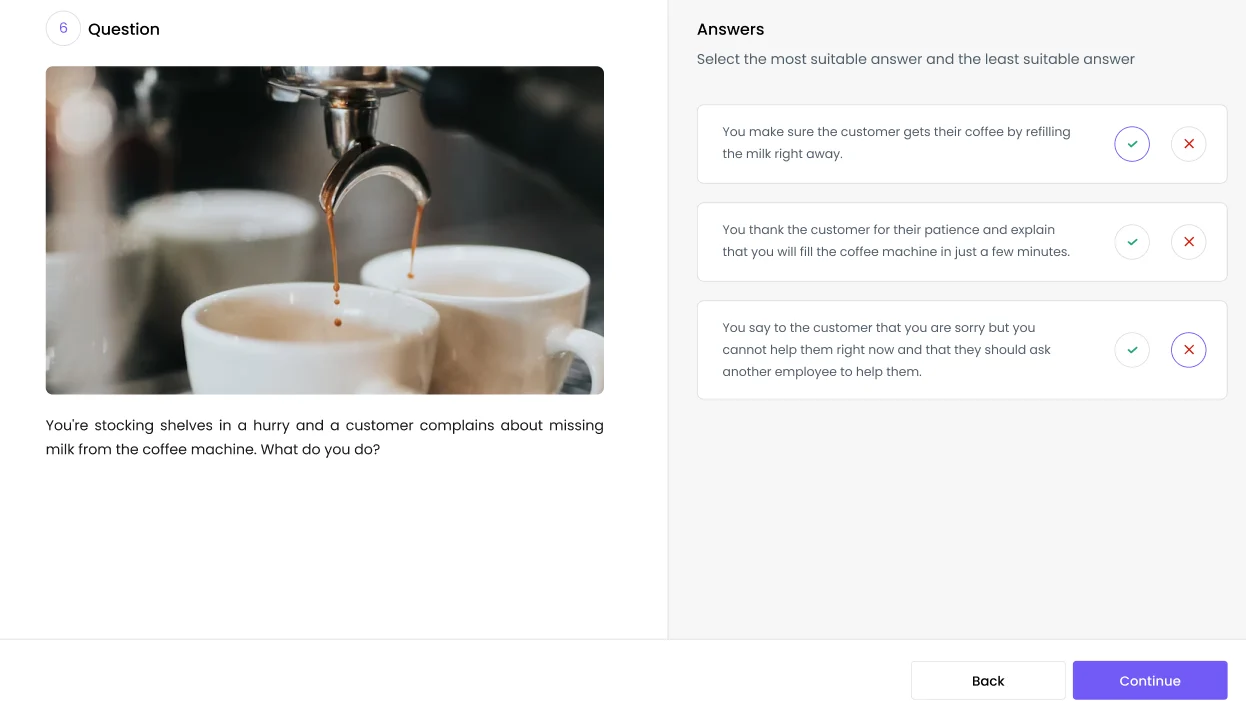
Role-specific scenarios improve prediction by:
Presenting situations candidates will actually face on the job
Testing decision-making under realistic time pressure
Measuring soft skills that resumes don't reveal
Helping candidates self-assess whether the work suits them
How do assessments work across industries?
Retail & Restaurants: Evaluates customer service orientation, pace management, and composure during rushes, identifying candidates who perform under pressure.
Healthcare: Validates certifications, tests domain knowledge, and assesses responsiveness and situational judgment in patient interactions. Screens for technical competence alongside the interpersonal behaviors that support quality care.
Logistics and Distribution: Assesses safety awareness, task accuracy, and teamwork in warehouse conditions to surface candidates suited to operational demands.
Hospitality and Travel: Tests multilingual capabilities, situational judgment for guest interactions, and adaptability to shifting demands. Reveals which candidates can deliver consistent service quality under pressure, whether it's experienced chefs, multilingual front desk staff, or managers navigating high-stress environments.
4. Branded Assessments That Reflect Your Organization
Branded assessments reflect an employer’s environment and tone, helping candidates visualize the role and creating continuity from application through onboarding. This contextualization strengthens employer brand and candidate engagement.
Branded scenarios build connection by:
Using company imagery, logos, and tone throughout the assessment
Embedding scenarios that reflect actual store layouts, facilities, or customer types
Creating a seamless visual experience from career site to evaluation
Demonstrating investment in candidate experience before the first interview
5. Instant Scoring That Drives Immediate Progress
Manual review creates bottlenecks that cost organizations qualified candidates. Strong applicants wait days for next steps, or accept offers elsewhere. With automation, candidates who hit the benchmark can be instantly advanced to the next step, like a virtual or live interview.
Automated scoring accelerates hiring by:
Advancing qualified candidates immediately upon completion
Triggering self-scheduling for interviews directly from assessment results
Removing recruiter time spent on initial screening
Reducing time to hire by up to 40% when automated routing and instant advancement are used
This automation frees up hours of recruiter and manager capacity each week, delivering faster fills and measurable return on investment. Self-scheduling right from their phone as they complete the assessment removes the biggest delays and gets interviews on the calendar instantly. There's no back and forth between emails, text messages, and missed calls. It's just quick, seamless progress to the next step.
6. Validated Assessments That Predict Performance
Assessments without validity become guesswork. Without scientific rigor, organizations filter candidates based on tools that don't actually predict who will succeed.
Pre-Hire Assessments are built on three C’s of validity:
Construct Validity: Assessments accurately measure specific traits like stress tolerance, teamwork, and problem-solving, not unrelated personality dimensions.
Content Validity: Questions cover all critical job requirements, from customer interaction skills to safety awareness, based on actual role demands.
Criterion Validity: High scores correlate with quality hires, retention, and performance proven through data that links assessment results to on-the-job outcomes.
This validation ensures organizations hire people who perform, not just people who test well.
Related: Four Ways to Improve the Interview Experience
The Broader Organizational Impact
When Pre-Hire Assessments are used consistently over time, their impact extends beyond individual hiring decisions and begins to shape how organizations operate and plan. Early accuracy compounds across hiring cycles, changing staffing patterns, manager workload, and organizational resilience.
Here’s what that often looks like:
Staffing volatility decreases across hiring cycles. As hiring outcomes stabilize over time, organizations experience fewer abrupt staffing gaps that disrupt schedules, shift coverage, and day-to-day operations. This steadier workforce reduces the need for constant rebalancing and emergency coverage.
Workforce planning becomes less reactive and more intentional. With fewer unexpected departures and rehires, workforce plans can be built around realistic timelines instead of contingency buffers. Seasonal demand, ramp periods, and peak volumes become easier to anticipate and staff without overcorrecting.
Manager workload shifts away from constant backfilling. Managers spend less time reopening requisitions, redistributing shifts, and onboarding replacements. That reclaimed capacity is redirected toward developing teams, maintaining performance standards, and supporting employees through change.
Operational continuity improves during periods of change. Store openings, service expansions, system rollouts, and seasonal transitions face fewer disruptions caused by staffing instability. Hiring becomes a more dependable operational input rather than a variable risk factor.
Growth initiatives encounter fewer talent-driven delays. Expansion plans are less likely to stall due to repeated hiring resets. Teams can move forward with greater confidence that staffing will keep pace with business needs, even as volume increases.
What Comes Next for High-Volume Hiring
High-volume hiring has long forced teams into choosing between speed and quality. Pre-hire assessments remove that tradeoff by giving both candidates and employers clearer insight from the very first step.
As expectations rise and competition accelerates, organizations need screening that balances accuracy with urgency. Assessments grounded in real work — supported by automation and shaped for modern candidate behavior — are becoming essential to building reliable, high-performing frontline teams.
Your next hiring cycle is already taking shape. The question is whether candidates move through it uncertain or advance with clarity and confidence from the moment they apply.
See how Phenom Pre-Hire Assessments support high-volume hiring at scale. Request a demo today.


Get the latest talent experience insights delivered to your inbox.
Sign up to the Phenom email list for weekly updates!


