

AI Governance at Global Scale: How Manulife Built a Framework That Makes Recruiters Confident, Not Cautious
Most organizations treat AI adoption as a technology rollout. Manulife treated it as a trust problem first. For a financial institution operating across 20-plus countries with 38,000-plus colleagues, getting AI into daily recruiting workflows wasn’t just a matter of flipping a switch. It required a governance framework that could hold up to legal scrutiny across multiple regulatory environments — and change management rigorous enough to convince 150 global recruiters that AI was there to support them, not sideline them.
Alicia Garbarino, AVP, Global Talent Acquisition Excellence, and Arina Barss, Director, Talent Excellence, from Manulife shared how they built that framework and what it produced.
Watch the full session here, or explore the highlights below!
What Made AI Adoption Complex?
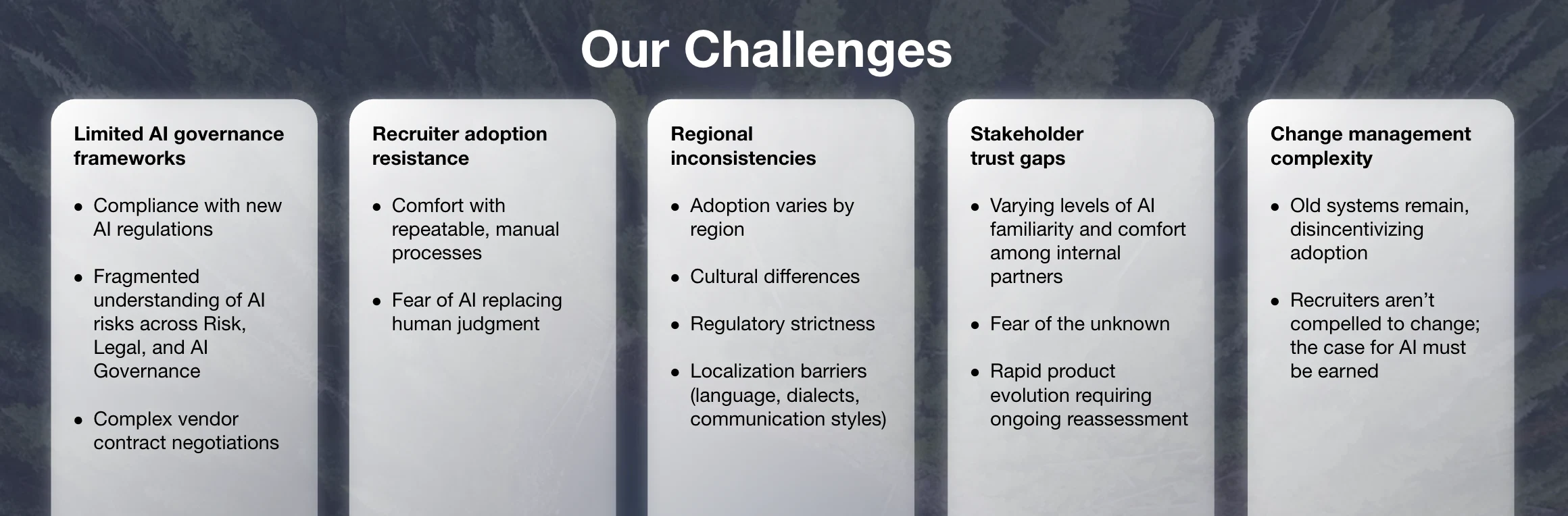
Manulife launched with Phenom in October 2024 with a career site in five languages. They added four more languages and Automated Interview Scheduling just a few months later.
But speed without structure in a regulated industry can introduce risk, especially for a country operating in multiple countries with different regulations. AI legislation and governance frameworks were evolving fast, and internally, risk, legal, compliance, privacy, and AI governance teams were all approaching the same questions from different angles and with different levels of understanding of how Phenom’s tools actually work.
AI readiness varied significantly, and recruiter adoption wasn’t guaranteed either. The old tools were still available, so recruiters could simply not use the new ones. “It wasn’t just a technology issue, it was a trust issue as well,” said Garbarino. Given the circumstances, a one-size-fits-all rollout wasn’t going to work.
How Did They Build an Effective Governance and Adoption Framework?
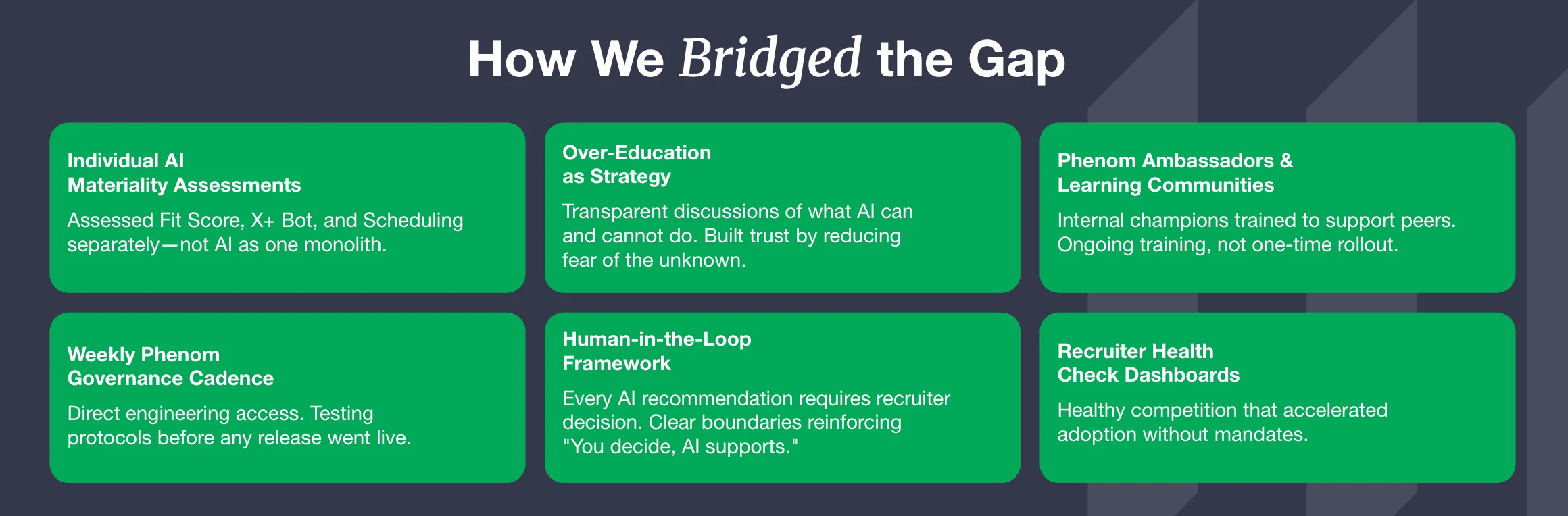
The cornerstone of Manulife’s approach is to conduct a separate materiality assessment for every AI feature before it goes live. Phenom Fit Score, Phenom X+ Generative AI, and Phenom Automated Interview Scheduling were each evaluated on their own. A risk officer works alongside the TA team to challenge assumptions and score each tool’s risk profile. From that score, safeguards are defined. Post-launch auditing is then built into the ongoing workflow, not treated as a one-time exercise.
That level of rigor gave their internal partners from legal, compliance, people comms, and tech something concrete to review and approve. It also created a clear paper trail. If a hiring decision is ever challenged, Manulife has documented evidence of how each AI tool was assessed, deployed, and monitored.
Related: Responsible AI: Building for Compliance & Trust
On the adoption side, Manulife built an ambassador program that put peer influence at the center of change management. Rather than top-down instructions, ambassadors who are selected from curious, engaged recruiters already experimenting with the tools, became the knowledge bridge between what’s technically possible and what’s practical day-to-day.
“It’s coming from a peer,” Barss said. “They’re more likely to want to use it when they see their peers using it.”
Education was continuous and region-specific, never a one-time training pushed down from the top.
What Changed After Getting Governance and Adoption Right?
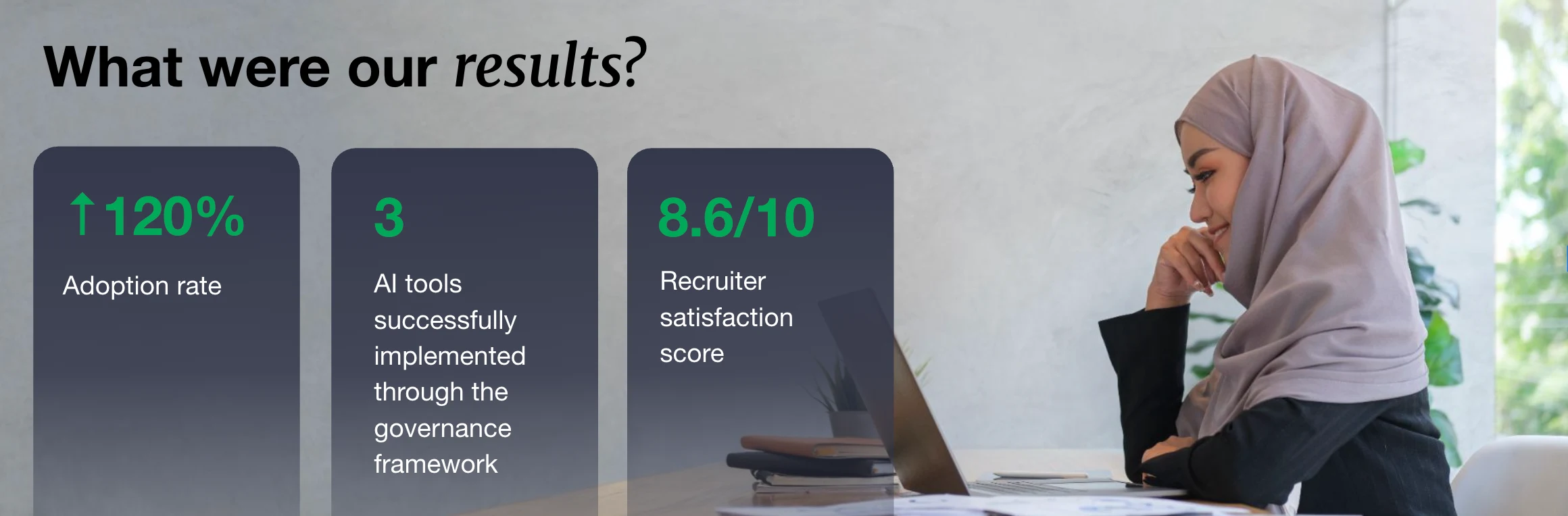
All three core AI tools that were evaluated are now embedded in daily recruiter workflows, with adoption climbing 120% since go-live. What stood out most, though, was a shift in posture. The team described moving from hesitant to responsible scaling, backed by a 8.6/10 recruiter satisfaction score they've kept high and continue to track as an ongoing metric.
That growing confidence carried weight beyond survey scores. “Them trusting the tool and then our leaders trusting the governance of it really allowed us to scale responsibly instead of hesitantly,” Garbarino said.
What Does Scaling AI Responsibly Look Like Going Forward?
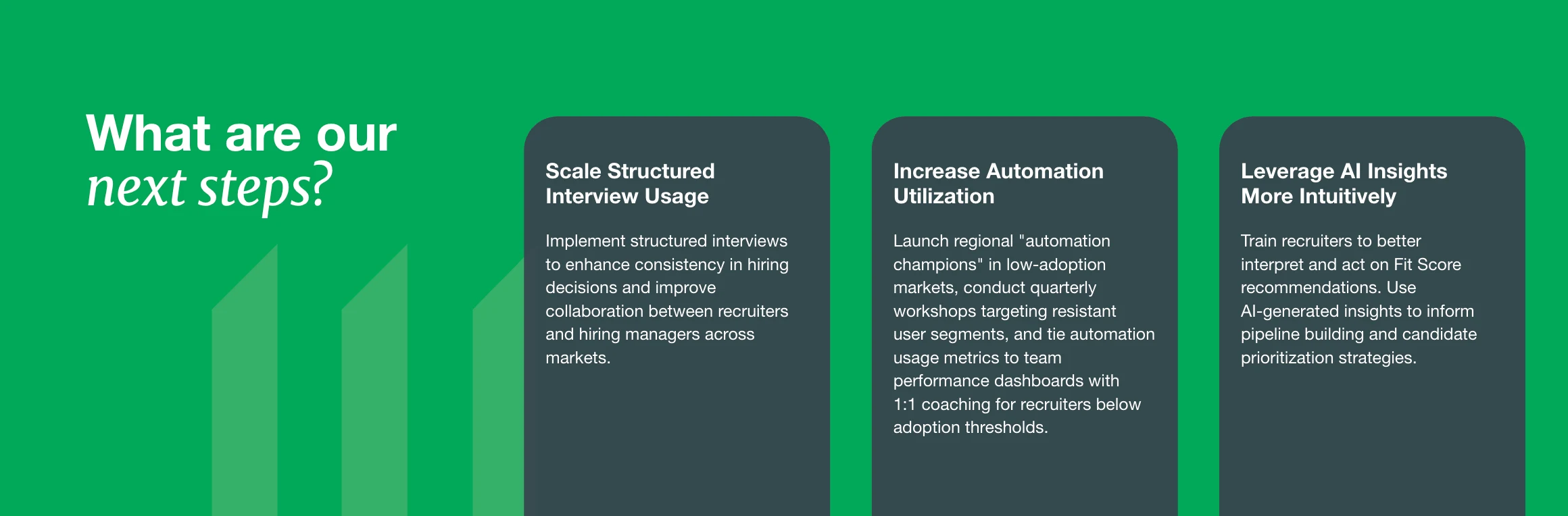
Manulife’s next phase is moving from adoption to optimization by deepening how the tools are used rather than expanding the footprint right now.
That means continuing to evolve the governance model as AI capabilities and legislation change, embedding AI more deeply into daily recruiter workflows, and scaling what’s working in early markets to the rest of the organization. Meanwhile, more AI tools are being actively evaluated through the materiality assessment process.
The broader lesson Manulife offered wasn’t about a specific feature or outcome. It was about the preconditions for sustainable AI adoption at scale.
Governance doesn’t slow you down if you build it in from the start. And getting internal partners aligned before you launch is what makes the difference between a rollout that stalls and one that takes flight.
Learn how Phenom can help you stay ahead of AI compliance



Get the latest talent experience insights delivered to your inbox.
Sign up to the Phenom email list for weekly updates!


