

Always-On AI Sourcing: What to Verify Before It Works Your Requisitions
Sourcing has never been a single search. Behind almost every open role sit several distinct talent markets: the obvious match, people in a neighboring specialty, candidates ready for a step up, and early-career talent with the right trajectory. Most first-generation AI sourcing tools did something much narrower, running one query against one database and starting from scratch the next time.
We launched our Sourcing Agent at last year’s AI Day 2025, and recruiters have used it in live hiring ever since. That daily use exposed four gaps between how the agent worked and how recruiters source, so our product and engineering teams redesigned it to close them
At this year's AI Day, they shared how the new version of the agent advanced. This blog walks through those changes, what each one means for recruiters and hiring managers, and what to verify before trusting any AI agent to source candidates.
Lessons From a Year in Sourcing Agent Production
Once recruiters started using the first version of the sourcing agent day to day, four challenges came back consistently. Each one is a useful test for any sourcing tool under evaluation.
It lived outside the workflow: Sourcing assisted in a separate chat window recruiters had to remember to open, so it competed with the requisition list instead of living inside it.
One search was never enough: Each search ran on one set of criteria, so it surfaced only one kind of candidate, usually the direct match. Most roles can be filled from several talent pools, so recruiters had to rerun searches by hand with different criteria to reach the rest
It worked from too little: The agent saw a query or a job description, but not what the hiring manager had just said about the role or how the company had filled it before.
Nothing carried over: Every search started cold. Who replied, who got shortlisted, and who was dismissed never informed the next attempt.
All four of these challenges shaped the next version, as part of our commitment to ongoing innovation and customer care. l
Related read: This AI Sourcing Agent Gives The Aspen Group More Time With Candidates. Here's How.
Sourcing That Starts When the Job Does
The agent now runs on the job page itself, so a recruiter who opens a requisition finds a sourcing tab already populated with ranked candidates. No separate tool, and no need to “start” the search.
When a job is published, our automation engine decides how it should be sourced. Some roles are set to always on, with sourcing beginning the moment the job opens. Others start only when the applicant pipeline stays below a healthy level, and the rest run when a recruiter switches them on. From there, the agent reruns every few days so the candidate pools stay fresh without anyone opening the tab.
A fixed schedule alone would miss moments that matter, so recruiter actions can trigger a new run too. If a recruiter shortlists or dismisses every candidate in a pool, the agent takes that as a signal to go find more. Each run is also saved step by step, which means it can pause a recruiter's decision and pick up days later exactly where it left off.
When evaluating sourcing automation, look at how it gets triggered. A tool that only acts when someone asks is still adding manual friction to your hiring.
Why a Single Role Needs Several Candidate Pools
The biggest shift is how the agent approaches a role. Instead of running one search, it breaks the requisition into distinct candidate pools, each worth searching on its own terms. During the AI Day 2026 session, the presenters used an ICU nurse opening to show what that looks like:
Pool | Who it targets | Why it gets its own search |
|---|---|---|
ICU nurses | The direct match | Anchored to what the hiring manager asked for, so it's never quietly widened |
Cardiac ICU | An adjacent specialty | Has its own certifications and talent market, which a single search would blur together |
Step-down and PCU | Nurses one level below | For them the role is a step up, so they respond for different reasons |
New-grad residency | Early-career nurses | Ranked on trajectory rather than years already served |
No one wrote a rule for that breakdown. The agent works out which pools exist for a given role and which deserve a dedicated search, then gives each one its own criteria. Every pool runs at the same time, so adding another angle widens the reach without slowing anything down.
Two design choices protect recruiters from misleading results. The best-fit pool always appears first, so recruiters see the strongest match before the alternatives. And if that pool comes back empty, the agent shows it as empty, because a market with no direct matches is real information a hiring manager needs to hear. When an alternative pool finds nobody, the agent reconsiders it, loosening the tightest requirement while keeping the role's intent and avoiding overlap with pools it already has.
Recommendations That Explain Themselves
Good sourcing depends on knowing what the hiring manager wants, which a job description rarely captures in full. Before the agent designs any pools, it gathers five sources of context:
Recruiter's request,
Hiring manager's intake notes,
Company's playbook for how this role has been filled before
Job description, and the screening criteria.
When those sources disagree, the hiring manager's intake wins, followed by the playbook and then the job description. Lower-priority details aren't thrown away; they shape how candidates are ranked instead.
The agent searches two sources at once. The first is the recruiting CRM, which includes past applicants and candidates the team has already engaged. These appear first, since existing relationships usually respond faster. The second is a passive pool of external profiles with no company history, added to the CRM only with consent. If either source fails, the search continues with the other
Every candidate arrives with a fit score and a plain explanation of why they match the role. Recruiters can see results while the agent is still ranking, so they start reviewing instead of waiting. That transparency matters during evaluation: if a tool can't tell a recruiter why it recommended someone, the recruiter has no way to judge whether to trust the next recommendation.
A Sourcing Agent That Remembers What Works
The fourth problem, nothing carrying over, may have been the most costly, because it meant the agent never got better at a role no matter how long it worked on it. The rebuilt agent remembers at three levels: the progress of each run, the signals that accumulate against a requisition, and hiring knowledge specific to each customer.
Those signals arrive on their own as recruiters and candidates act. Replies, opens, clicks, opt-outs, and applications are all tied back to the pool each candidate came from, alongside recruiter choices about who was shortlisted and who was dismissed. On every pass, the agent reviews each pool against that evidence. A pool that's converting is left alone, a thin one is broadened, and one that isn't producing results is swapped out. Decisions rest on what happened, not on a fresh guess each time, which is what makes the agent dependable enough to keep running unattended.
Automation still stops where judgment matters. Recruiters make decisions at exactly three points:
Confirming the role when a request could match more than one open requisition.
Reviewing pools and candidates, including adjusting filters, dismissing candidates, or adding them to a job, list, or project. Passive profiles are added only with consent.
Approving outreach. The agent proposes a sequence of messages, channels, and timing tailored to each pool, since a specialist and a new graduate respond to different reasons. Recruiters can edit any step or send it as proposed.
Once a campaign runs, consent and opt-out status are rechecked before every send, and a reply stops the rest of the sequence. Messages only go out on channels each customer uses.
Quality You Can Trace to the Source
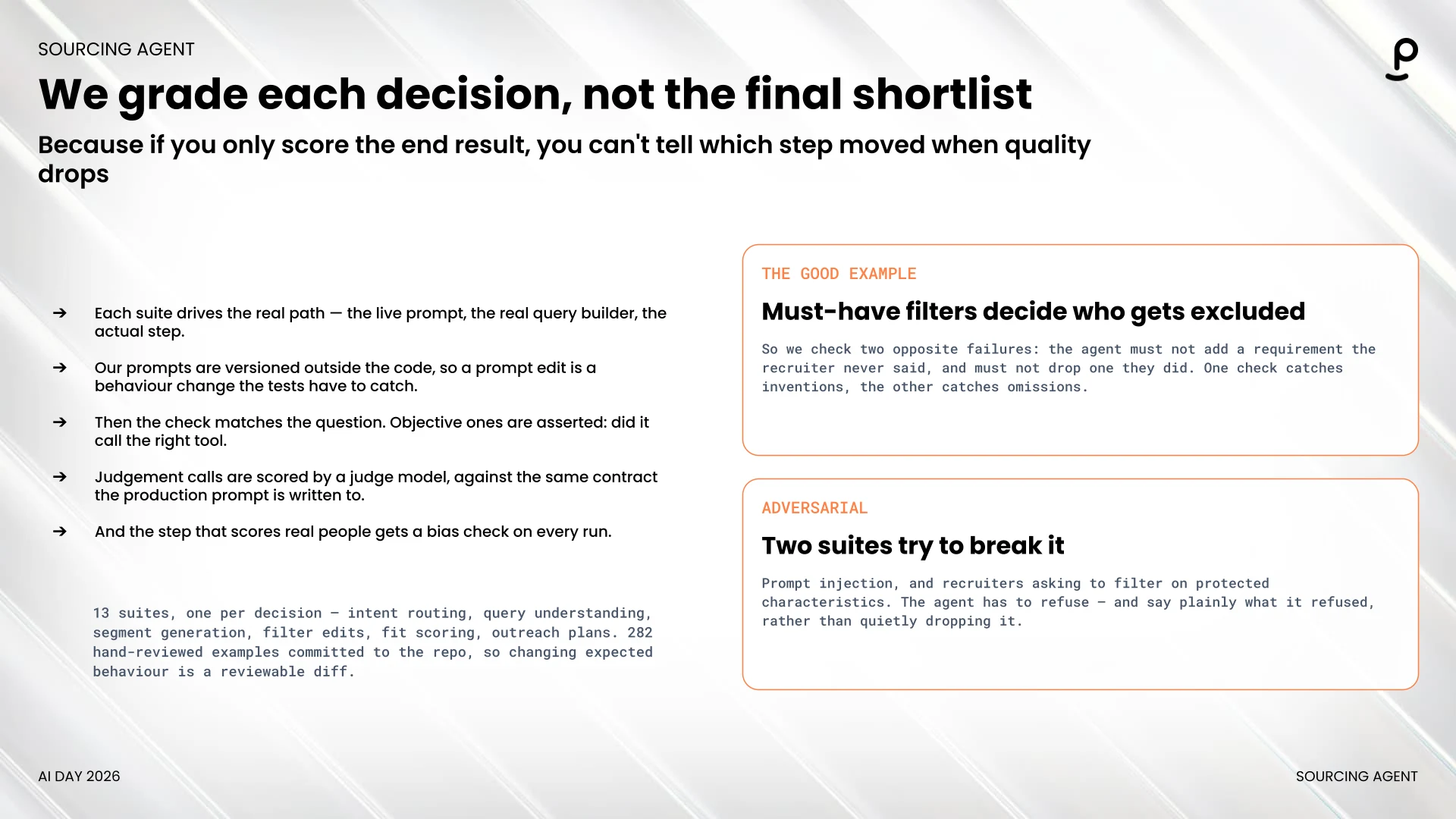
An agent that makes many decisions on its own needs a way to catch mistakes before recruiters do. Our team doesn't grade the final shortlist; it grades each decision the agent makes, with 13 separate test suites covering steps such as understanding the request, designing pools, editing filters, scoring fit, and planning outreach. When quality drops, our approach shows exactly which step caused it, rather than leaving the team to guess. The tests run against 282 hand-reviewed examples, and any change to expected behavior has to go through review.
Some checks target the failures that would cost recruiters the most trust. One confirms the agent never adds a requirement the recruiter didn't ask for and never drops one they did, since must-have filters decide who gets excluded. Two suites try to break the agent on purpose, attempting prompt injection and asking it to filter on protected characteristics. In both cases, the agent has to refuse and say plainly what it refused, instead of quietly ignoring the request. The step that scores real candidates also runs a bias check on every pass.
These are the safeguards worth asking any vendor about. Find out how they would know which step failed, what happens when a recruiter asks for a discriminatory filter, and whether bias checks run continuously or only during an annual audit.
40% Faster Qualified Candidate Shortlists
The figures below come from the live solution running inside a customer’s actual environments. Every dismissal, every candidate added to a job, and every reply serves as real-world feedback on whether the agent got it right.
Measure | Result | What it means |
|---|---|---|
Time to qualified shortlist | 30 to 40% faster | Reduction across the customers measured so far, varying with how hard the role is to fill |
Intent routing accuracy | 95% | How often the agent correctly understands what a recruiter wants from their first message |
Entity extraction accuracy | 91% | How reliably a recruiter's own words become the right search filters |
Search relevance (top 10) | 71% | Share of the top ten candidates that clear the quality bar, scored on every traced run |
From Finding Candidates to Working the Requisition
A year ago, this agent could find candidates. Today it works out who to go after for a role, refreshes its candidate pools without being asked, and improves every time a recruiter acts on its results. That shift reflects where AI in recruiting is heading more broadly: away from tools that answer one question at a time and toward agents that carry a task forward, learn from outcomes, and know when to hand a decision back to a person. The organizations that benefit most from agentic AI will be the ones that insist on context, memory, and clear human checkpoints from the start.
Fewer searches. Better pools. Faster shortlists. Book a demo to see how the Sourcing Agent works your open requisitions, from the first candidate pool to the first reply.

Devi is a content marketing writer passionate about crafting content that informs and engages. Outside of work, you'll find her watching films or listening to NFAK.


Get the latest applied AI insights delivered to your inbox.
Sign up to stay up-to-date on the latest original content from Phenom, including new podcast episodes, events, and more.


