

How Interview Intelligence Helped This Organization Drive Faster, Fairer Hiring
When a global life sciences organization opens a role in clinical research, IT, or engineering, the hire matters beyond headcount. In an industry where the work directly supports scientific discovery and product integrity, every hire carries real-world consequence. That context shaped everything about how the company approached interview intelligence.
The organization's Director of TA Enablement and Senior Manager of TA Processes and Experience shared how a privacy-first, pilot-driven rollout of Phenom Interview Intelligence unfolded, from the governance decisions made upfront to the adoption dynamics and results that followed.
Explore the highlights below!
What Was Making the Organization's Interview Process Difficult to Scale?
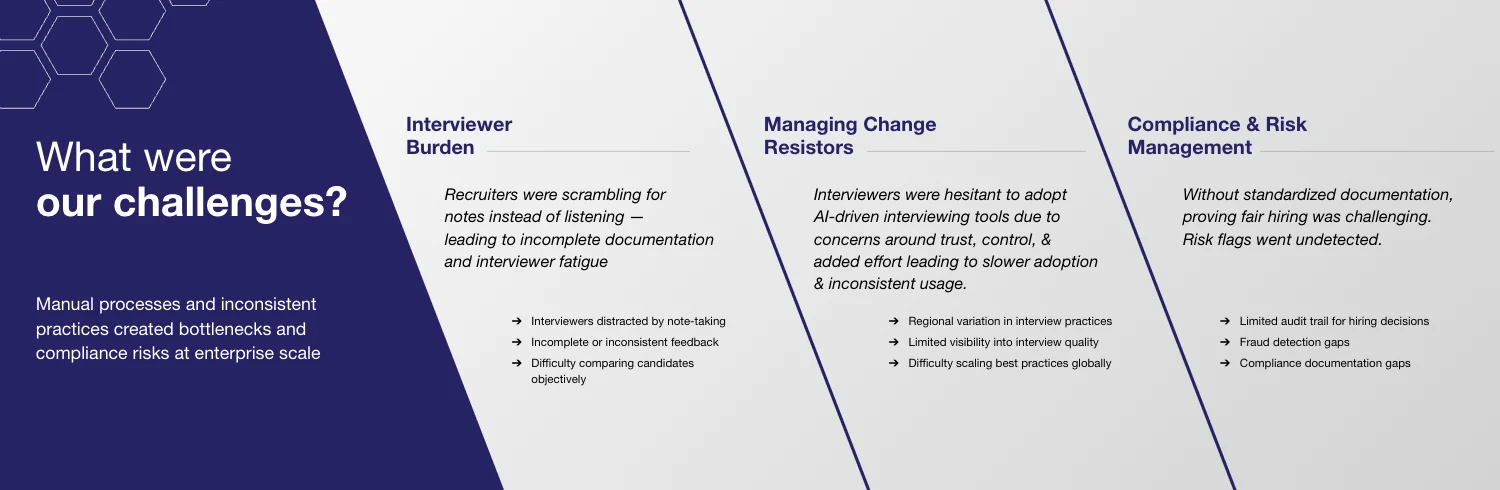
Before Interview Intelligence, the company’s interviewers were doing two jobs at once — listening to candidates and transcribing the conversation in real time. Note-taking during interviews meant split attention, which degraded both the quality of follow-up questions and the quality of the hiring decision. Debrief conversations reflected memory, interpretation, and sometimes irrelevant impressions rather than what the candidate actually said.
Hiring managers compounded the problem by requesting additional interview rounds when they felt uncertain about a candidate. That uncertainty often came from unclear or inconsistent debrief documentation, which then created scheduling backlogs and added directly to time to fill. For an organization running 10,000 to 20,000 hires a year across more than 60 countries, the efficiency gap created an operational risk they weren’t willing to take.
How Does Phenom Interview Intelligence Work?
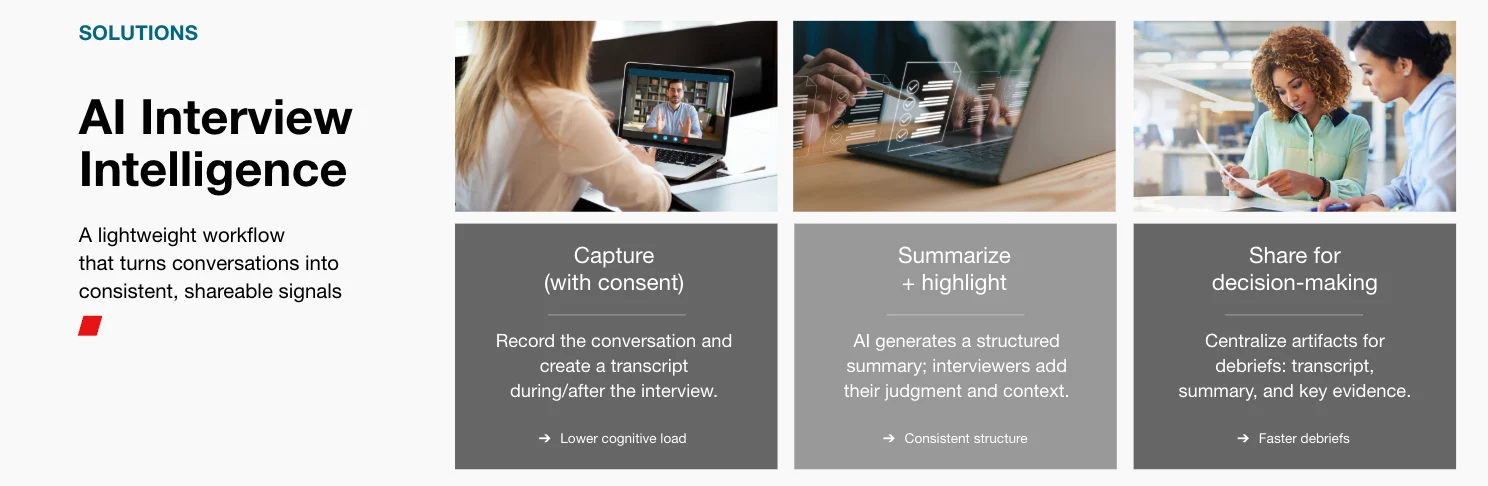
At its core, Interview Intelligence runs on three steps: capture, summarize, and share. An AI assistant joins the interview as an additional participant, with informed consent built directly into the meeting communications. The assistant records the conversation and generates a live transcript, which immediately lowers the documentation burden for interviewers. With note-taking removed from the equation, the company’s interviewers reported being more present and better able to check tone, catch nuances, ask better follow-up questions.
After the interview, AI generates a structured summary aligned to the role and its competencies. The summary is a draft, not a verdict. Interviewers review it, adjust it, and add their own judgment before sharing.
That human ownership step was non-negotiable for the organization from a compliance standpoint, and it also built trust within the hiring team. What changed in debrief sessions was significant. Instead of reconstructing what they remembered, teams worked from shared evidence. As a result, repeat interviews dropped and decisions got made faster, not by lowering the bar but by removing the ambiguity that was causing delay.
A risk-flagging layer sits inside the structured summary. For example, if a candidate mentions their birth year, or any other protected characteristic, the system flags it. Interviewers can also take optional notes during the session and review the full transcript and video clip after the fact. A reporting dashboard shows adoption by region and job family, opt-out rates, and where coaching around biased questions may be needed.
How Did They Design Its Rollout to Keep Privacy a Partner, Not a Blocker?
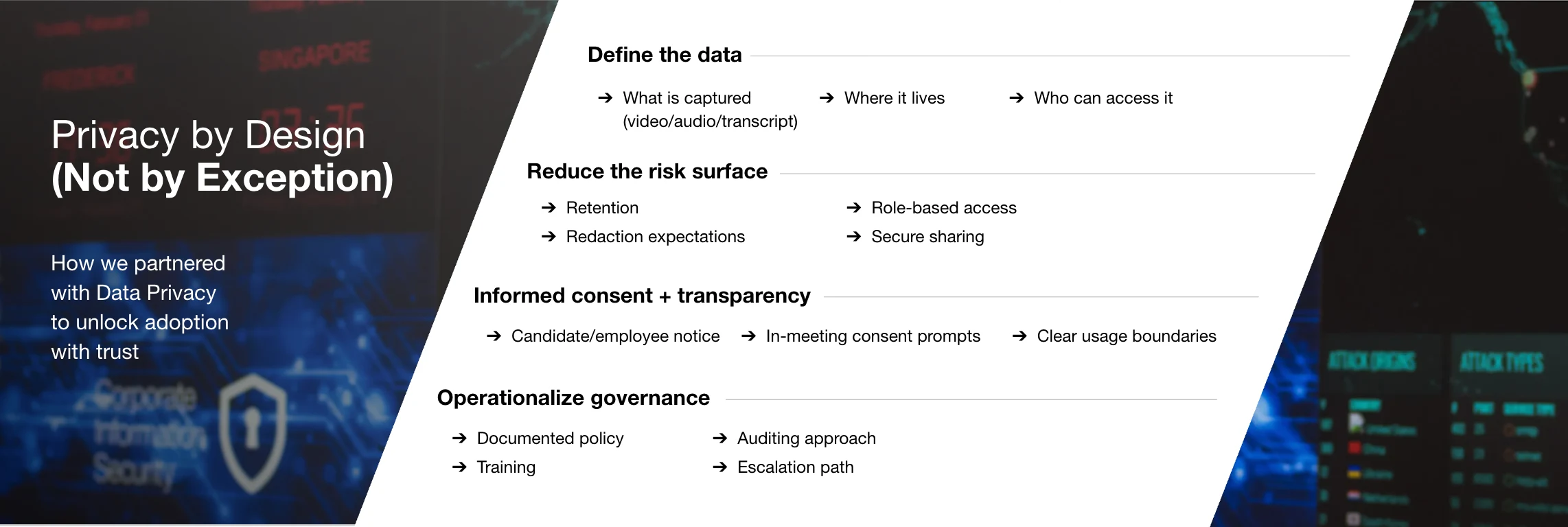
The most important decision the company made was treating privacy as a Day 1 design partner rather than a compliance review at the end. Before a single interview, the privacy team was brought in to define exactly what gets recorded, where it lives, how long it’s retained, and who has access. Consent language was crafted collaboratively.
That upfront investment paid off in ways the team hadn’t fully anticipated. With privacy defined and documented from the start, the legal and governance reviews that could have stalled expansion were already accounted for. The question the organization's team now asks before each new capability isn’t “Can we implement this?” but “How can we implement this in a way that reduces risk and builds trust?”
The pilot itself stayed deliberately focused on corporate functions (Finance, IT, and HR) across a handful of countries with feedback loops built into every stage. This privacy-first governance was the foundation that made scaling possible.
“Privacy shouldn’t be your blocker. It should really be your design partner from day one,” said their Director of TA Enablement.
What Results Did Interview Intelligence Deliver To Hiring Teams?
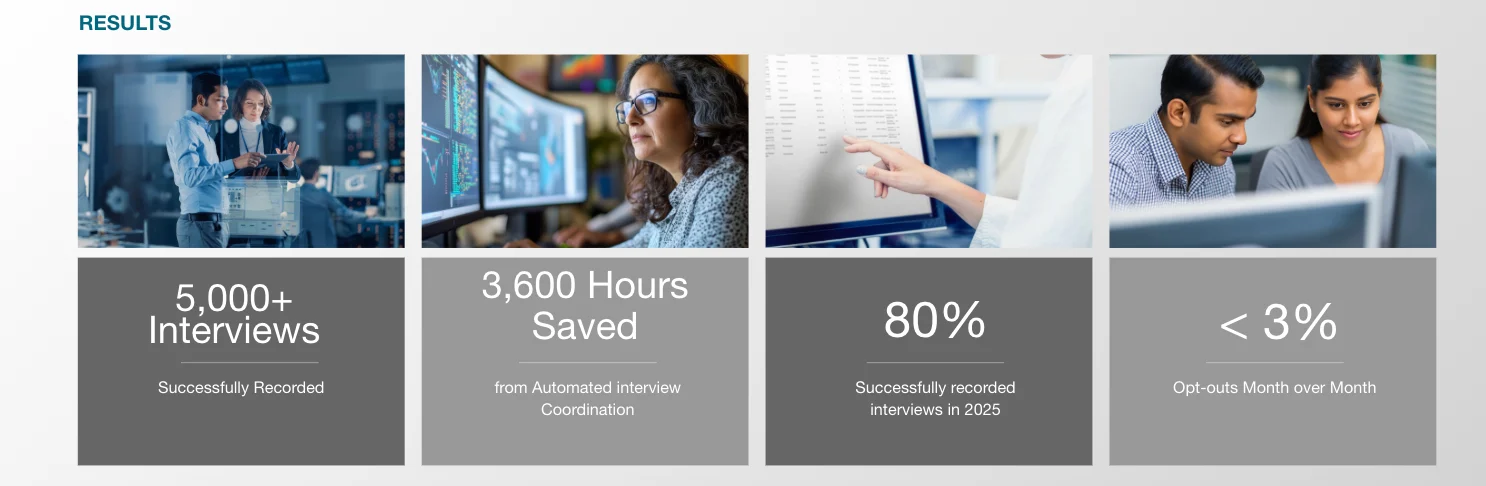
Since launch, the pilot has produced measurable shifts in recruiter behavior, debrief quality, and hiring team confidence. Results include:
5,000+ interviews recorded
3,600 hours saved through automated interview coordination
80% interview recording rate among eligible interviews
<3% opt-outs MoM with privacy-first consent
Fewer repeat interviews through shared recordings and clearer decisions
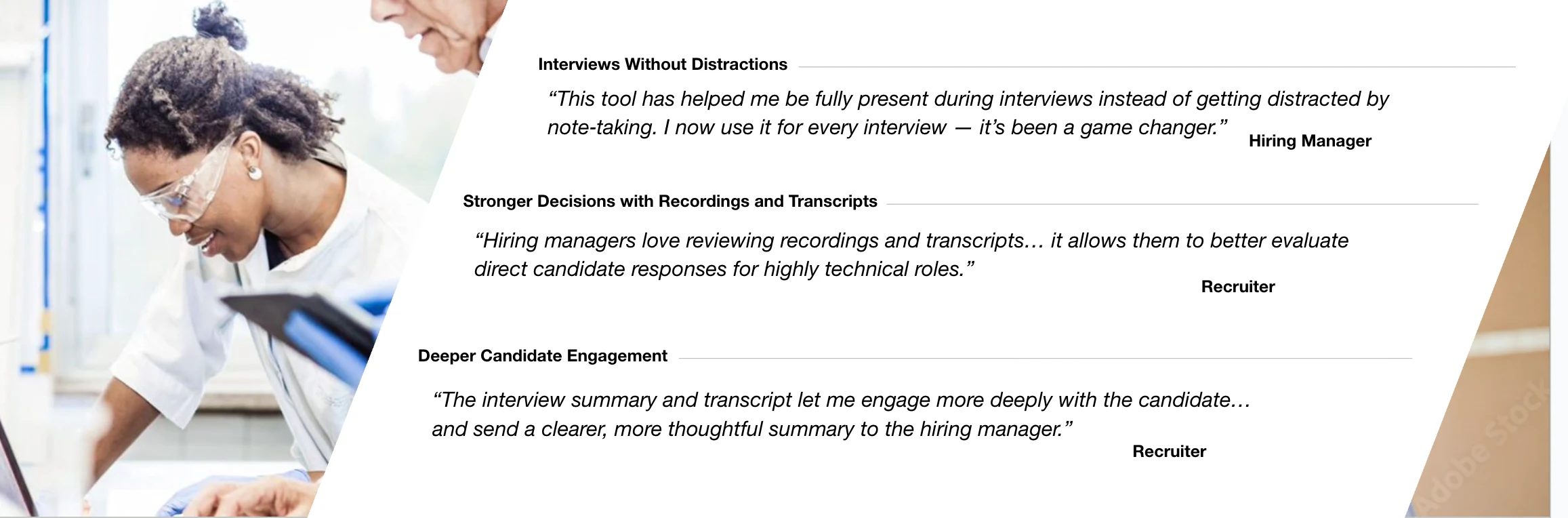
“We didn’t move faster by cutting corners. We moved faster by removing that ambiguity,” said their Senior Manager of TA Processes and Experience. Recruiters talked about better conversations, stronger technical evaluations, and clearer summaries. Hiring managers talked about confidence in their decisions. The shift from a tool implementation to a workflow improvement was the signal the team was looking for.
Where Is The Organisation Taking Interview Intelligence Next?
The next phase is broader expansion beyond corporate functions into additional roles and countries, following the same governance model: privacy-aligned first, piloted in focused populations, and feedback-driven before scaling. An “Interview Champions Network” is being built for peer-to-peer adoption support, replicating the approach that has worked for the organization's other Phenom implementations.
The Director of TA Enablement shared four recommendations for any team considering this path:
Start with a focused pilot where you can prove value before going enterprise-wide
Invest in change management early and position the tool as support for interviewers, not monitoring
Lead with the elimination of note-taking (that’s the moment when resistance drops)
Connect the implementation to compliance goals, because structured documentation is a risk reduction argument that resonates with leadership
What ties all four together is a question the team reframed from the start. "We did not ask, how do we move faster? We asked, how do we help people decide better? Because when decisions improve, speed follows."
Learn more about Phenom Interview Intelligence

Gautami is a Product Marketing Manager at Phenom. She loves twisted thriller movies and is passionate about bringing creativity to life through crafting.


Get the latest talent experience insights delivered to your inbox.
Sign up to the Phenom email list for weekly updates!


