

Agentic AI for Pharma: Matching Every Hire to Its Exact Context
Hiring for a role rarely comes down to the title alone. The skills it demands, the candidate pool, and how it competes in the local market can look completely different depending on where that role sits.
Take a manufacturing technician in Indiana and one in Los Angeles. Same title, same job family, probably the same template job description. But one role centers on metabolic disease manufacturing, largely GLP-1 production. The other centers on gene therapy, tied to the genetic research reshaping the West Coast. Different skills, different candidate pool, and the title captures none of it. That gap is costing pharma companies their strongest hires, often without anyone noticing.
A hypercell is designed to capture that distinction. During a recent webinar, Phenom's John Deal and Michael DeMarco unpacked why this shows up so clearly in pharma hiring, and what it looks like applied to two real hiring scenarios.
Beyond Job Titles, Introducing the Hypercell
A title sorts a role into a job family, sets a pay band, and defines who can apply. That works for most hiring, but it breaks down in industries where one title can mean two very different jobs.
Phenom solves this with the hypercell, a unit built to understand the exact context behind an organization’s hiring architecture: the intersection of role, function, industry, location, and workflow. A manufacturing technician in Indiana and one in Los Angeles share a title, but the hypercell sees past that. It picks up on the work, the skills, and the labor market that actually define each role, so two identical titles can point to two different hiring strategies.
"We get down to the molecular level here, looking at organizations all the way down to what we call the hypercell, which is really the DNA of your organization," DeMarco said.
A title doesn't tell you which regulations apply, which skills are relevant, or which labor market you're competing in. Two people with the same title can need two different sourcing strategies. The hypercell is built to catch that.
Why Context-Agnostic AI Models Underperform in Pharma Hiring
General-purpose AI models can write a job description or summarize a resume, but they lack the context to distinguish an oncology-focused role from a neuroscience-focused one, even when both carry the same title and draw from entirely different talent pools.
Historical job data, skills adjacency mapped across industries, and a record of how similar hiring workflows have played out are what separate a purpose-built tool from a generic one. Without that context, a general AI tool treats every candidate search as a blank slate, reintroducing the exact guesswork that role-specific criteria are meant to eliminate.
This limitation becomes most apparent in cross-industry competition for talent. "The complexity here isn't just pharmaceutical companies competing with each other for talent. Within a given geographic area, they're competing with companies across a range of other growing industries for that same pool of people," Deal said.
A manufacturing technician's skills in documentation discipline and sterile environment management transfer directly into food and beverage or chemical manufacturing. A tool with no visibility into that adjacency will overlook those candidates entirely.
Related Read: Three Pharma Hiring Problems That Cost Companies Millions Every Year
Use Cases for the Hypercell in Real Hiring Scenarios
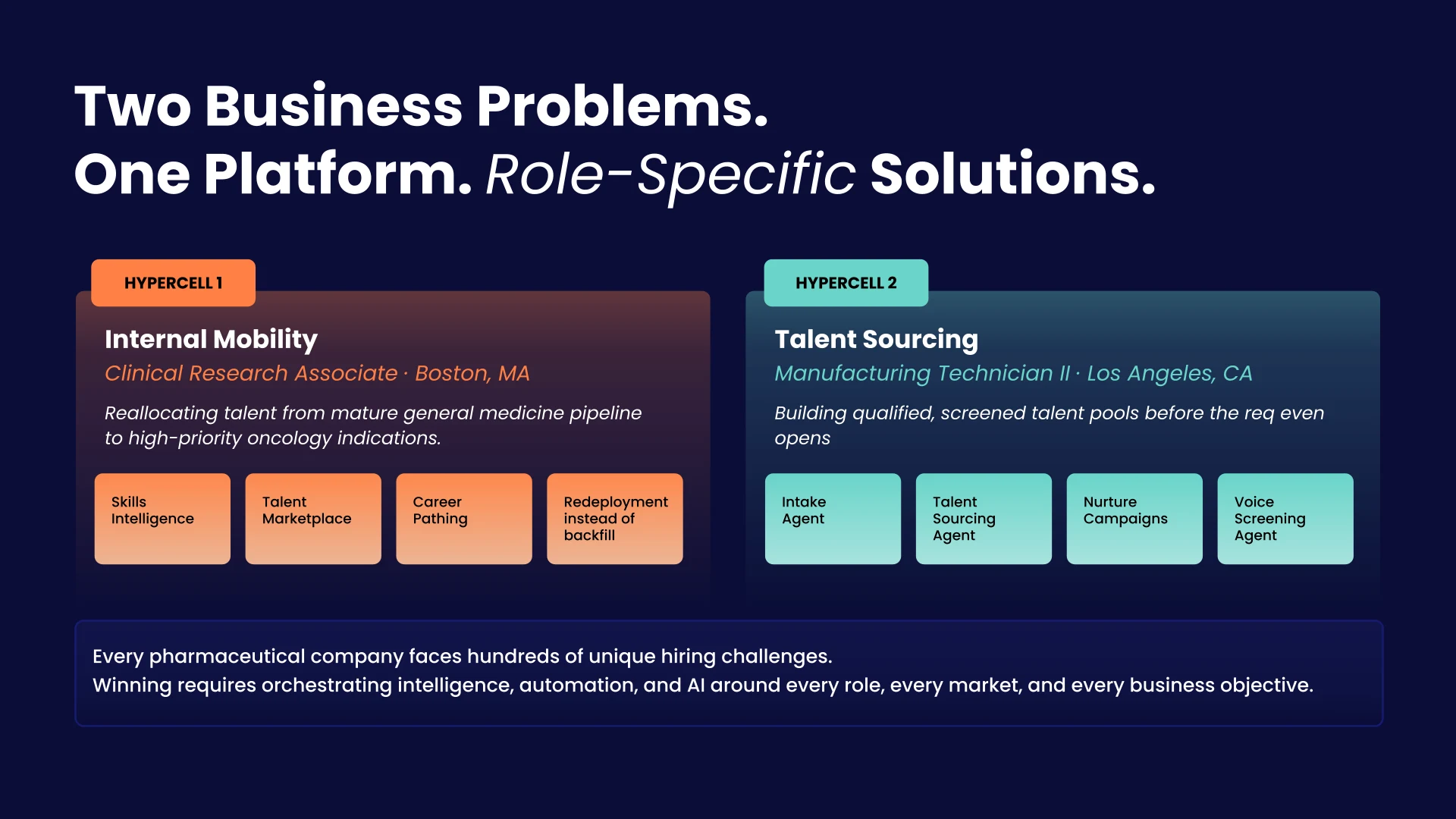
Defining a hypercell is one exercise. Observing how it changes a recruiter's day-to-day work is another. The two use cases below sit at opposite ends of the hiring spectrum, one centered on retention and internal mobility, the other on external sourcing speed, illustrating how the same underlying framework adapts to distinctly different problems.
1. Internal Mobility in Practice for Clinical Research Associates
The clinical research associate role based in Boston illustrates the retention side of this equation. CRA positions carry a notably high turnover rate across the industry, driven by demanding travel schedules, long hours at trial sites, and a labor market where CROs and competing pharma companies recruit continuously from the same limited pool. That turnover rate is precisely why this role, in this location, is better suited to an internal mobility strategy than to a cycle of constant external replacement.
The problem underneath this isn't usually a lack of qualified people inside the organization. It's a lack of visibility into who those people are, and what they could do next.
"It's so important to keep good talent within the organization and, as priorities shift, to redeploy that talent to meet new needs. That has to be a proactive effort, not a reactive one," Deal explained. Without that visibility, internal mobility becomes reactive, a scramble to backfill after someone's already walked out. A more precise approach flips that sequence, continuously matching existing skills against emerging needs so that when a CRA shows early signs of flight risk, there's already a shortlist of internal candidates ready to move.
2. Sourcing Velocity in Practice for Manufacturing Technicians
The Manufacturing Technician II role based in Los Angeles illustrates the opposite challenge. Tied to the region's growing gene therapy manufacturing footprint, this isn't primarily a retention problem. It's a velocity problem, and this is where hiring processes lose their strongest candidates. The first requirement, before sourcing even begins, is ensuring the job description and required skills are current. This step is often the slowest part of the process. Coordinating between recruiters and hiring managers to update a stale posting can take weeks, and each of those becomes a window for a strong candidate to accept an offer elsewhere.
From there, an intake agent can generate a starting set of interview questions from historical data on comparable hires, rather than a recruiter building the list from scratch. Recruiters still layer in the must-haves a given moment calls for, current good manufacturing practice (GMP) experience and demonstrated attention to detail, for example, requirements that matter in a high-compliance environment but may not appear in a generic template. Recruiters also retain a choice in how intake is handled. Some situations call for a live one-on-one meeting between recruiter and hiring manager. Others work well with the agent coordinating more of that conversation directly. This flexibility matters, since forcing a single workflow onto every organization runs counter to the specificity role-based hiring is meant to provide.
When this plays out well, the result is a meaningfully compressed timeline from sourcing through screening and into placement. In a labor market where the same candidate might be courted by a food and beverage manufacturer or a chemical company simultaneously, that compression is often the deciding factor in who secures the hire.
Related Read: Types of AI Agents Explained: The Complete Guide for HR Innovation (With Real-World Examples)
The Data and Orchestration Layer Behind Precision Hiring
Autonomous hiring depends on more than individual AI agents. It requires a shared data foundation that gives every agent access to the same, up-to-date understanding of jobs, skills, candidates, and hiring history. For example, an Intake Agent captures and structures the latest hiring requirements, such as responsibilities, required skills, and manager inputs. A Sourcing Agent then uses that information to identify qualified talent and engage candidates with personalized outreach. Without connected data, each agent operates in isolation, making consistent, high-quality decisions difficult.
Orchestration is equally important because not every hiring workflow should follow the same path. A CRA retention initiative in Boston might rely on recruiters to make most decisions while AI surfaces qualified internal candidates and supports the process in the background. A high-volume manufacturing hiring campaign in Los Angeles may require the Intake Agent to gather hiring requirements before the Sourcing Agent automatically identifies and engages external candidates. The ability to coordinate different agents based on the role, location, hiring volume, and business objective allows organizations to scale intelligently instead of forcing every hiring scenario through a rigid, one-size-fits-all workflow.
Common Pitfalls in Role-Specific AI Hiring
A few patterns show up repeatedly in organizations still working through this shift.
Applying one AI workflow across every role, regardless of what the underlying role, geography, and industry actually require
Prioritizing external sourcing while treating internal skills data as an afterthought
Assuming skills transfer across industries without checking that assumption against the specific role and market in question
Skipping human-in-the-loop checkpoints for roles where compliance and judgment genuinely matter
Each of these traces back to the same root cause. All of them treat a job title as if it reveals everything you need to know about the hire.
Scaling Precision Hiring Across the Pharma Workforce
Hiring the same role in Indiana and Los Angeles often requires different sourcing strategies, candidate outreach, and recruiter support. The same is true of the CRA in Boston, whose primary risk is attrition, compared with the manufacturing technician, whose primary risk is losing ground to a faster-moving competitor. Extend that logic across every role in a pharma organization, and the case for precision over generic tooling becomes difficult to ignore.
Pharma hiring will only grow more specialized. The organizations that build their hiring approach around that reality, rather than around a shared job title, will be the ones that keep pace with it.
See how Phenom's AI agents for pharma hiring can bring the same precision to your organization's roles, locations, and hiring challenges

Devi is a content marketing writer passionate about crafting content that informs and engages. Outside of work, you'll find her watching films or listening to NFAK.


Get the latest talent experience insights delivered to your inbox.
Sign up to the Phenom email list for weekly updates!


