

Skills Governance: From Theory to Practice
In today's rapidly evolving talent landscape, skills governance has become a critical component for organizations striving to maintain a competitive edge, yet many companies struggle with questions like:
How do we standardize skill definitions?
Who owns and maintains our skills ontology?
How do we ensure skills data remains accurate?
Without effective skills governance, companies risk misaligning their talent’s capabilities with their businesses’s needs and goals, which can lead to uninformed hiring decisions and a failure to adequately develop their workforce. As industries undergo digital transformation and new technologies emerge at an unprecedented pace, the skills required for success are constantly changing — and the constant reshaping of skills is necessary to keep up.
During Skills Day, Dr. Sandra Loughlin, Chief Learning Scientist at EPAM Systems, and Jesus Latorre-Socas, Director of Product Management at Phenom, highlighted how a dynamic skills environment demands a robust system for managing, updating, and aligning skills across the entire organization – including tips for getting started.
Watch the full conversation here or read on for the highlights.
Why Skills Governance is Important
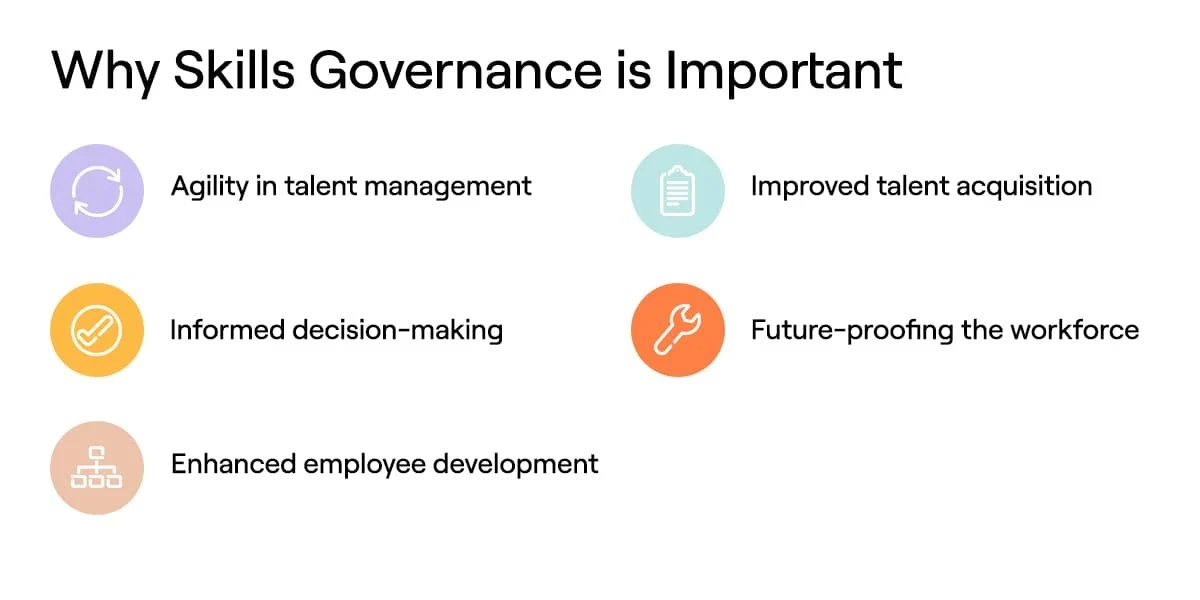
Skills governance is the systematic approach organizations and institutions take to identify, develop, and manage workforce capabilities through policies, frameworks, and strategic initiatives that align skills development with current and future business needs. It is essential for several reasons:
Agility in talent management: It allows companies to quickly adapt to market demands by identifying and developing crucial skills.
Informed decision-making: A well-governed skills framework provides data-driven insights for strategic workforce planning and resource allocation.
Enhanced employee development: It helps in creating targeted learning and development programs, fostering a culture of continuous improvement.
Improved talent acquisition: A clear understanding of required skills enables more effective recruitment strategies and better candidate matching.
Future-proofing the workforce: By consistently updating skill requirements, organizations can prepare for future challenges and opportunities.
EPAM's Approach to Skills Governance
Software engineering company EPAM Systems has had a 30-year journey in skills-based talent management, demonstrating the long-term benefits of implementing a robust skills governance model. They focus on matching people to work in a data-driven way. Loughlin explained, "From the very beginning of the organization, the leaders wanted to do that in a data-driven way and so they started by thinking about what is the common denominator that can connect people to work and they hit on skills as that core data foundation".
Loughlin provided a practical example of how a mature skills-based organization implements effective skills governance, emphasizing the importance of this process: "The whole purpose from my point of view of skills governance is building a mechanism so that you a) know your denominator and numerator and b) you are able to lock down that dynamic always changing set of numbers and facts and skills ontologies".
EPAM's Skills Governance Model
EPAM's governance model addresses the complexity and dynamism of skills data. Loughlin described skills data as a ratio:
Denominator: All skills the company needs to fulfill its business objectives
Numerator: Skills actually present in the business
The delta between those: Areas for skill development or hiring
Key Tenets of EPAM's Skills Governance
So, how do you actually carry out this model effectively? Loughlin outlined four key tenets:
Business Ownership: "Skills governance is actually owned by the business". EPAM recommends identifying subject matter experts closest to the roles, and having them define required skills.
Data-Driven Approach: People analytics teams monitor data sources and provide periodic reports on skill changes.
Cross-Functional Collaboration: Governance teams include representatives from various HR functions to align processes with new skill taxonomies.
Continuous Monitoring and Updating: Skills are updated as needed, with a minimum annual review.
Loughlin’s parting advice to organizations is to start building their skills foundation now, using data to understand and prioritize critical skills for the business. This will set you up for success later.
Related resource: Intro to Skills: The Key to Unlocking Employee Growth & Engagement
Technology's Role in Skills Governance
Once organizations have a model in place, they can use technology to simplify the skills governance process. But Latorre-Socas emphasized that before you dive in, “you have to make governance a habit.”
Here are four key elements that technology can bring to enhance governance:
Explainability: Technology aids in identifying and understanding skills across various jobs and employees, making it easier for organizations to pinpoint gaps and areas for development.
Smart nudges: This feature proactively assists organizations in managing their skills by providing timely reminders or suggestions based on current trends or changes within the workforce.
Automation: By automating routine tasks related to skills management, organizations can streamline their governance processes, allowing HR teams to focus on strategic initiatives rather than administrative burdens.
Contextualization: Technology helps align skill requirements with organizational goals and individual aspirations, ensuring that employees are equipped with the necessary competencies and motivated by their career growth paths.
Latorre-Socas stressed that technology should be viewed as an enabler rather than just a productivity tool: "Technology is not just here to help make you more productive, especially AI; it's here to also simplify processes, simplify how you govern your skills, as well as how you bring that to life and keep it evolving over time".
He further elaborated on the importance of establishing governance as an ongoing habit within organizations: "It's something that you have to do as an organization to ensure you're always up to speed". By integrating these technological capabilities into their governance frameworks, organizations can create a more agile response system that adapts to ever-changing skill demands while fostering employee growth.
Related resource: State of Skills: 2024 Market Data Report
Effective skills governance is not a nice-to-have in today’s talent market — it’s a necessity. Through innovative technological solutions, organizations gain actionable insights on how to navigate this critical aspect of workforce management successfully.
To continue your skills journey, get a demo of Phenom’s skills technology and see how it can help improve governance at your own organization.

Maggie is a writer at Phenom, bringing you information on all things talent experience. In addition to writing, she enjoys traveling, painting, cooking, and spending time with her family and friends.


Get the latest applied AI insights delivered to your inbox.
Sign up to stay up-to-date on the latest original content from Phenom, including new podcast episodes, events, and more.


