

AI Agents For HR: A Practical Guide Across the Talent Lifecycle
As AI integrates with everyday work functions, the conversation about its future applications never stops. In HR, especially, the ideas never stop flowing. HR is looking beyond how often AI shows up across its workflow, focusing on its vast, untapped capabilities. That line of thinking will always arrive at Agentic AI for HR.
This latest evolution of AI no longer works in isolation. Instead, it connects insight, action, and learning. Agentic systems can observe what’s happening, decide what needs to happen next, and move work forward across tools and workflows, while still involving humans when judgment or approval is needed. Early predictive AI helped teams look ahead by analyzing historical data, such as forecasting attrition or hiring demand. Perception-based AI came next, adding the ability to read real-time signals from candidate and employee behavior, like engagement patterns or drop-off points. More recently, Generative AI (GenAI) made it easier to create content at scale, from job descriptions to interview questions and candidate communication.
In this guide, we’ll explore how AI agents are mapped across the entire talent lifecycle and how they work together to support hiring, engagement, development, and workforce planning.
What Are AI Agents, and Why Does HR Need Them?
Agentic AIs are the expansion from insight to execution. They leverage applied intelligence to do more than analyze data. They actively assist with work across hiring, development, and workforce planning.
Agentic AI for HR has evolved in clear steps. Early predictive AI helped teams look ahead by analyzing historical data, such as forecasting attrition or hiring demand. Perception-based AI came next, adding the ability to read real-time signals from candidate and employee behavior, like engagement patterns or drop-off points. More recently, Generative AI (GenAI) made it easier to create content at scale, from job descriptions to interview questions and candidate communication.
These advances have all led to AI agents, or applied intelligence in action.
These autonomous software systems that operate continuously within a defined domain, observing signals, reasoning with shared context, and taking action.
AI agents don’t need to wait for step-by-step prompts. This distinction matters because HR work is not uniform. Recruiting, interviewing, onboarding, employee development, and workforce planning never follow the same formula twice. Each relies on different signals, constraints, and decision logic. Specialized AI agents in HR can solve a unique problem while remaining connected through AI agent frameworks. Modern frameworks allow agents to share an understanding of skills, roles, performance signals, and outcomes. Each agent learns from every one of its counterparts’ interactions.
The table below provides a quick view of how different types of AI compare, helping clarify where AI agents fit in practical HR use cases:
Capability | Traditional AI | General AI | Agentic AI |
|---|---|---|---|
Primary focus | Execute predefined tasks | Respond across many domains | Operate within a specific HR domain |
Decision logic | Fixed rules and thresholds | Broad reasoning | Context-aware, goal-driven decisions |
How actions occur | Triggered manually or by rules | Responds to prompts | Acts continuously without prompts |
Adaptability | Limited to defined scenarios | Theoretical and experimental | Adjusts to changing conditions |
HR use today | Screening tools, basic chatbots | Emerging concepts | Talent lifecycle automation |
The Phenom Agentic AI Framework
Phenom’s agentic AI framework is purpose-built for how HR work actually happens — adapting across industries, roles, and hiring models without losing precision. Agents handle the repetitive, administrative work that pulls recruiters and HR leaders away from relationship-building and strategic decisions. Phenom's framework brings together the following elements to make agentic AI deployable, governed, and effective at scale:
Ontologies: A shared intelligence layer grounded in skills, roles, career paths, and performance signals — built from years of hiring and workforce data. Ontologies give all agents a consistent grounding of talent that is accurate across recruiting, onboarding, and talent management workflows.
X+ Agents: Pre-built, vertical AI agents designed to automate and augment specific talent processes across industries such as healthcare, retail, manufacturing, financial services, and technology. X+ Agents handle tasks ranging from intake and sourcing to screening, scheduling, onboarding, and career development. They operate autonomously within defined guardrails, reducing manual effort while keeping humans in control of critical decisions.
Unified Orchestration Engine: A coordination layer that governs agents across lifecycle stages, routes intelligence between systems, and escalates decisions when human judgment is required.
Together, these building blocks enable scalable automation with built-in governance and human oversight at every step.
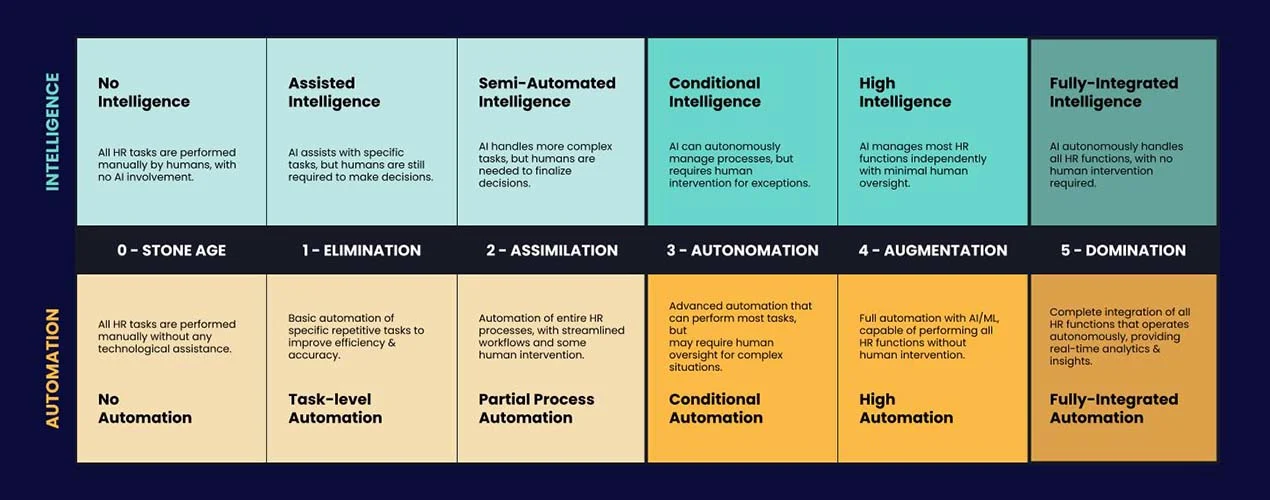
Understanding AI & Automation Maturity in HR
Organizations advancing through the AI maturity model face a critical inflection point: moving from isolated AI solutions to coordinated, autonomous systems. Early stages (Levels 0-2) rely on disconnected automation and human-guided decisions. But reaching Levels 4-5—where AI autonomously manages complex talent workflows while humans focus on strategy—requires a fundamentally different architecture. AI agents in HR make this transition possible by orchestrating specialized intelligence across the entire talent lifecycle, eliminating handoffs and reducing manual burden.
Without agentic capabilities, organizations plateau at partial automation with limited intelligence. With them, they unlock end-to-end autonomy across different talent lifecycle stages. All the while, humans retain their authority over outcomes.
The Talent Lifecycle as a Connected System
Every HR task is connected. Decisions made during intake influence the quality of sourcing; early screening affects interview efficiency; and inconsistent interviews often lead to mishires that show up later as poor retention. When each stage is handled in isolation, teams spend significant time fixing issues that could have been prevented earlier.
This is where agentic AI in HR becomes especially valuable. Instead of applying intelligence at a single point, agents are mapped intentionally across the talent lifecycle so insights carry forward from one stage to the next. By treating the lifecycle as a continuous system rather than a set of handoffs, HR teams gain better alignment, stronger signal quality, and more predictable outcomes.
With this lifecycle lens in place, we can now explore how AI agents assist at each stage and how their coordination improves how work gets done.
Job Posting: Establishing Momentum at the Start
Job Posting is one of the most consequential moments in the talent lifecycle. The way a role is defined at this stage shapes everything that follows, from the quality of applicants to the efficiency of screening and interviews. When expectations are unclear or incomplete, teams move fast in the wrong direction and pay for it later.
AI agents in HR play a decisive role in preventing rework and misalignment. Instead of relying on fragmented conversations and manual follow-ups, agents assist by capturing hiring managers’ role intent early and translating it into structured intelligence. To understand this further, let’s take a closer look:
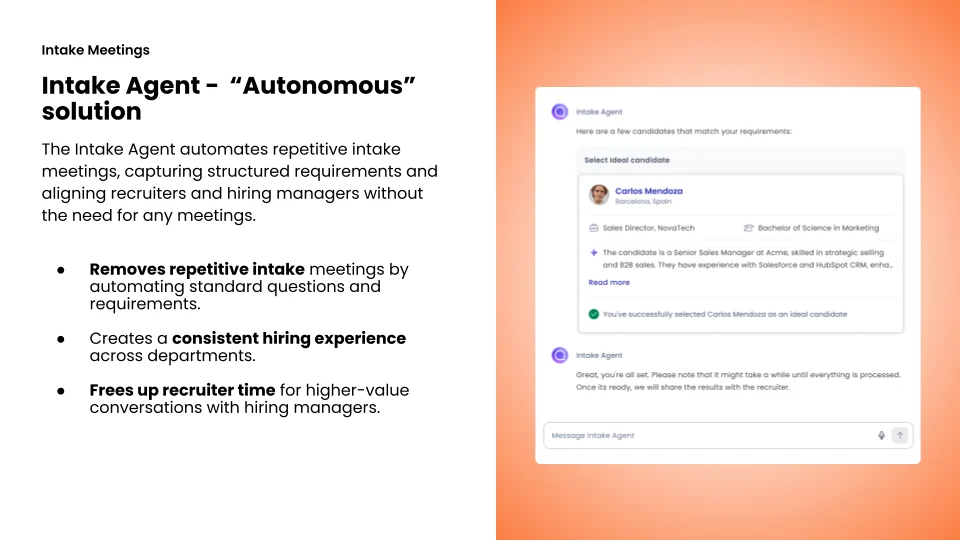
Intake Agent
Intake meetings quickly fill recruiters’ schedules, keeping them from other tasks. . In these conversations, important details get lost in note-taking, causing days of follow-ups and revisions.
The Intake Agent conducts structured, asynchronous intake conversations through collaboration tools like Teams. It captures success criteria, team context, required skills, and constraints—and then converts that information into a structured job profile. Based on this profile, it immediately surfaces internal candidates and generates a job description ready for posting. Here’s how the agent supports this stage:
Asynchronous intake through chat or forms
Optimized job descriptions using talent ontology
Internal talent matching and 1:1 Intake recording
Intake cycles shrink from days to hours. Job postings become more accurate, and internal mobility opportunities surface earlier.
Attraction and Engagement: Connecting Relevance at Scale
Attraction and engagement determine whether the right candidates enter the hiring process. Today’s talent market is crowded, and candidates are balancing multiple options. Visibility alone is no longer enough. What matters is how quickly and accurately opportunities connect with the skills, interests, and expectations of qualified talent.
At this stage, AI agents in HR identify candidates’ relevance to each opportunity early in the funnel.
Sourcing Agents continuously identify qualified candidates across internal and external talent pools.
Personalization Agents tailor outreach to reflect individual experience rather than general templates.
Content Curator and Engagement Agents support recruitment marketing by shaping and optimizing messaging based on real-time performance.
Search and Candidate Concierge Agents reduce friction once candidates begin exploring roles or applying.
Together, these agents help organizations scale engagement without losing precision.
Let’s take a look at two agents that illustrate how attraction shifts from broad outreach to targeted connection:
Sourcing Agent
Talent CRMs are full, yet recruiters still start from scratch for every role. Manual searches are slow and repetitive, and qualified candidates remain hidden.
The Sourcing Agent continuously scans internal databases and external sources to identify candidates aligned with current role requirements. It scores candidates on fit and initiates outreach sequences across preferred channels, adjusting follow-ups based on engagement.
At its core, the agent:
Executes complex talent workflows to fulfill specific applied AI needs
Scores candidates by fit.
Automates multi-channel outreach.
Returns matching candidates from both your Talent CRM and external cloud leads.
Sourcing becomes continuous instead of reactive. Qualified pipelines grow, and sourcing time drops dramatically.
Personalization Agent
High-demand candidates disengage when outreach feels generic, but manual personalization doesn’t scale.
The Personalization Agent analyzes candidate profiles, skills, career history, and engagement signals to generate tailored messaging at scale. It adapts tone, content, and timing based on response behavior. The agent’s capabilities include:
Deep candidate signal analysis
Dynamic message generation
Channel and tone optimization
Sequence-level personalization
Response rates improve without increasing recruiter workload, and early engagement quality improves downstream conversion.
Screening and Scheduling: Speed Effortlessly Meets Quality
As candidate pipelines expand, screening and scheduling quickly become pressure points. HR teams risk moving too fast and too slow — depending on the moment. High volumes, limited recruiter capacity, and complex coordination can stall progress when speed matters most. But moving too fast increases the risk of weak assessments and missed signals.
Agents assist teams in keeping hiring moving while preserving consistency and quality. Voice Screening Agents engage candidates early to assess fit and availability without waiting for recruiter bandwidth. Self-Scheduling Agents remove delays caused by manual coordination, allowing interviews to be booked as soon as candidates are ready. Location Routing Agents balance demand across sites so opportunities don’t stall in over-subscribed locations, while Simulation Agents add deeper skill-based evaluation where resumes fall short.
Together, these agents reduce friction across screening and coordination. The next sections focus on two of these agents to show how speed and rigor are maintained in practice.
Voice Screening Agent
Traditional phone screens limit throughput and depend on synchronous availability, delaying qualified candidates.
The Voice Screening Agent assists recruiters by extending screening conversations beyond business hours and human capacity limits. It engages candidates through natural, conversational interactions that assess role fit, availability, and interest, adapting questions based on responses rather than following general scripts. The agent’s role at this stage includes:
Conducts conversational screenings using natural language
Handles both qualifying and open-ended questions
Grades candidates against role-specific criteria
Produces recruiter-ready summaries and recordings
Screening shifts from a capacity-limited task to a continuous process. More candidates are evaluated fairly, the time to screen drops significantly, and recruiters can focus their time on deeper conversations where human judgment adds the most value.
Related: Scaling Reference Checks with AI: Inside Bright Horizons' Voice Agent Success
Self-Scheduling Agent
Interview coordination drains recruiter time and slows hiring decisions.
The Self-Scheduling Agent allows candidates to book interviews based on real-time interviewer availability. It manages panels, time zones, reschedules, and logistics automatically. In practice, this means the agent can achieve:
Calendar and panel coordination
Time zone handling
Automated rescheduling and resource booking
Scheduling friction disappears, accelerating time-to-interview and reducing candidate drop-off.
Interviewing and Assessment: Consistency That Builds Confidence
As AI reshapes hiring, remote interviews, digital assessments, and faster cycles have expanded access to talent. There are also new challenges. Interviewers now evaluate candidates they may never meet in person, while inconsistent interview practices and growing instances of candidate fraud make it harder to trust what’s being assessed.
A set of specialized agents assists teams in bringing structure and confidence into the evaluation process. Interview Agents support interviewers with role-aligned questions, consistent scorecards, and reliable documentation so candidates are assessed on comparable criteria. Fraud Detection Agents operate in the background, helping teams verify authenticity across interview stages and flag anomalies that could undermine hiring confidence. The sections that follow explore these agents in more detail:
Interview Agent
Interviewers vary in preparation and evaluation rigor, leading to inconsistent hiring decisions.
The Interview Agent provides live guidance during interviews, auto-transcribes conversations, captures structured notes, and generates summaries and interviewer performance insights afterward. The following are key features of the agent:
Automatic engagement with interviewers to provide relevant prep material
Live question guidance for bias reduction
Auto-transcription and note-taking
Structured scorecards
Interviewer coaching insights
Interviews become fairer, more consistent, and easier to review across teams.
Fraud Detection Agent
Remote interviews and AI-assisted preparation have made it harder to assess whether candidates are presenting genuine experience or polished representations.
The Fraud Detection Agent assists hiring teams by bringing intelligent verification into the interview process without disrupting candidate experience. It operates alongside interviews and assessments, examining patterns across responses, behavior, and identity signals throughout the hiring journey. The agent signals aspects that require closer review and provides context for interviewers to probe deeper with confidence.
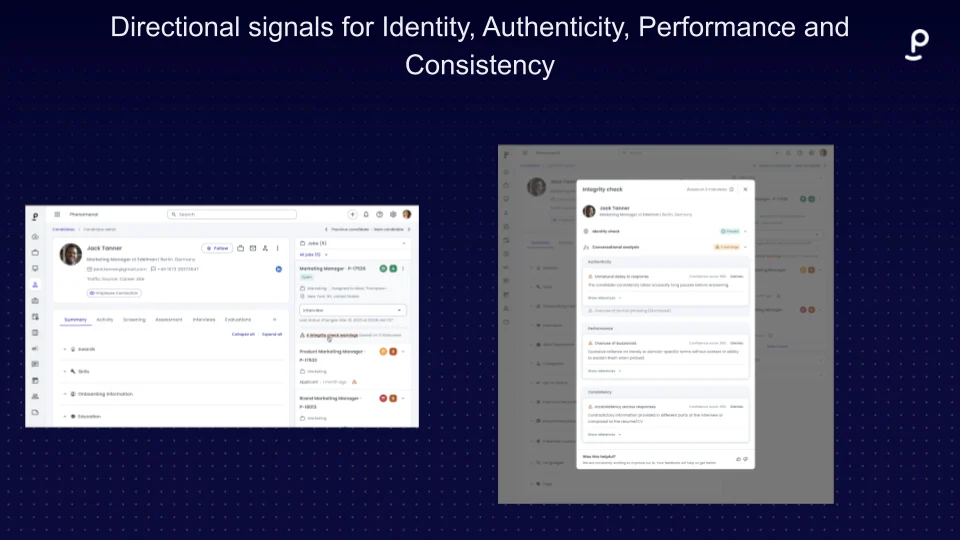
Here’s how the agent assists this stage:
Verifies identity consistency across interview stages
Detects response patterns that may indicate scripted or assisted answers
Flags behavioral inconsistencies for follow-up, not judgment
Provides time-stamped insights and audit-ready documentation
Hiring integrity improves, protecting both the employer brand and team performance.
Related: The AI Arms Race: Navigating Hiring Authenticity with Intelligent Fraud Detection
Onboarding and Development: Turning New Hires Into Engaged Contributors
Hiring marks the transition into a comparatively longer employee journey, where early experiences and ongoing guidance shape engagement and retention. What happens after day one determines whether employees build momentum or disengage before they settle in.
At this stage of the talent lifecycle, AI agents extend intelligence from hiring into onboarding and development workflows.
Onboarding Agents provide structure and continuity during the first weeks, helping employees complete requirements, access resources, and understand expectations with confidence.
Career Success and Employee Coach Agents support individual development by connecting skills, goals, and learning opportunities.
Manager Coach Agents support team management by guiding managers through effective 1:1 conversations, feedback, and development discussions, helping create consistency in how teams are led.
Together, these agents reinforce early hiring decisions and support steady employee growth over time.
Onboarding Agent
New hires are overwhelmed and unsupported during their first weeks, leading to early disengagement.
The Onboarding Agent guides employees through their first 90 days, managing tasks, answering questions, resolving exceptions, and escalating issues proactively. Key features include:
Proactive task and milestone reminders
24/7 question answering for new hire inquiries
Exception handling and escalation
Progress tracking and manager visibility
Integration with HRIS, IT, and facilities systems
New hire drop-off decreases as employees receive timely guidance and support from day one. Clear task ownership and proactive follow-ups help new hires become productive faster, shortening the time to productivity.
Related Read: One System, One Process: How UMMS Streamlined Healthcare Onboarding
Compliance Agent
In compliance-driven industries, hiring decisions carry regulatory risk. Employment requirements vary by role and region, and managing documentation manually increases the likelihood of delays, errors, and exposure that can affect both operations and reputation.
The Compliance Agent assists by embedding regulatory awareness directly into hiring and onboarding workflows. It understands role- and location-specific requirements, automatically initiates document collection, tracks completion, and flags exceptions before they become issues. The agent supports this work by:
Managing region- and role-specific compliance requirements
Automating document collection and verification
Tracking completion and escalation timelines
Generating audit-ready records for regulatory review
Organizations reduce compliance risk, avoid start-date delays, and operate with greater confidence in regulated environments, all while minimizing the administrative burden on HR teams.
Workforce Strategy and Governance: Planning With Confidence
As organizations plan for growth and market uncertainty, talent decisions increasingly shape whether strategy moves forward or stalls. Preparing the workforce for what comes next requires more than meeting immediate hiring needs. It calls for strategic workforce planning that aligns skills, capacity, and capability with long-term business objectives.
At this stage, AI agents assist organizations in planning while maintaining operational and regulatory confidence.
Workforce Planning Agents translate business direction into forward-looking talent needs, helping leaders anticipate future demand.
The Skills Governance Agent maintains accurate skill-to-role mappings across the organization, ensuring role definitions, career paths, and workforce plans are grounded in current and consistent skill frameworks.
Governance-focused agents support responsible execution at scale.
Succession Planning, Employee Retention, and Resource Optimization Agents add a longer-term view by improving visibility into readiness, risk, and workforce capacity over time.
Together, these agents help organizations operate with foresight rather than reacting after gaps appear. The following sections focus on two agents that illustrate how this stage comes together in practice:
Workforce Planning Agent
Organizations looking to future-proof their workforce often struggle to connect long-term business strategy with day-to-day talent decisions. Without a clear view of upcoming skill needs, workforce planning becomes reactive, leaving gaps unaddressed until they begin to impact execution.
The Workforce Planning Agent assists by linking strategic plans, market signals, and workforce data to forecast future talent demand. It identifies emerging skill gaps, evaluates internal readiness, and models different build-or-buy scenarios so leaders can make informed decisions well ahead of change.
The agent supports this work by:
Forecasting future role and skill demand
Modeling gaps between current and future workforce needs
Supporting scenario planning tied to business strategy
Aligning talent plans with financial and operational priorities
Ensuring organizations invest in talent ahead of change, not after disruption.
Organizations align human capital with long-term objectives, investing in skills and capacity early rather than responding to shortages after they surface.
Succession Planning Agent
As organizations navigate growth, transformation, and ongoing workforce shifts, succession planning has become an essential part of long-term workforce planning. Teams need clearer visibility into leadership readiness, role continuity, and internal capability development.
The Succession Planning Agent supports this need by continuously identifying potential successors for critical roles and mapping readiness across the organization. It brings together performance data, career progression, development signals, and retention indicators to maintain an up-to-date view of leadership pipelines. When coverage gaps emerge, the agent highlights them early and recommends development actions to strengthen bench strength. These capabilities allow teams to:
Identify potential successors on an ongoing basis
Map talent to critical roles and assess readiness
Surface gaps in succession coverage
Recommend targeted development and rotational opportunities
Track succession health as business needs evolve
Succession planning becomes an integrated workforce planning practice, improving leadership continuity, strengthening internal pipelines, and reducing reliance on external hiring for senior roles.
Unified Orchestration Engine: The Next Frontier of Agentic AI in HR
As organizations adopt more AI agents across the talent lifecycle, the real challenge shifts from implementing agents to coordinating them. Individual agents can improve speed and accuracy within a single stage, but without orchestration, work still breaks when conditions change. Talent processes rarely follow straight lines. They pause, branch, accelerate, and require judgment in ways rigid automation cannot accommodate.
The Unified Orchestration Engine addresses this gap by serving as an adaptive coordination layer that connects agents and workflows. Instead of executing fixed steps, it interprets context in real time, applies organizational policies, and determines what should happen next when exceptions arise. When a referral deviates from the expected path, a manager’s availability changes, or a compliance deadline becomes tighter, the engine evaluates options, routes work to the appropriate agent, and escalates decisions to humans when judgment is required.
This approach marks an important shift in agentic AI implementation. Orchestration moves HR systems beyond isolated automation toward outcome-driven execution, where agents collaborate, workflows adjust dynamically, and people remain firmly in control.
Looking Ahead: Building Stronger Talent Systems With Agentic AI
Agentic AI will continue to assist HR teams by expanding capacity rather than taking ownership of decisions. As agents coordinate, monitor, and administrate tasks, teams can focus more fully on strategic decision-making and long-term planning. Work shifts from constant task management toward more intentional oversight.
AI agents for HR are not an optional layer in advanced automation; they are what enable organizations to move beyond partial adoption. Levels 4 and 5 of AI and automation maturity depend on coordinated, autonomous systems that can manage complexity across the entire talent lifecycle. Without agents that observe, reason, and act across stages, organizations remain constrained by disconnected tools and manual handoffs, even when AI is present.
Organizations that benefit most from this model build strong foundations early. Shared intelligence through ontologies, governance embedded into workflows, and thoughtful change management all play a role in adoption. As agentic systems continue to mature, their value will be defined by how well they assist people, reinforce trust, and enable HR teams to operate with greater clarity and confidence across the talent lifecycle.
Agentic AI only delivers on its promise when the entire lifecycle moves together. See how 300+ TA leaders are closing the orchestration gap and where your organization stands.
Download the State of Hiring Automation: 2026 Benchmark Report

Devi is a content marketing writer passionate about crafting content that informs and engages. Outside of work, you'll find her watching films or listening to NFAK.


Get the latest talent experience insights delivered to your inbox.
Sign up to the Phenom email list for weekly updates!


