

Build, Enhance, Expand: How WEX Drove Recruiter Adoption at Scale with Phenom
Believe it or not, the hardest part of a technology rollout isn’t the implementation. It’s months after go-live, when the project team disbands, the training decks get filed away, and daily habits slowly pull everyone back to the system they traditionally knew.
WEX had already lived that story once. A global financial technology company managing billions of transactions annually across fleet and corporate payments, the team had a previous talent CRM tool that generated minimal usage and near-zero adoption across recruiters. When the team brought Phenom in, they made a deliberate decision that the technology alone would not be enough and that the model around it needed to be fundamentally different.
WEX’s Tim Cosby, Head of Global Talent Acquisition, and Christine Gratton, Manager of Global Talent Acquisition, shared the champion-led adoption framework they built, and the results that followed.
Watch the session here, or catch the key insights below!
Why Do Global TA Teams Struggle to Drive CRM Adoption?
When organizations bring in a new platform without a plan for how people will actually use it, adoption stalls at the pilot group. Recruiters continue working the way they always have, the tool sits underutilized, and the investment yields little. WEX had seen that firsthand with a previous CRM. Recruiters were not brought into the rollout in any meaningful way. There was no peer-level support structure, no shared understanding of the why, and no process for translating platform capabilities into workflows that fit how the team actually recruited.
When WEX went live with Phenom, the team knew the rollout could not follow the same path as the tool before it. "We really needed to think through, as we brought in this technology, the appropriate way to involve the team broadly and globally to ensure that we did have true adoption," Cosby said. The ATS handled the end-to-end process well but offered no flexibility for candidate engagement, talent pipeline development, or outreach. That gap was what Phenom was brought in to close, and closing it required a foundation built before any recruiter touched the platform.
What Does a Phenom Implementation Strategy Actually Look Like?
WEX structured their journey with Phenom across three phases, using a house-building analogy Cosby returned to throughout the session. Just as a house built on an uneven foundation will show its flaws in every wall and fitting, a technology rollout without deliberate groundwork produces the same compounding misalignment.
Build the Foundation: Phase one focused on introducing the tool early, forming the champion team, and defining a project plan built jointly with Phenom partners to create the conditions for sustainable adoption rather than chase immediate usage.
Enhance the Structure: Phase two shifted focus toward early wins, with recruiters beginning to engage with core CRM functionality, build pipelines, and explore automations. Visible progress at this stage matters because it creates the groundswell of interest that carries adoption forward into the broader team.
Expand and Embrace: Phase three was about adding capability onto a proven base. With the foundation in place and the team actively using the platform, WEX expanded its ecosystem to include Phenom Intelligent Sourcing, Phenom Interview Intelligence, Phenom High Volume Hiring, and Phenom Hiring Automations.
Each addition was far less disruptive than it would have been without the prior two phases in place. The structured approach from phases one and two made each addition far less disruptive than it would have been otherwise.
How Did WEX Select and Structure Its Champion Team?
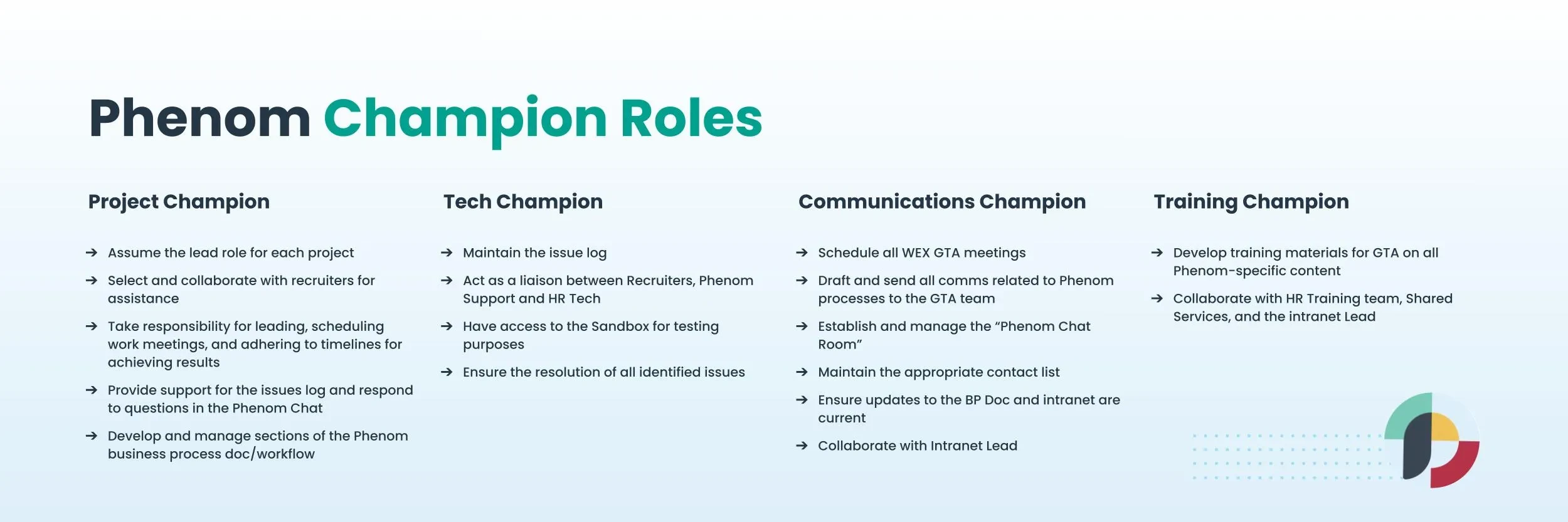
The first and most important decision was recognizing that adoption could not be managed by one person alone. From a team of 25 recruiters, four champions were selected based not on technical aptitude or seniority but on character. "I needed them to be coachable, curious, passionate, and positive. Those characteristics are what really helped to make us a really strong team and build that foundation," Gratton said.
The four were drawn deliberately from different parts of the business, one global, one covering technology, and one covering operations and sales, because a rollout shaped by only one team's workflow and perspective would not hold across a global organization.
Each champion held one of four defined roles. The Project Champion led individual projects, assembled recruiter support teams, managed meeting cadences, and maintained timelines. The Tech Champion owned the issue log and served as the liaison between recruiters, Phenom support, and HR tech, with sandbox access for testing. The Communications Champion managed WEX's dedicated Phenom Chat Room, drafted all process communications to the GTA team, and kept the business process documentation current. The Training Champion developed training materials and worked with HR training and shared services to make sure each monthly session was structured and genuinely engaging.
How Did aChampion Workflow Move Knowledge Across the Organization?
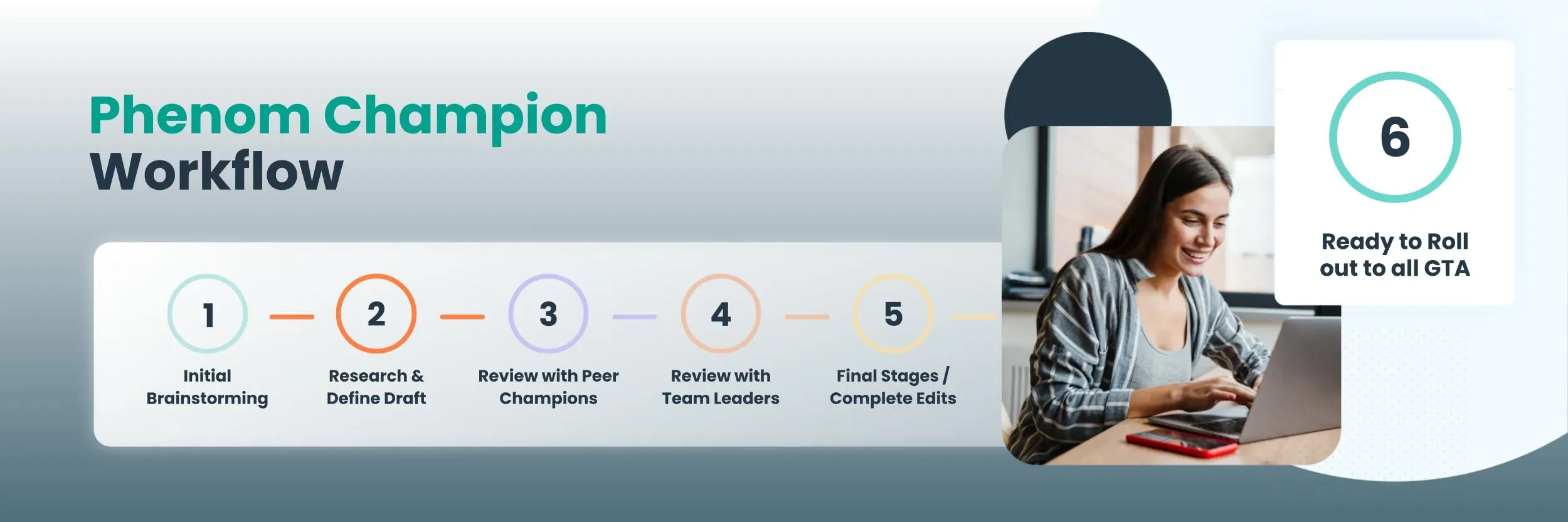
Each project followed a six-step workflow that moved knowledge from research to org-wide rollout without losing context at any stage:
Brainstorm using Phenom's resource library and training modules
Research and define a draft business process tailored to WEX
Review with peer champions to pressure-test assumptions
Present to leadership so managers understood what Phenom could do and could contribute to compliance and business considerations
Complete final edits based on leadership feedback
Roll out at the monthly team training, led by champions themselves
Before each session, champions would "wexify" everything, translating Phenom's generic guidance into workflows their colleagues could immediately apply. "The Phenom system works beautifully, but you have to make it your own," Cosby said.
Of all the tools introduced through this process, Phenom Automated Interview Scheduling drove the fastest and most visible buy-in. Every recruiter touches scheduling daily, making it a natural forcing function for adoption. "Interview scheduler is game-changing. When recruiters can actually understand and feel the difference in the amount of time it takes to do that, it's incredible," Cosby said. Reflecting on the rollout, WEX acknowledged that introducing it earlier would have been the right call.
What Results Did WEX Witness?
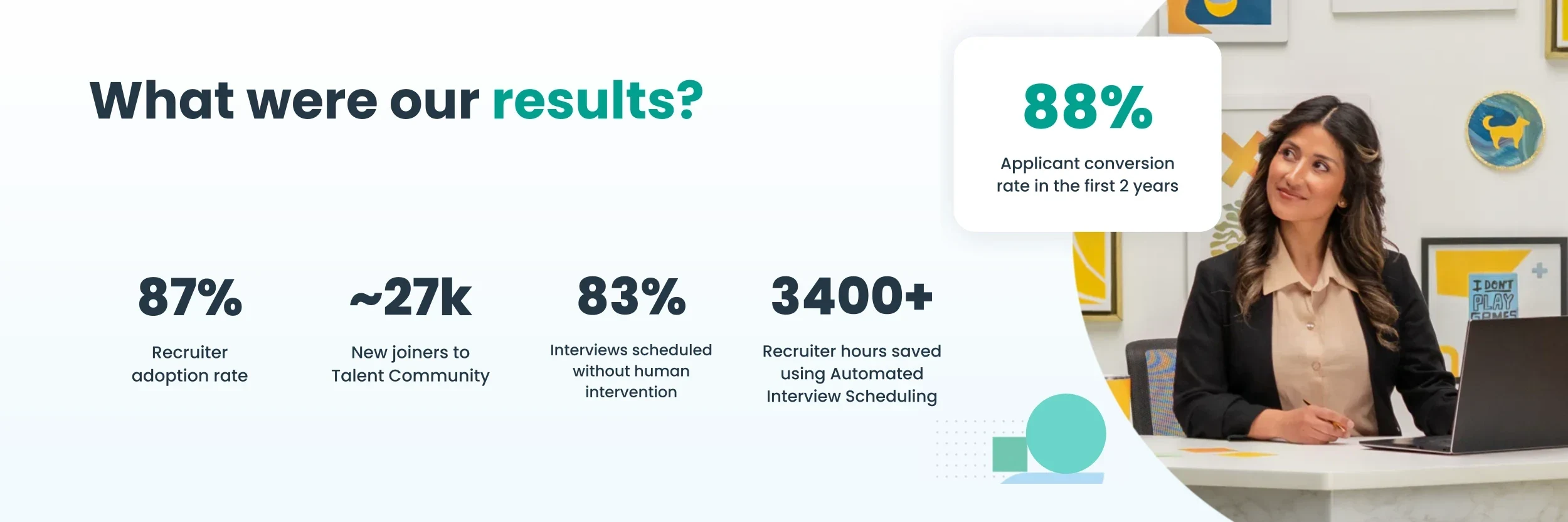
Two and a half years of consistent execution produced measurable change across every dimension the team cared about:
87%: Recruiter adoption rate across a global team
88%: Applicant conversion rate over the first two years
83%: Interviews scheduled without human intervention
3,400+: Recruiter hours saved through Phenom Automated Interview Scheduling
27K: Talent community joiners added since launch
Beyond the metrics, the shift in how recruiters experienced their day-to-day work was equally significant. Two of the original champions, Tanika and Vanessa, spoke to what the model produced at a personal level.
Tanika, who joined as a skeptic and became one of the platform's most vocal advocates, reflected, "Coming from a traditional ATS background, it took time to fully embrace the shift in workflow. However, I quickly realized I couldn't ignore the competitive advantages Phenom offered. From unprecedented candidate access to a more surgical, streamlined approach to sourcing, it has been a total game-changer for our team," she said.
Vanessa, whose work building automations shaped much of the platform's technical foundation at WEX, described what the champion experience meant beyond the system itself: "Being a Phenom Champion has made me realize how important it is to have a strong team around you. Every challenge we've faced, we've faced together, and we've celebrated both small and big milestones as a team. The most valuable part has been the diversity of perspectives we each bring and how well we complement one another," she said.
How Do You Start Building a Champion-Led Adoption Program?
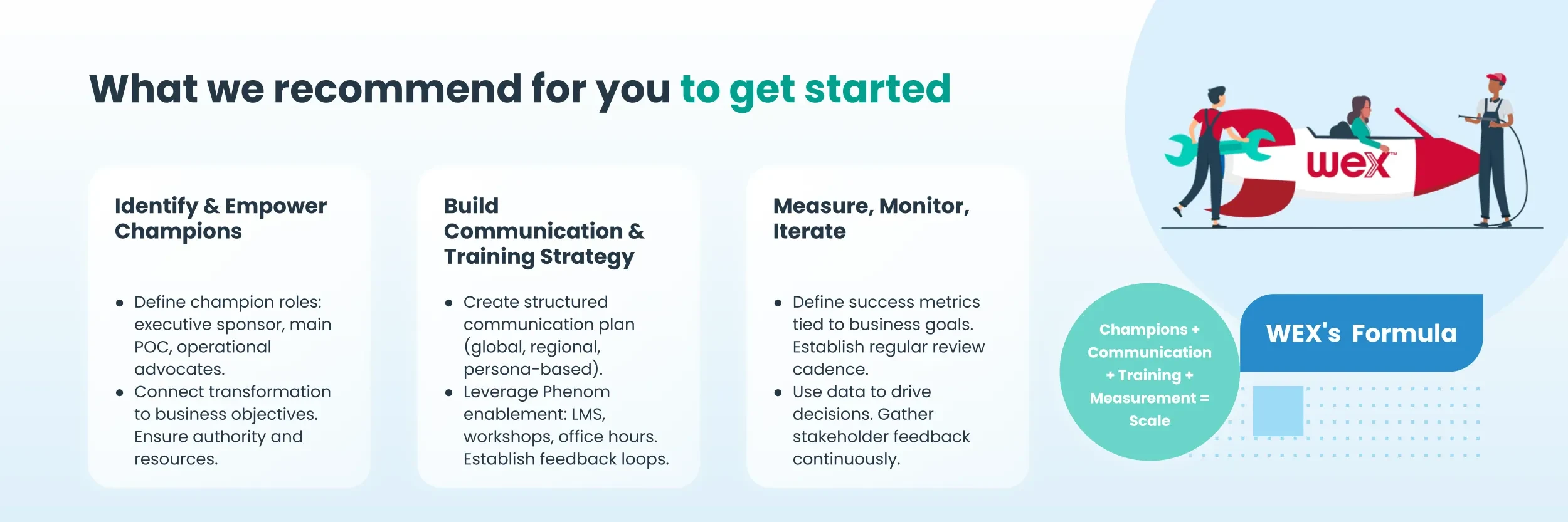
What WEX achieved points to a repeatable success model. Champions, communication, training, and measurement work together, with each element reinforcing the others. For teams looking to replicate the approach, the practices that mattered most were consistent throughout
Identify and empower champions: Selection criteria matter more than selection numbers. Curiosity, coachability, and enthusiasm for the platform will carry a rollout further than technical seniority. Pick people from different parts of the business, assign them defined roles with real responsibilities, and connect their work explicitly to organizational goals.
Build a structured communication strategy: A dedicated channel for platform questions, separate from general email, removes the friction that stops people from asking. Monthly training sessions run by champions rather than managers keep the content grounded in recruiter reality. Varying the format across quests, scenarios, and small group sessions reaches the different learning styles that a single all-hands presentation misses entirely.
Introduce interview scheduling early: If there is one lever to pull first to generate tangible buy-in, it is automated interview scheduling. The time savings are immediate, measurable, and felt by every recruiter regardless of role or region.
Measure and monitor as a coaching practice: Usage data surfaces where people are struggling before frustration becomes disengagement, and that information is most useful when it opens a conversation rather than triggers a mandate. "It wasn't big brother monitoring. It was really intended to guide them and continue to move them through the process," Gratton said.
Access Phenom's enablement resources to learn how organizations like WEX are driving platform adoption at scale

Gautami is a Product Marketing Manager at Phenom. She loves twisted thriller movies and is passionate about bringing creativity to life through crafting.


Get the latest talent experience insights delivered to your inbox.
Sign up to the Phenom email list for weekly updates!


