


High Volume, High Impact: What Hiring Automation Made Possible for United Airlines
Every flight United Airlines operates depends on a chain of people doing their jobs and doing them well: the ramp agents loading luggage, the customer service agents at the gate, the flight attendants running the cabin. Filling these roles at scale across seven major hubs, dozens of line stations, and 380 global destinations, means processing thousands of applications every week, without letting the sheer volume crush the team.
Two of United Airlines’ TA leaders, Jess Austin, Director of Talent Acquisition, and Kaitlyn Dayton, Talent Acquisition Manager, spoke at IAMPHENOM 2026 about how they’re identifying ineligible candidates before they start the full application — saving recruiters hundreds of hours a month and creating a candidate experience that respects people’s time even when the answer is no.
What High-Volume Hiring Challenges Did They Face?
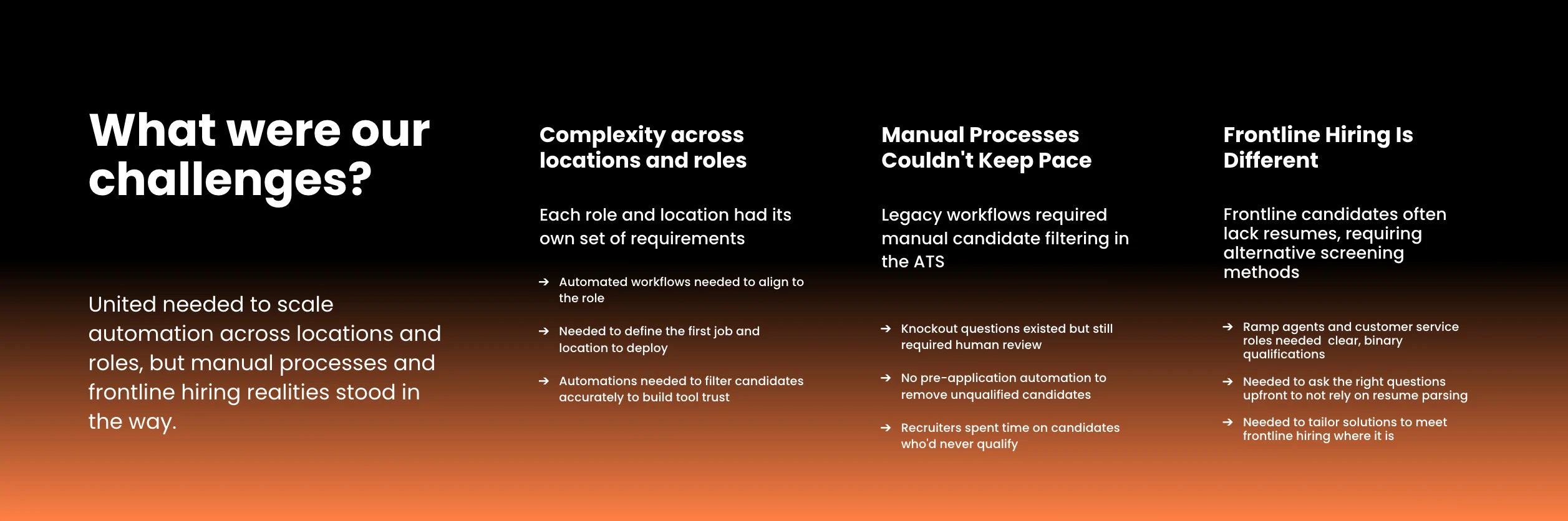
United, which has been a Phenom customer since 2022, has immense brand awareness, which is an asset that cuts both ways. The career site organically attracts large numbers of applicants, including serial applicants who return repeatedly across multiple roles, and many who don’t meet the basic qualifications for the positions they’re pursuing. With 113,000 employees and a mandate to grow quickly after the pandemic, the recruiting team needed to filter applicants without adding headcount.
The complexity of multi-location hiring added another dimension. With seven major hubs and a couple dozen line stations, each airport had its own hiring managers with their own preferences for how interviews should run. United wanted to ensure that a ramp agent applying in Indianapolis went through the same process as one applying in Chicago, no matter the location.
Frontline roles added a third wrinkle: many applicants for ramp, customer service, and ground operations positions didn’t have resumes. “A lot of these agents don’t come from a white collar position, so they might not have ever made a resume before,” Dayton said. “We had to find a way that the system could screen out these candidates without being able to parse a resume.”
Flight attendant hiring pushed everything to an extreme. When a single flight attendant posting could draw 15,000 applications and candidates were spending 30 to 45 minutes on a job assessment before learning they didn't meet the basic requirements, the case for a better process was clear.
Related: 1000+ Hires, 6 Weeks: Alight's High-Volume Automation Story
What Phenom Tools Did They Use To Improve Hiring?
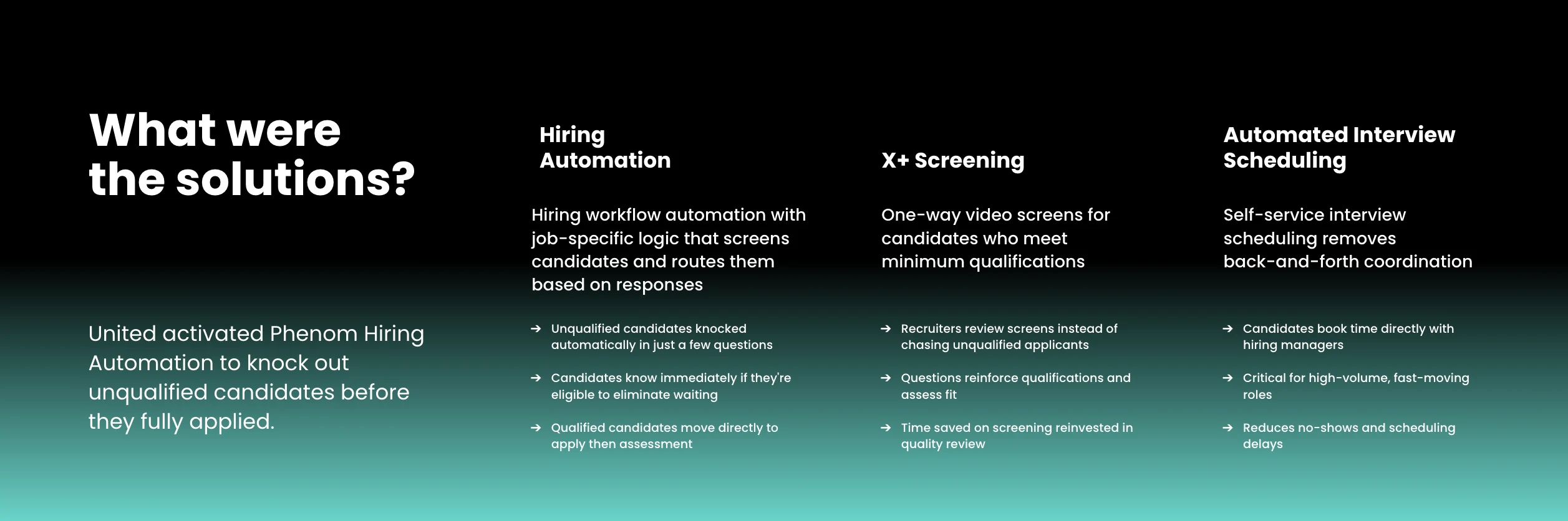
The team started with Phenom X+ Screening, Phenom’s one-way video interview feature, which let United get a real sense of candidates before moving them into the full application pipeline. It replaced an external vendor United had been using and consolidated the tool stack at the same time. For frontline roles, a job preview video was added to the beginning of the one-way interview, showing candidates exactly what the job looked like, including working all weather conditions and less desirable early-tenure shift schedules, so people could self-select out before investing more time.
Phenom Automated Interview Scheduling followed, removing the back-and-forth coordination that had been pulling recruiters away from meaningful candidate conversations. Candidates could book their own slot the same way they’d schedule any other appointment.
The biggest operational shift came from using Phenom Hiring Automation tailored for high-volume frontline hiring. Especially beneficial were pre-apply knockout questions asked before an applicant even started the full application. For a ramp agent role, the questions were direct: Are you 18? Do you have a driver’s license? These requirements were non-negotiable. And by asking them upfront, candidates who didn’t qualify were informed quickly and redirected to the Talent Community rather than completing a lengthy application and 45-minute assessment only to be declined at the end.
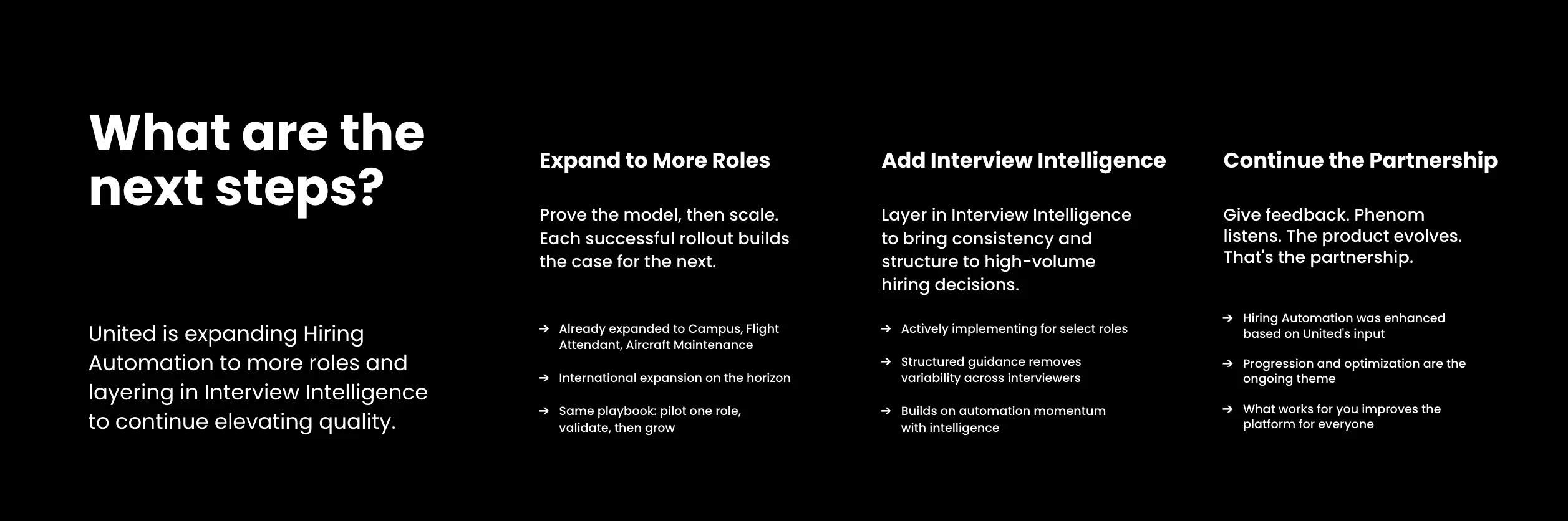
Rollout followed a champion model. Dayton piloted the automation at Chicago O’Hare first for a part-time ramp role. “Really small start,” said Austin. But “what we saw were some really good results,” she revealed. Dayton quickly became an advocate who helped expand the program to full-time ramp roles, then to all Chicago airport roles, and eventually to customer service, campus recruiting, and flight attendants.
What Did Knocking Out 20% of Unqualified Candidates Mean for Recruiters?
Once their high-volume hiring automations were running at scale, the benefits came swiftly.
“About 20% of the unqualified candidates are automatically knocked out before they even start their application. That saved our team, on average, about 200 hours per month,” Dayton said. That time didn’t just disappear. Recruiters redirected it toward actual candidate conversations, sourcing harder-to-fill roles, and the kind of work that makes recruiting a meaningful function rather than an administrative one.
The candidate experience impact proved equally significant. Applicants who learned early that a role wasn't the right fit avoided spending time on a full application and a lengthy assessment.
"One of the big call-outs is the appreciation we're getting from applicants. A lot of our frontline roles have assessments that could take 30 to 45 minutes. We're telling them upfront, ‘Hey, this isn't the right job for you. Let's focus your time elsewhere.’ They've really appreciated that. They're not wasting their time," Dayton said.
Related: How Phenom Hiring Automation Can Save You Hours Each Week
How Will United Continue To Improve Its Hiring Process?
Moving forward, the team is expanding hiring automations to additional roles beyond ramp, customer service, campus, and flight attendants. Phenom Interview Intelligence is also now live for corporate roles: recruiter-led interviews are being recorded, with careful coordination between the TA team, legal, and compliance to make sure every deployment meets the standards required in a highly regulated industry.
The broader philosophy at United is to stay close to the process and keep iterating.
“Understand your current process. Sit with your recruiters. Really dig into what they’re doing,” Austin said. “You can see the pain points when you put it down on paper.”
That same approach will guide what comes next.
Speed up volume hires. See Phenom High-Volume Hiring in Action


Get the latest talent experience insights delivered to your inbox.
Sign up to the Phenom email list for weekly updates!


