

The RBC Playbook for Turning Recruitment Events Into a Measurable Hiring Channel
Recruitment events consume significant budget and recruiter time, yet most Talent Acquisition teams walk away from them unable to answer the one question that matters most: Did we hire anyone?
Even well-attended events fail to build pipelines that produce hires because they lack the infrastructure to do so. For TA leaders trying to justify investment in events and scale what works, they need more than activity metrics.
On a recent episode of Talent Experience Live, Gemma May, Operations Analyst, and Tonya Carroll, Director of Strategic Partnerships & Programs, Royal Bank of Canada, shared how it moved from a fragmented, manual events process to a structured event strategy built around data, intentionality, and outcomes that matter to the business.
Why Manual Event Tracking Fails to Capture What Actually Matters
Before RBC formalized its approach, the events process carried what the team described as a "vintage vibe." Manual trackers, handwritten notes, and decentralized efforts made it nearly impossible to maintain a clear line of sight on who attended, who engaged, and what happened to those candidates after the event ended.
Not having that data meant no results. Recruiters could tell leadership that an event had a strong turnout and good energy, but they couldn’t deliver a plan to achieve real hiring outcomes. "Without data to report back on, the true story of what recruiters invested in building these events simply could not be told," Gemma said.
Phenom Recruitment Events changed that by giving recruiters a connected system that could track candidates from first touch through to hire.
How Designing Events Around Candidate Intent Produced Better Pipeline Outcomes
RBC's transformation began when the team reoriented around asking whether the right candidates were making it into the pipeline.
"Moving with intention meant starting with the candidate profile, getting the right recruiters in the room, and building in a way to track outcomes from the very beginning," Tonya said. That shift from event logistics to talent strategy was what separated an events program that filled seats from one that filled roles.
At a recent career expo, the team was reviewing resume books and identifying target candidates before logistics were finalized. Those candidates were added to Phenom and engaged through targeted campaigns weeks ahead of the event, building familiarity with the RBC brand before anyone walked through the door, so that recruiters arrived already knowing who they most wanted to connect with.
Related: How to Make Recruitment Events Work for Your Talent Acquisition Strategy
How RBC Personalized Events at Scale Without Building Separate Workflows
Running events that served meaningfully different candidate populations without building entirely separate workflows was critical. Early talent and experienced professionals come to events with different expectations and different signals of genuine interest, and a uniform approach to engagement produced generic interactions that failed both groups.
Personalization was built into the pre-event and post-event layers of the event.
"Using spotlights and lists to filter audiences and speak to specific candidate groups about relevant opportunities became one of the most valuable capabilities in the workflow," Gemma said. That filtering approach allowed the team to maintain a consistent brand experience across every event while still building personalized communication with the candidates.
Why Post-Event Follow-Up Is Where Pipeline Momentum Is Won or Lost
The moment an event ended was often where candidate momentum stalled. Relying on handwritten notes and individual recruiter follow-through did not scale across a team running multiple events at different stages simultaneously.
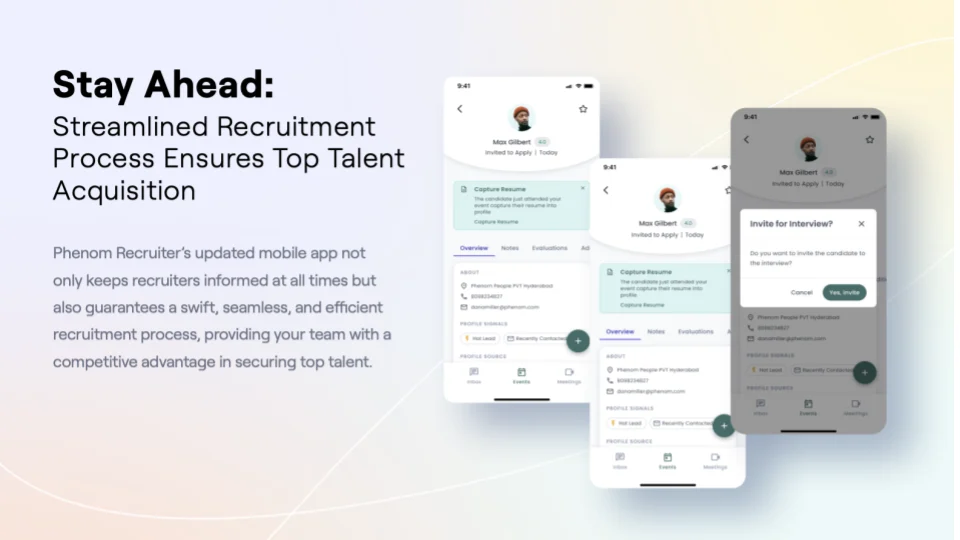
RBC rebuilt the post-event process around the same intentionality that drove the pre-event work. Recruiters used the Phenom app during events to take notes and flag top candidates in real time, so the data was actionable as soon as the event concluded. "The event was never the endpoint,” Tonya said. “Once it wrapped, the team used Phenom to segment attendees, send targeted follow-up to top candidates, and open a separate communication stream for those they wanted to fast-track to interviews."
Metrics That Measure Events ROI
That continuity between event and pipeline allowed RBC to credit events for the hires they made. And that was necessary because attendance was never the right measure for an event's program designed to produce hires. Tonya shared:
"Success came down to two things: hires, and whether those people stayed,"
Everything else served as data that could be used to achieve RBC’s hiring goals. "Having visibility into how many candidates entered the funnel, how many applied, and who made it to interview gave a clear picture of pipeline quality and a concrete way to measure return on investment," Tonya said.
That ability to walk into a leadership conversation with data rather than anecdotes allowed the events program to justify itself and grow over time.
Related Read: From Paper Sign-Ins to Tracked Leads: Baylor Scott & White Health’s Recruitment Events ROI
How to Build an Events Program That Connects Every Touchpoint to a Hire
The advice the team shared for TA leaders looking to elevate their events approach was to build the foundation of a house before decorating it.
"The temptation is always to jump straight to the wallpaper and furniture, but the work that actually holds everything together starts with building the right foundation," Tonya said. In practice, that foundation looked like this:
Identify target candidates before logistics: Reviewing candidate profiles before planning the experience ensured that every logistical decision was shaped by who the team needed in the room.
Define the roles and business areas up front: Aligning with hiring managers early on open roles and candidate criteria gave recruiters clear direction, not just general awareness.
Build pre-event outreach into the timeline: adding target candidates to Phenom weeks ahead and running familiarity campaigns meant the relationship had already started by the time they arrived.
Get business leaders into the app before the event: unlike recruiters, leaders often used Phenom Events for the first time onsite. Training them in advance kept their notes and evaluations in the pipeline, not in their heads.
Set up post-event segments in advance: defining follow-up streams before the event ended got top candidates fast, personalized outreach while the interaction was fresh, instead of after the team regrouped.
For TA leaders who have been measuring event success by attendance and survey scores, the more useful question is whether they can connect their last event to a hire. If the answer is no, the problem is rarely the events themselves. It is the process built around them.
Ready to move from activity to outcomes on events? Explore how Phenom Events can help your team build a strategy that connects every touchpoint to a hire.

Devi is a content marketing writer passionate about crafting content that informs and engages. Outside of work, you'll find her watching films or listening to NFAK.


Get the latest talent experience insights delivered to your inbox.
Sign up to the Phenom email list for weekly updates!


