

Intake Agent Memory: How Every Intake Makes the Next One Smarter
Every new hire begins with a conversation, or at least that's how it’s always been. In a traditional intake, a recruiter and hiring manager align on the role's needs, essential qualifications, and what success looks like in the seat. That shared understanding becomes the reference point for the rest of the hiring process. It's also one of the most promising places for agents to assist in recruiting.
Recruiters typically schedule the meeting, take notes, and spend hours shaping them into a job description. Much of that insight is worth reusing, too, since similar roles open again and the decisions made in one intake can guide the next.
Phenom's Intake Agent was built to capture that opportunity, guiding the hiring manager through a structured conversation and moving a requisition from unclear requirements to sourcing-ready specifications in hours instead of days. At AI Day, Phenom's engineering team went a layer deeper and showed what makes the agent improve over time.
In this Article:
Why Every Intake Currently Starts From Scratch
Intake is where hiring requirements get clarified, organizational knowledge gets captured, and sourcing strategy gets defined. Yet in most organizations, very little of what happens in one intake carries into the next.
Hiring managers end up restating the same preferences requisition after requisition. Recruiters make the same corrections to generated or templated content, removing a question that never works or adjusting criteria that are always too narrow. Historical context about what worked before isn't easy to find, and when a hiring manager or recruiter changes roles, their accumulated knowledge leaves with them.
The cost goes beyond repeated effort. Without that history, a job description can emphasize the wrong requirement, sourcing can target the wrong backgrounds, and candidates the hiring manager would never accept keep reaching the shortlist. An intake that remembers what came before can avoid all three.
The Intake Agent’s Role in Hiring
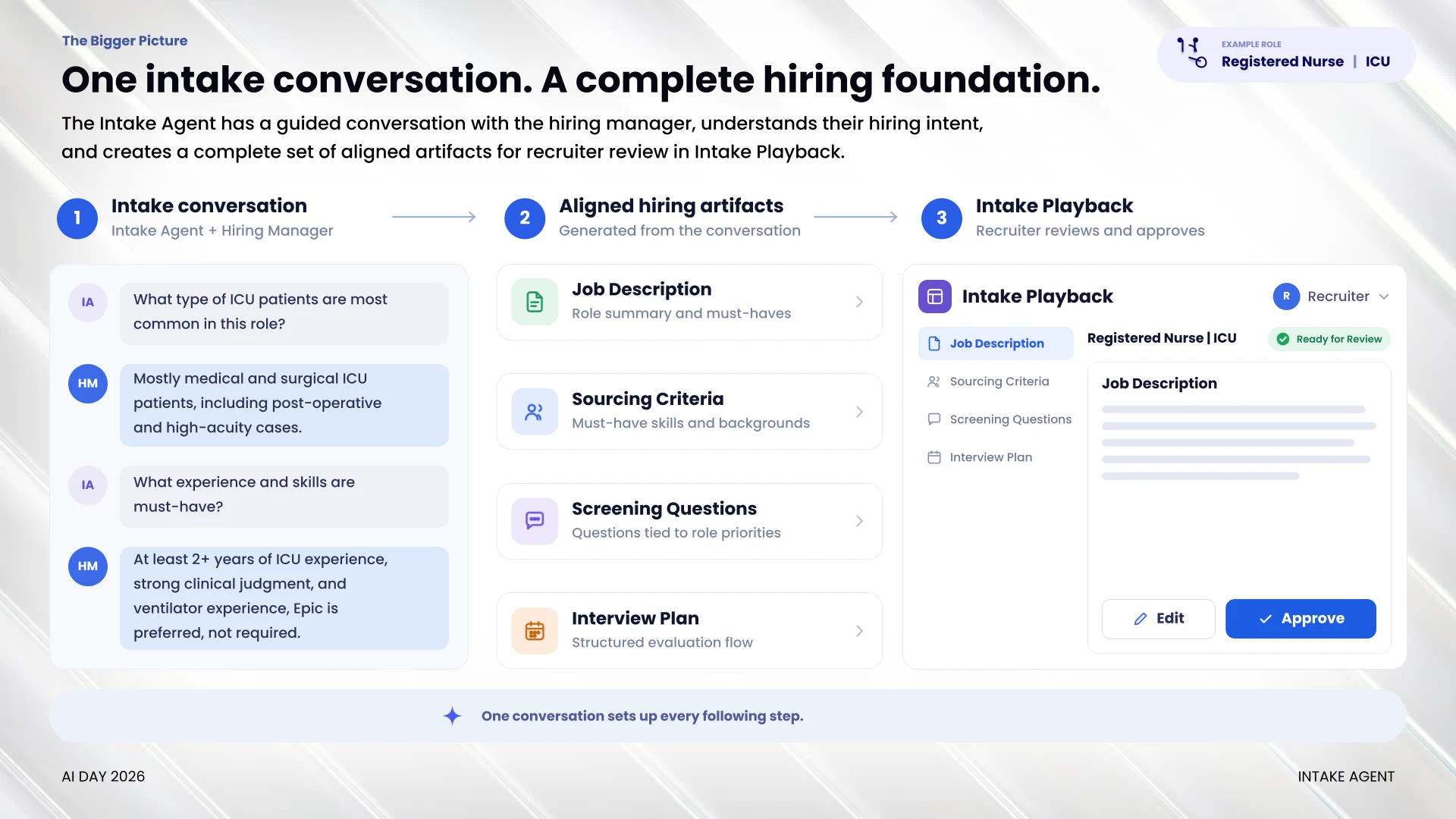
The Intake Agent is an AI-powered assistant that runs the intake conversation on the recruiter’s behalf and generates artifacts to be used by the entire hiring team. When a new requisition opens, the recruiter triggers the agent, and the hiring manager answers its questions asynchronously through the Phenom Hiring Manager experience or Microsoft Teams, whenever their schedule allows.
The agent adapts as the conversation unfolds, skipping irrelevant questions and probing unclear answers, then generates a job description, sourcing criteria, screening questions, and an interview plan. The recruiter reviews and approves everything in Intake Playback before it goes live, moving the requisition from unclear requirements to sourcing-ready in hours. What makes the agent sharper with each requisition is the stored context behind each conversation.
Related Read: Types of AI Agents Explained: The Complete Guide for HR Innovation (With Real-World Examples)
Five Sources of Context the Agent Gathers Before the First Question
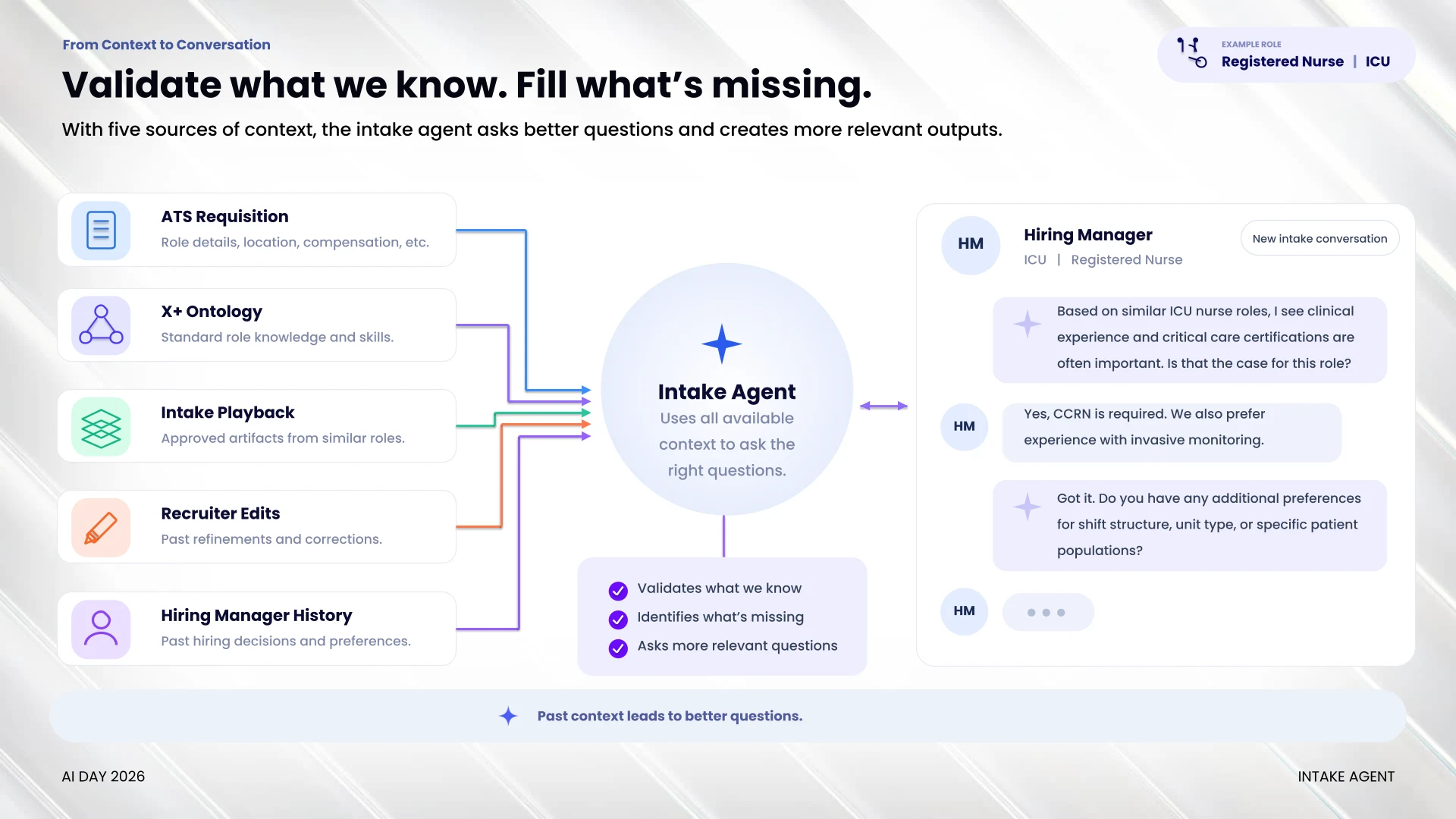
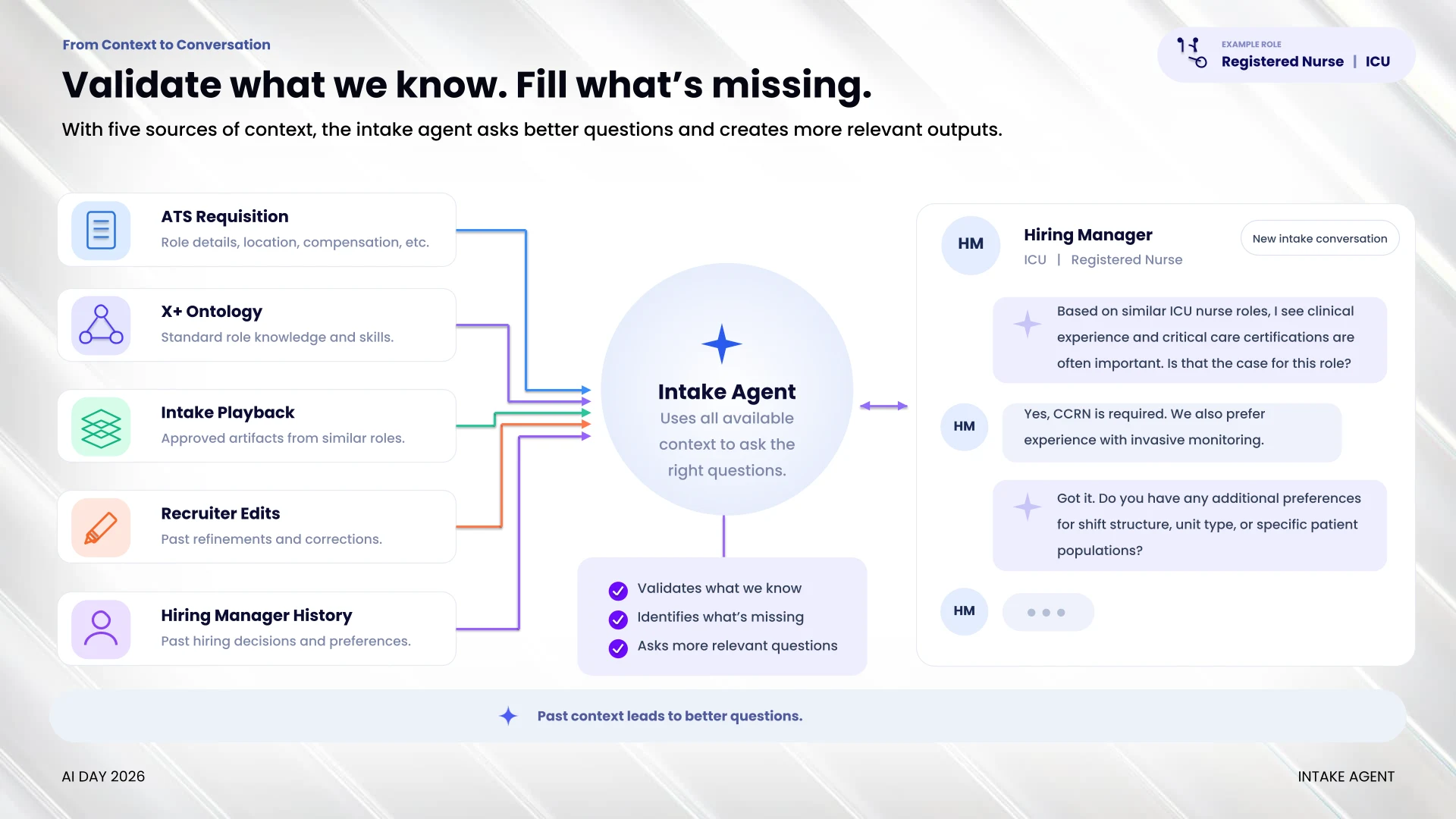
Consider a requisition for a Registered Nurse in an ICU. Before the hiring manager answers a single question, the Intake Agent has already pulled together five sources of context.
ATS requisition: Supplies the job metadata already on file, such as title, department, location, compensation band, and hiring manager, so the agent never asks for information it already has.
Phenom X+ Ontology: Explains what the role means beyond its title. It resolves the requisition into a role family, specialty, and seniority, maps the capabilities the role involves (high-acuity patient care, clinical judgment, monitoring and escalation), and links related skills and adjacent roles. It also knows that Epic, for instance, is an electronic health record system, a technology skill, rather than a clinical capability.
Approved artifacts from Intake Playback: Provide job descriptions, sourcing criteria, screening questions, rubrics, and interview plans already approved for comparable roles.
Recruiter edits: Reveal patterns in how recruiters have refined past outputs, such as questions they routinely remove or backgrounds they routinely add.
Hiring manager history: Shows what this manager has valued before, including recurring must-haves, nice-to-haves, preferred interview formats, and the profiles of candidates they’ve hired in the past. Past hires are an especially strong signal, because they reveal which backgrounds, skills, and experience levels the manager accepts in practice, not just what they ask for in the intake.
With that context in hand, the conversation validates what's already known and focuses on what's missing. Rather than opening with generic questions, the agent might say, "Based on similar ICU nurse roles, clinical experience and critical care certifications are often important. The hiring manager confirms or corrects the assumption, and the agent then moves on to details that only the hiring manager can supply, such as preferred shift structure or specific patients.
How Hiring History Becomes Usable Memory
Passing every past intake transcript and artifact to the agent on every requisition would be slow, costly, and noisy. Instead, Phenom keeps the original records intact as the source of truth and derives a compact layer of memory from them. Each piece of memory stays linked to the conversations and edits it came from, so anyone can trace a recommendation back to its evidence.
Four mechanisms turn raw history into that memory.
Roll-ups: Build recurring preferences. Background processes break each intake into discrete facts, then combine those facts across many intakes. If a hiring manager has called high-acuity ICU experience essential and Epic experience preferred across five similar requisitions, the agent learns that pattern and opens the next intake with it, asking the manager to confirm rather than starting fresh.
Graph deduplication: Keeps memory clean. People describe the same thing in different ways. Mentions of "Epic," "Epic EHR," and "Epic charting system" across past intakes all resolve to one concept, so the evidence adds up instead of splitting into separate, weaker signals. The original wording is preserved for reference.
Temporal versioning: Keeps decisions current. When a hiring manager says future ICU hires should go through two interview rounds instead of three, the agent uses the new decision going forward while keeping the earlier version on record.
Behavioral aggregation: Turns repeated edits into policy. If recruiters keep deleting the same generic question about charting software or keep widening the same salary band for similar roles, the system clusters those edits, spots the pattern, and builds it into future outputs. The goal is simple. A recruiter shouldn't have to make the same correction twice.
How One Hiring Decision Carries Across Every Artifact
The intake captures the hiring manager's intent. Memory adds what past intakes have shown. Together, they produce a set of shared hiring decisions that every downstream artifact follows.
Consider a hiring manager who says, "I don't want someone who just knows Epic. I want someone who has managed high-acuity patients in an ICU setting." The agent records high-acuity ICU patient care as a must-have and Epic experience as good to have, and that single decision shapes all four outputs.
Job description: The agent retrieves comparable approved roles, uses the ontology to understand the role's structure, and checks what's different about this opening. The result lists ICU patient care as a required qualification and Epic as preferred, matching what the manager said.
Sourcing criteria: The ontology looks beyond the exact title to backgrounds that show the same required capability, such as critical care nurses or float-pool RNs with documented ICU experience. Historical hiring data, including the profiles of people hired into comparable roles, highlights which attributes have mattered most, so the wider pool still meets the manager’s bar.
Screening questions: Instead of a generic question like "Do you have experience using Epic?", the agent filters approved questions against the hiring intent and selects one that tests what matters, such as how a candidate would prioritize care and escalate when an ICU patient's condition deteriorates. Each question comes with a calibrated rubric describing strong, mixed, and weak answers, so evaluation stays consistent across interviewers.
Interview plan: When the manager says clinical judgment needs explicit evaluation, the plan dedicates a clinical-scenario round to it within the current two-round structure, with the panel and sequence drawn from comparable approved plans.
The agent doesn't produce four independent documents. It carries one set of decisions consistently through the entire hiring process.
How Do Recruiters Stay in Control
Every artifact the agent generates lands in Intake Playback, where the recruiter reviews the job description, sourcing criteria, screening questions, and interview plan together. Recruiters can approve an artifact as it stands, remove a sourcing criterion, replace a screening question, or change the interview loop. Once approved, the artifacts go live and hiring flows can begin.
That review step does double duty. Every edit, addition, or deletion is captured as an explicit signal and fed back into memory, so the corrections a recruiter makes today shape what the agent produces tomorrow. Recruiters bring judgment the system can't replace, and the system makes sure that judgment isn't lost after a single requisition.
Related Read: The Power of an AI Intake Agent: SSM Health’s Journey to Hiring Excellence
Why Intake 100 Looks Different From Intake 1
Between the first intake and the hundredth, the underlying AI model doesn't necessarily change. What changes is the context around it. By intake 100, the agent can draw on more approved artifacts, more validated decisions, clearer recruiter and manager preferences, a record of how those preferences shifted over time, and evidence about what works. The system improves because its memory improves.
That shift turns intake from a one-time information capture into institutional memory. Hiring manager transitions no longer erase what worked, similar roles benefit from every previous requisition, and recruiters spend less time correcting outputs and more time with candidates. As AI agents take on more of the hiring process, the organizations that capture and reuse their own hiring judgment will be the ones whose agents get noticeably better with every requisition.
One conversation. Smarter with every intake. Book a demo to see how the Intake Agent turns your hiring history into better job descriptions

Devi is a content marketing writer passionate about crafting content that informs and engages. Outside of work, you'll find her watching films or listening to NFAK.


Get the latest applied AI insights delivered to your inbox.
Sign up to stay up-to-date on the latest original content from Phenom, including new podcast episodes, events, and more.


