

AI Agents, Hypercells, and the Future of Finance
A contact center representative and a personal banker sound like they belong to entirely different job families, and in most org charts they do. But the recruitment plan for each position can vary dramatically depending on the organization's context. Finding the right contact center rep in Phoenix might best involve an internal move, someone the organization already employs and simply hasn't equipped for a bigger role. A personal banker in a newly opened Charlotte branch, however, will require external sourcing in a market where the bank has no history and no existing pipeline.
Phenom's hypercell approach is designed to tell these two situations apart and execute a specialized plan that fills the role. Raghu Dahagam and Mike DeMarco, both of Phenom's product marketing team, recently walked through how this shows up in banking and financial services hiring, and what it looks like applied to two real scenarios.
Related: Navigating the Workforce Gap: AI Agents for Consumer Finance's Hiring Challenges
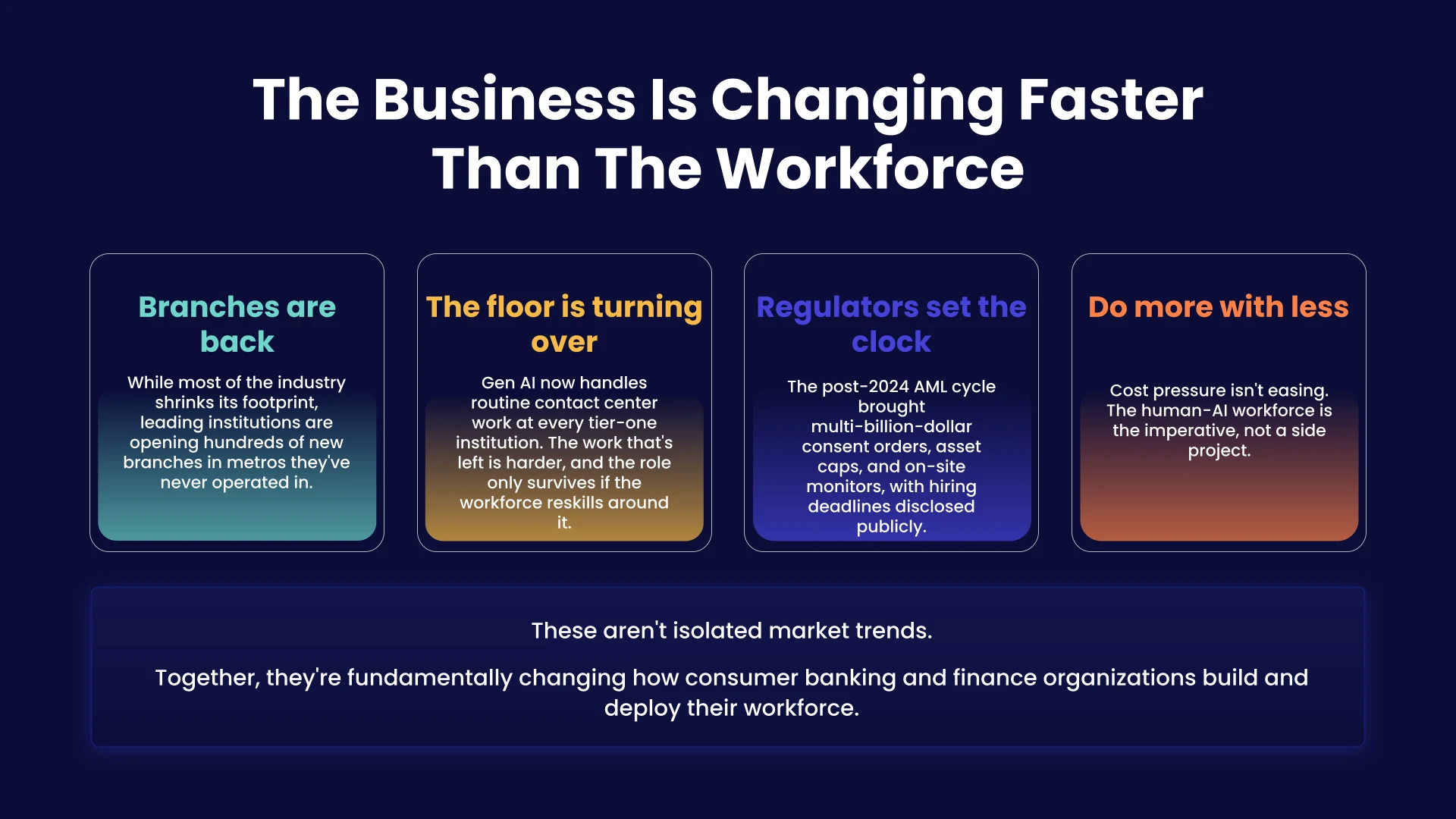
Why General-Purpose AI Models Fall Short in Banking
It's a reasonable question for any financial institution to ask why a purpose-specific system matters when tools like ChatGPT exist. But the simple answer is that those tools weren’t designed for the problems HR professionals in the finance and banking industry face. "ChatGPT isn't going to build you an intake agent that connects your hiring managers and recruiters,” DeMarco said. It isn't going to build you a sourcing agent that already understands your organization's data, its industry, its jobs, and its skills across every geography.”
Regulatory compliance raises the stakes further. Financial services hiring touches anti money laundering requirements, know-your-customer standards, and forensic reporting obligations that most general-purpose tools have no visibility into at all.
"It's not just about making sure that the employees have the right skills, but it's also protecting the organization, especially in regulatory environments where things like the Bank Secrecy Act and principles like knowing your customer are so important for the reputation of the financial institution,” DeMarco added.
A model that doesn't understand those requirements can recommend a candidate who looks strong on paper and still exposes the organization to real regulatory risk.
Related Read. Types of AI Agents Explained, The Complete Guide for HR Innovation
Two Use Cases Where the Hypercell Changes the Outcome
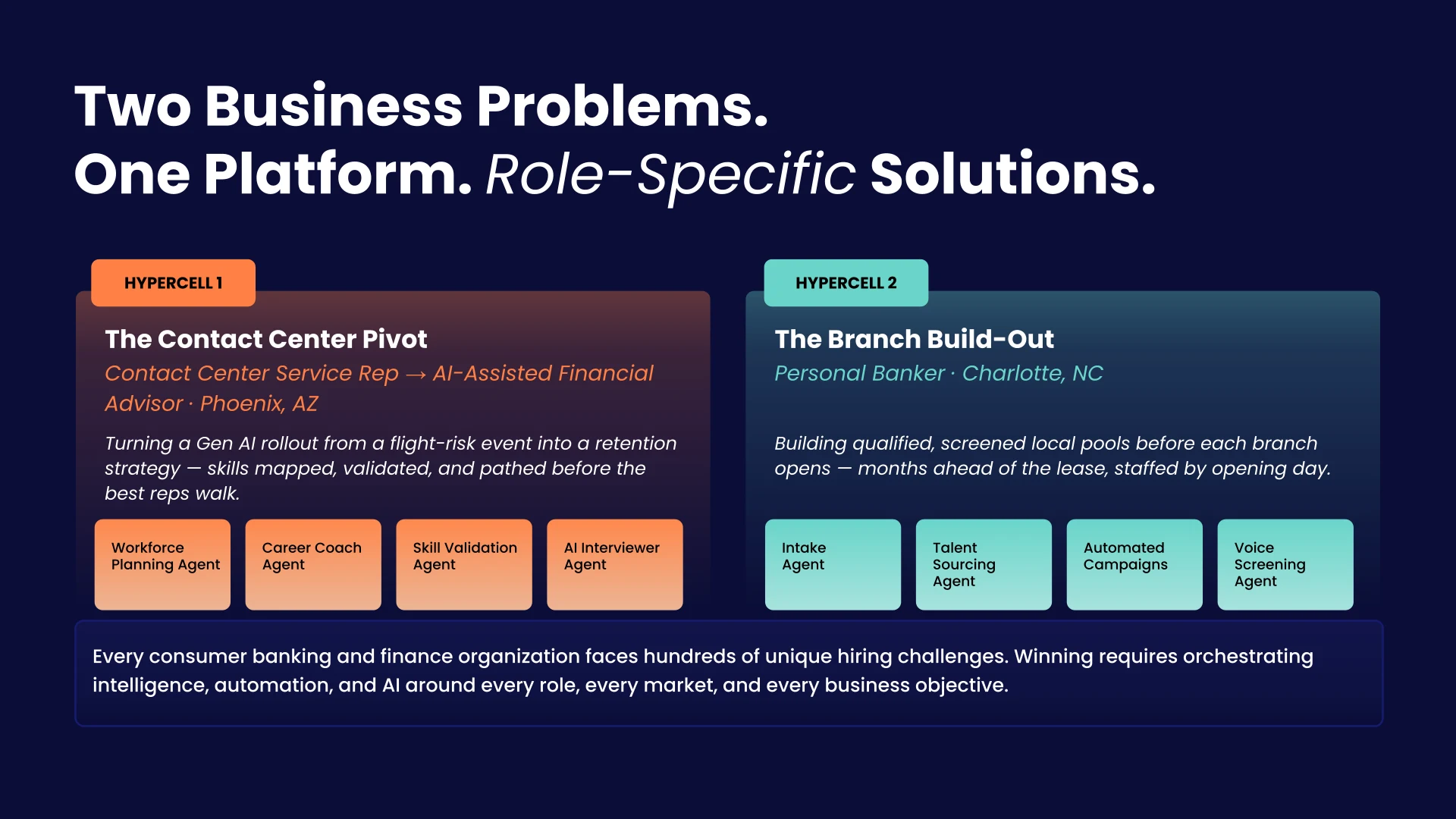
Phenom’s hypercell approach is about using AI agentic technology to determine the most effective way to fill a role and adapting to ensure it gets done. The two scenarios below show what that looks like in practice: one focuses on developing the workforce a bank already has, while the other involves building a workforce from the ground up in a market the bank has never operated in before.
Together, they help illustrate how hypercell insights play out in real teams, from identifying where existing employees can grow to deciding which skills and roles to hire for.
1. Turning Contact Center Reps Into AI-Assisted Advisers
The employees most capable of becoming AI-assisted advisers are often already on staff; they just need to be more visible to a hiring process that never looks past open requisitions.
"I was listening to one of the calls, and this came up: they didn't know what skills they already had for their employees,” Dahagam said. “The people who could really become your AI-assisted advisers are probably already with you, or maybe in a different department. But you couldn't see it because the resume you had was three years old. Nobody had opened those files in ages. You cannot build a reskilling plan based on data you can't see."
Four agents work together to fix this:
Workforce Planning Agent: Scans the team against current goals and flags who's ready to move now, who's buildable in six to twelve months, who's a hidden gem conventional matching would miss, and who looks strong on paper but carries transition risk
Skills Validation Agent: Sets an assessment rubric weighted toward whatever mix of technical, behavioral, and situational criteria the role needs, and then follows up after training to confirm the gap has closed
Career Coaching Agent: Enrolls the flagged employee in a development plan built around their specific skills gaps
AI Interviewer Agent: Runs a structured, scored interview, giving the manager a defensible basis for the promotion instead of a gut call
What used to take months of manual coordination collapses into a process a manager can launch in minutes. The agents produce the evidence. The manager makes the call.
“It's removing all the manual processes that would keep people from keeping their best talent,” DeMarco said.
Related Resource: Financial Services HR Product Evaluation Checklist
2. Staffing a Brand New Branch Before It Opens
A newly announced branch in a market the bank has never operated in needs to hire an entire team from scratch. There's no existing local pipeline, no history to draw candidates from, and possibly no employer brand recognition. Every part of the funnel has to be assembled, and every day that funnel sits empty is a day closer to opening without enough staff on the floor.
“How many hours does manual sourcing and screening take up?” Dahagam said. “About fifty days to fill, if not more, are lost, and you're losing your top candidates with every delay you make."
Four agents get you from a blank job description to a scored, ready-to-decide candidate.
Intake Agent: Sends structured questions straight to the hiring manager's inbox instead of waiting on a scheduling back-and-forth, then drafts a role-specific job description automatically from the answers
Talent Sourcing Agent: Searches using natural language instead of Boolean search strings
Automated Campaigns: Handle personalized, multi-touch outreach to the shortlist on a set cadence
Voice Screening Agent: Conducts the actual phone screen, gathering consent, asking role-specific questions, and returning a scored evaluation the recruiter can act on the same day
"We already found more than a thousand personal bankers with a year or more of experience in the area we were looking at, and we did it without a single complex search query," Dahagam said during the demo.
A process that traditionally stretched toward fifty days to fill compresses down to something closer to twelve. The agents produce the evidence. The manager makes the call.
Related: From Cold Leads to Hot Hires: TD SYNNEX's Proactive Recruiting Strategy
Why Connected Data Matters More Than Any Single Agent
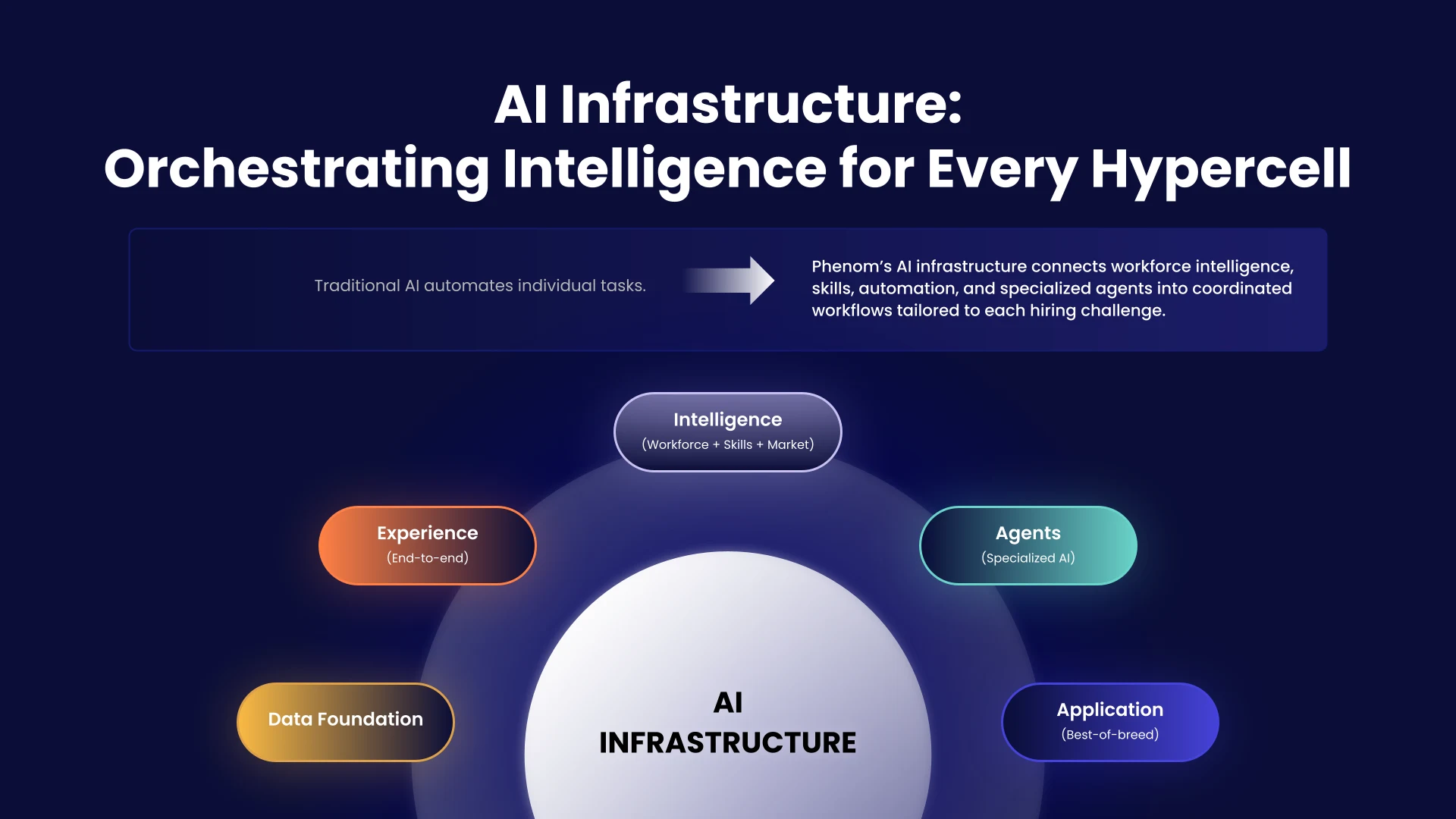
A Workforce Planning Agent needs accurate skills data across the organization to know who's actually redeployable.
A Talent Sourcing Agent needs to understand the industry, the role, and the geography it's searching in before it can move quickly.
That shared understanding comes from a single data foundation drawing on structured inputs, like company plans and hiring goals, combined with unstructured signals like one-on-ones and team meetings that rarely make it into a spreadsheet.
“We layer LLM reasoning on top of that, and that's what pushes the ontology,” DeMarco said.
Other platforms are trained just on general web text. But the Phenom ontology is trained specifically on jobs, skills, and industries, which is what lets an agent reason for a personal banker role in Charlotte differently than the same title in Nashville.
This is also why upskilling tends to beat replacement on cost. Raising a new requisition, sourcing a candidate, and screening them from scratch carries real expense that redeploying an existing employee simply avoids.
Connected data is what makes that comparison visible in the first place, since neither option looks cheaper or faster without a system that can see both paths clearly.
A bank comparing the two without that visibility is essentially guessing, and guessing gets more expensive the longer a seat stays open.
"It's way cheaper and more efficient to upskill somebody in your organization than to raise a new requisition, source a candidate, and find the person,” DeMarco said.
Related Read: Deploying HR AI Agents with Confidence: Trust, Oversight, and Workflow Integration
Where AI Hiring Breaks Down in Financial Services
A handful of patterns tend to slow this down across banks and financial institutions. Here are those problems and how Phenom handles them:
Treating a general-purpose AI solution as sufficient for a regulated hiring process with real compliance stakes.
Phenom closes that gap with a data foundation built specifically for HR: structured inputs like company plans and hiring goals, combined with unstructured signals like one-on-ones and team meetings, layered under an ontology trained on jobs, skills, and industries, built on fifteen years of data spanning 1.1 billion candidate profiles and 200,000 skills.Leaving internal skills data stale for years, so redeployment opportunities go unnoticed until an employee has already left.
The Workforce Planning Agent solves this by pulling durable skills profiles instead of relying on a resume that hasn't been touched in three years, surfacing who's ready to move, who's buildable, and who the organization would otherwise miss.Building a new branch's hiring plan around Boolean search habits that only work as long as the person who set them up stays with the organization.
The Talent Sourcing Agent replaces that with natural language, so a new recruiter can source a qualified pipeline without inheriting anyone's search logic.Removing recruiters and hiring managers from the decision entirely instead of keeping them in control of the final call.
Phenom keeps every agent in a review-and-approve posture: recruiters set the guardrails, edit intake questions, and adjust rubrics before an agent acts, and every recommendation comes back to a person for the final call.
Every one of these comes back to the same issue, treating hiring infrastructure as an afterthought rather than a system designed with the same rigor as the core banking platforms it needs to sit alongside.
"This matters most for banking and finance because they already run on a serious stack,” Dahagam said. “They have core systems, an HRIS, an ATS, a learning platform. It matters more to have a unified system, because at that point it's not about adding a new solution; you need a system that can talk through all of these and communicate that data. Only then is the investment worthwhile.”
Meet with our AI and automation advisors to learn how you can confidently apply intelligence and automation exactly where it matters most

Raghu is a Product Marketing Manager at Phenom. Outside work, he experiments in the kitchen and unwinds with a good thriller.


Get the latest talent experience insights delivered to your inbox.
Sign up to the Phenom email list for weekly updates!


