

From Cold Leads to Hot Hires: TD SYNNEX's Proactive Recruiting Strategy
The highest cost in recruiting isn't the hire itself. It's the time lost when a critical role opens, and the pipeline isn't ready with warm candidates, active conversations, and runway to build more. For too many talent acquisition teams, urgency drives the process rather than the other way around.
TD SYNNEX, a global IT distribution company with 23,000 employees across 50+ countries, is one of the teams that changed that.
At IAMPHENOM 2026, Grant Smith, Global Recruitment Marketing Specialist at TD SYNNEX, walked through how his team used Phenom Applied AI, including Talent CRM email campaign automations, to build a pipeline that runs ahead of demand. In 18 months, they cut the time to fill by 25%, generated up to 90 applications from a single email campaign, and filled 30 roles in under a month.
Watch the entire session here, or catch the key insights below!
How Do You Build a Proactive Talent Pipeline from Scratch?
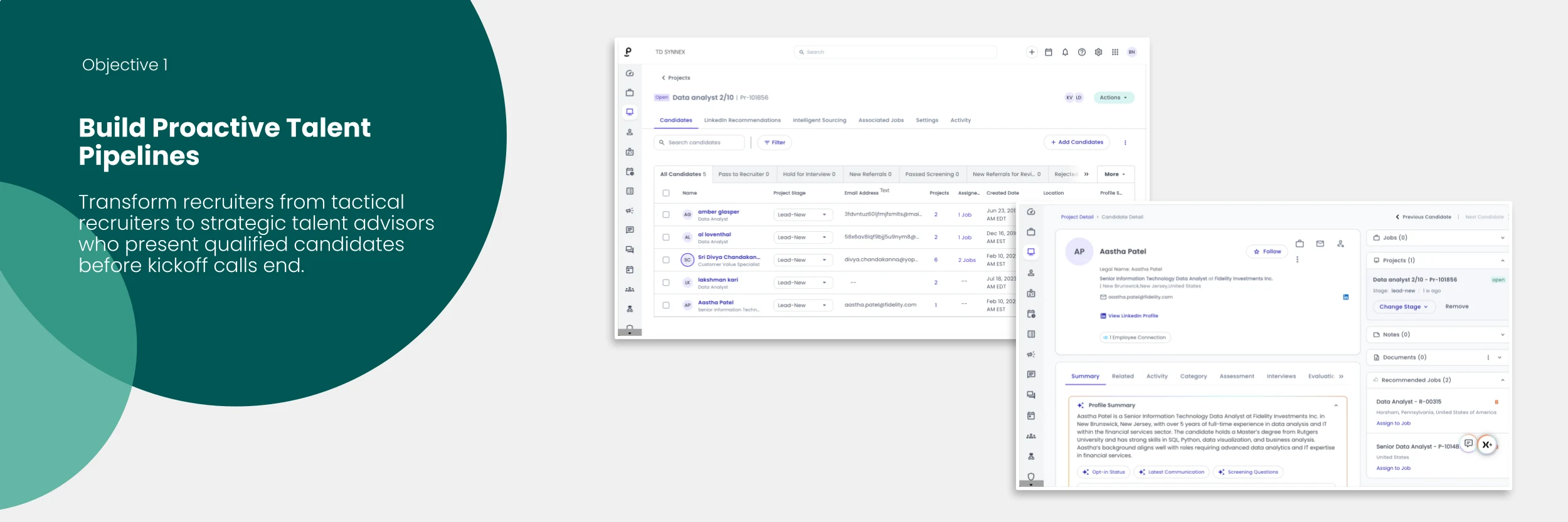
Before Phenom, the TD SYNNEX recruiting model operated only at the extremes of the funnel. Candidates either arrived at the career site and applied through Workday, or they didn't. There was no way to re-engage someone who had shown interest but never converted. Every urgent role started from a cold list, and the team was perpetually playing catch-up.
The answer, Smith found, started with changing how the team thought about their role. The goal wasn't just to fill open requisitions faster — it was to arrive at every kickoff call with candidates already in conversation. Two priorities anchored that shift. First, building proactive pipelines by talent segment. Second, proving the ROI of talent marketing with data that holds up in a quarterly business review, showing email campaigns as a legitimate source of hire, tracked all the way through to placement. Both required an AI infrastructure like Phenom’s that could connect outreach, nurture, attribution, and analytics in one place.
How to Run Persona-Based Email Campaigns at Scale
Persona-based email templates
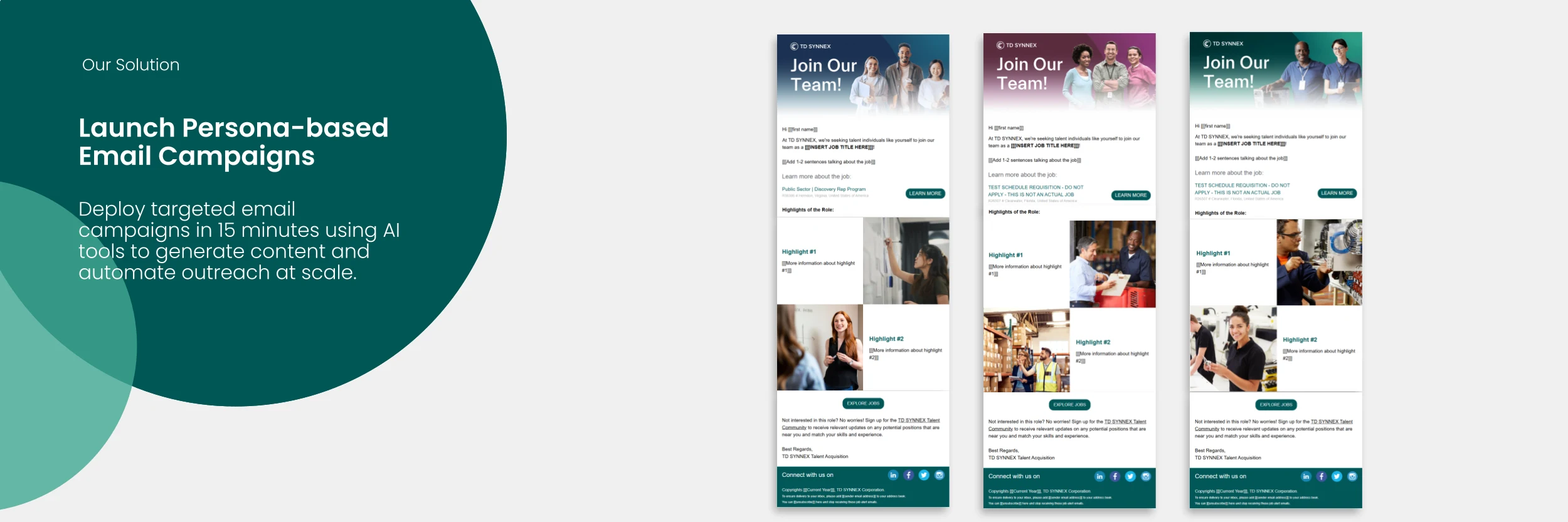
The first step was building templated campaigns organized by talent segment: university, warehouse, corporate, and others. Rather than asking recruiters to write from scratch, Smith easily created branded templates pre-approved by the corporate communications team. Recruiters customize the placeholder fields and send. What once took 15 to 30 minutes now takes 15 at most.
To further accelerate content creation, Smith built an AI assistant into the workflow. Recruiters paste in a job description; the assistant outputs the specific information needed for each placeholder field, guided by TD SYNNEX's storytelling guidelines. Brand consistency is maintained without additional review cycles, and campaign launch time shrinks further still.
Automated lead nurturing
When a candidate enters the system as a lead, automations take over. Two to three days after initial interest, they receive a follow-up with more context about the relevant team or function, links to career blogs, a how-we-hire page, and an invitation to join the talent community. If the specific role isn’t the right fit, the automation redirects them to the broader job category page. The design principle is simple: fewer clicks and a shorter path back to the career site.
This layer also creates room for creative experimentation. The team used it for AB testing, including campaigns that lean into humor and cultural moments. One tied to the Super Bowl read: "Score your next career touchdown with TD SYNNEX." It was timely, on-brand, and measurably more engaging than a standard job alert. Timing matters too. Campaigns sent early in the morning in local time consistently outperform those sent late on a Friday, when inboxes are effectively closed.
Related: 3 Ways Talent CRM Automations Reduce Time-to-Hire Without Sacrificing Quality
Full-funnel attribution through MSR integration
Closing the loop between campaign activity and hire data required building a custom integration that auto-appends the source of application when a candidate applies directly from an email campaign. That attribution flows into a dashboard the team built to track performance across regions, including open rates, click rates, applies, influenced applies, and hires. Combined with Phenom's native analytics, hiring managers now have a clear view of which channels are driving results, with email campaigns, social media, and other sources surfacing as verified contributors to hire.
"If you look at the candidate's profile and see they started way back then, went through campaign after campaign, and got all the way from apply to hire, it is a game changer," said Smith
How Do You Get Recruiters to Think Like Talent Marketers?
Shifting a recruiting team's mindset is less a training exercise than a change management effort, and Smith approached it as one. Recruiters were being invited to think less like sourcers and more like campaign managers — building pipelines before roles were open, sending emails to candidates who hadn't asked to hear from them, and measuring success beyond whether someone applied today.
The turning point wasn't a presentation or a mandate. It was a hire. Smith tracked every apply from early campaigns manually, and when the first candidate could be directly attributed to an email outreach, the conversation changed. "Once we had that first hire, that is when we could start making a stronger case," Smith said.
From there, celebrating incremental wins kept momentum building. When a campaign performed well, Smith reached out to the recruiter personally to acknowledge it. That recognition compounded. Today, sending a campaign immediately after a kickoff call with a hiring manager has become standard practice across the team.
Download: The Talent CRM Migration Kit
What Results Did TD SYNNEX's Campaign Strategy Deliver?
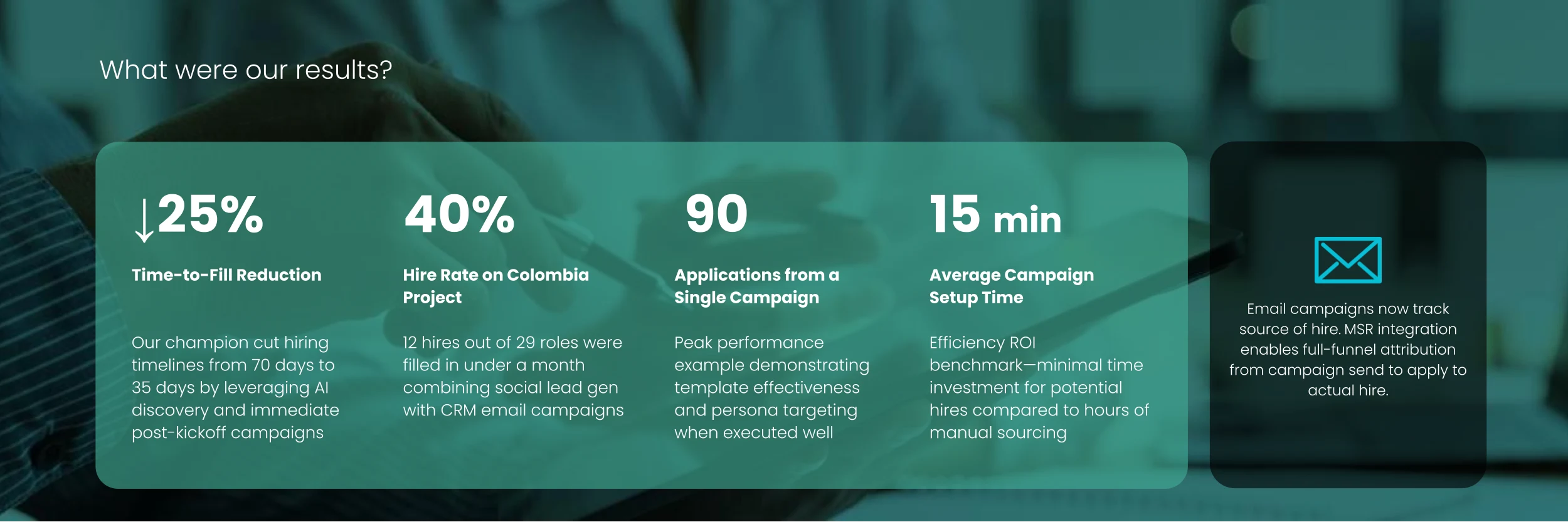
Eighteen months in, the numbers reflect a team that has genuinely shifted from reactive to proactive:
25% reduction in time to fill. The team's Phenom champion cut her personal hiring timeline from 70 days to 35 days through proactive AI-assisted outreach and immediate post-kickoff campaigns
40% hire rate. 12 hires out of 29 roles were filled in under a month for the team’s Columbia project, combining social media lead generation ads with Talent CRM email campaigns
90 applications from a single campaign: Peak performance is possible when the right templates and persona targeting are used
15-minute campaign setup time: Minimal time investment for potential hires compared to hours of manual sourcing before the AI assistant
5,000 hours saved: Automation returns approximately 5,000 hours to recruiters
What Should TA Teams Know Before Launching Email Campaigns?
The instinct when results are slow is to question the channel. Smith's advice is to question the metric instead. A low-volume campaign isn't necessarily a failure; it's still a touchpoint. The mistake is evaluating email campaigns the same way you evaluate a job board posting, where quantity is the only signal that matters.
"Don't get discouraged by low numbers at first,” said Smith. “Build your templates by persona, use AI to move fast, and track the full story in analytics — opens, influenced applies, not just clicks. Even two to four applies from 15 minutes of work can result in a hire. That is the ROI lens that changes everything."
Download a copy of the TD SYNNEX Email Campaigns Playbook to learn how to build proactive talent pipelines with persona-based email campaigns.

Branka’s a marketer with flair, a teacher turned Phenom player. She loves products that shine, making candidates’ paths fine and turns job hunts into a winner.


Get the latest talent experience insights delivered to your inbox.
Sign up to the Phenom email list for weekly updates!


