

4 Steps to Becoming a Skills-First Organization
Skills are taking the HR industry by storm, but there is still a lot of confusion when it comes to understanding them. For instance, do you need a skills ontology? Skills taxonomy? Skills intelligence? Skills cloud or databases? All of the above?
During Skills Day, we discussed all this and more. But before we can get into the nitty gritty of skills, it’s important to understand the foundational elements for getting started. To become a skills-first organization, there are four main steps you need to take to get there.
In this blog, we’ll outline key terms to know, a simple framework for understanding how to leverage skills at your organization, and the best approach to skills technology.
You can watch the full episode here, or read on for the highlights.
8 Skills Terms to Know
Before we get into the steps to becoming a skills-first organization, here are a few terms you should know:
Skills Catalog: A collection of all the skills in your organization
Skills Map: Connecting the skills from your catalog to roles, employees, succession, and development
Skills Taxonomy: Building categorization on top of skills data to understand what skills apply to which roles
Skills Ontology: A collection of skills with knowledge of how each skill is related to each other within the context of your business, drives a dynamic skills architecture
Dynamic Skills Architecture: Automated technology that connects skills, roles, progressions, learning content, and people. This tech updates in real time so decision-making and gap analysis can help teams apply change effectively.
Skills Gap: The mismatch between the skills and qualifications that job seekers possess and the skills and qualifications that employers require for a particular job or role
Skills Intelligence: The process of analyzing individual skill sets, observing their application in the workplace, and strategizing ways to enhance them through learning opportunities
Workforce Intelligence: Technology that uses AI to analyze employee data (like skills, experience, goals, gig work, etc.) and provide context to people managers and the talent management team to help drive talent mobility and career development throughout the organization
Understanding this terminology is crucial for leveraging skills at your organization. Next, let's look at four steps you can take to start implementing skills technology today:
Step 1: Build a Catalog of Skills
To use skills effectively, you need a catalog of all the skills you have at your organization. When you look at your metadata, you’ll usually see skills grouped in this way:
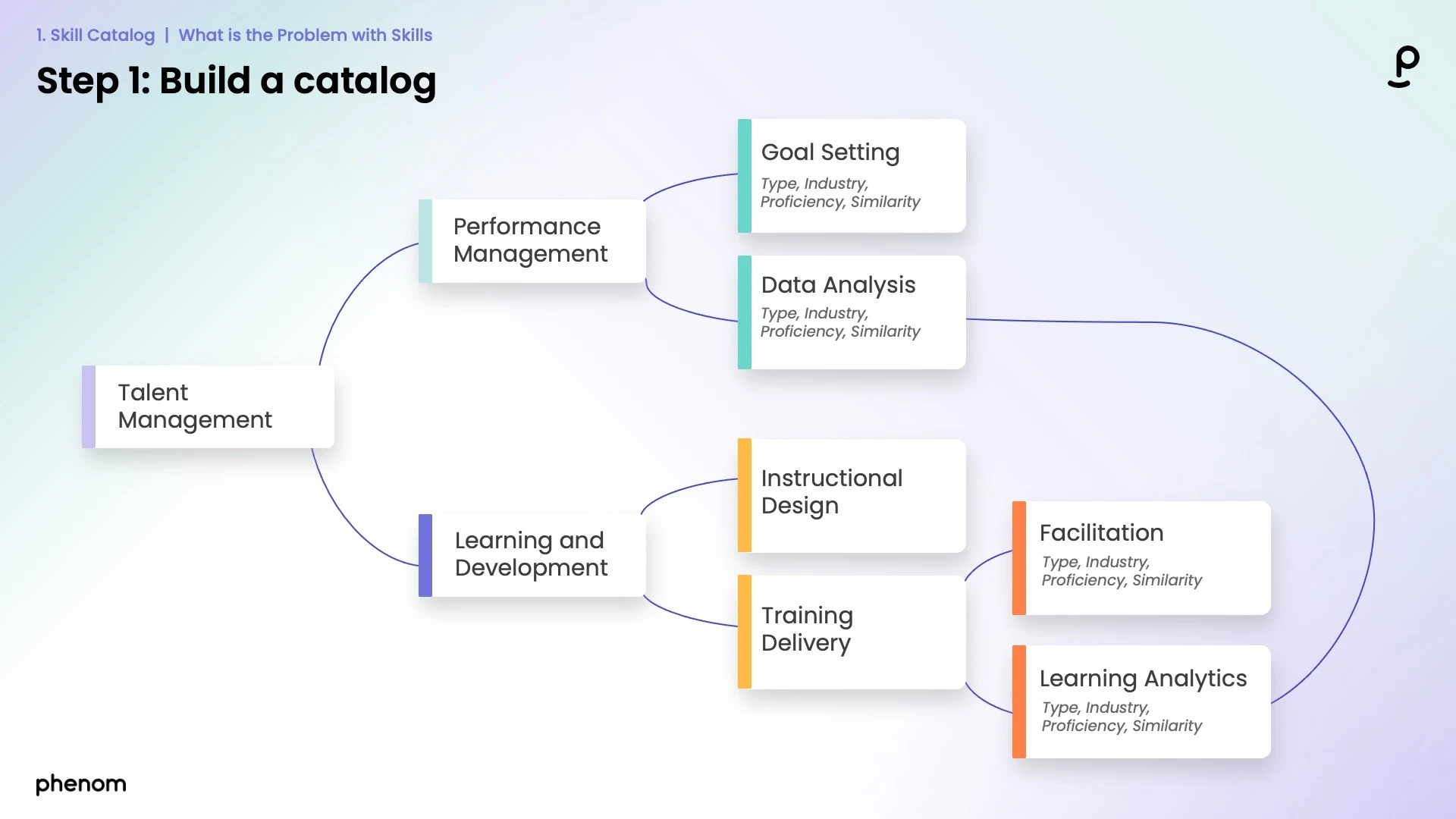
Top level skill group > Skills clusters related to top level skill > Individual skills related to clusters
Depending on the overall group, there will most likely be multiple layers of skills within your catalog.
But how do you actually build the catalog? It’s important to consider the following when deciding between building your own skills catalog or using one that is pre-built:
How exhaustive and granular is the ontology?
How often is the library being updated?
Who in your organization will manage and maintain this?
Once you’ve talked through these questions with the decision-making team, you can move on to the next step: mapping your skills.
Step 2: Map Skills
Now that you have a catalog, you have to map all the skills within it. This process can help you determine the top skills associated with a role, which employees within specific departments have skills that are transferable to other roles, and much more.
To map skills effectively, you used to have to:
Meet with a department
Identify the key functional roles within that department
Map competencies to key roles
Map proficiencies to each competency
Publish career architectures for managers
Repeat this process for each department
This is effective in mapping skills, but if you’re doing it manually it’s extremely laborious and time-consuming. If you work at a company of 20,000 employees, for example, it could take you two years to complete this mapping exercise. And since skills change and develop often, the mapping could be obsolete once you’re done.
Because of this, you need a skills ontology that will map skills for you automatically and keep your company at the forefront of your industry. To decide whether you should build that in-house, use a consulting firm, or capitalize on existing tech, consider:
Are business leaders committing time and resources to this?
How do we plan on constantly learning and refining our skills ontology?
Does skills prediction technology represent our entire organization?
Step 3: Roll Out Skills
You’ve built a dynamic, continuously learning catalog, mapped the skills within it, and now you must roll out the skills. HR, managers, and employees must all adopt this tech in order for it to work effectively.
HR can use skills on job profiles for open requisitions, map skills to learning, and analyze performance based on skills. Managers can add skills to interview questions and performance reviews as well as use skills as a basis for employee career development and succession planning. Employees can use the skills ontology to update their profiles, find learning and development opportunities that focus on skills gaps, aid in career pathing, and pick up gigs or find a mentor to grow their skills.
To roll out your framework effectively, you must consider:
Whether your solution requires users to input skills to function
How simple the user experience is and whether or not the system can learn
Whether you have change management support to roll this out
Step 4: Use Data to Inform Talent Decisions
Now that you’ve rolled out skills, your HR team and other leaders at the organization can finally make data-driven decisions on emerging skills trends, workforce planning, identifying and bridging skills gaps, reviewing talent, boosting retention, and more.
Managers can use this data to grow, retain, and upskill talent, boost employee engagement, plan succession better, and hire the best people for the job.
To make these decisions, you need a skills ontology, skills intelligence, and talent intelligence that work together. Skills are already in your organization, you just need to start using them.
To dig deeper into how this technology benefits both talent acquisition and talent management teams, check out these blogs:
Get a Snapshot of Skills at Your Organization
To get a view of your organization’s roles, skills, and progressions and learn how to implement, deploy, and adopt tech that will drive your talent management and talent acquisition goals, request a complimentary skills snapshot from Phenom.
Our team of experts will show you where skills already exist within your organization and provide you with tailored recommendations for your organization that detail:
How to rapidly move from the snapshot to a full career architecture
The steps you should take to effectively deploy the necessary workforce intelligence solutions
How to justify budget and receive executive buy-in for your technology plans

Maggie is a writer at Phenom, bringing you information on all things talent experience. In addition to writing, she enjoys traveling, painting, cooking, and spending time with her family and friends.


Get the latest talent experience insights delivered to your inbox.
Sign up to the Phenom email list for weekly updates!


