


How RBC Integrated Workday and Phenom for End-to-End Hiring
Phenom doesn’t operate in a silo. Every implementation lives inside a broader technology stack, and for many enterprise organizations, that stack includes Workday. With over 300 Workday-Phenom customers, how those two systems connect becomes critical to ensuring data flows correctly, and recruiters can work seamlessly across both.
At IAMPHENOM 2026, Royal Bank of Canada (RBC)’s Sami Adnan, Recruiting Technology Solutions Architect, walked through the exact steps RBC took to build its Workday-Phenom integration.
Read on to discover the seven core integration workflows they’re using, the specific edge cases they ran into, and the decisions that shaped how their 150+ recruiters now use both systems every day.
Watch the full session here, or explore the highlights below.
How Did RBC End Up Running Workday and Phenom Together?
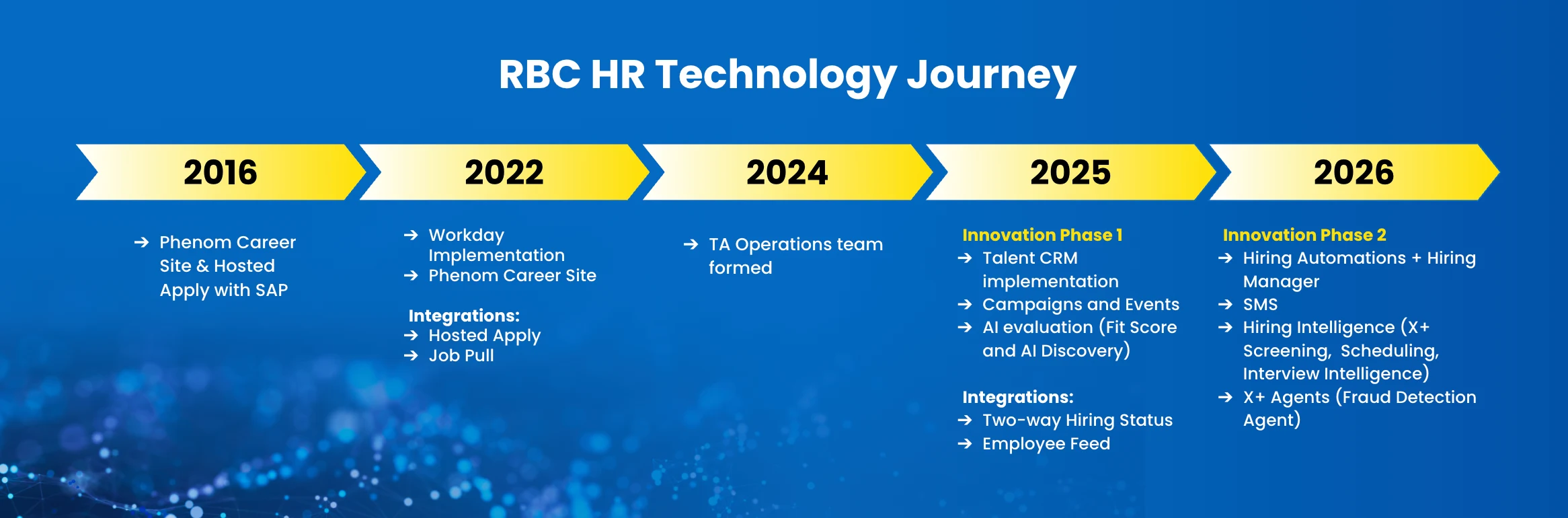
RBC is Canada's largest bank by market capitalization, with nearly 100,000 employees across 29 countries. Their global talent acquisition team created over 23,000 requisitions and hired 22,000 people in 2025. This is the kind of volume where a gap between systems isn't just an inconvenience, it's a hiring delay.
The bank has been a Phenom customer since 2016. When they completed one of Canada's largest HR system migrations in 2022 — moving from another vendor to Workday as their Applicant Tracking System (ATS) and Human Capital Management System (HCM) — they re-integrated Phenom so they could continue providing the exceptional experience and AI innovation their team now expects.
Phenom Career Site delivers the personalized, AI-powered job discovery experience candidates see externally, and Phenom Hosted Apply keeps candidates on that same experience through the application itself, while also capturing leads from candidates who start but don't complete. For RBC, Workday handles downstream steps like offer letters, background checks, and onboarding, making the integration between the two systems central to a recruiter's daily workflow.
In 2025, RBC implemented Phenom Talent CRM, giving recruiters a dedicated AI tool to source, build pipelines, and engage candidates at the top of the funnel. Building out all the core bidirectional integrations was vital as that foundation now positions them to move into agentic automation and AI capabilities. "We took a long time because we wanted to do it right," Adnan said.
Related Resource: The Top Talent CRM Features You Need Now
How Do Workday and Phenom Work Together Across the Hiring Funnel?
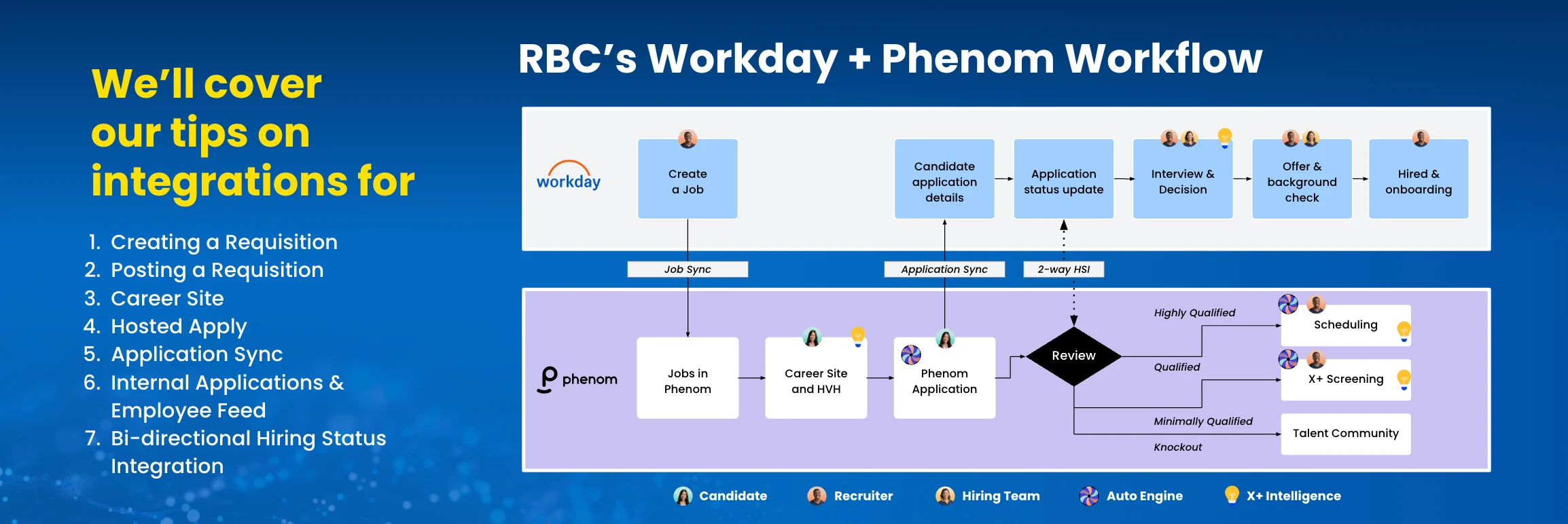
Adnan walked through seven integration points, starting with how job requisitions move from Workday into the Talent CRM. RBC implemented Phenom's unposted jobs integration, which runs hourly to pull approved requisitions into the CRM as soon as the hiring manager's approval chain completes — before the role is posted externally. Recruiters can begin sourcing immediately. RBC also mapped custom Workday fields (cost center, supervisor organization, management level) into the CRM to support recruiter filtering and enable automation rules downstream.
On the career site, two configuration decisions shaped the candidate experience. Using Hosted Apply moves candidates from job discovery through application without ever leaving the Phenom career site, while also giving the team lead capture for incomplete applications, drop-off analytics, and full control over the application form. Because Workday's career site still exists and gets indexed by search engines, RBC worked with their Workday administrators to redirect to the Phenom career site. They also explored zeroing out job listings on the Workday site entirely as a cleaner long-term solution.
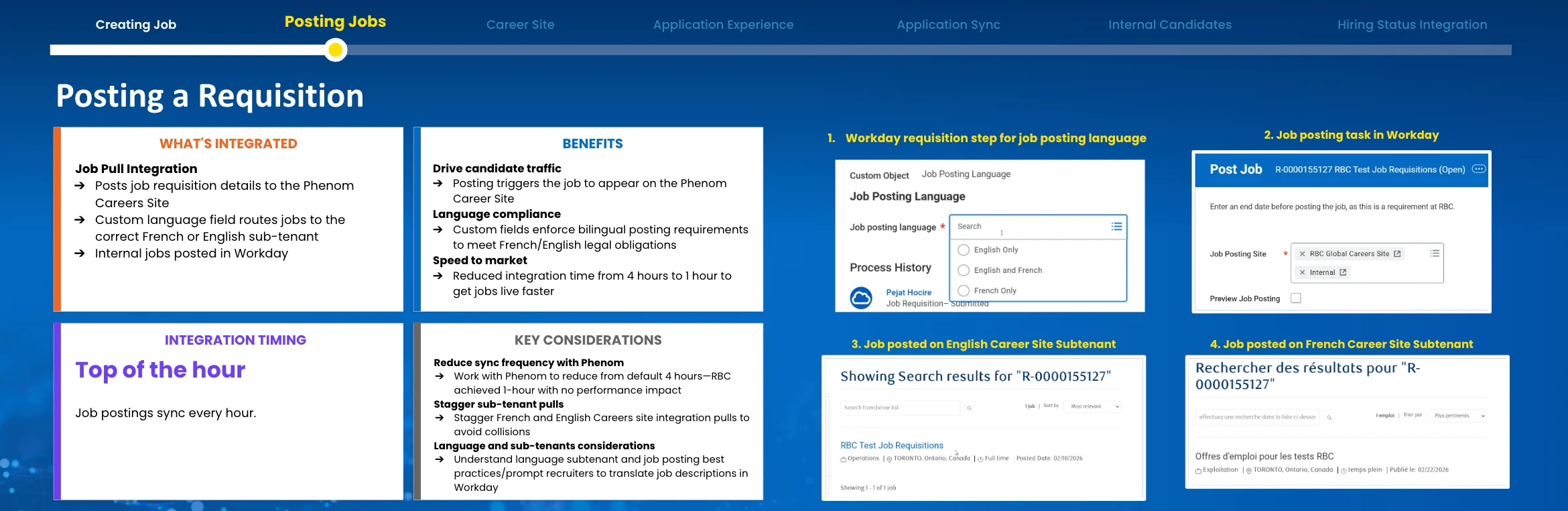
Bilingual requirements added another layer. RBC serves candidates in both English and French, so the posting workflow includes a custom task in Workday where recruiters select the posting language before a req goes live. The job pull integration picks up that designation and routes the posting to the correct career site sub-tenant accordingly. Working with Phenom, RBC changed that integration's sync frequency from every four hours to every hour, getting new roles in front of candidates faster.
What Integration Gaps Did They Encounter and Solve?
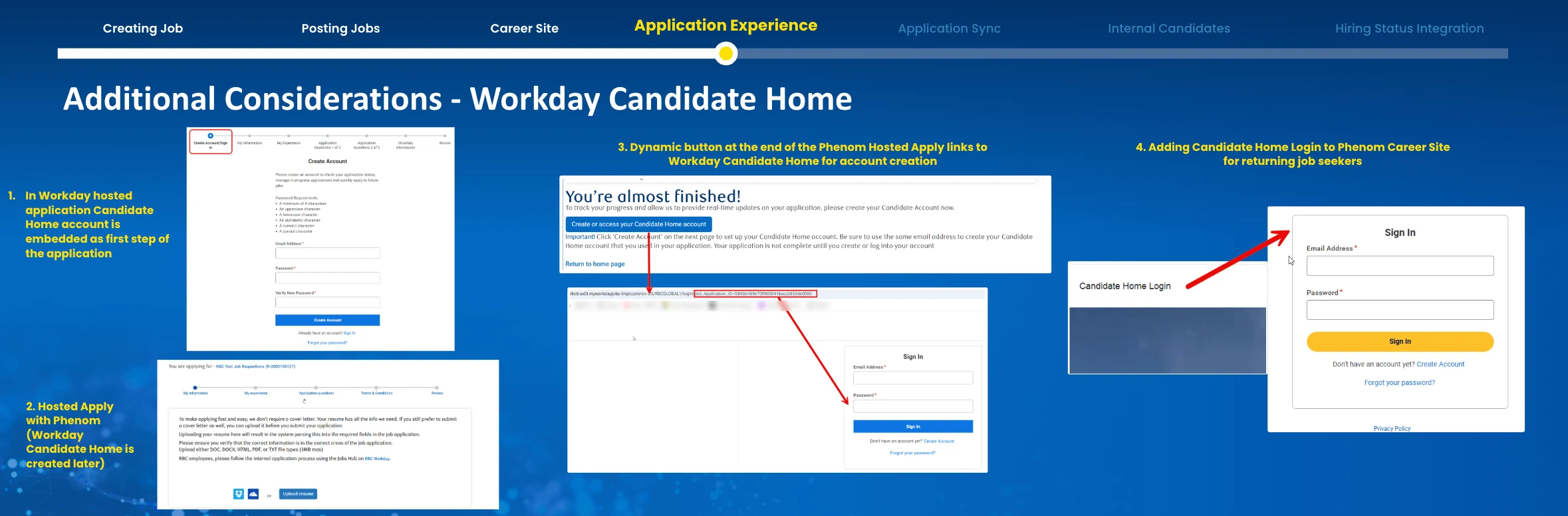
With Hosted Apply, the Workday candidate home account where candidates later sign offer letters and track application status is created at the end of the application rather than the beginning. RBC added a dynamic button at the close of the application process that prompts candidates to create their Workday login. As a fallback, a rule built into Workday automatically triggers a notification at the offer stage for any candidate who hasn't completed that step yet, ensuring nothing holds up the offer letter going out.
Internal employees who land on the external career site are redirected back to Workday via a link embedded at the start of the hosted application. For primary questionnaires (legally required questions like work authorization built in Workday), RBC worked with Phenom to surface those questions within the hosted application flow. As Adnan noted, making sure candidate responses also appear in the CRM under the candidate profile is worth the extra configuration effort, since it lets recruiters assess candidates fully without switching systems.
Related Resource: How Retailer Sleep Number Unifies Workday and Phenom
Should You Use One-Way or Bidirectional Hiring Status Sync with Phenom?
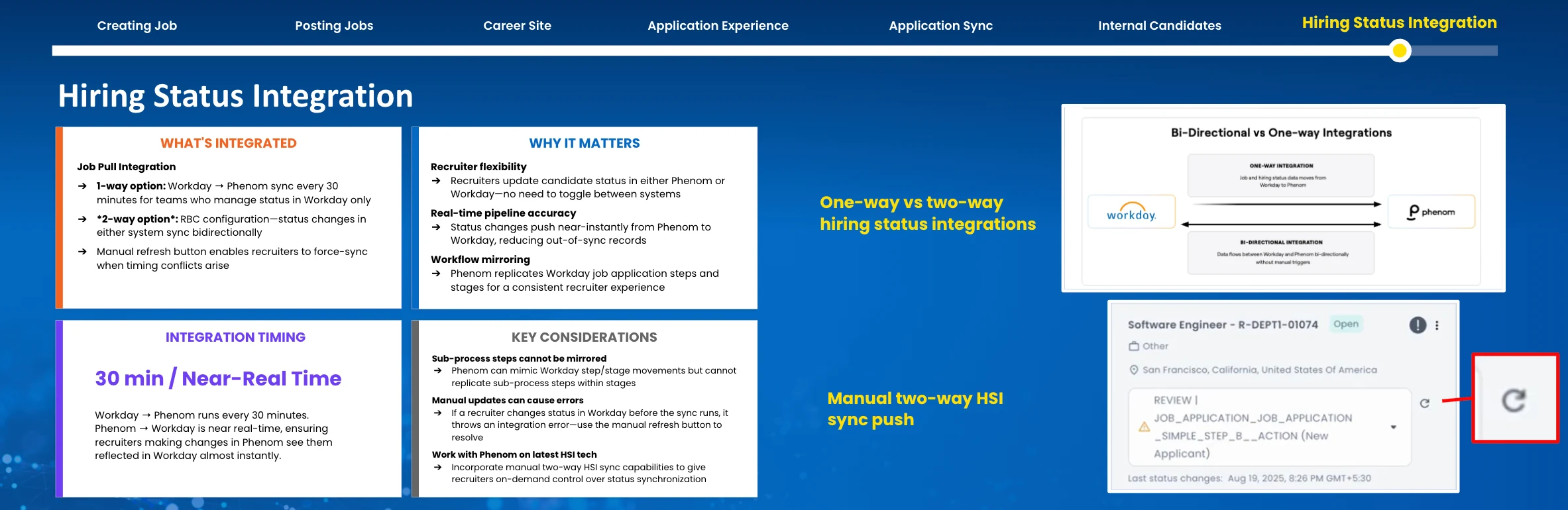
When it comes to keeping candidate statuses aligned across both systems, teams have two options. One-way sync moves status changes from Workday to Phenom every 30 minutes — straightforward if recruiters manage status exclusively in Workday. Bidirectional sync, which is what RBC implemented, allows changes in either system to propagate to the other. Changes made in Phenom sync back to Workday near real-time; changes made in Workday reach Phenom within 30 minutes.
RBC chose bidirectional for the flexibility it gives recruiters and to avoid being locked into one system for status management as their use of both platforms deepens. They also enabled Phenom's manual two-way hiring sync refresh feature, which gives recruiters a self-service button to force a sync when a timing conflict causes an error, rather than waiting for the next scheduled run or filing a support ticket. Worth noting when configuring this: Phenom mirrors Workday's job application steps and stages, but sub-process steps within stages don't replicate, so mapping that out before go-live prevents surprises down the line.
What Workday-Phenom Integration Issues Only Surface Through Back-End Testing?
During RBC's go-live, two integration issues surfaced that wouldn’t have been caught by looking at the front end alone.
The first involved the "previous workers" field — the standard question asking whether a candidate has previously worked for the company. The field wasn't populating in the hosted application because it was missing from Workday's web service integration. Building a custom object resolved it. The second was a bilingual notification issue: French-language applicants were receiving English-only confirmation emails because the integration wasn't referencing the correct API field. Phenom identified the problem and corrected it.
As Adnan put it: "Any time it's an API integration, don't just look at the front end and see if the data is there. Test properly. Do the back-end testing to ensure everything is coming in as expected."
How Does a Stable Workday-Phenom Integration Unlock the Next Phase of AI Hiring?
With core integrations stable, RBC is moving into phase two: Phenom Hiring Manager, Phenom SMS, Phenom X+ Screening, Phenom Automated Interview Scheduling, Phenom Interview Intelligence, and Phenom X+ Agents — including Phenom Fraud Detection Agent. AI capabilities like Phenom Fit Score and Phenom AI Discovery, evaluated during phase one, are also moving toward deployment.
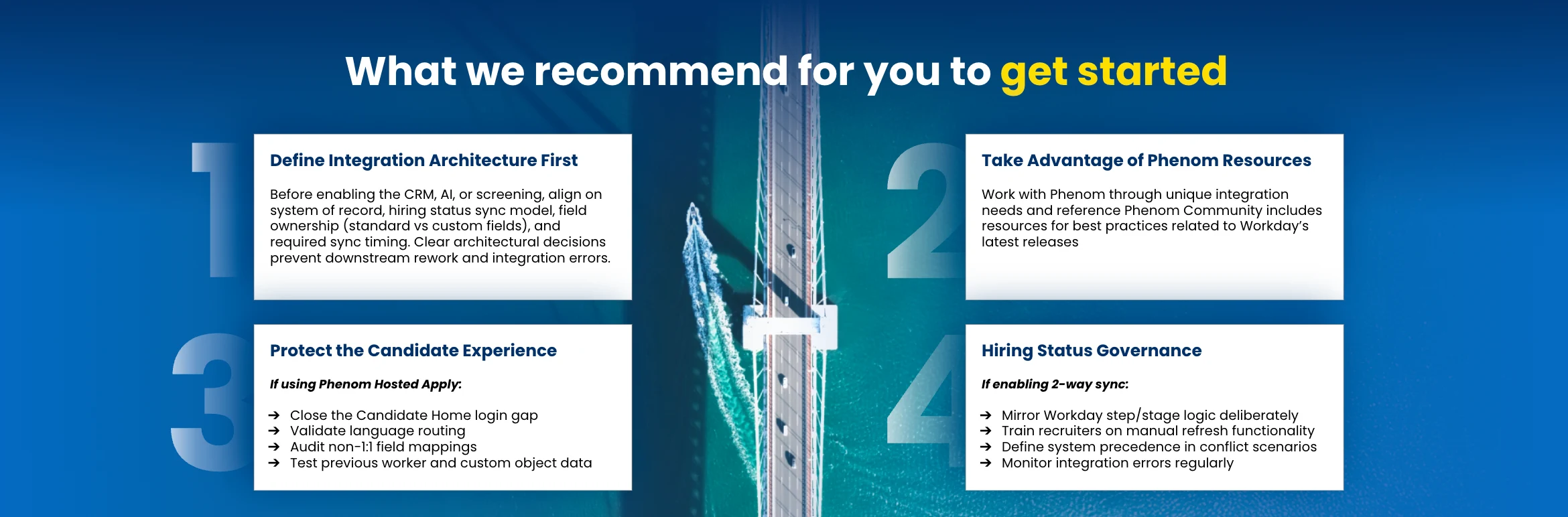
For teams earlier in this journey, Adnan's advice is straightforward. Define your integration architecture before enabling anything else, test thoroughly at the data layer, and work closely with Phenom. The organizations that get value fastest are the ones that do the infrastructure work carefully the first time.
"The biggest challenge is understanding both technologies really well," Adnan said. "Phenom is always going to help you. But if you're proactive, I feel like you're going to be successful."


Get the latest talent experience insights delivered to your inbox.
Sign up to the Phenom email list for weekly updates!


