

Internal Mobility Adoption: Evolving Tools to True Talent Advantage
There is a version of internal mobility that exists in every organization: the one on the roadmap, fully funded, technically ready, and quietly ignored by the people it was built for. The internal job board is live, career pathing is configured, and the platform is ready. Yet adoption stays flat. Employees are not logging in, managers are not encouraging movement, and HR is not sure where the program is actually landing.
Julia Thrush, a Customer Enablement Manager at Phenom, addressed this directly at IAMPhenom. This blog captures her guidance on the three adoption challenges that stall internal mobility programs and what it takes to move past each one.
Why Internal Mobility Tools Stall Before They Scale
When HR teams invest in internal mobility software, the business case is usually clear: open roles take too long to fill, growth paths are invisible to employees, or talent data lives in too many disconnected systems. The tool purchase follows logically from the problem. What is harder to solve is what happens after go-live.
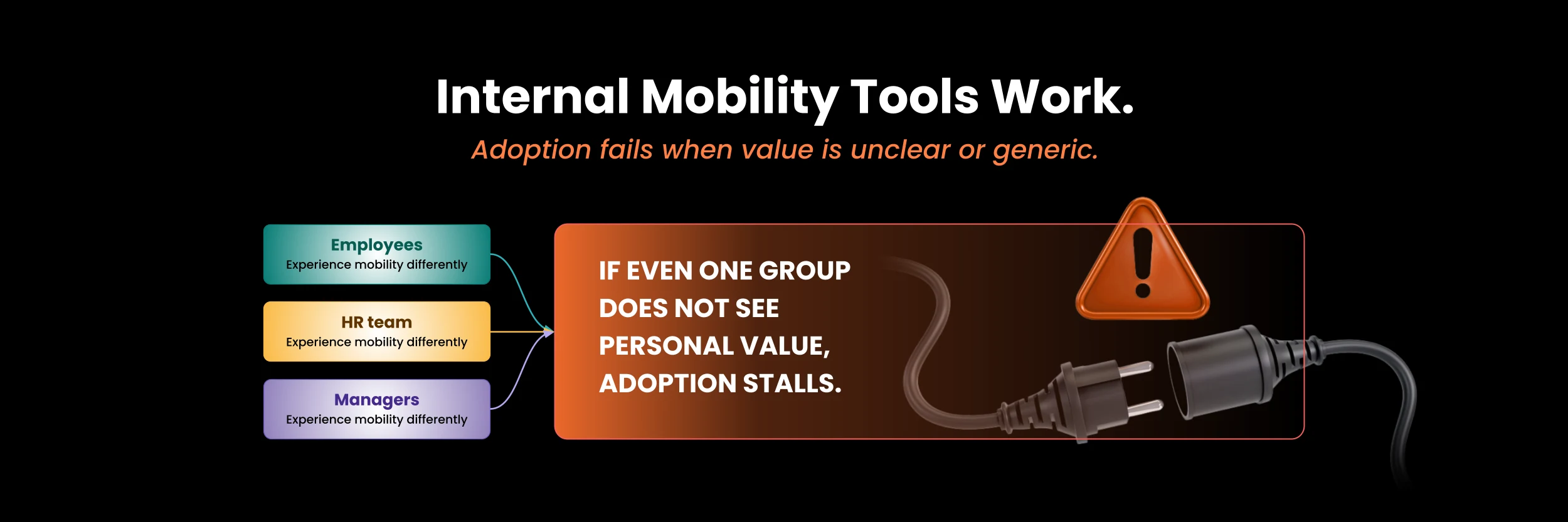
HR can configure the platform, launch communications, and monitor completion rates. But sustained adoption depends on employees and managers finding genuine value in the system. An employee who does not see why updating their profile benefits them personally will do the minimum to comply and never return. A manager who sees the tool as a way to lose good people has little reason to support it. The technology rarely fails. The change management does. Organizations that sustain adoption treat the tool purchase as the starting point, not the solution. They build a case for each stakeholder group before launch, answering not just what the tool does, but what changes for each person who uses it. Waiting until engagement drops to ask that question is too late.
The sections that follow outline how to make that case effectively for both employees and managers, and why doing that work before rollout is what separates programs that scale from those that stall.
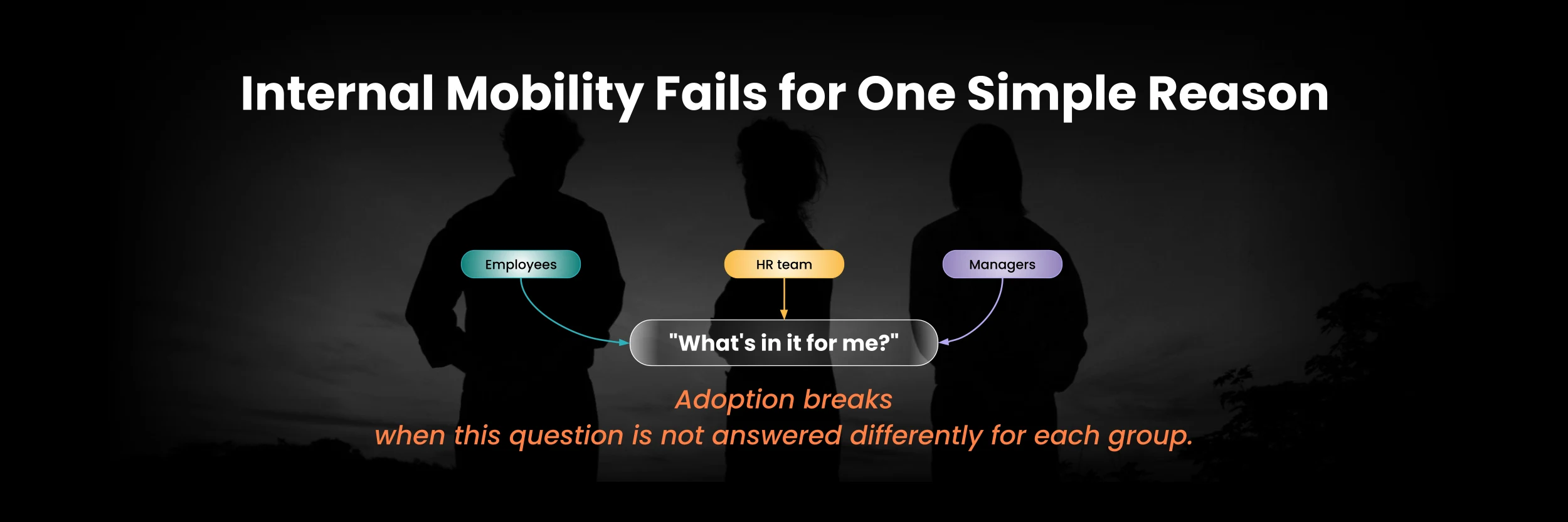
HR Adoption: The Foundation for Internal Mobility Momentum
HR and program owners are where internal mobility tool adoption either gets strengthened or gets skipped. Before employees can be told what the program offers them, the HR team needs to believe in it, understand it, and feel equipped to support it. As Thrush puts it: "Before we can tell employees what's in it for them, our own teams need to believe and be equipped to support the program."
48% of HR leaders cite low adoption as their biggest technology challenge, and research from Prosci shows that projects with effective change management are six times more likely to meet their objectives. The gap is not enthusiasm. It is readiness.
Getting HR Buy-In Right
Involving HR early in the process, even where their role is not technical, makes a measurable difference. Organizations that bring HR teams into kickoff conversations and keep them informed throughout implementation consistently see stronger downstream adoption because those teams become genuine advocates rather than passive communicators.
Proving value before scaling is equally important. Rolling out every feature at once asks too much of every group simultaneously. Common starting points are internal job visibility, skills profile completion, or talent marketplace participation, each of which generates an early signal on what is working before more complex capabilities are introduced. Advanced features earn their place once the foundation is established.
Defining success before launch is what keeps the program measurable. Profile completion rates, internal application volume, time to fill internal versus external, and movement across roles or skills are all indicators worth tracking from day one. Creating visible internal champions, employees, or managers who have already moved through the system and are willing to share their experience, gives the program social proof that no campaign can manufacture.
Employee Adoption: Making Internal Mobility Opportunities Visible Enough to Act On
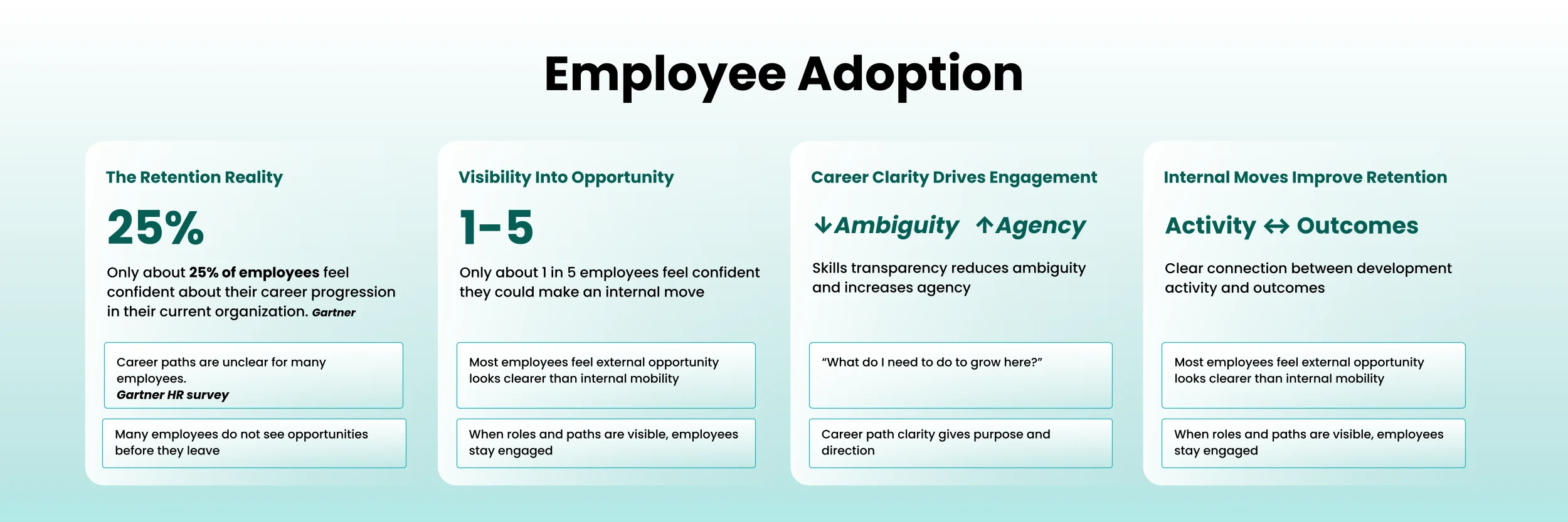
Employees are the group most organizations focus on first, but the message they typically receive is too generic to drive behavior. The data shows how wide the gap actually is: only 25% of employees feel confident about their career progression inside their current organization, and just one in five believe they could successfully make an internal move. Most feel that external opportunities look clearer than internal ones, which means the platform is not the barrier. Visibility is.
The most powerful thing an internal mobility program can do for employees is make growth tangible. When an employee can see what skills a role requires, what path connects their current position to where they want to go, and what peers have done before them, the decision to engage with the platform becomes obvious rather than optional. Career pathing tools that surface this clarity give employees direction and purpose rather than asking them to explore without a map.
Reducing ambiguity increases agency. When roles and development paths are visible, employees stay engaged with the organization rather than looking outward for the growth they cannot see internally. The platform makes this possible. The change management work makes employees want to use it. Thrush recommends starting with a small champion group before a full rollout, not just to test the technology but to gather real feedback on where the experience is unclear or unconvincing. "What organizations have found is that they could find where there was a gap. They could get feedback from that, and when we're rolling it out to the broader group, we have a better understanding of what's going to work."
Manager Adoption: Shifting from Talent Hoarding to Mobility
Managers are consistently the hardest group to bring along, and the data explains why. More than 50% of organizations report that managers hoard talent, 44% of managers worry that internal mobility means losing their best performers, and in one in three US firms, employees apply for internal roles without telling their manager at all. The resistance is not irrational. Managers are measured on team performance and delivery, so losing a high performer to another team feels like a direct risk to their own results.
The real conflict is not that managers resist growth, but rather uncertainty. When a team member moves, the manager faces an unclear backfill timeline, a potential gap in delivery, and no guarantee of a strong replacement. Addressing the behavior without addressing the underlying risk is what makes most manager-focused change initiatives fail.
What Actually Shifts Manager Behavior
When internal movement becomes an expected part of how the organization operates rather than an exception that requires permission, resistance drops. Career pathing and talent marketplaces give employees more agency over their own movement, which reduces the dynamic where managers feel like gatekeepers and shifts it toward one where they feel like sponsors.
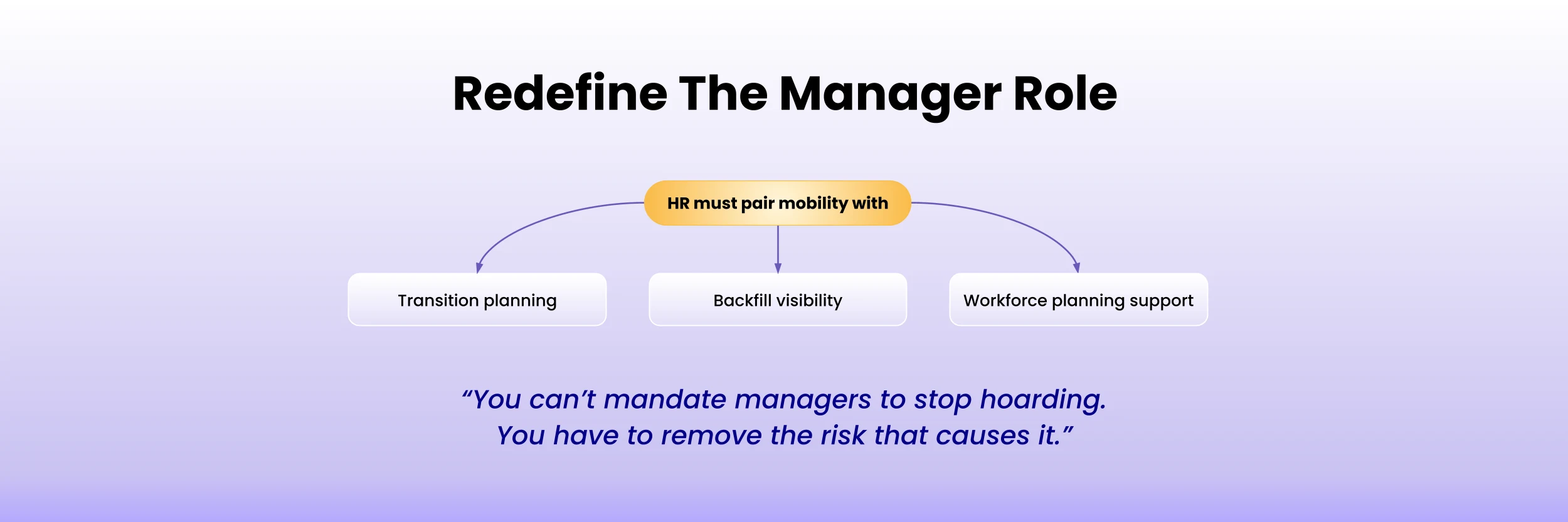
Redefining the manager role is the structural piece. As Thrush notes: "You can't mandate managers to stop hoarding. You have to remove the risk that causes it." HR needs to pair internal mobility with transition planning, backfill visibility, and workforce planning support so that a team member's internal move does not land entirely on the manager to absorb. The strongest organizations reward leaders not just for retaining talent but for developing it, making talent development a visible part of performance expectations rather than an informal aspiration.
Turning Insight Into Internal Mobility Action
Three actions apply regardless of where an organization currently sits on adoption.
Audit by stakeholder group: Identify which group is lagging and why before making any changes to messaging or platform configuration. The issue with employees is rarely the same as the issue with managers, and treating them as one problem produces solutions that work for neither.
Find one quick win in the next 30 days: A targeted campaign to re-engage employees who have profiles but have not logged in recently, a manager briefing on backfill planning, or a champion story shared in a company newsletter are all low-effort moves that generate visible momentum without waiting for a full program overhaul.
Solve manager resistance with systems: Building backfill visibility and transition planning into the mobility process removes the uncertainty that drives hoarding behavior. Policy alone does not change what managers do when a team member applies elsewhere. Removing the risk does.
Internal Mobility Is a Cultural Shift, Not a Launch Event
The organizations that see sustained adoption treat internal mobility as an ongoing cultural commitment rather than a one-time rollout. The technology handles visibility, matching, and communication. The change management work handles belief, behavior, and buy-in. Neither is sufficient without the other.
When all three stakeholder groups see personal value in the program, adoption stops being something HR has to push for and starts being something the organization pulls toward on its own.
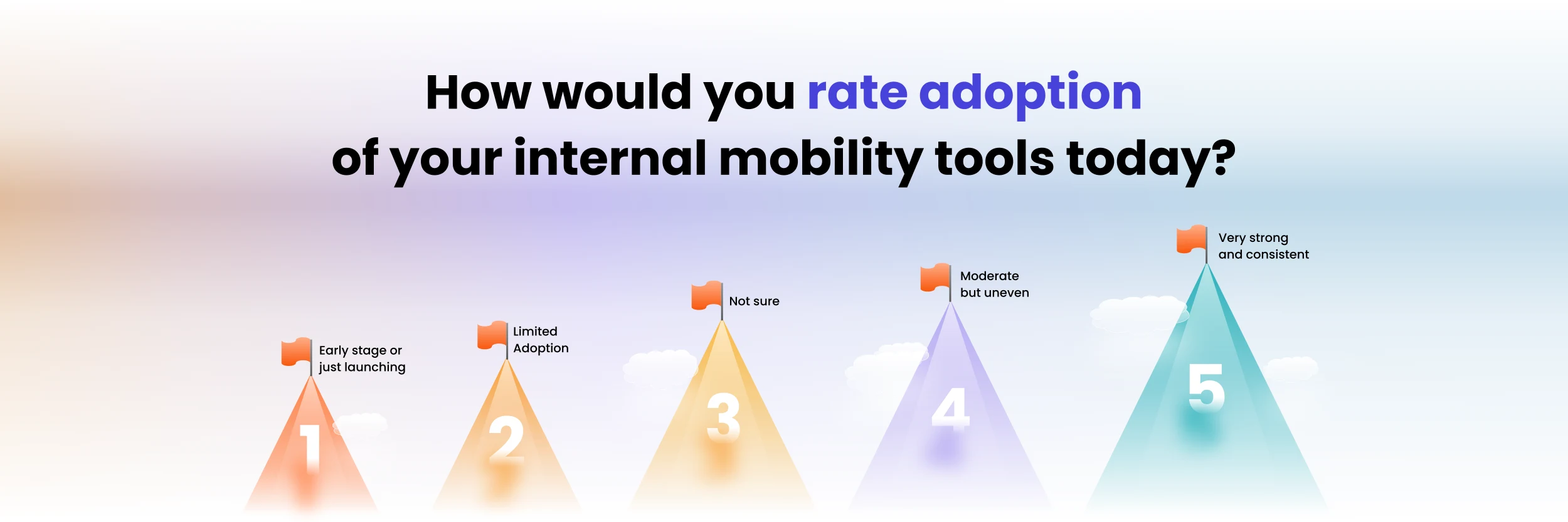
Knowing where to focus is the hardest part. Your Phenom account manager can help you audit where adoption is lagging by stakeholder groups.

Devi is a content marketing writer passionate about crafting content that informs and engages. Outside of work, you'll find her watching films or listening to NFAK.


Get the latest applied AI insights delivered to your inbox.
Sign up to stay up-to-date on the latest original content from Phenom, including new podcast episodes, events, and more.


