

Cheering for Change: Varsity Brands Rallies Around Phenom Voice Screening Agent
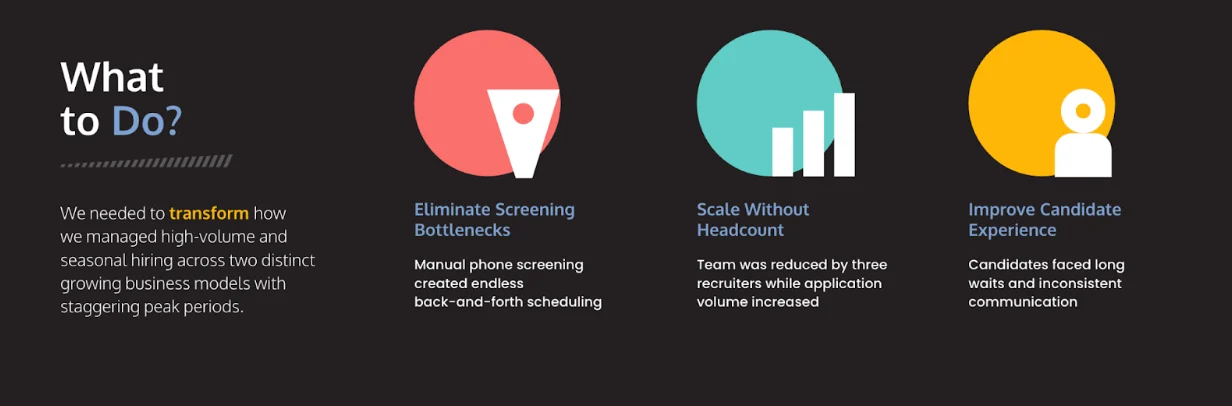
Every varsity athlete remembers the moment they put on a uniform for the first time. Varsity Brands has spent decades creating that moment for millions of young people across sports and spirit. But behind the scenes, a very different kind of pressure was building. Applications were surging, headcount wasn’t increasing, and the team was spending full weeks just trying to get candidates on the phone. Something had to change.
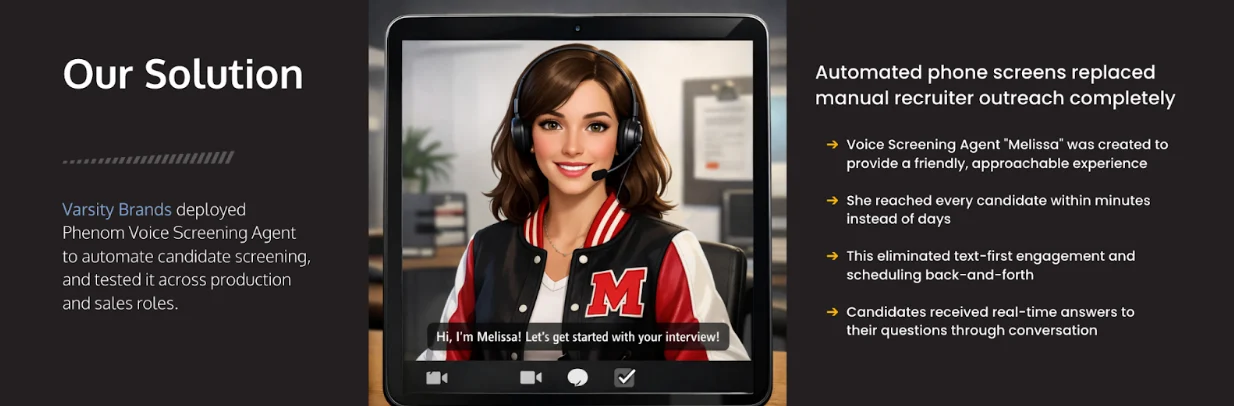
So Varsity Brands added a new member to the team, an AI voice screening agent named Melissa. And unlike a traditional hire, she’s available 24/7, never burns out, and is waiting in a candidate's inbox before the excitement of hitting 'Apply' fades. Three members of Varsity Brands’ Talent Acquisition (TA) team joined us at IAMPHENOM 2026 to give us the scoop.
Watch the full session here or explore the highlights below!
What Happens When Application Volume Surges But the Team Stays Lean?
In 2024, Varsity Brands received roughly 50,000 applications across its two primary business units, BSN Sports and Varsity Spirit. By 2025, that number had climbed to nearly 75,000. At the same time, the TA team was operating with fewer resources — a smaller group now responsible for a significantly larger volume. That created a gap that traditional processes couldn’t bridge.
Operating as two business units added another layer of complexity. BSN Sports focuses on manufacturing and sales; Varsity Spirit is driven by events and apparel. Each runs on different seasonal cycles with different candidate profiles. When one was ramping up, the other was ramping down, but the same lean team was responsible for both.
"Regardless of the business or roles we were supporting, the recruiters were in some cases spending entire weeks just trying to get people on the phone," said Paige Collison, Talent Acquisition Manager at Varsity Brands. "Not interviewing, not sourcing, just scheduling that initial screen."
The lag between application and first contact stretched from five to seven days, and even then, it was uncertain whether the candidate would pick up. The team knew candidates were slipping through the cracks, but the volume simply outpaced what any lean team could manage manually. Compounding that, the team was also trying to surface candidates with niche experience (cheer or spirit backgrounds for apparel sales roles, and club sports connections for BSN's club direct teams). These credentials rarely appear on a resume.
How Did Varsity Brands Design a Voice Agent That Felt Like the Brand?
Rather than using a generic screening tool, the team built an experience that felt distinctly on-brand. Varsity Brands deployed Phenom Voice Screening Agent and named her Melissa. Candidates received a beautifully designed, consent-based email the moment they applied, inviting them to schedule or start a call on their own time — not five to seven days later, but in the window when they were most engaged.
Building Melissa's screening questions required real intentionality. The team crafted a mix of knockout questions for non-negotiables like location, hours, and certifications, alongside multiple-choice questions designed to uncover the kind of experience resumes rarely capture. "Get really clear on what qualified means in your organization and then take that one step deeper," said Kristin Sanchez, Sr. Talent Acquisition Specialist at Varsity Brands. "Create questions that you typically can't find just based off looking at a resume."
What Does It Actually Take to Deploy an AI Voice Agent?
Getting Melissa approved internally was its own process. The team worked through procurement, finance, IT, legal, compliance, and a newly formed AI governance committee before getting the green light.
"We had to show them that it was safe and that it was definitely going to show some ROI,” admitted Bianca Donerkiel, Director of Talent Acquisition & Operations at Varsity Brands. An early win: their CHRO was sold after a single demo and gave the team an immediate go-ahead — which, as Donerkiel noted, is sometimes half the battle.
Getting recruiter buy-in was just as necessary. Introducing an AI agent to a lean team already navigating change required careful change management. "We wanted to let them know we care about them, support them, and this is just to help supplement them," shared Donerkiel. Recruiters were brought into the testing process early, and once they saw the time savings, adoption followed quickly.
The team learned through iteration. Their first pilot, focused on production roles, didn't land the way they hoped. They applied those lessons to the apparel sales pilot, refined the questions, and watched the results shift dramatically.
What Did 17,000 Hours Saved Actually Mean for Varsity Brands Recruiters?
The apparel sales pilot delivered results that stopped the room, and for good reason."It would save our recruiting team 17,000 hours,” Sanchez told the audience. “That's about 300 days per recruiter. Those are massive numbers."
70% interview acceptance rate (up from 22%)
20% decrease in time to offer
10% increase in offer acceptance rate
303 days saved across seven recruiters
17,000 recruiter hours saved by automating initial screening and qualification
The numbers mattered, but so did what they represented. Recruiters who had been buried in scheduling calls were now spending that time sourcing harder-to-fill roles and acting as strategic partners to hiring managers rather than administrative coordinators.
The candidate experience shifted, too. Feedback from applicants described the process as cool, conversational, and convenient, words rarely associated with a recruiting screen. Because Melissa reached candidates at the peak of their interest, the interview acceptance rate climbed drastically. And because qualified candidates were identified faster, offers went out before those candidates had accumulated five or six competing options.
Where Is Varsity Brands Taking Melissa Next?
With the apparel sales success as a foundation, Varsity Brands is expanding Melissa's reach. The next phase brings voice screening to cheerleading's seasonal hire process, where roughly 3,500 candidates per year are currently contacted through manual outreach. Beyond notifications, Melissa will handle real-time Q&A so candidates get the information they need about tryouts without a recruiter having to field every call.
A recent acquisition also introduced retail operations recruiting to the team's scope, another high-volume area where voice screening can absorb the initial contact load and free store managers from screening calls. Phase two of the roadmap adds Phenom Automated Interview Scheduling, so Melissa won't just screen candidates; she'll book the next conversation, too. Custom analytics dashboards are also in development to track screening completion by role type and compare voice agent performance to the manual process.
What began as a single pilot has become one of the most impactful changes to hit the Varsity Brands TA team in years, and Melissa is just getting warmed up.
Explore Phenom's limitless AI agents and listen to Voice Screening Agent in action here!

Fariya Banu is a content marketing writer at Phenom who loves decoding buyer psychology and crafting stories that convert. With engineering and marketing expertise, she brings analytical thinking to creative storytelling. When not writing, she's snorkelling, cooking, or diving into any adventure that sparks curiosity.


Get the latest talent experience insights delivered to your inbox.
Sign up to the Phenom email list for weekly updates!


