

The Complete Guide to Bidirectional HR Data Integrations
In a world without bidirectional data integration, a recruiter updates a candidate's stage in the Applicant Tracking System (ATS). The Human Capital Management system never receives the change. Two weeks later, the new hire's onboarding email goes out late, payroll has the wrong start date, and someone on the HRIT team spends an afternoon reconciling records by hand. That is the cost of an HR tech stack where data only flows one way.
A bidirectional integration in HR is two-way data sharing between multiple HR systems, where a change in either is automatically reflected in the other. It removes manual reconciliation, prevents data drift, and keeps every team working from the same source of truth.
Most enterprise HR teams run a sprawling stack of HR tech applications across recruiting, hiring, payroll, learning, and performance. The complexity of the modern stack is what makes bidirectional sync a baseline requirement, not simply a “nice to have.” Below, you'll see how bidirectional data flow works, where it matters most, and how to set it up without breaking your stack (or your budget).
In this Article:
What is the Difference Between Bidirectional and Integrated?
That definition between “integrated” and “bidirectional” matters because they are often confused. Two systems can be integrated through a one-way export, a nightly batch file, or a flat data dump. None of those makes the connection bidirectional. The defining feature is direction: changes can originate in either system, and the other system applies them.
Three data objects most often flow bidirectionally in HR: candidate status (created in the ATS, mirrored in the HCM), job requisitions (often opened in the HCM, surfaced in the ATS), and employee records that need to stay current everywhere they appear. Phenom HRIS integrations support each of these flows.
The shift has accelerated as AI moves deeper into hiring and workforce decisions. Models are only as good as the data feeding them, and data fragmented across one-way connections produces fragmented decisions. The system of record can no longer be the only system that knows the truth.
Bidirectional vs Unidirectional Integration: What's the Difference?
A one-way integration pushes data from System A to System B. A two-way integration syncs changes in both directions. Bidirectional integrations differ from unidirectional integrations because each system can act as both sender and receiver, with no need for manual export, batch reconciliation, or duplicate data entry.
That single difference of direction drives almost every other decision about how the integration is built, monitored, and maintained. The table below shows how the two compare across the dimensions that matter most for HR teams.
Dimension | One-way (unidirectional) | Two-way (bidirectional) |
Data flow direction | System A → System B | System A ↔ System B |
System of record | The source system holds the truth; the target is a copy | Both systems can write; rules define the source of truth per field |
Latency | Often batch; minutes to hours | Real-time |
Conflict risk | Low (no two-sided writes) | Present; requires conflict resolution logic |
Best-fit use case | Reporting exports, compliance archives, ML training pulls | Operational sync between the ATS, HCM, HRIS, and CRM |
Setup complexity | Lower | Higher up front, offset by lower ongoing maintenance |
A two-way integration is not always the right call. One-way integrations remain the smarter choice in three situations:
Compliance and audit exports rarely need to write back to the source since sending data into a regulated archive is the entire purpose.
Read-only analytics and Machine Learning (ML) training pipelines only need to consume HR data without changing it.
Legacy systems that don't support real-time APIs and are only capable of one-way batch transfers.
The pattern that matters is direction matched to intent. If a downstream system only needs to observe, one-way works. If it needs to participate, the connection should be bidirectional.
How a Bidirectional HR Integration Actually Works
A bidirectional HR integration works in four stages: a change event triggers the sync, an API call or webhook transports the event, the integration layer translates the data between the two systems' schemas, and the target system reconciles the change, handles any conflicts, and confirms receipt. Real-time syncs run this loop in seconds.
Trigger. A change event fires in either system: a candidate moves to a new stage, an offer is accepted, an employee record is edited, or a requisition is opened.
Transport. The event is sent through an API call or a webhook to the integration layer. REST APIs and webhooks are the standard transport mechanisms; OAuth handles authentication and scope.
Translation. Data is mapped from one system's schema to the other. Field names are matched, types are coerced (a date string in one system becomes a date object in the other), and values are normalized.
Reconciliation. The target system applies the change, runs any conflict resolution logic, and emits an acknowledgment. Idempotency keys prevent the same change from being applied twice if a retry fires.
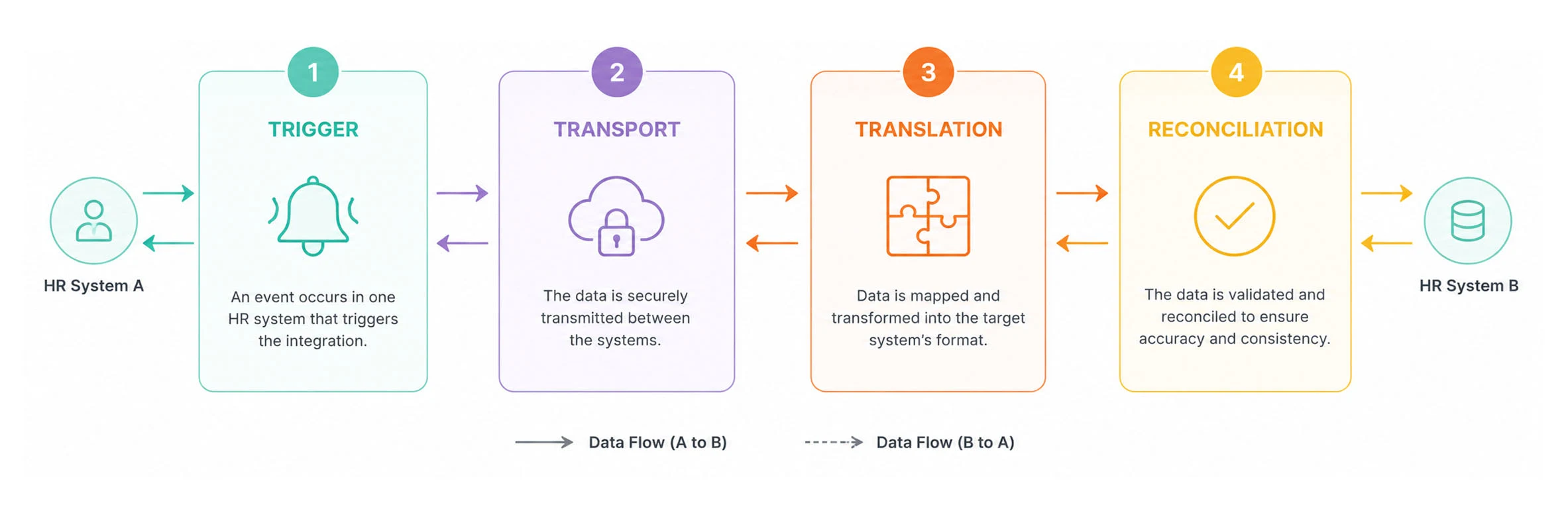
Real-time sync runs the full four-stage loop in seconds and fits operational HR data: candidate status, requisition updates, and offer acceptances. Batch sync collects changes and applies them on a schedule, and fits analytics’ feeds and high-volume historical data. Most enterprise HR stacks use both, with real-time reserved for the data that drives downstream decisions.
The integration layer itself can be hand-built, but most HR teams now use a low-code integration builder or iPaaS platform. Phenom Flow Studio is one example. Pre-built connectors handle authentication, retries, and conflict resolution out of the box, which moves the work from writing integration plumbing to designing the data flow.
Where Bidirectional Integrations Matter Most in HR
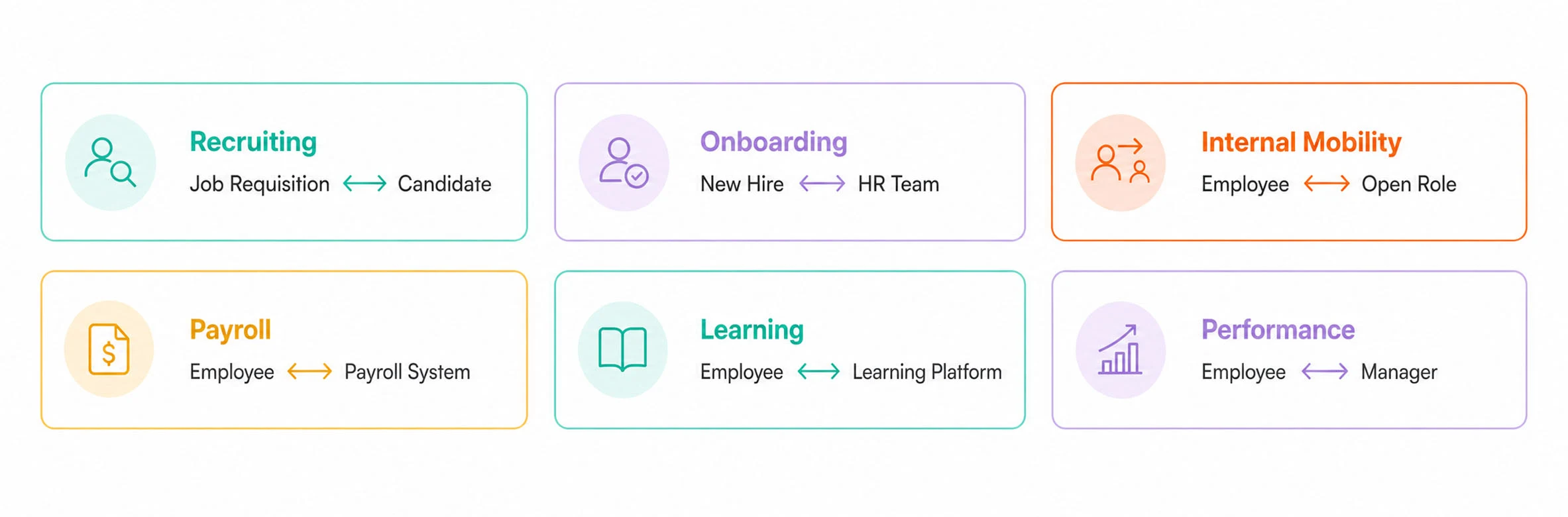
Bidirectional integrations matter most in HR functions where the same data needs to be acted on by multiple systems and teams: recruiting and candidate experience, onboarding, internal mobility, payroll and benefits, and learning and performance. Each function has at least one data object that loses value the moment it falls out of sync.
Recruiting and candidate experience
When candidate data lives only in the ATS, the HCM doesn't know an offer was accepted until someone enters it by hand. Bidirectional sync between the ATS and the HCM keeps candidate status, offer details, and pre-hire records aligned. At one biopharma, the bidirectional integration between Phenom and SAP SuccessFactors cut application completion times to under five minutes (a 75% reduction) across roughly 100,000 applications per year. Full story below.
Onboarding and new-hire data
Onboarding breaks when the start date in the HCM doesn't match the start date in IT provisioning, or when the new hire's manager assignment lags. Bidirectional sync moves the new-hire record between the HCM, the onboarding platform, and downstream systems (payroll, benefits, IT, security) the moment the offer is accepted. The result: fewer day-one surprises and shorter time-to-productivity.
Internal mobility and talent CRM
Internal candidates are visible only when their skills, interests, and career history are current. Bidirectional sync between the HCM and a talent CRM keeps internal talent searchable in real time. Phenom Talent CRM uses this pattern to surface internal candidates alongside external ones for every open role, which is what makes internal-first hiring practical at scale.
Payroll and benefits
A change to an employee's pay rate, address, dependents, or tax election affects multiple downstream systems. Bidirectional sync between the HCM and payroll, benefits, and time-and-attendance platforms keeps those changes consistent without double entry. The outcome is fewer payroll corrections per cycle and faster benefits enrollment when life events occur.
Learning and performance
When learning completions, certifications, and performance ratings live only in the Learning Management System or performance system, the HCM has an incomplete picture of the workforce. Bidirectional sync brings those signals back into the system of record, where they can inform succession planning, internal mobility, and skills intelligence.
Benefits of Bidirectional HR Integrations
The five primary benefits of bidirectional HR integrations are a single source of truth across systems, faster cycle times, fewer data errors, a better candidate and employee experience, and stronger reporting and analytics. Each follows from the same mechanic: data stays consistent everywhere it needs to be, in real time.
A single source of truth across HR systems. When the ATS, HCM, HRIS, and CRM all reflect the same data, teams stop debating whose number is right and start acting on it.
Faster cycle times. Application, requisition approval, onboarding, and offboarding all move faster when status changes propagate automatically.
Fewer data errors and duplicate records. Manual reentry is one of the largest sources of HR data quality problems. Bidirectional sync removes most of that surface area.
A better candidate and employee experience. A candidate or employee who updates information once expects to see the change everywhere. Bidirectional sync makes that match reality.
Stronger reporting and analytics. Unified data is the prerequisite for reliable workforce reporting, skills intelligence, and AI-powered talent decisions.
The Risks of Bidirectional Data Integrations (and How to Avoid Them)
Bidirectional HR integrations introduce real risks: sync loops, conflict resolution gaps, system-of-record ambiguity, API rate limits, security exposure, and integration debt. Each is preventable with the right architecture and operating model. The pattern is the same in every case: define the rules before the data starts moving.
Sync loops and race conditions. Two systems writing back to each other can create circular updates and conflicting versions of the same record. Idempotency keys, event deduplication, and clear field ownership stop the loop before it starts.
Conflict resolution gaps. When both systems can edit the same field, the integration needs explicit rules about which write wins. Define those rules at the field level, not globally.
System-of-record ambiguity. If no system is named as the authoritative source for a given data object, every team will assume a different one is. Document the system of record for each object before the first sync runs.
API rate limits and quota issues. Real-time syncs can hit vendor API limits during peak periods. Build in backoff logic, retry policies, and batched fallbacks for high-volume events.
Security and PII exposure. Bidirectional connections move sensitive data across systems. OAuth, encryption in transit and at rest, scoped permissions, and audit logging are the floor, not the ceiling. GDPR, SOC 2, and the EU AI Act apply.
Integration debt. Hand-coded integrations age fast. As systems change schemas and APIs, custom code breaks. Pre-built connectors and low-code integration builders reduce long-tail maintenance costs.
Phenom HRIT Experience addresses these risks through pre-configured templates, real-time monitoring, and security-first integration design.
How to Set Up a Bidirectional HR Integration: The MAPS Method
Setting up a bidirectional HR integration follows five steps:
Map. Inventory the data objects and fields that need to move between the two systems. Identify the system of record for each field, and document type expectations, allowed values, and any transformations needed. Mapping is the most underestimated step; integrations that fail in production usually fail because of a mapping gap found too late.
Authenticate. Set up OAuth, API keys, or service accounts with the minimum scopes required. Confirm that authentication tokens refresh automatically and that revocation paths are documented. Security review happens here, not later.
Pilot. Run the integration with a single use case in a non-production environment first. Pick something measurable, such as candidate status sync between the ATS and the HCM for one business unit, and observe it for at least two weeks. The pilot exposes edge cases that mapping alone won't.
Sync. Move to production with monitoring and alerts in place from day one. Track event volume, latency, error rate, and reconciliation drift. If any metric spikes, the team should know in minutes, not days.
Support. Bidirectional integrations need ongoing care. Version-control field mappings, review them when either system upgrades its schema, and assign a clear owner. Ungoverned integrations turn into integration debt within a year.
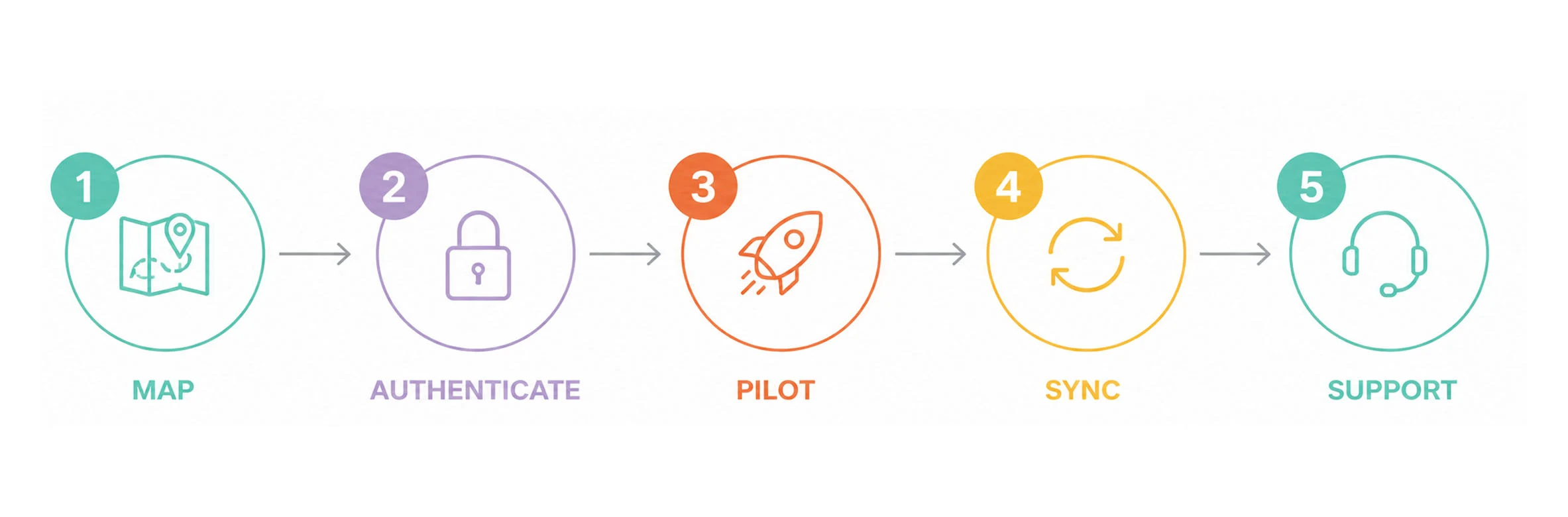
The MAPS Method works because it sequences decisions in the order they actually need to be made. Teams that authenticate before they map, or scale before they pilot, almost always have to redo earlier steps under pressure.
Related Resource: Read the full UCB customer story.
Frequently Asked Questions
1. What is a bidirectional integration in HR?
A bidirectional integration in HR is a two-way data connection between two or more HR systems, where a change made in either system is automatically reflected in the other. It removes manual reentry, prevents data drift, and keeps the ATS, HCM, HRIS, and CRM aligned in real time.
2. How is a bidirectional integration different from an API?
An API is the mechanism that two systems use to talk to each other. A bidirectional integration is a pattern of using APIs (and webhooks) so that data flows in both directions. Every bidirectional integration relies on APIs, but not every API connection is bidirectional.
3. Is real-time sync the same as bidirectional sync?
Real-time sync refers to speed, while bidirectional sync refers to direction. A connection can be one without the other.
4.What HR systems should be connected bidirectionally?
The strongest candidates are the ATS and the HCM, the HCM and payroll, the HCM and the talent CRM, and the HCM and the LMS or performance system. Any pairing where the same data is acted on in both systems benefits from a two-way connection.
5.Are bidirectional integrations secure?
Yes, when built with current standards. OAuth for authentication, encryption in transit and at rest, scoped permissions, audit logging, and adherence to GDPR, SOC 2, and applicable regulatory frameworks (including the EU AI Act and EEOC guidance for AI-influenced data) are baseline expectations for any enterprise HR integration.
6.Do I need a developer to build a bidirectional HR integration?
Not always. Pre-built connectors and low-code integration builders such as Phenom Flow Studio handle the most common HR system pairings out of the box. Custom or legacy systems may still require developer work, but the share of integrations that need hand-coded plumbing is shrinking each year.
Build an HR Tech Stack That Actually Connects
Bidirectional integrations are the layer beneath every reliable HR tech stack. Without them, AI, skills intelligence, and unified reporting all sit on broken data.
Discover how Phenom HRIT Experience reduces integration complexity across HR systems.

Fariya Banu is a content marketing writer at Phenom who loves decoding buyer psychology and crafting stories that convert. With engineering and marketing expertise, she brings analytical thinking to creative storytelling. When not writing, she's snorkelling, cooking, or diving into any adventure that sparks curiosity.


Get the latest talent experience insights delivered to your inbox.
Sign up to the Phenom email list for weekly updates!


