

Peer-Led HR Tech Adoption: Cincinnati Children’s Success
Most HR technology adoption stalls after go-live.
Cincinnati Children's (one of the top-ranked pediatric hospital systems in the country, treating patients from all 50 states and dozens of countries) broke that pattern. Behind its 19,500-person workforce is a talent acquisition function recruiting continuously across clinical care, biomedical research, allied health, and administrative roles. Getting an entire team of recruiters and sourcers to use Phenom every day, without leaning on IT at every step, was the real challenge.
At IAMPHENOM 2026, Brandon Sandlin, Senior Specialist in Talent Acquisition, and Ben Enegren, Data and Project Consultant in Talent Acquisition, shared how Cincinnati Children's answered that question — not with a software update or new dashboard, but with people.
Watch the session here, or catch the key insights below!
Why Do Healthcare TA Teams Struggle To Scale HR Tech Adoption?
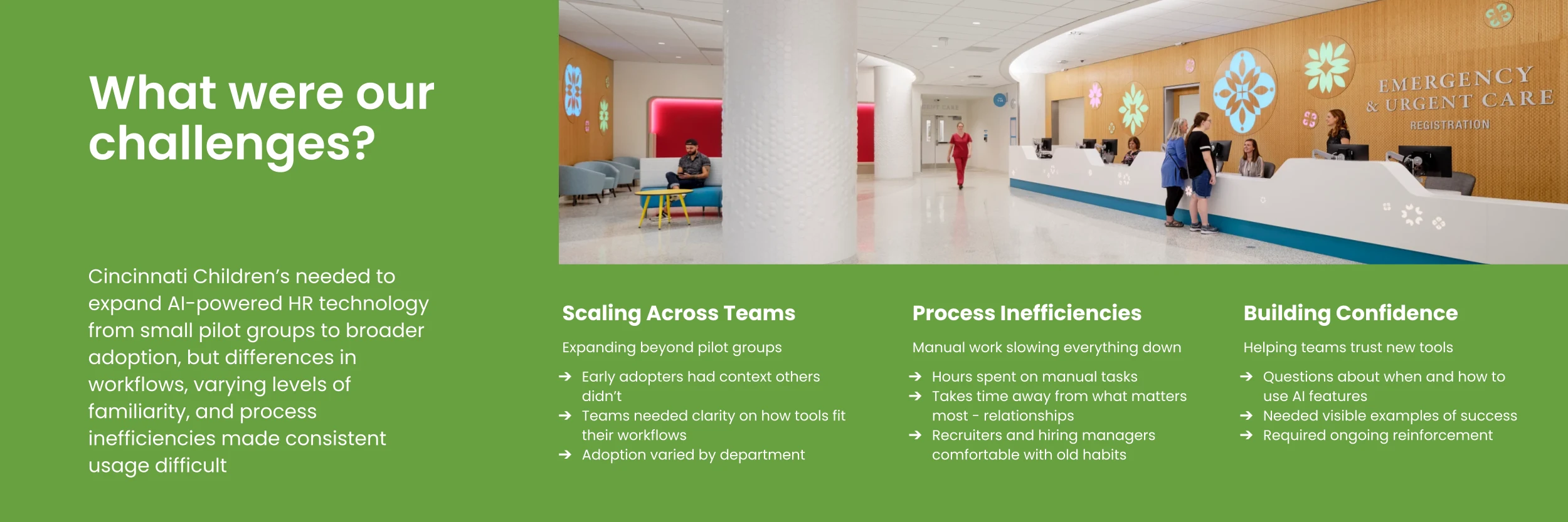
By the time Cincinnati Children's began its push toward broader adoption, the team had already moved through discovery, implementation, and go-live. What remained was the phase that many healthcare organizations quietly struggle with: getting past the pilot group.
In a healthcare environment where recruiters are simultaneously managing clinical, research, and administrative pipelines, there is little margin for learning curves. Workflows varied across teams, familiarity with the tools ranged widely, and the manual habits built up over the years were not going to dissolve on their own. Recruiters and hiring managers had grown comfortable with traditional processes, and the time those processes consumed was time taken away from the relationships that drive quality hires in a high-stakes care setting.
Sandlin and Enegren identified three distinct barriers:
Scale: How do you move knowledge from a handful of early adopters to an entire department when each team runs its own workflow and pace?
Process inefficiency: Manual work was slow, and no one had seen enough of the new tools in action to trust them as a replacement.
Confidence: People had real questions about when and how to use AI features within Phenom.
Why Does Peer-Led Training Work Better for TA?
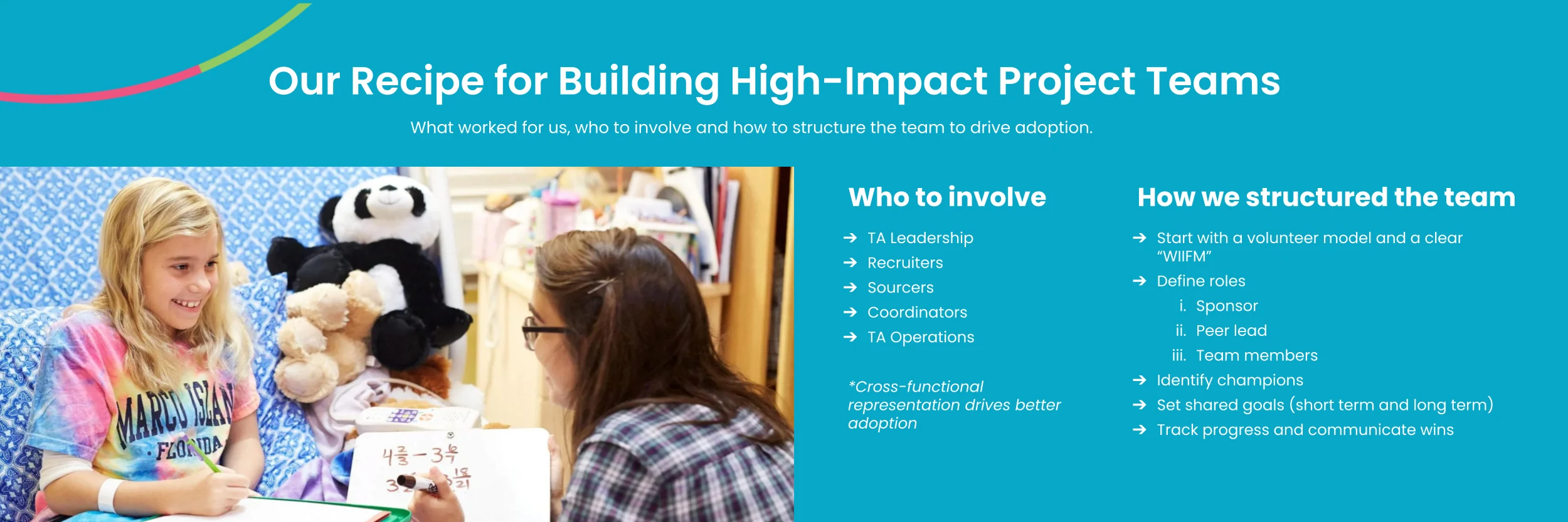
To address their challenges, the team decided to stop treating adoption as an IT responsibility and start treating it as a shared one.
They built peer-led project teams, structured groups made up of volunteers drawn intentionally from recruiters, coordinators, TA operations, and leadership stakeholders. That cross-functional mix wasn’t accidental. Adoption challenges look different depending on where you sit in the workflow, and having people from each of those vantage points in the same room meant problems could be identified and solved from multiple perspectives, not just the one closest to the technology.
Each team was built around three roles: a Project Sponsor, a Project Peer Lead, and Project Team Members. The Project Sponsor, drawn from TA leadership, provided strategic direction, ensured alignment with organizational goals, and served as the primary advocate when blockers needed resolving at a higher level. Sponsors met monthly to review progress and share updates.
The Project Peer Lead worked directly with the sponsor to develop a project charter with defined milestones, coordinated the day-to-day rhythm of the team, escalated issues that could not be resolved internally, and kept everyone informed of progress. Project Team Members attended all scheduled meetings, contributed ideas and expertise, took ownership of assigned tasks, and communicated openly within the group.
The model started with a volunteer structure and a clear answer to the question that determines whether anyone shows up: what's in it for me? Recruiters and coordinators who stepped into peer lead roles were given real leadership opportunities, not honorary titles. The chance to build collaboration skills, take charge of a piece of the organization's technology direction, and grow professionally was part of the pitch, and it was genuine.
How Do You Build an HR Tech Adoption Roadmap That Sticks?
The timeline tells the story of how sustained effort compounds. In March 2025, the team attended IAMPHENOM and returned with a sharper model, having seen how other organizations structured HR tech ambassador programs. A few months later, the project team's initiative was formally launched. Over the following two months, a five-session Phenom Refresh Training series gave people the foundation they needed before the broader push began.
By 2026, the team committed to three specific goals: growing Phenom Talent CRM usage, expanding automation adoption, and building their Talent Community. At the same time, a weekly TA Tech Talk series launched, providing a touchpoint that became a consistent space for questions, updates, and peer-driven problem solving. The distinction between a one-time training event and a recurring rhythm turned out to matter considerably.
The team had expanded its focus to hiring managers, conducting ongoing training covering profile review, candidate screening, and Phenom Interview Intelligence.
Why Does Peer Support Fix HR Tech Problems Faster Than IT Alone?
One of the clearest illustrations of the model's value was the contrast in how support worked before and after. Previously, when a recruiter hit a problem, the path forward was to submit a ticket and wait. Three days later, if they had not already given up, they might get a resolution.
With peer-led teams in place, the path became simpler: ask the subject matter expert (SME) embedded in your team. Five minutes later, the issue was resolved, and the recruiter kept moving. That shift from a bottlenecked IT queue to an accessible peer who already understood the context removed one of the most common reasons HR technology adoption breaks down quietly without anyone tracking it.
The same logic applies to training itself. When a peer lead working the same types of requisitions as their colleagues explains how to use Phenom Automated Interview Scheduling or set up a Talent CRM nurture sequence, the explanation carries credibility that IT-delivered training often can’t replicate. As Sandlin described it: "Before, it was 'Submit a ticket,' a three-day wait, and people quit. After peer-led teams, it was 'Ask your SME,' a five-minute fix, and people keep going."
Enegren pointed to what made the difference: "We had the want to do more, but the inability to actually put the foot on the gas and go forward. The project team model changed that," he said.
As an exercise, try mapping your single biggest adoption blocker right now. Not the full list, just the one thing most responsible for slowing your team down. Then choose one action you could take within 48 hours to address it, and find one peer who will ask you whether you followed through.
The peer-led model works because it shortens that gap. When someone in your workflow, already familiar with your requisitions and your pressures, is the one helping you move forward, the first step becomes smaller and more accessible. Accountability does not have to come from leadership or a training calendar. It can come from a single peer who asks, "Did you try it yet?"
Related Read: The First 90 Days Determine HR AI Tool Adoption Success
Can Peer-Led Teams Actually Improve HR Tech Adoption?
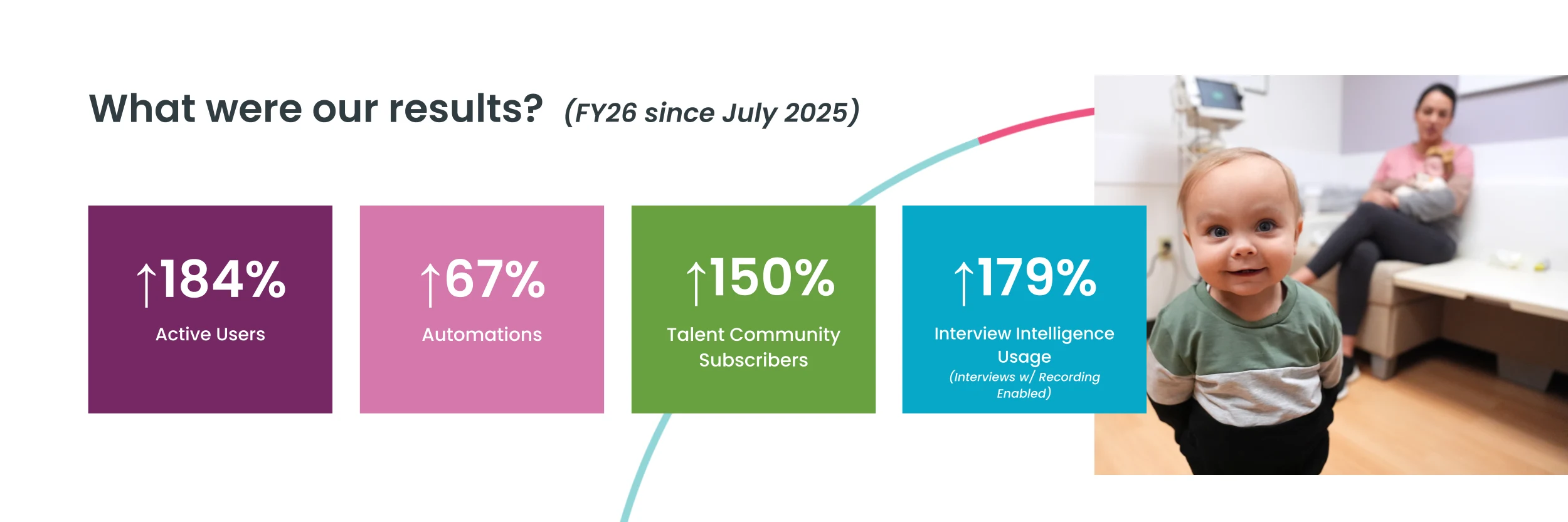
Cincinnati Children's adoption improvements over the course of a year reflect what happens when accountability is distributed, support is immediate, and progress is tracked consistently:
Active users grew by 184%, the clearest signal that the tools became part of daily work rather than an optional add-on.
Automation usage increased by 67%, driven by bi-weekly workshops and peer leads who helped colleagues apply Phenom's hiring automations to their specific workflows.
Talent Community subscribers rose by 150% following targeted engagement campaigns and the February 2026 exclusive member event.
Phenom Interview Intelligence usage climbed by 179%, measured by the share of interviews conducted with recording enabled.
The improvements didn't come from a single initiative. They came from discipline applied consistently across every layer of the model. As Sandlin put it: "We held each other accountable. Project teams met weekly. No excuses. Just progress." That rhythm, repeated without exception over twelve months, is what the numbers actually reflect.
How Do You Start a Peer-Led HR Tech Adoption Program?
Here is where to start:
Identify adoption barriers first: Gather feedback from daily users to understand where the actual friction lives. The gap between what leadership assumes is working and what recruiters experience on the ground is often wider than expected.
Establish peer-led teams with real roles: Assign sponsors, peer leads, and team members with defined responsibilities. Give peer leads genuine charge of the rollout, not just a title. As Enegren shared, "One person trying to own adoption leads to nothing happening. A project team owning it leads to a 184% user increase in six months."
Anchor progress to three metrics: Pick three metrics that reflect real usage, track them on a reliable cadence, and report them regularly so the team can see what is moving and what is not.
Build a network of champions: Identify one power user per Phenom feature area, give them a recognized role, and let them support their peers directly. When someone can get a question answered in five minutes by a colleague who works the same roles they do, the likelihood of continued use goes up substantially.
Ready to close the adoption gap? Learn how boosting your knowledge of Phenom helps propel your talent acquisition or management career forward.



Get the latest talent experience insights delivered to your inbox.
Sign up to the Phenom email list for weekly updates!


