


How United Airlines and Phenom Redesigned Interview Scheduling Together
At United Airlines, home to more than 110,000 employees and flights to over 380 destinations, scale is built into everything, including hiring. Coordinating flight attendant interviews across 30 interviewers, each with their own availability, at high volume, required a scheduling process built to match.
At IAMPHENOM 2026, Nikki Jaskiewicz, Sr. Manager of Talent Acquisition Programs, Process & Systems, and Samantha Zito, Sr. Analyst of Inflight Talent Acquisition, shared how United worked with Phenom to get there and the results that followed: a 107% increase in automated interview scheduling and thousands of recruiter hours reclaimed.
Watch the full session here, or explore the highlights below.
What Makes Interview Scheduling Difficult for Flight Attendant Hiring?
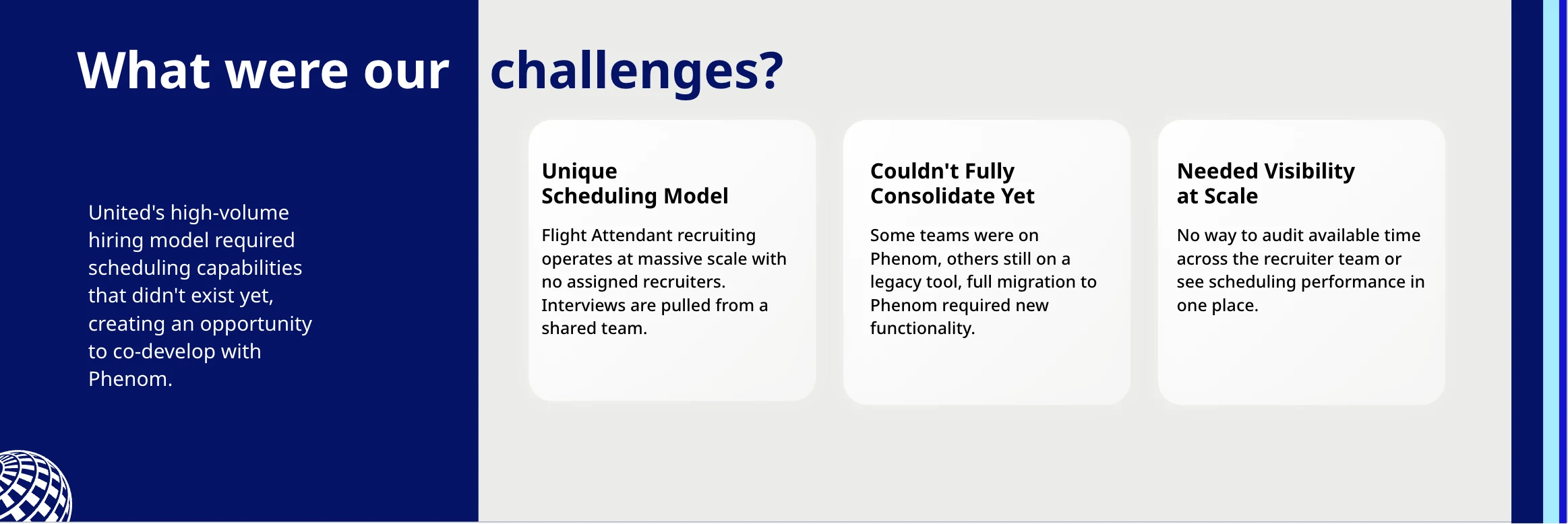
At United, roughly 30 interviewers handled all flight attendant TA interviews, each with their own availability windows and no shared system to manage them across a high-volume hiring process. One interviewer might be available Monday mornings, another Friday afternoons. Coordinating across that many schedules meant the team had long relied on a separate scheduling tool outside of their Phenom environment, pulling recruiters between systems and making a single view of scheduling, sourcing, and screening difficult to maintain.
Jaskiewicz pointed to the 25-line spreadsheets her team sent and received every month just to manage interviewer availability. "We really had a focus of how do we get this into one streamlined process," she said.
Shifting to automated scheduling also meant interviewers would have less direct control over what landed on their calendars. Getting buy-in would require clear visibility into what the system was booking on their behalf, and confidence that the process would work as expected.
Related: How UAB Medicine Built Recruiter Buy-In One Dose at a Time
How Did United and Phenom Co-Build Automated Interview Scheduling?
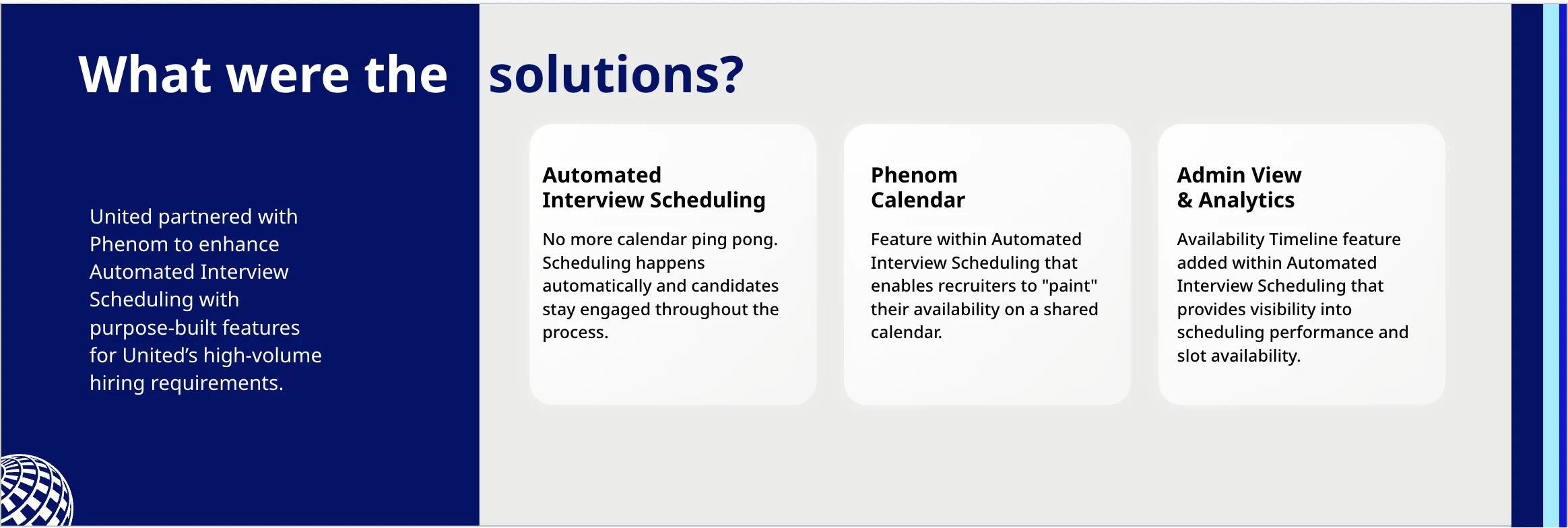
United worked closely with Phenom to shape the solution around how the flight attendant team actually hires, testing on real production data and providing feedback throughout.
With Phenom Automated Interview Scheduling, interviewers could set up different availability blocks for different hiring scenarios: flight attendant interviews, engineering screens, recruiter-led calls. An override toggle told the system when to use those blocks regardless of what else appeared in Outlook, and a placeholder feature kept Outlook in sync so interviewers could see their reserved time. An availability timeline gave admins a view across all 30 interviewers at once.
Once the calendar was live, United's flight attendant TA team could trigger automated invitations the moment a candidate hit the right hiring status in Phenom. Coordination that had required manual back-and-forth now happened in the background.
Jaskiewicz put the operational change in personal terms. "When I think about the way I scheduled interviews when I started recruiting 15 years ago, it makes me want to cry," she admitted.
How Did Automated Interview Scheduling Save Recruiters Thousands of Hours?
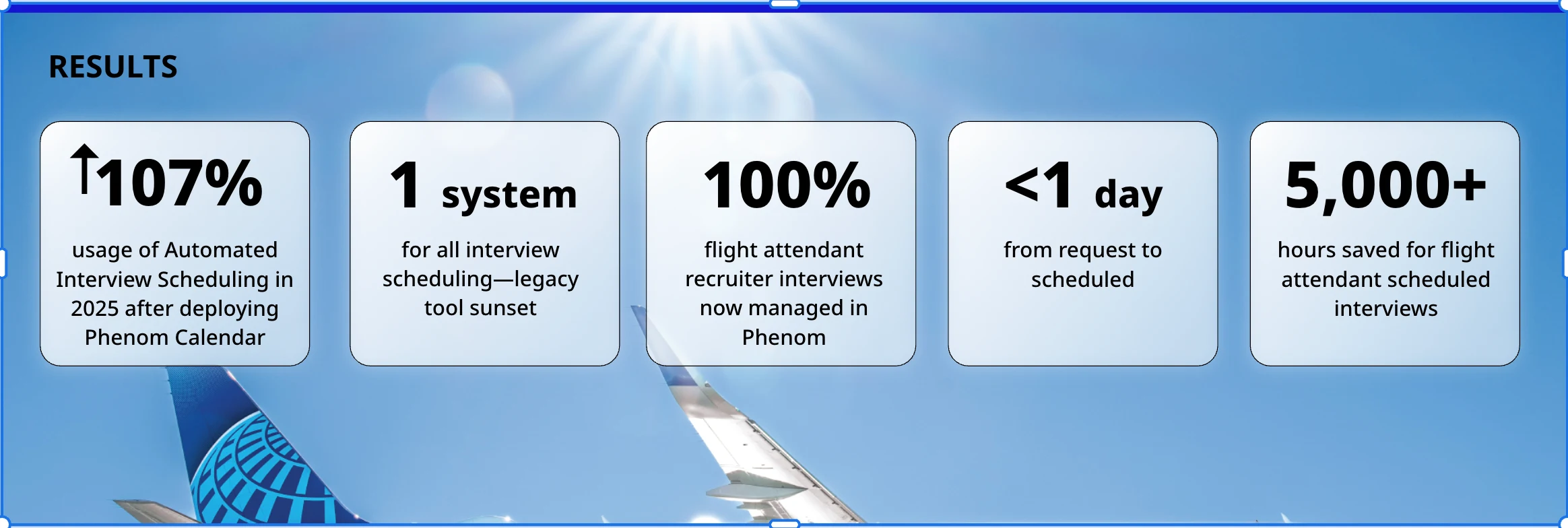
With the legacy scheduling tool sunset and all interview scheduling consolidated into Phenom, the results for the flight attendant team were significant:
107% increase in usage of Automated Interview Scheduling in 2025
100% of flight attendant recruiter interviews now managed in Phenom
Less than 1 day from request to scheduled
5,000+ hours saved for flight attendant scheduled interviews
For a team hiring at United's volume, full automation changed the day-to-day in a meaningful way. "We have a very high volume of interviews that we do and that need to be scheduled. By doing this, we're able to automate everything," Zito said.
"We wanted to have all of our scheduling processes, the sourcing, the screening, and the interviewing in one system," Zito said. By the close of 2025, that was the reality.
What’s Next, and What Can Other Teams Learn?
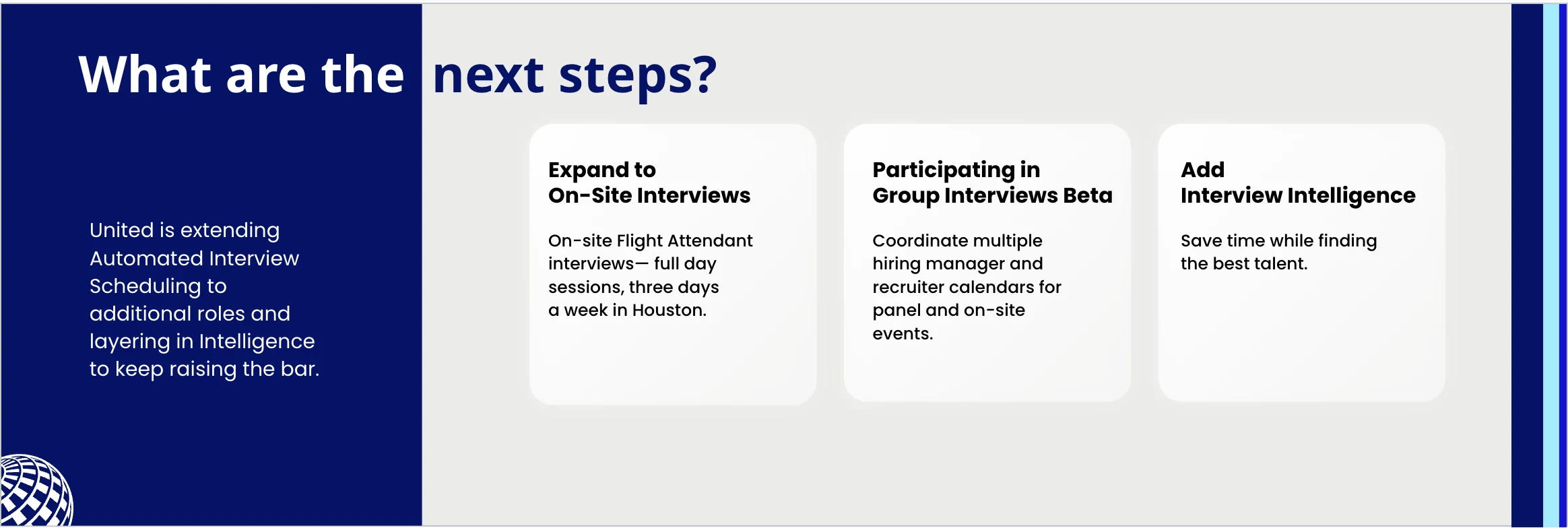
On-site flight attendant interviews are the one piece not yet fully automated. Given the volume involved, the standard event-based scheduling model isn't the right fit. United is currently in beta with Phenom on group interview functionality that would allow slot creation outside of a formal event structure — purpose-built for high-volume hiring days. The goal is to have all scheduling managed in Phenom by the end of 2026.
The use of Phenom Interview Intelligence is also expanding at United. Currently live for corporate recruiting, interview transcriptions and system-generated summaries help recruiters pass notes and candidate context to hiring managers without the manual write-up. Jaskiewicz noted the time it saves on a task that used to eat up recruiter bandwidth. "I used to attach five resumes and all these bullet points," she said. "Interview Intelligence really helps with that process."
See what live interview guidance looks like
For teams considering a similar path, Jaskiewicz's advice is practical: start by understanding how your recruiters actually hire, share feedback early and often with your technology partners, and don't be afraid of imperfect early versions. Everything is fixable. The path from spreadsheets to automated scheduling isn’t immediate, but it’s very much worth the trip.
Learn more about how AI scheduling is transforming interview coordination for busy recruiters


Get the latest talent experience insights delivered to your inbox.
Sign up to the Phenom email list for weekly updates!


