

OMERS’ Workday-to-Phenom Data Playbook for HR Implementation
Most implementation success stories start at go-live. OMERS' starts months before. When Canada's largest pension plan decided to implement Phenom, the team made a decision that's unusual in HR tech deployments. They slowed down before they sped up.
They audited their current Workday data, redesigned their recruitment workflow, remapped every job category in the system, and pressure-tested their configuration before a single real candidate ever touched it. The result was a smooth launch that quickly drew results.
Two of OMERS’ principal figures behind the effort, Anna Servedio, Director of Talent Acquisition at OMERS, and Kayley Connell, Manager of Talent Acquisitions Services, walked through the data cleanup that made their implementation better than most.
Watch the full session here, or explore the highlights below.
What Were the Limitations of Their Talent Acquisition Data Before Phenom?
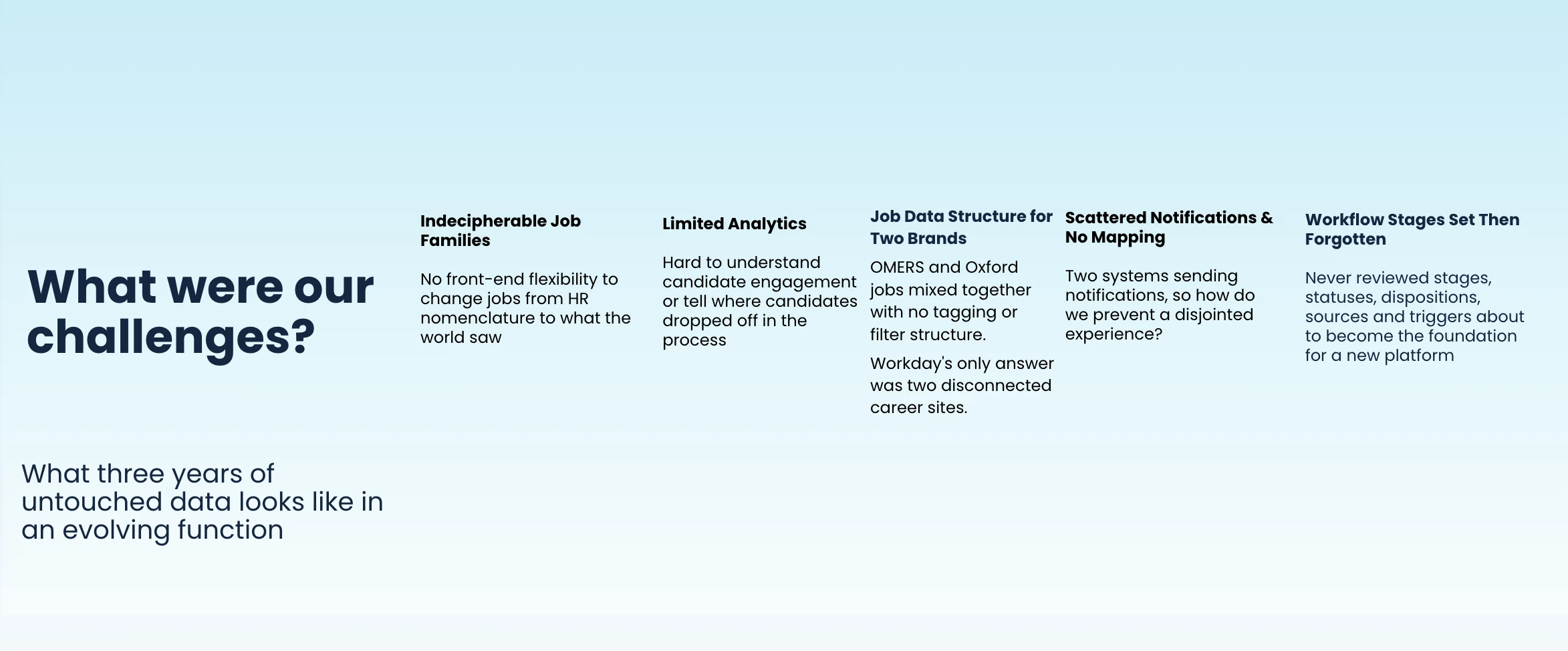
OMERS operates two distinct brands: the pension plan itself and Oxford Properties, its global real estate subsidiary. On their previous Workday career site, there was no separation of brand, no filtering by business line, and no way for candidates to understand which opportunity belonged to which organization.
"We would have roles for our investment professionals — a private analyst, a principal for private equity — and then right under it, we would have an Oxford job that was like a guest experience ambassador at a mall,” Servedio said. “We weren't targeting candidates well."
The job category filters compounded the issue. Workday was surfacing internal HR nomenclature, such as team names in abbreviated form and job family codes that only made sense to someone inside the organization. However, candidates couldn't use the filters to find the type of role they were looking for because the language bore no resemblance to how anyone outside the company would describe their own career. And because the team had limited analytics on their career site, they couldn't see where candidates were dropping off.
"We had a feeling that we were losing candidates because of that, but we didn't really have much analytics to go by in terms of our career site to see what our engagement was like or see where we had drop-off,” Connell said. “So we knew that that was something we wanted to be able to gain when we looked towards Phenom."
What Key Strategies Led To a Better Implementation?
When Connell, who had led their Workday implementation in 2021, was brought in to anchor the Phenom project from the technology side, she quickly recognized that the two-system architecture required a clean data foundation to work well together.
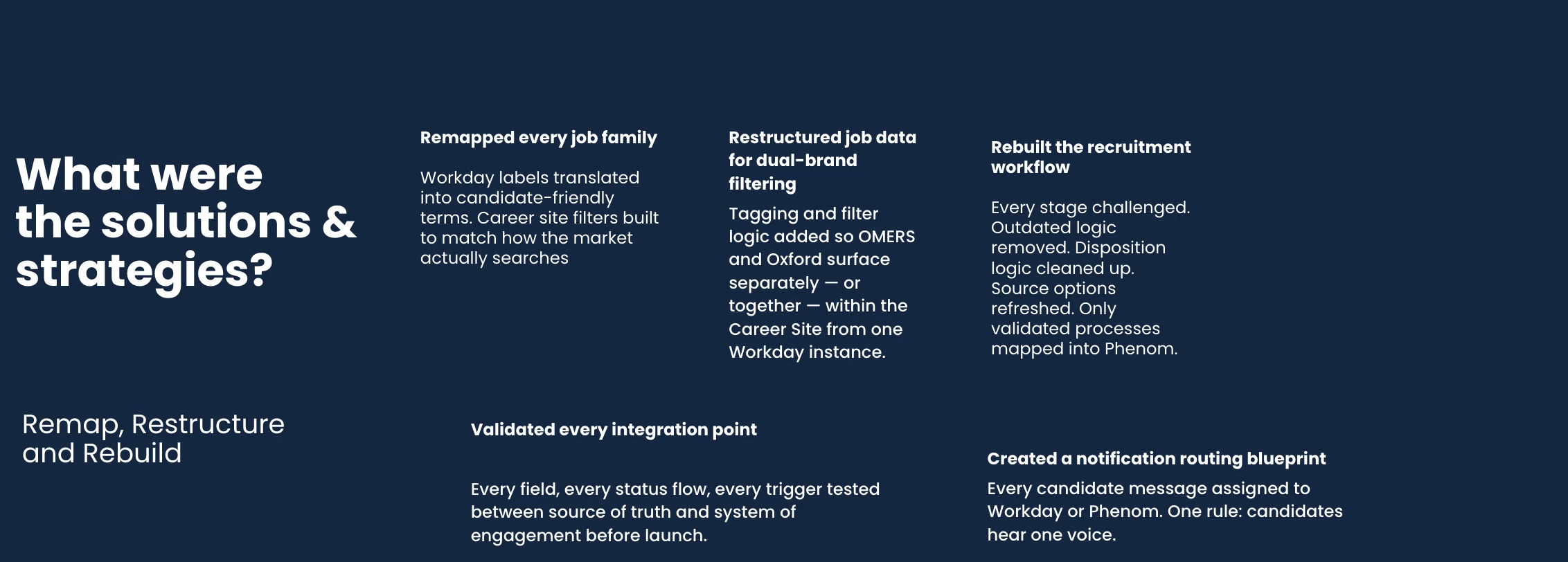
OMERS uses Workday as the source of truth for requisition data and offer processing. Everything in between is run by Phenom Applied AI. For their Hosted Apply process and bi-directional integration to be effective, the underlying data mapping had to be consistent and explicitly documented.
The team went back to basics on their Workday recruitment workflow first, sitting down with recruiters to build a stage and disposition framework that actually matched how the team worked, not how it had been configured on a previous platform. Requiring candidates to create a Workday account upfront was identified as a likely drop-off point, so account setup now only triggers at the offer stage, when commitment is established.
Job families were remapped to candidate-friendly language, and unified email notification templates were built to look consistent whether they originated from Workday or Phenom, so candidates never felt passed between systems. Documenting every mapping decision in real time paid off when job categories needed updating post-launch, doing in minutes what used to take days.
"As excited as the team was — we had all this new tech and new features we wanted to dive into — we really realized that we needed to take a step back and build time into our project plan to get our foundation right so that the overall implementation could be successful,” Connell said.
Related: How RBC Integrated Workday and Phenom for End-to-End Hiring
What Were Their Results A Year After Launch?
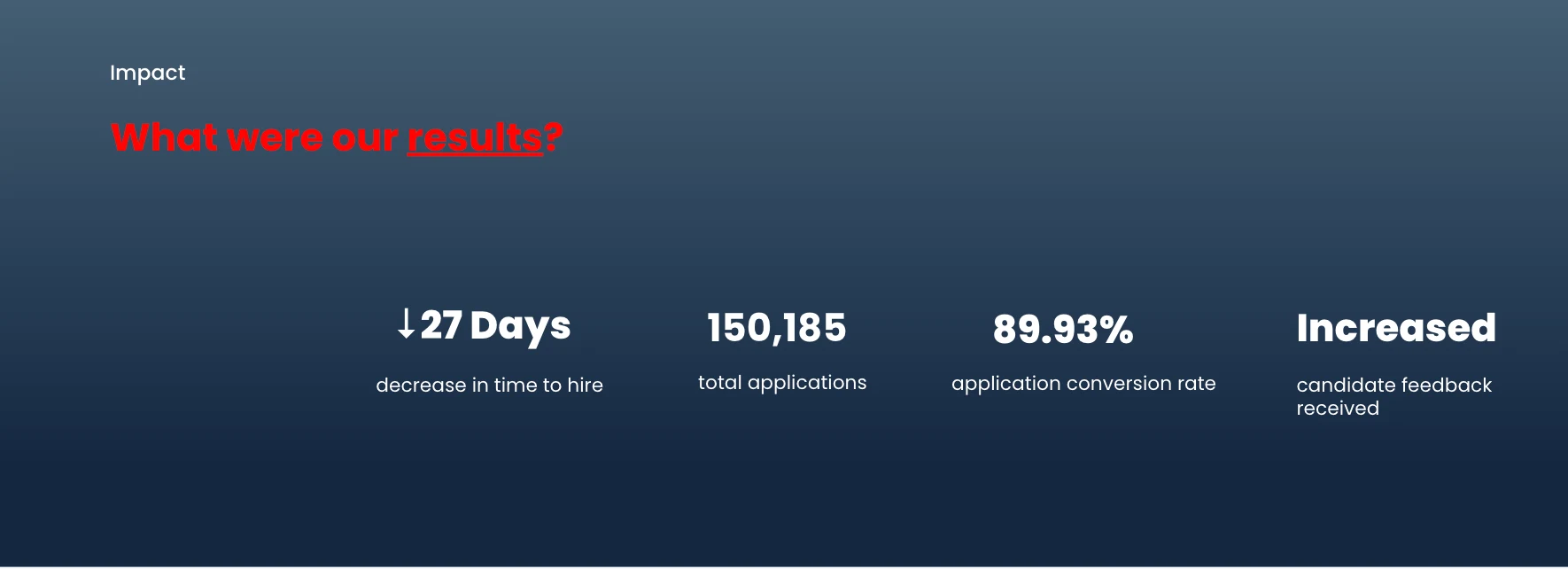
Once OMERS went live with Phenom, the next year saw a wide range of positive results that tied directly back to the pre-launch work:
27-day decrease in time to hire
65%+ increase in application volume
90% application completion rate
"Being thoughtful about what you're bringing into the implementation versus just rushing to get it done really serves dividends in the long run,” Connell said.
Most applicant tracking configurations see significant drop-off in the apply flow, a problem partially driven by requiring candidates to create a system account before they have made any real investment in the process. Removing that barrier was a big factor in increasing completed applications.
The career site itself was also transformed. From the start, Connell's goal was clear: "We don't want the candidate to feel like they're being handed across two different systems and have two experiences."
That standard shaped every configuration decision thereafter. OMERS and Oxford Properties now appear as distinct brands with separate imagery and job visibility, job category filters were rebuilt in candidate-friendly language rather than internal HR nomenclature, and notification templates were unified so the experience felt seamless end to end.
What Should You Do Before Implementing AI in HR?
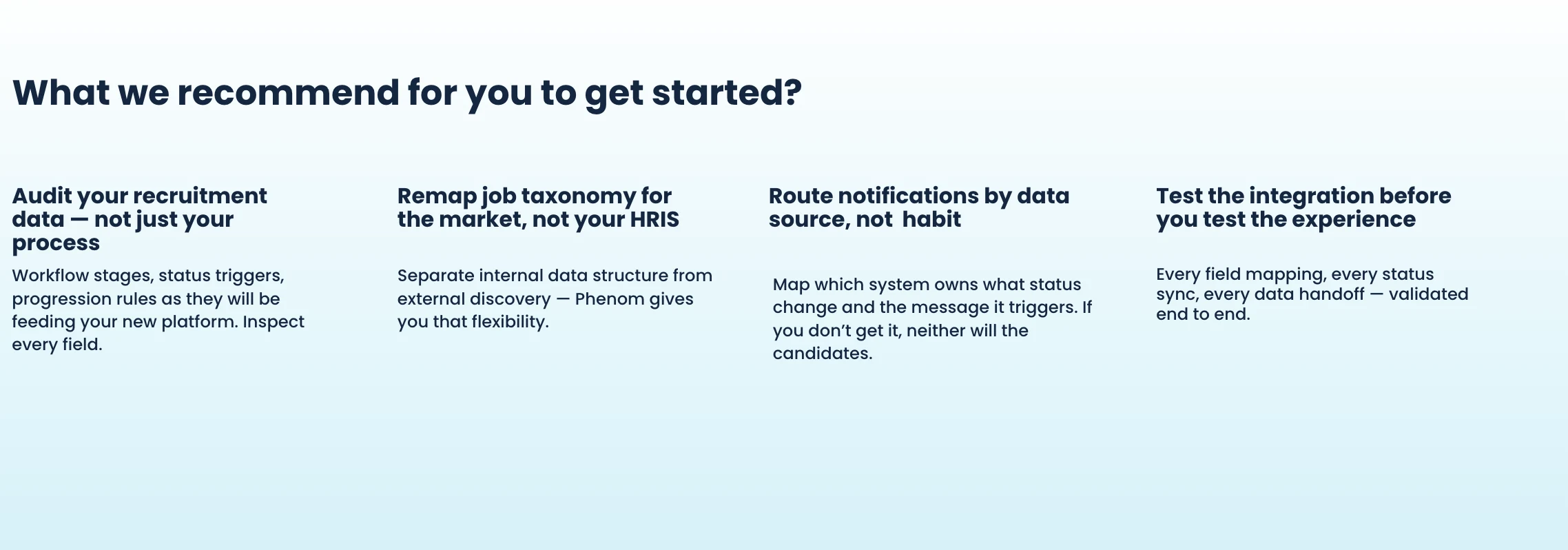
Audit your recruitment data — not just your process
Inspect workflow stages, status triggers, and progression rules as they will be feeding your new platform.
Remap job taxonomy for the market, not your HRIS
Separate internal data structure from external discovery. Phenom gives you that flexibility.
Route notifications by data source, not habit
Map which system owns what status change and the message it triggers. If you don't get it, neither will candidates.
Test the integration before you test the experience
Validate every field mapping, status sync, and data handoff end-to-end.
Connell's main takeaway? The data cleanup that feels slow and laborious in the middle of a project is exactly what saves you post-launch. Every test scenario you add reduces the chance that a candidate sees something broken or confusing on day one.
Servedio emphasized that it's never too late to audit. Remapping job categories and cleaning up workflow stages after go-live is harder than doing it before, but it still moves the needle on candidate experience and recruiter efficiency. The willingness to go back to the drawing board, even when things feel like they're working, is what gets teams from go-live to scaled innovation.
Unleash deep reasoning from unstructured data with Phenom Applied AI



Get the latest talent experience insights delivered to your inbox.
Sign up to the Phenom email list for weekly updates!


